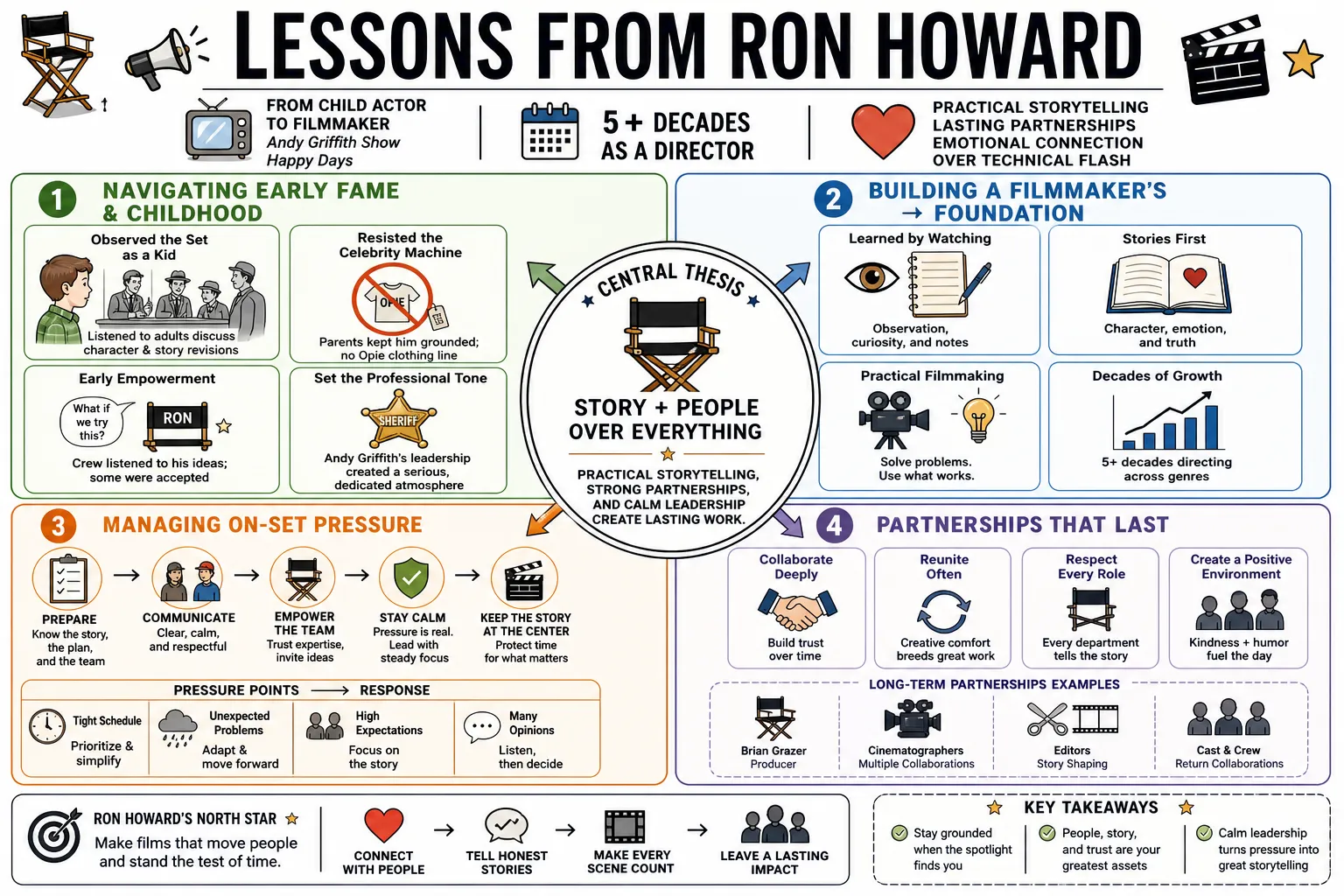
Lessons from Ron Howard
Ron Howard grew up acting on The Andy Griffith Show and Happy Days before spending the next five decades as a director. He built his career on practical storytelling and lasting partnerships, choosing emotional connection over technical flash. The insights collected here detail how he learned to manage on-set pressure and navigate his early fame to develop this grounded approach to filmmaking.
Part 1: Navigating Early Fame and Childhood
- On observing the set as a kid: "He spent his childhood hanging around the cast and crew of The Andy Griffith Show to listen to adults discuss character development and story revisions." — Source: MeTV
- On resisting the celebrity machine: "His parents actively prevented him from being absorbed by promotional work, like an Opie clothing line, to keep him grounded." — Source: MeTV
- On early empowerment: "He felt a growing interest in directing even as a child because the adult crew members would listen to and sometimes accept his ideas." — Source: MeTV
- On setting a professional tone: "He viewed Andy Griffith as a natural leader whose self-schooled intelligence established a serious, dedicated atmosphere on set despite the show's comedic nature." — Source: MeTV
- On evaluating early gigs: "He initially saw his role on Happy Days simply as a temporary way to earn money to fund his film school education." — Source: MeTV
- On managing expectations: "Having assumed The Andy Griffith Show was an unrepeatable fluke, he did not anticipate the massive, long-term success of Happy Days." — Source: MeTV
- On building lifelong bonds: PEOPLE reported Howard saying he and Henry Winkler clicked immediately on Happy Days and stayed close over the decades, with Howard also saying he looked up to him early on. That supports the safer lesson that durable creative partnerships often begin with immediate trust and deepen through long-term mutual respect. — Reference: PEOPLE on Howard and Winkler clicking immediately and staying close
- On side projects: "While starring on a hit sitcom, he spent his free time making short films on the side to prepare for his eventual transition." — Source: MeTV
- On the endurance of classic television: "He finds the lasting appeal of his early sitcoms mind-blowing, noting that they possess a specific nostalgic quality that keeps them relevant to new generations." — Source: Collider
Part 2: The Transition to Directing
- On choosing a path: "If I had to choose between a great acting job and a good directing job, I'd choose the directing job." — Source: Daily New Quotes
- On taking responsibility: "He left acting for directing because he preferred the burden of the director's chair over the feeling of being victimized as a performer who had no control over the final cut." — Source: CBS News
- On controlling his destiny: "It was always my dream to be a director. A lot of it had to do with controlling my own destiny, because as a young actor you feel at everyone's disposal." — Source: AZ Quotes
- On embracing a lifelong pursuit: "One of the great things about being a director as a life choice is that it can never be mastered. Every story is its own kind of expedition, with its own set of challenges." — Source: AZ Quotes
- On learning the craft: On PBS NewsHour, Howard says he watched directors from The Andy Griffith Show, saw his father rehearse theater, and was drawn to the total process of making stories. That supports the safer lesson that directing is a craft learned through close observation, repetition, and understanding how the whole production works. — Reference: PBS NewsHour interview on being drawn to the total directing process
- On stepping into leadership: "He realized early on that he didn't just want to participate in the business; he wanted to become a leader within it." — Source: AZ Quotes
- On trusting preparation: "Confidence is preparation in action." — Source: AZ Quotes
- On valuing imagination: "Your creativity has value. You're not wasting your time dreaming." — Source: Goodreads
- On building a directorial language: "He advocates that young filmmakers keep shooting and editing constantly in order to develop their own distinct visual language." — Source: OSAM
Part 3: The Craft of Storytelling
- On the core of narrative fulfillment: "Is there a thematic narrative question that's being asked? And is it answered? Because without that, it's not very fulfilling storytelling." — Source: WordPress
- On serving the story: In the same PBS NewsHour interview, Howard says directing means creating the right environment and then interpreting the story on both a macro and micro level. That supports the lesson that a director's job is to understand the story well enough to align every department around it. — Reference: PBS NewsHour interview on directing as story interpretation
- On emotional connectivity: "As a filmmaker, you ought to feel emotionally, not intellectually, connected to the story. You should live, breath and dream the story." — Source: Magda Olchawska
- On objective evaluation: "It's easy to fall in love with the story, but part of your job as a filmmaker is to step back, evaluate the story objectively, and find its strong and weak points before you commit to that story." — Source: Magda Olchawska
- On blending concept with depth: Discussing Splash in MasterClass excerpts republished by Screenwriting from Iowa, Howard says the fantasy premise worked because it also asked a thematic question and carried the idea that love is not perfect. That supports the safer lesson that high-concept material resonates more deeply when it is anchored in a human theme. — Reference: Screenwriting from Iowa on Howard tying Splash to a thematic question
- On taste and judgment: "The big thing is taste—taste and judgment. That's what it's all about. It's understanding what exists in the possibilities in the story you're interested in telling." — Source: No Film School
- On prioritizing the frame: "At the end of the day it doesn't matter how much money people are being paid or how many trucks you have on the sidelines. What'd you get inside the frame? That's all I care about." — Source: Television Academy
- On selecting projects: "He eventually stopped viewing movies as genre experiments and began choosing projects strictly based on ideas and characters he could personally relate to." — Source: AZ Quotes
- On defining the profession: "He considers himself fundamentally a storyteller rather than just a filmmaker, noting that the medium of delivery is secondary to the narrative itself." — Source: Tribeca Film
- On serialized narrative: "He appreciates the shift toward television and serialization, as it allows for a more literary approach where stories don't have to be neatly wrapped up in two hours." — Source: Activation Quotes
Part 4: Leadership and Collaborative Dynamics
- On the six-of-one rule: "If a collaborator’s idea achieves the scene's goal just as effectively as his original plan, he drops his ego and adopts their approach." — Source: Psychology Today
- On unlocking the X factor: "By allowing crew members to execute scenes their own way when appropriate, he finds they deliver an organic energy because they are expressing themselves rather than just following orders." — Source: Psychology Today
- On thriving under stress: "I get charged by problem-solving, usually under some kind of stress—the sun is going down, and we have eight minutes, and we have to solve it. Great things come out of it." — Source: Activation Quotes
- On embracing creative friction: "The complications and constraints that filmmakers often fear are frequently the exact forces that push a project to a higher creative plane." — Source: MasterClass
- On over-controlling a set: "I began to recognize that I was the problem. I was creating a ceiling. It was my imagination, my sense of what to do." — Source: Global Leadership
- On opening up the floor: "Once he stopped trying to dictate every moment, he noticed scenes taking off and going somewhere far beyond what he had originally imagined." — Source: Global Leadership
- On keeping the story intact: In MasterClass, Howard describes the director as the keeper of the story while also saying strong collaborator suggestions should be used when they still achieve the objective of the scene. That supports the lesson that collaboration works best when the director remains accountable for the narrative spine. — Reference: MasterClass on the director as keeper of the story
- On maintaining equilibrium: "Drawing from his sitcom days, he believes a set must maintain a careful balance between intense focus, professionalism, and an ongoing sense of play." — Source: No Film School
- On recognizing his impact: "He remains highly conscious of how a single careless comment from a director can negatively affect a collaborator's life trajectory or daily performance." — Source: Goodreads
- On problem-solving energy: "He views collaboration not just as a way to gather ideas, but as a mechanism to generate the collective energy required to solve complex logistical problems." — Source: Activation Quotes
Part 5: Working with Actors and Performance
- On understanding methodology: "I've acted with all types, I've directed all types. What you want to understand, as a director, is what actors have to offer. They'll get at it however they get at it. If you can understand that, you can get your work done." — Source: Daily New Quotes
- On prioritizing compatibility: "During the casting process, he values creative compatibility far more than sheer congeniality or friendliness in the room." — Source: MasterClass
- On trusting the gut: MasterClass's casting chapter says Howard urges directors to look beyond an actor's tangible skills, trust their gut, and notice the intangible qualities a performer can bring to a role. That supports the safer lesson that casting judgment includes instinct about presence and fit, not only measurable technique. — Reference: MasterClass casting chapter on trusting instinct about performers
- On communicating with actors: "His background as an actor allows him to speak the performer's language, translating technical requirements into emotional beats they can play." — Source: Quote Fancy
- On defending performers: "He has been openly protective of actors facing premature public backlash, knowing firsthand the vulnerability required to perform on screen." — Source: Reddit
- On guiding child actors: "When working with young performers, he focuses on keeping the environment safe and ensuring they are acting rather than just reciting lines." — Source: MeTV
- On finding the character: "He believes actors shouldn't be boxed in by rigid direction; if they find a different but valid path to the character's truth, the director should adapt." — Source: MasterClass
- On the director's empathy: "Having felt helpless as an actor, he makes a point to ensure his cast feels heard and respected regarding their character choices." — Source: CBS News
- On capturing the moment: "He relies on actors to deliver the raw material of a scene, knowing that all the technical preparation in the world cannot fix a fundamentally dishonest performance." — Source: No Film School
Part 6: The Producer-Director Partnership
- On committing to a partner: In Interview Magazine, Howard says he and Brian Grazer met as young executives on the Paramount lot, made Night Shift together, and came through the difficult making of Splash with their friendship cemented. That supports the lesson that long producer-director partnerships are built by going all in together on hard early projects. — Reference: Interview Magazine on how Splash cemented the Howard-Grazer bond
- On identifying strengths: "In Grazer, I saw energy, passion, ideas and the ability to get inside offices. Let's be honest, he's a bit of a character. Brian's made a science of these things." — Source: Woman Around Town
- On shared history: The same Interview Magazine conversation traces Howard and Grazer's collaboration back to 1979 and their first studio feature, Night Shift. That supports the safer lesson that durable creative partnerships usually grow out of years of shared context rather than one-off convenience. — Reference: Interview Magazine on the Howard-Grazer partnership beginning in 1979
- On early hustle: "He often reflects on their beginnings as the two youngest guys with offices on the Paramount lot back in 1979, trying to prove they belonged." — Source: Interview Magazine
- On cementing the bond: "The sheer difficulty of getting their early films like Night Shift and Splash off the ground is what permanently cemented their professional friendship." — Source: Interview Magazine
- On marrying ambitions: "They built Imagine Entertainment by marrying his ambition as a craftsman director with Grazer’s relentless drive as a salesman and producer." — Source: Forbes
- On avoiding complacency: "Despite decades of success, he admits that they are usually too busy working to stop and deeply analyze their own dynamic." — Source: Woman Around Town
- On shared tenacity: "The durability of their company relies on a mutual refusal to quit, pushing through decades of industry shifts and economic downturns together." — Source: Inc.
- On mutual reliance: "He credits Grazer’s ability to kick down doors and pitch concepts for allowing him the freedom to focus entirely on the execution of the films." — Source: Forbes
Part 7: Evolving with Technology and the Industry
- On the editing room: "He views film editing not just as a technical assembly process, but as the final, crucial rewrite of the entire movie." — Source: MasterClass
- On shaping meaning: "Editing is where he applies his final layer of taste and judgment, finding the precise sequence of details that will hit the audience hardest." — Source: No Film School
- On accepting new tools: "Why fight technology at all? The audience is always going to tell you what they like best. And you, as a storyteller, as a communicator, are going to be required to adjust to that." — Source: Daily New Quotes
- On the irrelevance of the camera: "He argues that whether you shoot on an iPhone or an Arri system, the core requirements of storytelling and framing remain exactly the same." — Source: OSAM
- On camera logistics: "The primary difference between consumer cameras and professional cinema rigs is simply the level of crew support and resources they demand on set." — Source: OSAM
- On preserving energy: "He adopts new digital workflows and technologies specifically when they save time on set, allowing him to redirect that saved energy back into the actors." — Source: Masters of Scale
- On the future of AI: "He believes that the ultimate arbiter of AI-generated content will be the audience, who will decide what forms of synthetic entertainment they actually want to watch." — Source: Reddit
- On the human element: "Despite technological leaps, he remains confident that audiences will always retain an inherent craving for deeply human, lived-in storytelling." — Source: Substack
- On avoiding obsolescence: "His willingness to pivot into digital filmmaking and documentary formats is driven by a conscious effort to never rest on his past laurels." — Source: Reddit
Part 8: Grounding, Family, and Life Philosophy
- On a normal upbringing: "He credits his father for ensuring he had a real childhood, insisting on public school, homework, and Little League despite his acting career." — Source: Fatherly
- On recognizing integrity: "He views his father, Rance Howard, as a model of integrity, noting that the family benefited immensely from his clear moral standing." — Source: Pass It On
- On alternative lives: "He occasionally reflects on what would have happened if his parents hadn't moved to New York, joking that he likely would have ended up a farmer in Oklahoma." — Source: LitHub
- On parental influence on character: "It was his real father who suggested making the dynamic between Opie and Andy Griffith tender and innocent, rather than falling back on the trope of a wisecracking sitcom brat." — Source: MeTV
- On growing through parenthood: "He believes that the pressure to raise his four children correctly forced him to learn and grow more than any other challenge in his life." — Source: Parade
- On relying on tradition: "When faced with difficult parenting decisions, he and his wife bypassed Hollywood advice and simply tried to emulate the grounded approach of their own parents." — Source: Parade
- On lasting TV lessons: PEOPLE reported that Howard said Andy Griffith was sort of like a father to him, but that when it came to raising his own family he ultimately relied on his own instincts. That supports the safer lesson that formative mentors can shape your values without becoming a script you copy literally in real life. — Reference: PEOPLE on Griffith as a father figure and Howard trusting his own parenting instincts
- On the role of luck: "He attributes a significant portion of his career success to luck and the fortunate reality that his personal tastes often naturally align with public sensibilities." — Source: MeTV
- On defining success: "He avoids the trap of assuming past box office hits guarantee future relevance, subscribing to the industry reality that you are only as good as your last film." — Source: Reddit
- On avoiding cliches: "Having grown up surrounded by the pitfalls of child stardom, he actively engineered a strict code of life to avoid the scandals and behavioral failures that derailed many of his peers." — Source: MeTV