Royce Yudkoff is a professor of management practice at Harvard Business School and co-founder of the private equity firm ABRY Partners. He is known for championing entrepreneurship through acquisition, a model that teaches individuals to buy and operate existing profitable small businesses rather than launching new startups. This profile outlines his practical frameworks for evaluating, financing, and managing these enduringly profitable companies.
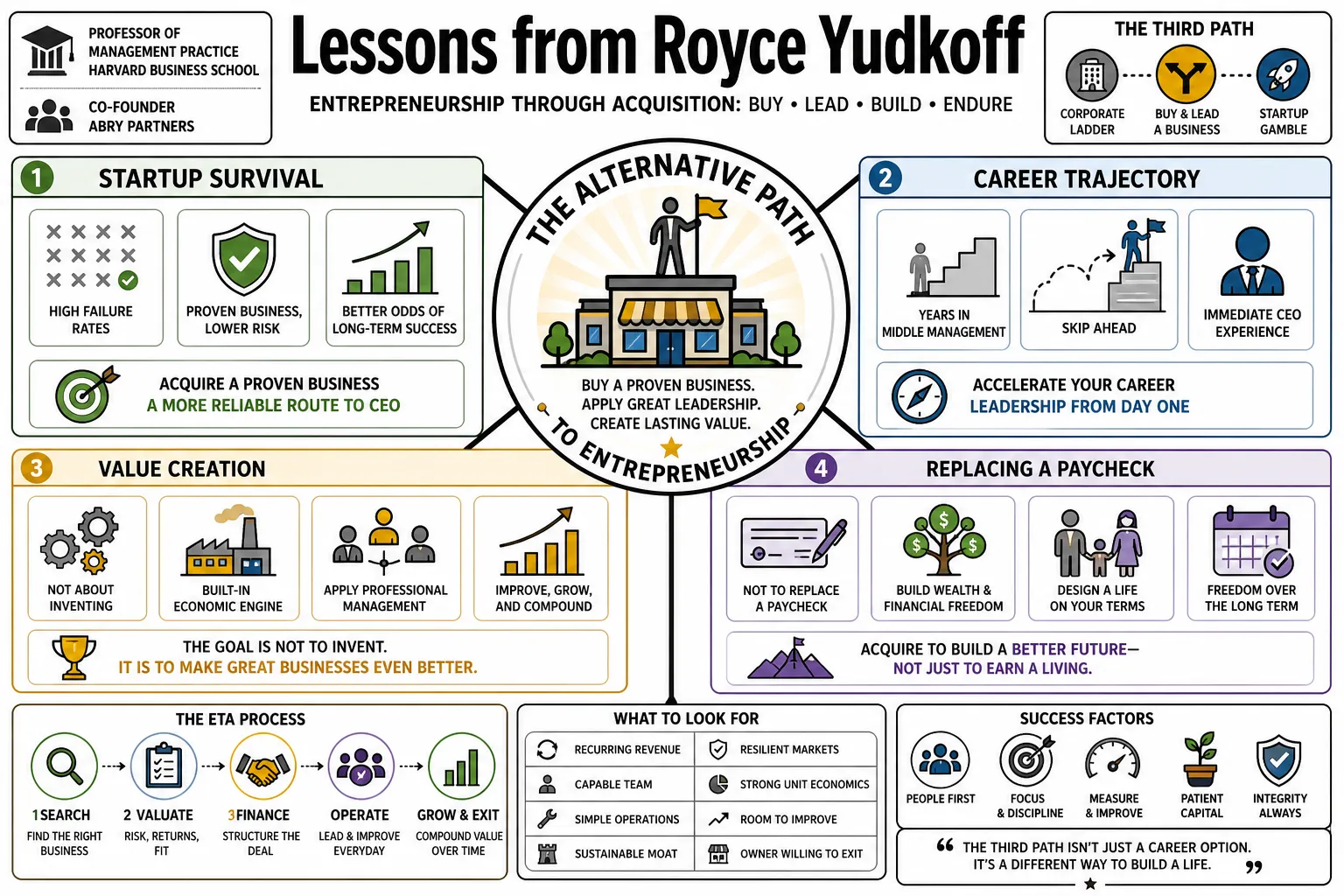
Part 1: The Alternative Path to Entrepreneurship
- On the Third Path: "Buying an existing small business is a radical third path between the traditional corporate ladder and the high-risk gamble of a startup." — Source: [HBR Guide to Buying a Small Business]
- On Startup Survival: "Startups have high failure rates, making the acquisition of a proven business a more reliable route to CEO." — Source: [Harvard Business School]
- On Career Trajectory: "Entrepreneurship through acquisition allows young professionals to skip years of middle management and immediately apply their leadership skills." — Source: [Think Big, Buy Small Podcast]
- On Value Creation: "The goal is not to invent a new product, but to apply professional management to a solid, existing economic engine." — Source: [The Key Point]
- On Replacing a Paycheck: "You should acquire a business to build an enduring enterprise, rather than simply to replace the salary of a job you left." — Source: [Acquiring Minds]
- On Entrepreneurial Risk: "When you buy a retiring founder's company, you drastically reduce the 'go-to-zero' risk that terrifies most founders." — Source: [Axial]
- On Age and Experience: "You do not need a decades-long track record in an industry to succeed; general management skills and a willingness to learn are often enough." — Source: [Think Like an Owner Podcast]
- On Mainstream Appeal: "What was once a niche pursuit for elite MBA students is rapidly becoming a mainstream career choice for mid-career professionals." — Source: [Searchfunder]
- On Economic Impact: "Transitioning leadership in small businesses ensures the survival and growth of the backbone of the economy as baby boomers retire." — Source: [HBS Working Knowledge]
- On the True Meaning of ETA: "It is the realization that leadership and execution often matter more than original invention." — Source: [Invest Like the Best]
Part 2: Identifying Enduring Profitability
- On Enduring Profitability: "The single most important criterion is finding a company with an established history of enduring profitability." — Source: [The Key Point]
- On Recurring Revenue: "The essential characteristic of an enduringly profitable business is a loyal base of recurring customers." — Source: [HBR Guide to Buying a Small Business]
- On Boring Businesses: "The best targets are often found in 'boring' niches like pest control or plumbing, which offer immense stability." — Source: [Built to Sell]
- On Niche Dominance: "Look for businesses that dominate a small, specific market where they face little direct competition." — Source: [Think Big, Buy Small Podcast]
- On Founder Dependency: "Avoid companies where the entire value proposition is intrinsically tied to the personal relationships of the retiring owner." — Source: [Acquiring Minds]
- On Customer Concentration: "A business is fragile if a significant portion of its revenue comes from just one or two major clients." — Source: [Quiet Light Podcast]
- On Capital Expenditure: "Target service-based businesses that require low capital expenditures to maintain operations." — Source: [HBS Working Knowledge]
- On High Margins: "Thick profit margins provide a safety cushion against the inevitable mistakes a new CEO will make." — Source: [The Key Point]
- On Simplicity: "If you cannot easily explain how the business makes money, it is likely too complex for a first-time acquisition." — Source: [Axial]
Part 3: Valuations and the Magic of Multiples
- On Magical Multiples: "In the small firm space, the valuation multiples are truly magical, often pricing companies at three to four times earnings." — Source: [Acquiring Minds]
- On Lower Middle Market Pricing: "The inefficiency of the small business market is exactly what creates such compelling purchase prices." — Source: [Invest Like the Best]
- On Slow Growth Benefits: "Slow-growth businesses sell at lower prices, making them far more attractive targets for value-oriented buyers." — Source: [The Key Point]
- On EBITDA Adjustments: "Correctly calculating seller's discretionary earnings is necessary because it reveals the true cash flow available to a new owner." — Source: [Peak CFO]
- On Valuation Discipline: "Never fall so in love with a business that you justify paying a multiple that mathematically guarantees a poor return." — Source: [Think Big, Buy Small Podcast]
- On Information Asymmetry: "Small business valuations reflect the lack of transparent, centralized financial data available to the broader market." — Source: [Harvard Business School]
- On Risk Premiums: "The low multiples in small business acquisitions are essentially a risk premium for illiquidity and transition challenges." — Source: [Think Like an Owner Podcast]
- On Enterprise Value: "When evaluating enterprise value, ensure you account for the working capital required to keep the lights on day one." — Source: [HBR Guide to Buying a Small Business]
- On Return on Investment: "A well-priced acquisition can yield cash-on-cash returns that significantly outpace public market indexes." — Source: [Poets & Quants]
- On Multiple Arbitrage: "While private equity relies on multiple expansion, ETA success is driven by cash flow generation at purchase." — Source: [Axial]
Part 4: The Discipline of the Search Process
- On Self-Assessment: "Before you search, take stock of your skills and weaknesses, and never buy a business you are fundamentally unsuited to run." — Source: [The Key Point]
- On Personal Fit: "If you are allergic to fur, do not buy a pet shop; personal affinity matters in long-term operations." — Source: [HBR Guide to Buying a Small Business]
- On Sourcing: "Finding a good business requires treating the search itself like a full-time, highly disciplined sales job." — Source: [Think Big, Buy Small Podcast]
- On Intermediaries: "Brokers are useful for identifying motivated sellers, but you must remain objective about the information they present." — Source: [Shortform]
- On Proprietary Search: "Direct outreach to owners can uncover hidden opportunities that have not yet been shopped to the broader market." — Source: [Acquiring Minds]
- On Geographic Flexibility: "Widening your geographic search area exponentially increases your odds of finding an exceptional company." — Source: [Searchfunder]
- On Seller Psychology: "Understanding the emotional attachment a retiring founder has to their legacy is just as important as analyzing the financials." — Source: [HBS Working Knowledge]
- On Due Diligence: "Diligence is about validating the story the numbers tell about customer loyalty, not just checking math." — Source: [Think Like an Owner Podcast]
- On Patience: "The search process can take years, making stamina and the avoidance of deal fatigue essential." — Source: [Axial]
Part 5: Financing the Acquisition
- On the SBA: "Small Business Administration loans are a structural advantage that make small acquisitions uniquely accessible." — Source: [Acquiring Minds]
- On Leverage: "Using debt correctly amplifies equity returns, but over-leveraging can quickly sink an otherwise healthy business." — Source: [The Key Point]
- On Seller Financing: "Having the seller hold a note aligns their post-sale interests with the ongoing success of the company." — Source: [HBR Guide to Buying a Small Business]
- On Self-Funded Search: "The shift toward self-funded search allows buyers to retain significantly more equity compared to traditional search funds." — Source: [Think Big, Buy Small Podcast]
- On Institutional Capital: "The ecosystem has evolved from wealthy individuals to tiny private equity funds backing searchers." — Source: [Castos]
- On Investor Alignment: "Ensure your investors understand the long-term, cash-flow nature of the asset rather than expecting rapid venture-style exits." — Source: [Invest Like the Best]
- On Personal Guarantees: "SBA loans require personal guarantees, meaning you must be deeply convicted about the business's downside protection." — Source: [Axial]
- On Working Capital: "Negotiating sufficient working capital at close prevents the new owner from facing an immediate cash crunch." — Source: [Peak CFO]
- On Structuring: "Keep the capital structure simple, as complex preferred equity layers can create misaligned incentives." — Source: [Think Like an Owner Podcast]
- On Cash Flow Priority: "Debt service must always take precedence, as cash flow generation is the ultimate measure of financial health." — Source: [HBS Working Knowledge]
Part 6: Transitioning to the CEO Role
- On The First 100 Days: "Your initial goal as CEO is not to revolutionize the business, but simply to do no harm." — Source: [HBR Guide to Buying a Small Business]
- On Earning Respect: "A new owner must earn the trust of the existing employees by listening more than they speak in the early months." — Source: [Think Big, Buy Small Podcast]
- On Transitioning Founders: "Managing the seller's exit requires empathy, as they are stepping away from what is often their life's work." — Source: [Acquiring Minds]
- On Operational Focus: "Success comes from the operational ability to run the firm daily, not just the financial engineering to acquire it." — Source: [Libsyn]
- On Continuous Learning: "The role of a small business CEO demands a zeal for continuous learning and extreme humility." — Source: [Shortform]
- On Controllable Factors: "Focus intensely on what you can control, such as customer satisfaction and employee retention, rather than macroeconomic noise." — Source: [Harvard Business School]
- On Culture: "Do not disrupt the existing company culture abruptly; evolve it slowly through steady, reliable leadership." — Source: [Searchfunder]
- On Delegation: "Moving from a 'doer' to a 'manager' is the hardest transition for searchers acquiring small service firms." — Source: [The Key Point]
- On Community: "Embed yourself in the local community, because small businesses thrive on local reputation and word-of-mouth." — Source: [SciSpace]
Part 7: Risk Management and Downside Protection
- On High Growth Traps: "High growth often absorbs cash rapidly and attracts aggressive competitors, making it riskier than steady operations." — Source: [The Key Point]
- On Moats: "A small business moat is usually not intellectual property; it is extreme customer inertia and localized switching costs." — Source: [Think Big, Buy Small Podcast]
- On Downside Protection: "Focus on what could go wrong before modeling upside scenarios, because preservation of capital is paramount." — Source: [Invest Like the Best]
- On Economic Moats: "Businesses that provide essential, unglamorous services are inherently more resilient during economic downturns." — Source: [Axial]
- On Customer Churn: "Carefully scrutinize customer churn rates, as a leaky bucket will eventually bankrupt a leveraged acquisition." — Source: [Peak CFO]
- On Key Man Risk: "Ensure the business is not overly dependent on a single salesperson or technician whose departure would cripple operations." — Source: [Quiet Light Podcast]
- On Industry Fads: "Avoid businesses built on trends and seek out industries that have existed for decades and will exist for decades more." — Source: [HBR Guide to Buying a Small Business]
- On Regulatory Risk: "Steer clear of sectors where a single local regulatory change could instantly invalidate the business model." — Source: [HBS Working Knowledge]
- On Margin of Safety: "Buying at a low multiple provides a built-in margin of safety against the inevitable operational hiccups." — Source: [Think Like an Owner Podcast]
Part 8: Private Equity and Value Investing Principles
- On Value Investing: "The principles of ETA are fundamentally the principles of value investing applied to micro-cap private markets." — Source: [Harvard Business School]
- On Data over Gut: "Use objective data and financial metrics rather than gut feel to drive investment decisions." — Source: [McGraw Hill]
- On Exceptional Partners: "Long-term investment success is ultimately about betting on resilient, capable partners and management teams." — Source: [Wave]
- On Market Inefficiencies: "ABRY Partners was built on exploiting the structural inefficiencies found in middle-market media and communications." — Source: [ABRY Partners]
- On Specialization: "Deep sector expertise allows an investor to see value and mitigate risks that generalists overlook." — Source: [Garnett Station Partners]
- On Discipline: "The most important trait for an investor is the discipline to walk away from a deal when the math no longer works." — Source: [Think Big, Buy Small Podcast]
- On Aligning Interests: "Private equity works best when the financial incentives of the operators and the investors are perfectly aligned." — Source: [Invest Like the Best]
- On Professionalization: "The largest value-add a financial sponsor brings to a small company is professionalizing its reporting and management systems." — Source: [Axial]
- On Long-Term Vision: "Building wealth through private markets requires patience, as the compounding effects take years to fully materialize." — Source: [Carnegie Corporation]