Russ Laraway is a former Marine Corps company commander turned tech executive, known for his leadership roles at Google, Twitter, and Qualtrics. He is the author of When They Win, You Win and the co-founder of Candor, Inc. This profile distills his practical frameworks for management, focusing on his straightforward approach to direction, coaching, and career development.
Part 1: The Core of Management
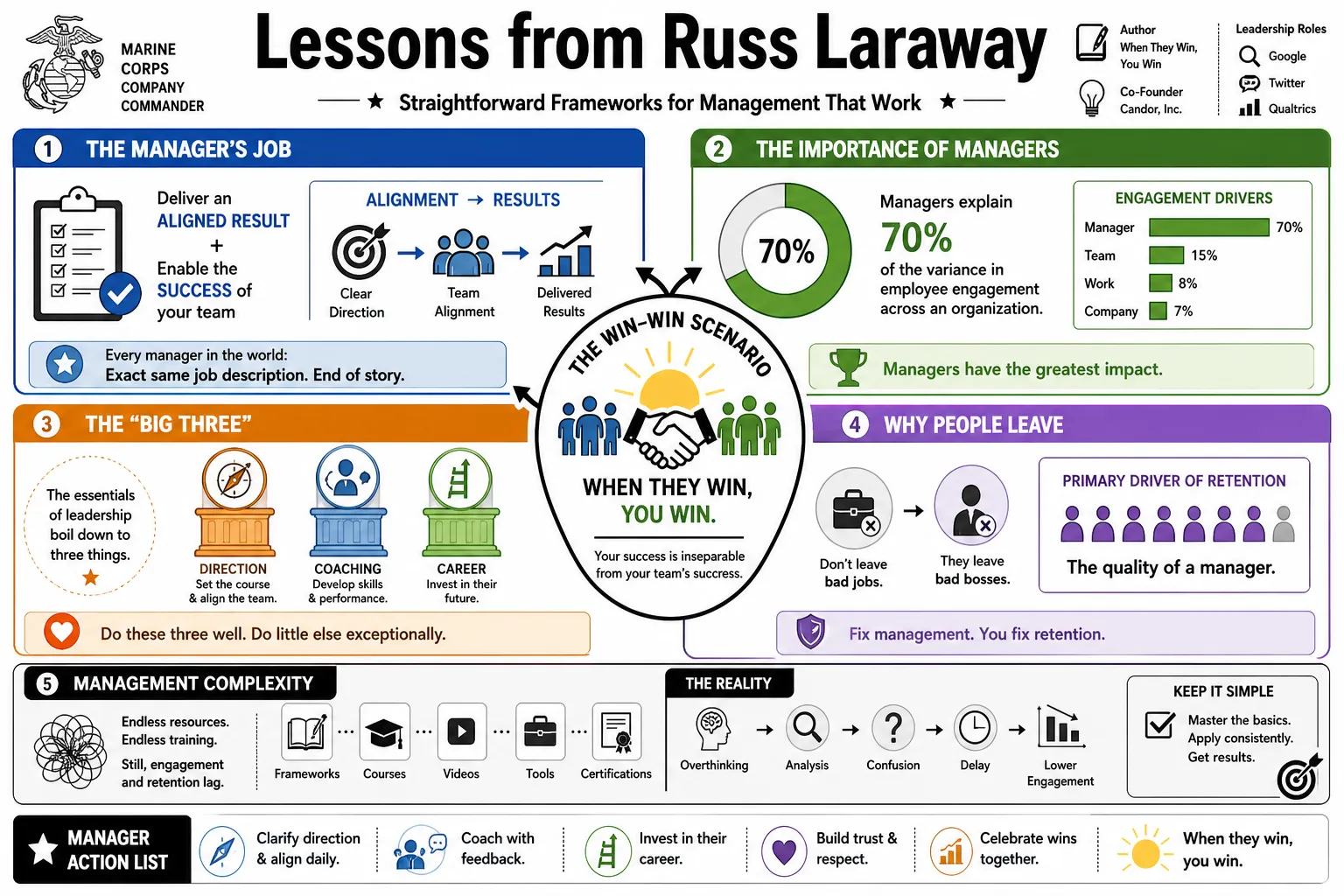
- On The Manager's Job: "Every manager in the world, exact same job description, end of story: deliver an aligned result and enable the success of the people on your team." — Source: [Radical Candor]
- On The Importance of Managers: Managers explain a remarkable 70% of the variance in employee engagement across an organization. — Source: [When They Win, You Win]
- On Why People Leave: People don't leave bad jobs, they leave bad bosses. The quality of a manager is the primary driver of employee retention. — Source: [When They Win, You Win]
- On The "Big Three": The essentials of leadership boil down to three things: Direction, Coaching, and Career. — Source: [Radical Candor Podcast]
- On The Win-Win Scenario: A manager’s success is inseparable from the success of their team. When they win, you win. — Source: [Coaching for Leaders]
- On Management Complexity: Despite endless resources and training, global employee engagement remains low because managers lack a simple, coherent, and quantitatively-backed leadership standard. — Source: [Radical Candor]
- On Leadership Principles: Laraway builds his career around two principles: finding and solving hard problems with good people, and doing something that matters for something that matters. — Source: [When They Win, You Win]
- On Leading by Example: "Leadership by example never goes out of style, and it's impossible to lead by example if you don't know what example you are supposed to set." — Source: [When They Win, You Win]
- On "Born" Leaders: Leadership and management are skills that can be taught, assessed, and improved, rather than innate traits you are simply born with. — Source: [One Knight in Product]
- On Promoting Talent: Companies must stop the common practice of promoting high-performing individual contributors into management without proper training or support. — Source: [Shortform]
Part 2: Providing Direction and Clarity
- On Prioritization: "Prioritization is about subtraction, not addition." A leader must help the team figure out what to ignore. — Source: [BeFreed]
- On Setting Expectations: Your job as a leader is to create clarity of expectations and to hold people accountable to them. — Source: [BeFreed]
- On The Four Steps of Expectations: To set expectations properly: (1) know what you expect, (2) make sure your people know what you expect, (3) have a way to measure it, and (4) manage to those expectations. — Source: [When They Win, You Win]
- On Alignment: The most critical part of providing direction is ensuring that every individual's work maps directly to the broader goals of the organization. — Source: [First Round Review]
- On Avoiding Ambiguity: Ambiguity is the enemy of execution. Managers must translate complex strategies into simple, actionable daily tasks. — Source: [When They Win, You Win]
- On Long-term Vision: Providing direction is about more than this quarter's metrics; it involves connecting the team's daily work to a multi-year vision. — Source: [First Round Review]
- On Ruthless Focus: When everything is a priority, nothing is. Managers must fiercely protect their team's time from distraction. — Source: [Radical Candor Podcast]
- On Goal Transparency: Team goals should be visible to everyone, ensuring cross-functional alignment and reducing siloed efforts. — Source: [First Round Review]
- On Course Correction: Direction is not set-and-forget. It requires constant calibration and repetition until the team can recite the goals from memory. — Source: [When They Win, You Win]
- On The Cost of Confusion: When employees lack clear direction, they fill the void with anxiety, which rapidly erodes both morale and performance. — Source: [Radical Candor]
Part 3: Coaching and Feedback
- On The Goal of Coaching: Coaching consists of two distinct elements: giving specific, sincere praise and providing kind, clear criticism. — Source: [Radical Candor]
- On Initiating Feedback: To avoid overthinking a tough conversation, start with: "I think I'm seeing some behavior that I believe is getting in your way. Are you in a spot where you can hear that right now?" — Source: [Coaching for Leaders]
- On The SBI Model: Organize feedback conversations using the Situation, Behavior, and Impact framework to keep things objective and actionable. — Source: [Coaching for Leaders]
- On "The Truth": There is rarely one single objective "truth" in a feedback conversation. Frame your feedback as simply offering them what you see from your perspective. — Source: [Coaching for Leaders]
- On Inviting Dialogue: After delivering feedback, always follow up with a question to invite the other person’s perspective, such as, "What are your thoughts about that?" — Source: [Coaching for Leaders]
- On Praise to Criticism Ratios: While ratios can feel forced, a manager must ensure that their praise is both frequent and highly specific to reinforce good behavior. — Source: [Radical Candor Podcast]
- On Kindness in Criticism: Being kind doesn't mean being soft; it means being clear. Unclear feedback is the cruelest thing a manager can give. — Source: [First Round Review]
- On Immediate Feedback: Coaching should happen in the moment, rather than saved up for a mid-year or annual performance review. — Source: [When They Win, You Win]
- On Receiving Feedback: Great managers do more than give coaching; they actively solicit it from their direct reports to improve their own leadership. — Source: [Radical Candor]
Part 4: Career Conversations: The Past
- On The Gravity Assist: Managers should use a "gravity assist" approach, helping employees slingshot toward their real ambitions rather than merely moving them blindly up the corporate ladder. — Source: [First Round Review]
- On Rethinking Reviews: Shift the manager-employee relationship away from backward-looking performance reviews and toward forward-looking, developmental dialogues. — Source: [First Round Review]
- On The Three-Part Conversation: Effective career development requires three specific conversations: The Life Story, The Career Vision, and The Career Action Plan. — Source: [Coaching for Leaders]
- On The Life Story: To understand someone's future, you must first understand their past. Start by asking them to walk you through their life story starting from kindergarten. — Source: [First Round Review]
- On Identifying Core Values: During the life story conversation, pay close attention to the transitions and pivots; these reveal the employee's deepest values and motivations. — Source: [First Round Review]
- On Building Trust: Taking the time to understand an employee's personal history builds a foundation of deep trust, which is required for effective management. — Source: [First Round Review]
- On Finding the Through-Line: The manager's job during the life story is to listen actively and help the employee identify the common threads that have driven their major life choices. — Source: [First Round Review]
- On Moving Beyond Resumes: A resume tells you what someone did; their life story tells you why they did it. The "why" is what you need to manage them effectively. — Source: [First Round Review]
- On Employee Vulnerability: When managers ask about an employee's life story, they must be prepared to listen with empathy and without judgment. — Source: [First Round Review]
Part 5: Career Conversations: The Future
- On The Career Vision: Don't ask where they want to be in five years. Ask them to describe their wildest, pinnacle career dream, even if it has nothing to do with their current job. — Source: [Coaching for Leaders]
- On Specificity in Dreams: Push employees to get specific about their dreams: what size company, what industry, and what type of role do they envision at the peak of their career? — Source: [First Round Review]
- On Multiple Paths: It is normal for employees to have three to five completely different career dreams. The manager's job is to help them explore the commonalities among those paths. — Source: [First Round Review]
- On The Action Plan: Once the dream is defined, work backward to create a concrete, immediate action plan that builds the specific skills needed for that future. — Source: [First Round Review]
- On Aligning Present and Future: The most engaging way to manage someone is to show them exactly how their current role is a stepping stone to their ultimate career dream. — Source: [First Round Review]
- On Network Building: A key part of the career action plan is helping the employee expand their network, introducing them to people who currently hold their dream job. — Source: [First Round Review]
- On Honest Assessments: If an employee's current skills do not align with their dream, a manager must be radically candid about the gap and what it will take to close it. — Source: [First Round Review]
- On Retaining Talent: Ironically, helping an employee plan for a future outside of your company is often the best way to retain them in the present, as it builds immense loyalty. — Source: [First Round Review]
- On Continuous Development: The career action plan should be reviewed regularly, rather than annually, to ensure the employee is constantly progressing. — Source: [Coaching for Leaders]
Part 6: Leadership Lessons from the Military
- On Commander’s Intent: The military concept of "Commander’s Intent" is vital in business: simplify the mission so everyone understands the end goal, enabling autonomy without micromanagement. — Source: [One Knight in Product]
- On Decentralized Command: When the intent is clear, those closest to the problem are empowered to make decisions, speeding up execution. — Source: [One Knight in Product]
- On Duty to the Team: A commander’s primary duty is not to their own career advancement, but to the safety, development, and success of the troops under their command. — Source: [First Round Review]
- On The STAC Framework: To build leaders, organizations should adopt a structured approach: Select, Teach, Assess, and Coach, rather than leaving leadership to chance. — Source: [One Knight in Product]
- On Discipline vs. Rigidity: True discipline in leadership is about consistency in standards and care for the team, rather than enforcing rigid, top-down bureaucracy. — Source: [When They Win, You Win]
- On Leading Through Adversity: Military experience shows that teams bond and perform best when they are united by a difficult, meaningful challenge. — Source: [First Round Review]
- On Managing Fear: A leader's job is not to eliminate fear, but to provide enough clarity and support that the team can operate effectively despite it. — Source: [When They Win, You Win]
- On Post-Mortems: The military practice of the "After Action Review" is essential in business: objectively analyzing what went right, what went wrong, and how to improve, without assigning blame. — Source: [One Knight in Product]
- On The Weight of Command: Leadership is a heavy responsibility; taking on a management role means accepting that your decisions directly impact the livelihoods of others. — Source: [First Round Review]
Part 7: Measuring Success and OKRs
- On Data-Driven Management: Management should be treated as a measurable discipline; effectiveness must be quantified rather than based purely on gut feeling or opinion. — Source: [One Knight in Product]
- On Outcome vs. Output: When setting OKRs, managers must distinguish between measuring mere output (tasks completed) and true outcomes (value created). — Source: [When They Win, You Win]
- On Measuring Engagement: The ultimate metric for a manager's success is the engagement score of their team, as it is a leading indicator of future business performance. — Source: [When They Win, You Win]
- On Setting Baselines: Before attempting to improve team performance, a leader must establish a clear, quantitative baseline of where the team currently stands. — Source: [BeFreed]
- On Simplicity in Metrics: If a goal cannot be measured simply, it is likely too complex or poorly defined to be useful to the team. — Source: [When They Win, You Win]
- On Surveying the Team: Upward feedback surveys are non-negotiable; they are the most critical tool for a manager to assess their own performance and blind spots. — Source: [First Round Review]
- On Qualitative Context: While data is crucial, it must be paired with the qualitative context gathered through one-on-one conversations to paint a complete picture of team health. — Source: [When They Win, You Win]
- On Goal Cascade: OKRs should not exclusively cascade down from the top; they should be influenced by the ground-level insights of the individual contributors doing the work. — Source: [When They Win, You Win]
- On Accountability: Measuring success means holding people accountable when they fall short, not as a punitive measure, but as an opportunity for coaching and course correction. — Source: [BeFreed]
Part 8: Employee Engagement and Retention
- On The Engagement Crisis: We are facing a global crisis of employee engagement, largely because companies overcomplicate management and neglect the fundamentals. — Source: [Radical Candor]
- On The ROI of Management: Investing time in becoming a better manager is not a soft HR initiative; it has a direct, outsized return on investment through increased retention and productivity. — Source: [When They Win, You Win]
- On Caring Personally: You cannot engage an employee if you do not genuinely care about them as a human being outside of their economic output for the company. — Source: [Radical Candor]
- On The Danger of Apathy: A team that lacks direction and career support won't necessarily quit immediately; worse, they will stay and succumb to apathetic underperformance. — Source: [First Round Review]
- On Building Resilience: Highly engaged teams are far more resilient in the face of company pivots, market downturns, and inevitable organizational friction. — Source: [When They Win, You Win]
- On Psychological Safety: Engagement thrives in environments where employees feel psychologically safe to take risks, make mistakes, and speak truth to power. — Source: [Radical Candor]
- On The Power of Autonomy: Once direction is set, managers must step back. Giving employees the autonomy to execute their work is a massive driver of engagement. — Source: [One Knight in Product]
- On Recognizing Contributions: People need to know that their work matters. Regularly drawing the line between an employee's daily tasks and the company's ultimate mission is vital for retention. — Source: [When They Win, You Win]
- On Managing Out: Sometimes, the best way to maintain team engagement is to quickly and kindly manage out individuals who are toxic to the culture or consistently failing to meet standards. — Source: [Radical Candor Podcast]
- On The Legacy of a Manager: Ultimately, a manager's legacy is not the code they shipped or the revenue they generated, but the capability and trajectory of the people they developed. — Source: [When They Win, You Win]