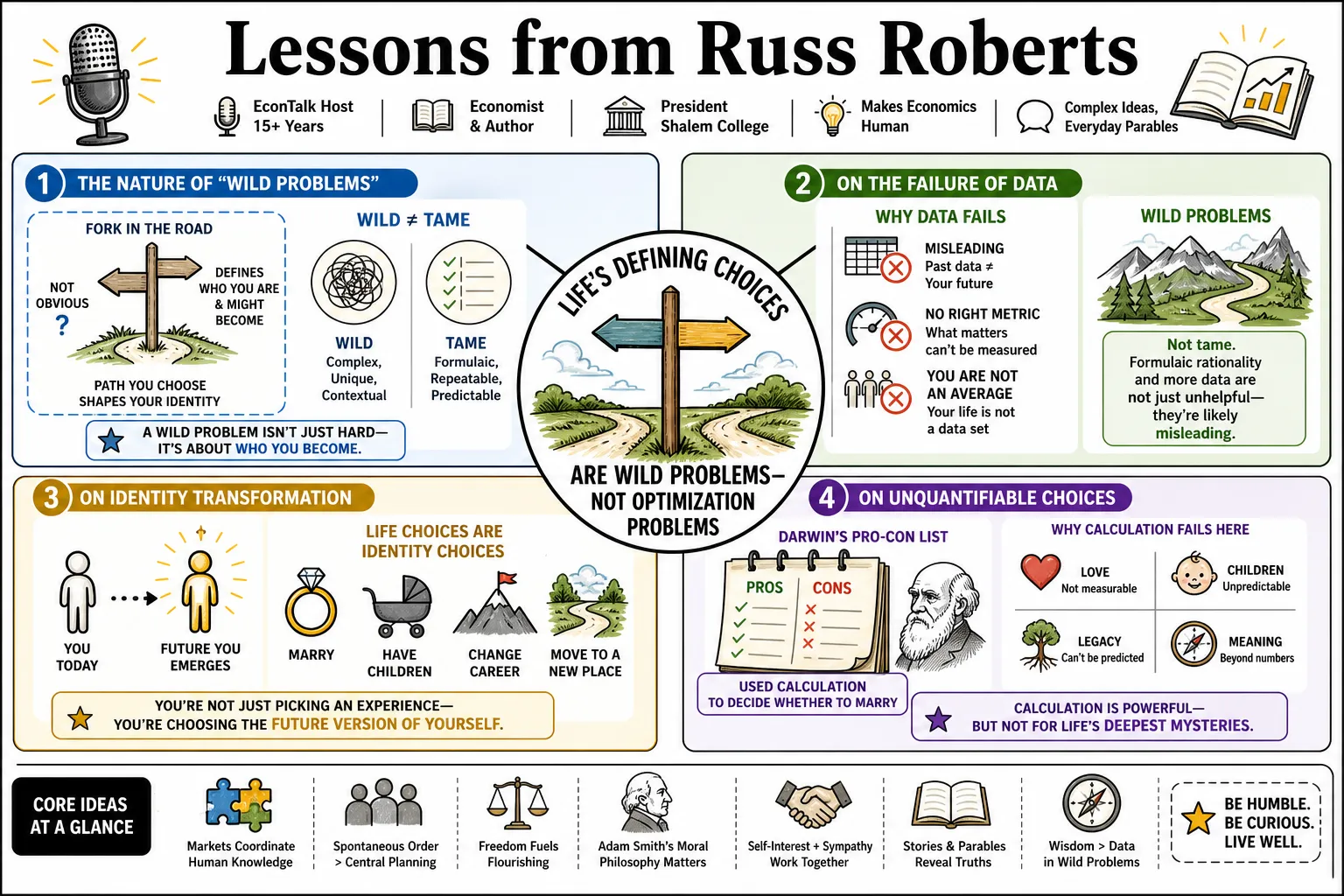
Lessons from Russ Roberts
Economist and author Russ Roberts has hosted the EconTalk podcast for over 15 years, turning complex economic principles into everyday parables. This profile outlines the Shalem College president's core ideas on markets and Adam Smith's moral philosophy, alongside his argument that life's defining choices simply cannot be optimized with data.
Part 1: The Nature of "Wild Problems"
- On defining wild problems: "A wild problem is a fork in the road of life where knowing which is the right one isn't obvious and where the path we choose defines who we are and who we might become." — Source: [Wild Problems]
- On the failure of data: "Wild problems are problems that are not tame, meaning that the application of formulaic rationality, or the accumulation of data, is not only not helpful but is likely to be misleading." — Source: [Wild Problems]
- On identity transformation: "Choosing to marry or have children goes beyond picking an experience; it is about choosing the future version of yourself." — Source: [Wild Problems]
- On unquantifiable choices: "Charles Darwin tried to use a pro-and-con list to decide whether to marry, perfectly illustrating how calculation fails when applied to life's deepest mysteries." — Source: [Wild Problems]
- On decision-making paralysis: "Many people stay stuck in a state of inaction, waiting for more data that will never arrive to solve a problem that requires a leap of faith." — Source: [Wild Problems]
- On flipping a coin: "Using a coin helps you know what you hope. If the coin comes up tails and you are disappointed, you really wanted to go to the other option." — Source: [Wild Problems]
- On evaluating life paths: "You cannot have all the data needed to make a rational choice about a new way of life because your perspective will fundamentally change once you are living it." — Source: [Wild Problems]
- On heartbreak and growth: "As we get older, we understand that the pain we have endured, especially heartbreak, has done more than make us stronger. It has made us who we are." — Source: [Wild Problems]
- On taking leaps: "Because you cannot know the outcome of a major life decision in advance, the only way to truly understand a way of life is to take the risk of living it." — Source: [Wild Problems]
- On experiencing over solving: "Life is not a puzzle to be solved with a spreadsheet, but a mystery to be experienced and lived." — Source: [Wild Problems]
Part 2: Adam Smith and Human Flourishing
- On self-deception: "The first principle is that you must not fool yourself, and you are the easiest person to fool." — Source: [How Adam Smith Can Change Your Life]
- On the core human desire: "Man naturally desires, not only to be loved, but to be lovely." — Source: [How Adam Smith Can Change Your Life]
- On moral behavior: "If you want to make the world a better place, work on being trustworthy, and honor those who are trustworthy." — Source: [How Adam Smith Can Change Your Life]
- On the impartial spectator: "We improve our own moral behavior by imagining how an objective, fair-minded observer would view our actions." — Source: [How Adam Smith Can Change Your Life]
- On the limits of selfishness: "How selfish soever man may be supposed, there are evidently some principles in his nature, which interest him in the fortune of others." — Source: [How Adam Smith Can Change Your Life]
- On the good life: "For Smith, prudence means taking care of yourself, justice means not hurting others, and beneficence means being good to others. That is not a bad trio for thinking about how to live the good life." — Source: [How Adam Smith Can Change Your Life]
- On Smith's realism: "He is mostly interested in how people actually behave, not how he would like them to behave." — Source: [How Adam Smith Can Change Your Life]
- On true wealth: "Adam Smith, the father of capitalism, understood that personal happiness and virtue are found in social connection rather than material accumulation." — Source: [How Adam Smith Can Change Your Life]
- On being worthy of love: "We want more than the praise of others; we want to know deep down that we have acted in a way that genuinely earns that praise." — Source: [How Adam Smith Can Change Your Life]
Part 3: Emergent Order and Market Magic
- On spontaneous order: "The farmer who grows the wheat and the miller that grinds the flour are all on their own, making independent decisions. But somehow their plans fit together with the greatest degree of precision." — Source: [It's a Wonderful Loaf]
- On systemic design: "It is the product of our actions but no single mind has designed it." — Source: [It's a Wonderful Loaf]
- On the illusion of control: "The curious task of economics is to demonstrate to men how little they really know about what they imagine they can design." — Source: [EconTalk]
- On the lack of a bread czar: "In a large city, people sleep peacefully without worrying about whether there will be food the next morning, despite there being no minister of flour to orchestrate the process." — Source: [It's a Wonderful Loaf]
- On market coordination: "Prices do more than transfer money; they communicate vital information across a decentralized society." — Source: [The Price of Everything]
- On disrupting prices: "When we interfere with prices, we create disorder." — Source: [The Price of Everything]
- On the invisible hand: "Complex goods are created through the invisible hand of the market, requiring the peaceful cooperation of millions of strangers." — Source: [EconTalk]
- On top-down interventions: "When we rely on top-down design to manage complex systems, we often ignore the unintended consequences of disrupting emergent order." — Source: [EconTalk]
- On infrastructure and markets: "While government legal systems and infrastructure support property rights, the actual coordination of goods is spontaneous rather than commanded." — Source: [It's a Wonderful Loaf]
- On economic harmony: "Markets are far more than a mechanical exchange of goods; they form a remarkable web of human cooperation that functions without a central conductor." — Source: [EconTalk]
Part 4: The Limits of Data and Quantification
- On the streetlight effect: "Not everything that is important can be quantified. I worry that as economists, we too often are like the drunk at 1 a.m. looking for his keys under the glare of a streetlight because the light is better there." — Source: [Medium]
- On GDP as a metric: "We tend to focus exclusively on what can be measured, like GDP, while ignoring deeper, qualitative aspects of human well-being." — Source: [EconTalk]
- On utilitarianism: "Viewing life purely through a utilitarian lens strips away the nuance of faith, grace, and human connection." — Source: [EconTalk]
- On optimization: "Optimization is a powerful tool for building a bridge or maximizing profits, but it is a terrible framework for building a meaningful life." — Source: [Wild Problems]
- On data-driven illusions: "The accumulation of data gives us a false sense of certainty in domains where human unpredictability rules." — Source: [Wild Problems]
- On measuring success: "We mistakenly believe that if we cannot measure something, it must not matter. In reality, the most important things in life evade measurement." — Source: [Medium]
- On algorithmic living: "Relying on algorithms to make our life choices outsources our agency and diminishes our humanity." — Source: [Wild Problems]
- On the limits of spreadsheets: "You cannot put a value on a sunset, a true friend, or a peaceful conscience into a cost-benefit analysis." — Source: [Wild Problems]
- On accepting uncertainty: "A mature approach to life requires accepting that our most profound experiences will always resist precise quantification." — Source: [Wild Problems]
Part 5: Intellectual Humility and Conversation
- On shifting away from debate: "Over the course of hosting EconTalk, I realized that conversation is far more valuable than debate. The goal is not to win, but to understand." — Source: [EconTalk]
- On listening to opponents: "We should strive to seek truth even with guests we fundamentally disagree with, rather than trying to score points." — Source: [EconTalk]
- On the economic way of thinking: "Economics at its best teaches us humility in the face of complex systems and the limits of our own knowledge." — Source: [EconTalk]
- On intellectual blind spots: "We must constantly remind ourselves that we view the world through our own ideological filters." — Source: [EconTalk]
- On connecting with others: "The most profound podcast episodes are not the ones with the most facts, but the ones where a powerful human connection is formed." — Source: [EconTalk]
- On the limits of communication: "You cannot reach the brain through the ears. True understanding requires more than just hearing words; it requires an openness to change." — Source: [EconTalk]
- On admitting ignorance: "Saying 'I do not know' is one of the most difficult but necessary habits for a public intellectual to develop." — Source: [EconTalk]
- On Chesterton's Fence: "If a norm or rule makes no sense to you, you cannot assume it serves no purpose. Prudence requires one to not tear the fence down until its purpose can be deduced." — Source: [EconTalk]
- On ideological tribalism: "We are too quick to assume the worst motives of those in the other tribe, instead of engaging with the strongest version of their arguments." — Source: [EconTalk]
Part 6: Trade, Prices, and The Invisible Heart
- On the heart of capitalism: "Capitalism involves struggle, but it has an invisible heart beating at its core that transforms people's lives." — Source: [The Invisible Heart]
- On serving the customer: "There is an invisible heart at the core of the market place, serving the customer and doing it joyously." — Source: [The Invisible Heart]
- On the long-term benefits of trade: "Can you imagine how poor America would be today if we had made a decision decades ago to preserve the size of agriculture in the name of saving jobs?" — Source: [The Choice]
- On free trade and freedom: "Free trade is fundamentally what allows individuals, including our children, the freedom to pursue their own unique dreams." — Source: [The Choice]
- On the morality of markets: "Markets are often characterized as heartless, but they are built on a foundation of mutual benefit and voluntary exchange." — Source: [The Invisible Heart]
- On creative destruction: "Economic progress requires allowing old industries to fade so that labor and capital can flow toward solving new problems." — Source: [The Choice]
- On protectionism: "Protecting specific jobs through tariffs inevitably harms the broader public by raising prices and stifling innovation." — Source: [The Choice]
- On poverty reduction: "The spread of market economies has done more to lift humanity out of grinding poverty than any top-down aid program in history." — Source: [EconTalk]
- On the beauty of commerce: "There is a quiet dignity in the everyday transactions of the market, where strangers serve each other's needs without coercion." — Source: [The Price of Everything]
Part 7: Leadership, Education, and Identity
- On liberal arts education: "A true liberal arts education is less about acquiring a specific job skill and more about learning how to think clearly and live an examined life." — Source: [Shalem College]
- On institution building: "Starting and leading a college requires navigating the tension between ambitious ideals and the practical realities of a budget." — Source: [Shalem College]
- On the role of a university: "A university should be a place where students are challenged to grapple with the greatest texts and ideas of human history." — Source: [Shalem College]
- On learning from philosophy: "Studying Aristotle and other foundational thinkers equips us to ask the right questions about our own moral character." — Source: [Medium]
- On immigration and identity: "Moving to a new country later in life is a profound wild problem that reshapes your daily habits and your sense of belonging." — Source: [EconTalk]
- On community norms: "Institutions thrive when they foster a culture of trust, open inquiry, and shared purpose among their members." — Source: [Shalem College]
- On the value of hardship: "The struggles involved in building something new, whether a family or a college, are what give the endeavor its ultimate meaning." — Source: [EconTalk]
- On cultural heritage: "Engaging deeply with our historical and religious traditions provides an anchor in a rapidly changing modern world." — Source: [Shalem College]
- On the purpose of studying economics: "We study economics primarily to understand the unseen forces that shape our society and our choices, rather than simply to get rich." — Source: [The Choice]
Part 8: Meaning, Luck, and the Well-Lived Life
- On the meaning of life: "What we are seeking is not the meaning of life as an abstract answer, but a feeling of being fully alive." — Source: [EconTalk]
- On David Foster Wallace's insight: "Everyone worships something. The only choice we get is what to worship." — Source: [EconTalk]
- On the role of luck: "I did not choose my parents. I am so lucky. Had things turned out differently or the timing been different, my fate could have been entirely otherwise." — Source: [Medium]
- On gratitude: "Recognizing the massive role that luck plays in our success should make us deeply grateful and humble, rather than arrogant." — Source: [Medium]
- On living the narrative: "Life is like a book that you are writing and reading at the same time. For it to be a great book, it needs to be savoured and chewed and digested along the way." — Source: [Medium]
- On the fragility of civilization: "The peace and prosperity we enjoy are fragile gifts that rely on a thin veneer of social trust and accumulated wisdom." — Source: [EconTalk]
- On faith and grace: "There is a mushy yet beautiful world of faith, love, and grace that exists entirely outside the bounds of economic modeling." — Source: [EconTalk]
- On defining success: "True success is measured by the quality of our relationships and the integrity of our character, rather than by wealth or status." — Source: [How Adam Smith Can Change Your Life]
- On the beauty of the unknown: "Embracing the mystery of life is far more rewarding than trying to control every variable." — Source: [Wild Problems]
- On human flourishing: "We flourish when we lean into the unquantifiable aspects of existence, accepting that life is an adventure rather than an equation." — Source: [Wild Problems]