Russell Ackoff spent his career explaining why our organizations and institutions consistently fail to do the things they claim to do. An operations researcher who grew deeply skeptical of his own field, he is best known for his work in systems thinking—specifically the idea that a system is defined by how its parts interact, not how they act independently. This profile collects his most enduring observations on why we solve the wrong problems, manage "messes" instead of isolated issues, and build bureaucracies that stifle the very goals they intend to achieve.
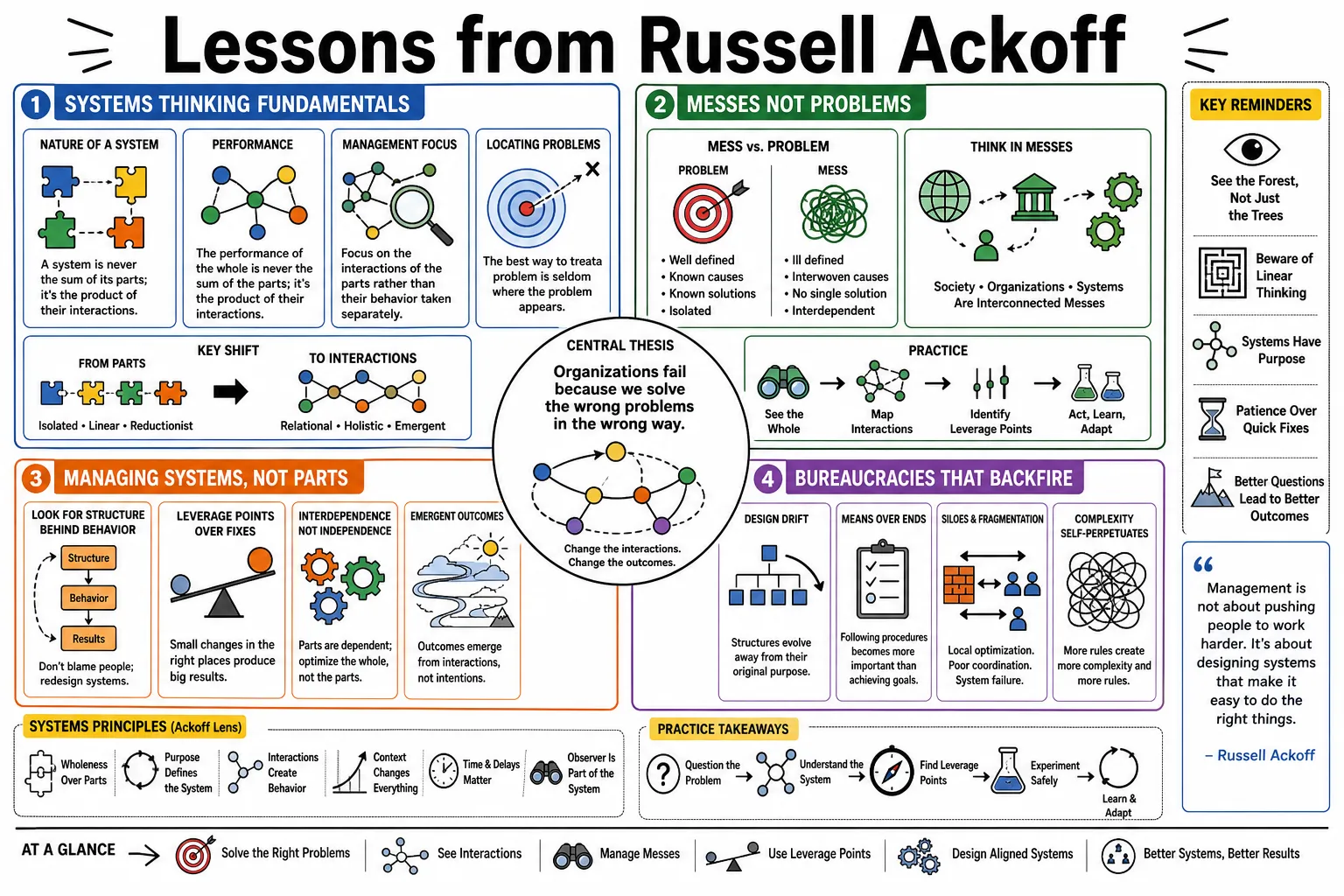
Part 1: Systems Thinking Fundamentals
- On the nature of a system: "A system is never the sum of its parts; it’s the product of their interactions." — Management-Quotes
- On performance: "The performance of the whole is never the sum of the performance of the parts taken separately, but it’s the product of their interactions." — Management-Quotes
- On management focus: "To manage a system effectively, you might focus on the interactions of the parts rather than their behavior taken separately." — AZ Quotes
- On locating problems: "In a system, the best way to treat a problem is seldom where the problem appears, because of the interactions of the parts." — Quote Fancy
- On interconnectedness: "A problem never exists in isolation; it is surrounded by other problems in space and time." — Quote Fancy
- On understanding over knowledge: "In systems thinking, increases in understanding are believed to be obtainable by expanding the systems to be understood, not by reducing them to their elements." — AZ Quotes
- On the direction of understanding: "Understanding proceeds from the whole to its parts, not from the parts to the whole as knowledge does." — AZ Quotes
- On optimizing parts: "We've been focusing on improving parts of the system rather than focusing on the system as a whole. As a result, we have been improving the parts, but not the whole." — Wikiquote
- On systemic design: "We have got to restart by focusing on designing the whole and then designing parts that fit it rather than vice versa." — Wikiquote
- On the car analogy: "If you take the best parts from every car in the world and try to put them together, you won't even have a car—because the parts won't fit." — Lateral Works
Part 2: Managing Messes and Problem Dissolution
- On messes: "Managers are not confronted with problems that are independent of each other, but with dynamic situations that consist of complex systems of changing problems that interact with each other. I call such situations messes." — AZ Quotes
- On the manager's true job: "Managers do not solve problems, they manage messes." — AZ Quotes
- On extraction: "Problems are extracted from messes by analysis." — Medium
- On dissolving vs solving: "It is better to dissolve a problem than solve it." — Medium
- On the definition of dissolution: "To dissolve a problem is to redesign the organization that has the problem or its environment so the problem is eliminated and cannot reappear." — WordPress
- On problem solutions creating new problems: "A solution to a problem taken separately can create a much more serious problem than the problem solved." — WordPress
- On the reality of problems: "Problems are not objects of experience, but mental constructs extracted from it by analysis. Problems are to messes what atoms are to desks." — WordPress
- On identifying the problem: "Successful problem solving requires finding the right solution to the right problem." — Goodreads
- On the root of failure: "We fail more often because we solve the wrong problem than because we get the wrong solution to the right problem." — Goodreads
Part 3: The Illusions of Management and Measurement
- On measurement: "Managers who don't know how to measure what they want settle for wanting what they can measure." — Management-Quotes
- On corporate planning: "A good deal of the corporate planning I have observed is like a ritual rain dance; it has no effect on the weather that follows, but those who engage in it think it does." — Management-Quotes
- On consulting advice: "Much of the advice is directed at improving the dancing, not the weather." — Management-Quotes
- On management rank and knowledge: "The lower the rank of managers, the more they know about fewer things. The higher the rank of managers, the less they know about many things." — AZ Quotes
- On complexity: "The less managers understand their business, the more variables they require to explain it." — Medium
- On simple solutions: "Complex problems do not have simple solutions; only simple-minded managers and their consultants think they do." — Medium
- On risk aversion: "Risk aversion is a core competency of most managers." — Medium
- On continuous education: "The higher their rank, the less managers perceive a need for continuing education, but the greater the need for it." — Medium
- On ignoring the present: "So much time is currently spent in worrying about the future that the present is allowed to go to hell." — AZ Quotes
Part 4: Efficiency vs. Effectiveness
- On doing the wrong thing: "The more efficient you are at doing the wrong thing, the wronger you become." — Goodreads
- On doing the right thing wrong: "It is much better to do the right thing wrong than the wrong thing right." — Goodreads
- On learning from mistakes: "If you do the right thing wrong and correct it, you get better. If you do the wrong thing right, you just get 'wronger'." — AZ Quotes
- On the definitions: "Intelligence is the ability to increase efficiency; wisdom is the ability to increase effectiveness." — UNG
- On the limitations of knowledge: "Information, knowledge, and understanding enable us to increase efficiency, not effectiveness." — UNG
- On doing things right vs right things: "The righter we do the wrong thing, the wronger we become. Therefore, it is better to do the right thing wrong than the wrong thing right." — Goodreads
- On learning from success: "Managers cannot learn from doing things right, only from doing things wrong." — Medium
- On operations research: "The future of operational research is past... it has been moving away from the world of management and toward the world of mathematics." — Wikiquote
- On the nature of OR: "Operations research is neither a method nor a technique; it is or is becoming a science and as such is defined by a combination of the phenomena it studies." — Wikiquote
Part 5: Data, Knowledge, and Wisdom
- On defining data: "Data are symbols that represent the properties of objects and events." — UNG
- On the utility of data: "Data has no inherent meaning or value until it is processed." — UFMG
- On defining information: "Information consists of processed data, the processing directed at increasing its usefulness." — UNG
- On the questions information answers: "Information provides answers to 'who', 'what', 'where', and 'when' questions." — UFMG
- On defining knowledge: "Knowledge is the application of data and information to answer 'how' questions." — SlideShare
- On control: "Knowledge is the 'know-how' that makes control of a system possible." — Washington.edu
- On defining understanding: "Understanding is the appreciation of 'why'." — UFMG
- On the value of understanding: "An ounce of understanding is worth a pound of knowledge." — UNG
- On defining wisdom: "Wisdom deals with values. It involves the exercise of judgment." — Goodreads
- On evaluating understanding: "Wisdom is evaluated understanding. While the first four levels deal with the past and efficiency, wisdom deals with the future, values, and effectiveness." — SlideShare
Part 6: Education and the Mechanics of Learning
- On the true objective: "The objective of education is learning, not teaching." — Quote Fancy
- On the flaw of teaching: "Traditional education focuses on teaching, not learning. It incorrectly assumes that for every ounce of teaching there is an ounce of learning by those who are taught." — AZ Quotes
- On retention: "Most of what is taught in classroom settings is forgotten, and much of what is remembered is irrelevant." — AZ Quotes
- On the role of mistakes: "We never learn by doing something right; we already know how to do it... We can only learn from mistakes." — AZ Quotes
- On conventional schooling: "All through school, we are shown that making a mistake is a bad thing, something for which we are downgraded. This reveals how little conventional schools are interested in learning." — Quote Fancy
- On assessment: "Exams do not assess anything significant to the future of children, because no one knows how to assess or measure the key factors to the future success of any person, child or adult." — Quote Fancy
- On natural learning: "Most of what we learn before, during, and after attending schools is learned without its being taught to us." — AZ Quotes
- On adult education: "Adults learn most of what they use at work or at leisure while at work or leisure." — AZ Quotes
- On design as pedagogy: "The power of design as an instrument of learning is almost completely overlooked by the educational system. For example, the best way to learn how an automobile works... is to design one." — Goodreads
Part 7: Idealized Design and Planning for the Future
- On retrograde planning: "The way to get to the best outcome is to imagine what the ideal solution would be and then work backward to where you are today." — Wikiquote
- On defining idealized design: "An idealized design of a system is the design its stakeholders would have right now if they could have any system they wanted." — Wikiquote
- On the clean sheet approach: "Imagine that the program never existed, and we were now to create one." — Wikiquote
- On constraints: "Suggestions are subject to a single constraint: that they be physically possible, e.g., no time travel. But when in doubt, go ahead and shout it out." — Wikiquote
- On feasibility: "Don't worry about whether resources are available to implement an idea... If you don't know what you would do if you could do whatever you wanted, how can you know what to do when you can't do everything you want?" — Wikiquote
- On creating the future: "Interactive planning is directed at creating the future. It is based on the belief that an organization's future depends at least as much on what it does between now and then, as on what is done to it." — Curious Cat
- On forecasting: "The future is better dealt with using assumptions than forecasts." — Quote Fancy
- On imperfect control: "It is better to control the future imperfectly than to forecast it perfectly." — Medium
- On reactive problem solving: "In reactive problem solving we walk into the future facing the past — we move away from, rather than toward, something." — Citas.in
- On continuous adaptation: "No problem stays solved in a dynamic environment." — Quote Fancy
Part 8: Organizational Structure and Bureaucracy
- On omissions vs commissions: "Errors of omission, lost opportunities, are generally more critical than errors of commission." — Quote Fancy
- On why organizations fail: "Organizations fail or decline more frequently because of what they did not do than because of what they did." — Quote Fancy
- On bureaucracy: "A bureaucrat is one who has the power to say 'no' but none to say 'yes'." — AZ Quotes
- On institutional inertia: "The only thing more difficult than starting something new in an organization is stopping something old." — Medium
- On secrets: "The uniqueness of an organization lies more in what it hides than what it exposes." — Medium
- On hierarchy: "The circular organization is a democratic hierarchy built on the absence of an ultimate authority." — Wikiquote
- On autonomy: "Autonomy is the ability of members, individually or collectively, to make and implement decisions that affect no one other than the decision maker." — Wikiquote
- On leadership intent: "Effective management must be directed at what you want, not against what you don't want." — Management-Quotes
- On creativity: "Creativity is the ability to identify self-imposed constraints, remove them, and explore the consequences of their removal." — Quote Fancy