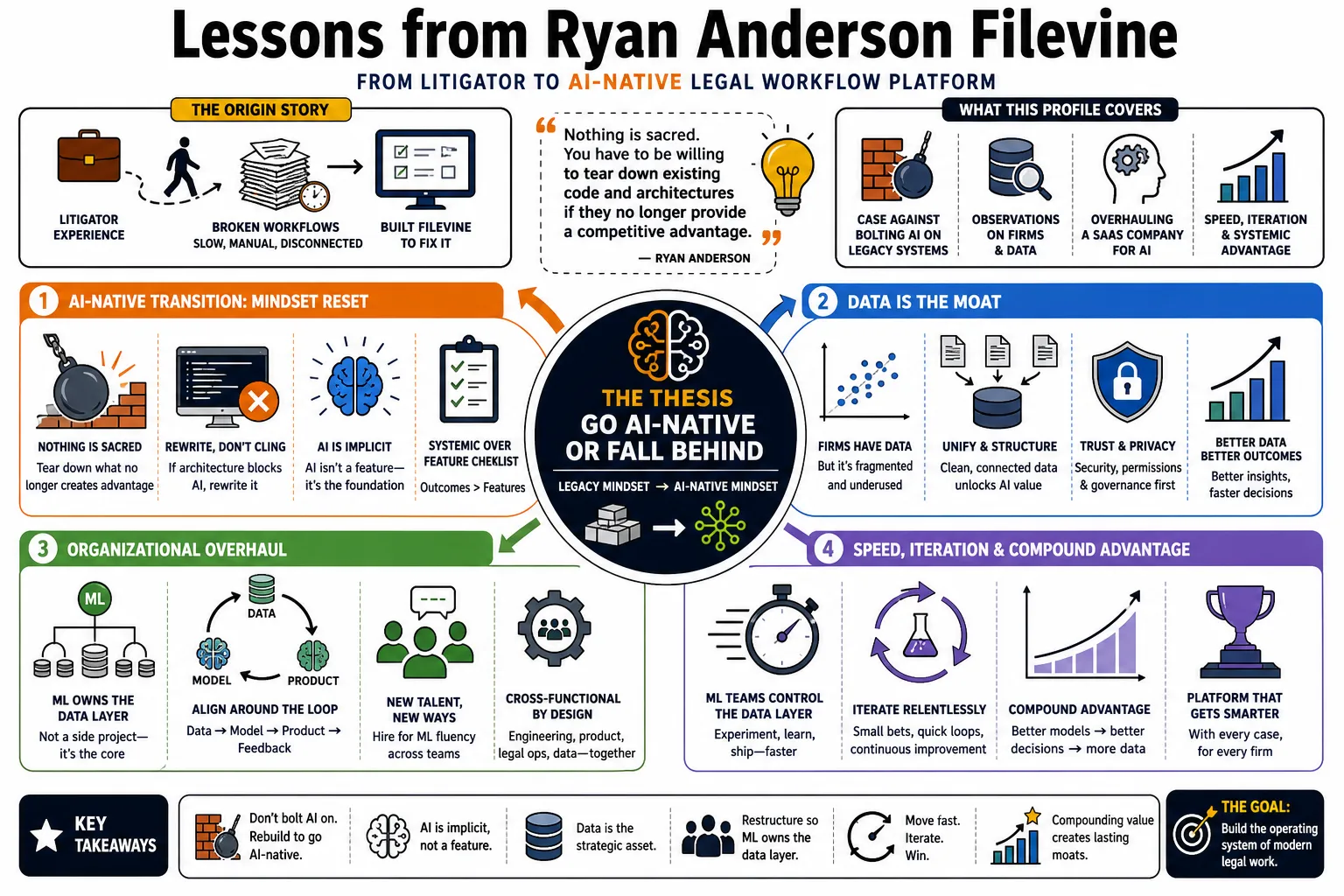
Lessons from Ryan Anderson Filevine
Ryan Anderson co-founded Filevine to solve the workflow problems he encountered as a litigator, pushing legal tech past basic case management toward AI-native systems. This profile covers his case against bolting AI onto legacy software, his observations on how law firms use data, and what it takes to overhaul a SaaS company for an AI-centric market.
Part 1: The AI-Native Transition
- On organizational mindset: "Nothing is sacred. You have to be willing to tear down existing code and architectures if they no longer provide a competitive advantage." — Source: [The Official SaaStr Podcast]
- On legacy code: Clinging to software architecture just because it worked in the past is dangerous. If it blocks the integration of AI models, it needs to be rewritten entirely. — Source: [SaaStr Europa]
- On AI expectations: The entire organization must assume AI is implicit in everything being built, shifting away from a feature-based mentality to a systemic one. — Source: [TeamDay AI]
- On organizational debt: Companies that treat AI as a separate division or side project fail. You have to restructure so that machine learning teams own the underlying data layer. — Source: [The Official SaaStr Podcast]
- On iterative speed: When ML teams control the data layer, a company can iterate on daily releases rather than waiting on legacy infrastructure bottlenecks. — Source: [SaaStr London]
- On hiring for the shift: Transforming a software platform requires bringing in "AI natives" who naturally think in terms of model capabilities rather than just traditional application logic. — Source: [The Official SaaStr Podcast]
- On the pain of transition: Moving a successful company to an AI-native posture means intentionally disrupting your own stable systems before a competitor does it for you. — Source: [SaaStr Europa]
- On product roadmaps: The roadmap shouldn't have an isolated "AI section." If a new feature doesn't rely on intelligence at its core, you are likely building for the past. — Source: [PMF Show]
- On execution speed: The speed at which you abandon old paradigms correlates directly with your ability to capture the AI market in vertical SaaS. — Source: [The Official SaaStr Podcast]
Part 2: Legal Operating Intelligence Systems (LOIS)
- On embedded intelligence: "Some early versions of legal AI forced lawyers to work in two systems: their systems of record and their AI tools. But that framework isn't what the market demands." — Source: [Pulse 2.0]
- On systemic integration: "Filevine embeds intelligence into the DNA of daily legal work, with the first true legal operating intelligence system." — Source: [Pulse 2.0]
- On task augmentation: The goal of LOIS is that every single task a legal professional completes should be augmented with built-in intelligence. — Source: [Pulse 2.0]
- On product ambition: "I think it's the most ambitious AI product in all of legal AI. We don't think anybody's even attempted to do something like this, nor really could they at this point." — Source: [CCB Journal]
- On read-only AI: Older AI tools could only summarize documents. Agentic AI can write results back into the law firm's system of record to trigger the next workflow step. — Source: [Filevine Blog]
- On automated workflows: An operating intelligence system doesn't just read a contract; it sets the follow-up tasks, updates the calendar, and drafts the initial response. — Source: [Filevine Blog]
- On closing the research gap: "Citators tell you about the case. Lawyers cite the holding. LOIS Legal Research closes that gap." — Source: [PR Newswire]
- On verifiable research: "AI is changing how lawyers research the law. LOIS Legal Research is built so that AI can be trusted to tell them whether the law still holds." — Source: [PR Newswire]
- On structured matter graphs: LOIS minimizes hallucinations by grounding its outputs in a structured matter graph built from thousands of actual legal cases and precedents. — Source: [Filevine Documentation]
- On connecting the firm: The platform's ultimate purpose is to serve as the central nervous system of a law firm, connecting personnel, daily processes, and historical data. — Source: [Filevine Blog]
Part 3: From Lawyer to Founder
- On self-awareness as a founder: "I don't doubt myself very much at all." — Source: [TechBuzz News]
- On personal work habits: "I'm not a naturally organized individual. I'm naturally anxious." — Source: [Substack]
- On recognizing market gaps: The initial idea for Filevine came from the realization that no existing software could handle the highly specific workflows of a personal injury litigator. — Source: [Maximum Lawyer]
- On early pain points: Practicing law exposed him to severe administrative friction, proving that attorneys spent too much time managing software rather than practicing law. — Source: [Utah Business]
- On building for yourself: The most durable vertical SaaS products often come from founders who were deeply frustrated users of the legacy systems in their specific industry. — Source: [Forbes]
- On domain expertise: Understanding the exact sequence of events in a mass tort settlement is why Filevine's architecture mirrors real legal workflows rather than generic CRM logic. — Source: [Maximum Lawyer]
- On transitioning careers: Moving from a founding partner at a law firm to a tech CEO required trading the immediate feedback loop of litigation for the slow compounding of software development. — Source: [Utah Business]
- On handling complexity: Lawyers are trained to manage complex fact patterns, which translates directly into designing data structures that can handle complex user workflows. — Source: [Lawyer Stories Podcast]
- On the origin of automation: The desire to automate didn't come from a theoretical love of technology, but from a practical need to reduce the anxiety of dropping the ball on a client's case. — Source: [Substack]
Part 4: The Limitations of "Sprinkling" AI
- On superficial integration: "Sprinkling AI on top is fundamentally wrong. You can't just connect to OpenAI's APIs and call it an AI product." — Source: [Substack]
- On the longevity of wrappers: "Thin wrappers of AI don't tend to stand the test of time. When an AI product can be launched quickly by wiring together a few APIs, it is rarely deep." — Source: [Forbes]
- On dependability: "My company learned early that simply connecting large language models (LLMs) to our existing workflows was not enough to create a dependable product." — Source: [Forbes]
- On industry requirements: In the legal industry, a dependable and verifiable product is not just expected by users; it is professionally required by ethics rules. — Source: [Forbes]
- On technical debt: Adding a chat interface to a poorly structured database does not fix the database; it just exposes its flaws faster. — Source: [TeamDay AI]
- On user trust: If an AI tool bolted onto a system hallucinates a case citation even once, the lawyer will likely abandon the tool entirely. — Source: [SaaStr Europa]
- On API reliance: Building a core business feature entirely reliant on the un-modified output of a third-party API leaves a company highly vulnerable to platform shifts. — Source: [SaaStr Europa]
- On ground truth: True AI products must be rooted in the ground truth of the user's daily work—the actual documents, deadlines, and facts they manage. — Source: [Stanford CodeX]
- On the wrapper illusion: The ease of building a demo with modern LLMs creates a false sense of security for software companies that haven't done the hard work of data structuring. — Source: [Forbes]
Part 5: Rethinking SaaS and Data Context
- On the "Clueless" analogy: SaaS platforms that just store files without understanding their contents are operating blindly. They must move from providing storage to providing context. — Source: [YouTube - Filevine]
- On competitive moats: A SaaS company's true moat is no longer its user interface, but the proprietary context it can feed into an AI agent to make it effective. — Source: [The Official SaaStr Podcast]
- On data fragmentation: Law firms suffer when they use fragmented point solutions. Unified platforms provide the complete data picture an AI needs to be accurate. — Source: [TechBuzz News]
- On the unified platform: Comparing legal tech to the iPhone, the future requires combining case management, billing, and document storage into one fluid interface. — Source: [TechLaw Crossroads]
- On the value of internal data: Public LLMs know the law generally, but they only become useful when combined with the specific, private data history of a law firm's past cases. — Source: [AI in Business Podcast]
- On overcoming data silos: You cannot train an effective internal model if your billing data is completely walled off from your deposition transcripts. — Source: [AI in Business Podcast]
- On contextual prompts: The heavy lifting of vertical SaaS AI happens in the background, carefully structuring prompt context from the user's specific system of record. — Source: [Filevine Blog]
- On system architecture: Modern legal software must be designed from the ground up to assume that a machine will be reading the data alongside a human. — Source: [Stanford CodeX]
- On data hygiene: The sudden availability of AI has forced law firms to confront their terrible data hygiene practices, as AI makes messy data immediately obvious. — Source: [Legal Toolkit Podcast]
- On moving past storage: The era of software acting merely as a digital filing cabinet is over; software must now act as an active participant in the work. — Source: [YouTube - Filevine]
Part 6: Building and Scaling the Organization
- On executive hiring: Scaling past initial product-market fit requires bringing in executives who have solved the problems you are about to face, rather than just promoting early generalists. — Source: [MaxLawCon]
- On leveraging trade shows: Early on, Filevine aggressively used industry conferences and trade shows to establish credibility in a highly traditional market. — Source: [How To SaaS]
- On investing in employees: Law firms and tech companies alike fail when they view employee training on new systems as an expense rather than a capital investment. — Source: [Steve Fretzin Podcast]
- On cloud adoption: Convincing lawyers to move to the cloud required proving that cloud security was fundamentally stronger than a server sitting in a firm's broom closet. — Source: [Steve Fretzin Podcast]
- On the playbook for growth: Going from zero to a massive valuation requires a willingness to constantly rewrite the company playbook as the scale changes. — Source: [SaaStr Europa]
- On cross-functional alignment: When transitioning to an AI focus, the product, engineering, and sales teams must completely align on the new messaging to avoid confusing the market. — Source: [The Official SaaStr Podcast]
- On strategic acquisitions: Acquiring companies like Pincites wasn't just about buying revenue; it was about bringing in specific AI-native engineering talent and contract analysis capabilities. — Source: [LawNext Podcast]
- On capital deployment: Raising significant funding is a tool to accelerate a technical roadmap, specifically to build complex AI infrastructure that competitors can't afford to replicate. — Source: [LawNext Podcast]
- On founder mentality: The intensity required to win personal injury cases translates directly into the competitive drive needed to win enterprise software deals. — Source: [Utah Business]
Part 7: Strategy and Pricing in the AI Era
- On pricing to dominate: Companies with strong legacy SaaS margins should use their blended gross margins to undercut new AI-only competitors. — Source: [The Official SaaStr Podcast]
- On margin strategy: By subsidizing expensive AI compute costs with high-margin traditional software subscriptions, incumbents can starve out thin-wrapper startups. — Source: [SaaStr Europa]
- On the cost of compute: Legal tech companies have to figure out how to deliver high-quality LLM outputs without pricing the software out of reach for mid-sized law firms. — Source: [The Official SaaStr Podcast]
- On platform stickiness: An AI feature might get a user's attention, but the core system of record is what prevents them from churning when a cheaper AI tool appears. — Source: [SaaStr Europa]
- On bundling AI: Integrating AI capabilities directly into the base platform pricing can be a brutal but effective weapon against single-feature competitors. — Source: [TeamDay AI]
- On value metrics: The software industry needs to shift from pricing by the user seat to pricing by the unit of work completed by the AI agent. — Source: [The Official SaaStr Podcast]
- On software economics: The introduction of agentic AI rewrites the unit economics of a SaaS business, demanding a fundamental rethink of customer acquisition costs. — Source: [SaaStr London]
- On market position: It is better to cannibalize your own add-on revenue by including AI in the core product than to let a startup peel away your customers one feature at a time. — Source: [The Official SaaStr Podcast]
- On the AI arms race: The companies that survive the AI transition will be those that view LLMs as a raw utility rather than the product itself. — Source: [Forbes]
Part 8: The Future of Legal Practice
- On human limits: "It is not an appropriate answer for a lawyer to say, 'Your case just got too big,' I stopped remembering the facts. They can't say that. And yet, of course, that is obviously true at some level of complexity." — Source: [CCB Journal]
- On replacing lawyers: AI won't replace lawyers outright, but lawyers who heavily leverage AI systems will inevitably replace those who insist on manual workflows. — Source: [LEX Summit Keynote]
- On the ethics of tech: Using technology to ensure nothing slips through the cracks in a client's case is fundamentally an ethical obligation for modern attorneys. — Source: [Filevine Fireside]
- On legal strategy: As machines take over document review and timeline generation, the value of a lawyer will shift entirely toward human judgment, strategy, and empathy. — Source: [LEX Summit Keynote]
- On client expectations: Clients will soon refuse to pay billable hours for manual research tasks that a legal AI can complete and verify in thirty seconds. — Source: [TechLaw Crossroads]
- On access to justice: Automating routine legal workflows lowers the cost of representation, allowing firms to take on cases they previously would have rejected. — Source: [Stanford CodeX]
- On the billable hour: The widespread adoption of agentic AI will force law firms to reconsider the billable hour model in favor of flat fees or contingency models. — Source: [Legal Toolkit Podcast]
- On regulatory environments: Building AI for the legal industry requires navigating strict compliance and confidentiality rules, making generalized LLMs too risky for raw use. — Source: [Stanford CodeX]
- On the speed of justice: Courts and firms that adopt connected, AI-driven platforms will resolve disputes faster, reducing the chronic backlog in the civil justice system. — Source: [LEX Summit Keynote]
- On the ultimate goal: The end state of legal tech is not just making lawyers faster, but materially improving the quality of outcomes for the people relying on the justice system. — Source: [Filevine Fireside]