Ryan Dahl created Node.js in 2009 and Deno in 2018. His career maps the transition of JavaScript from a browser-bound scripting tool into a dominant server-side standard. This profile collects his public thoughts on language design, the shift toward TypeScript, and the changing mechanics of software engineering.
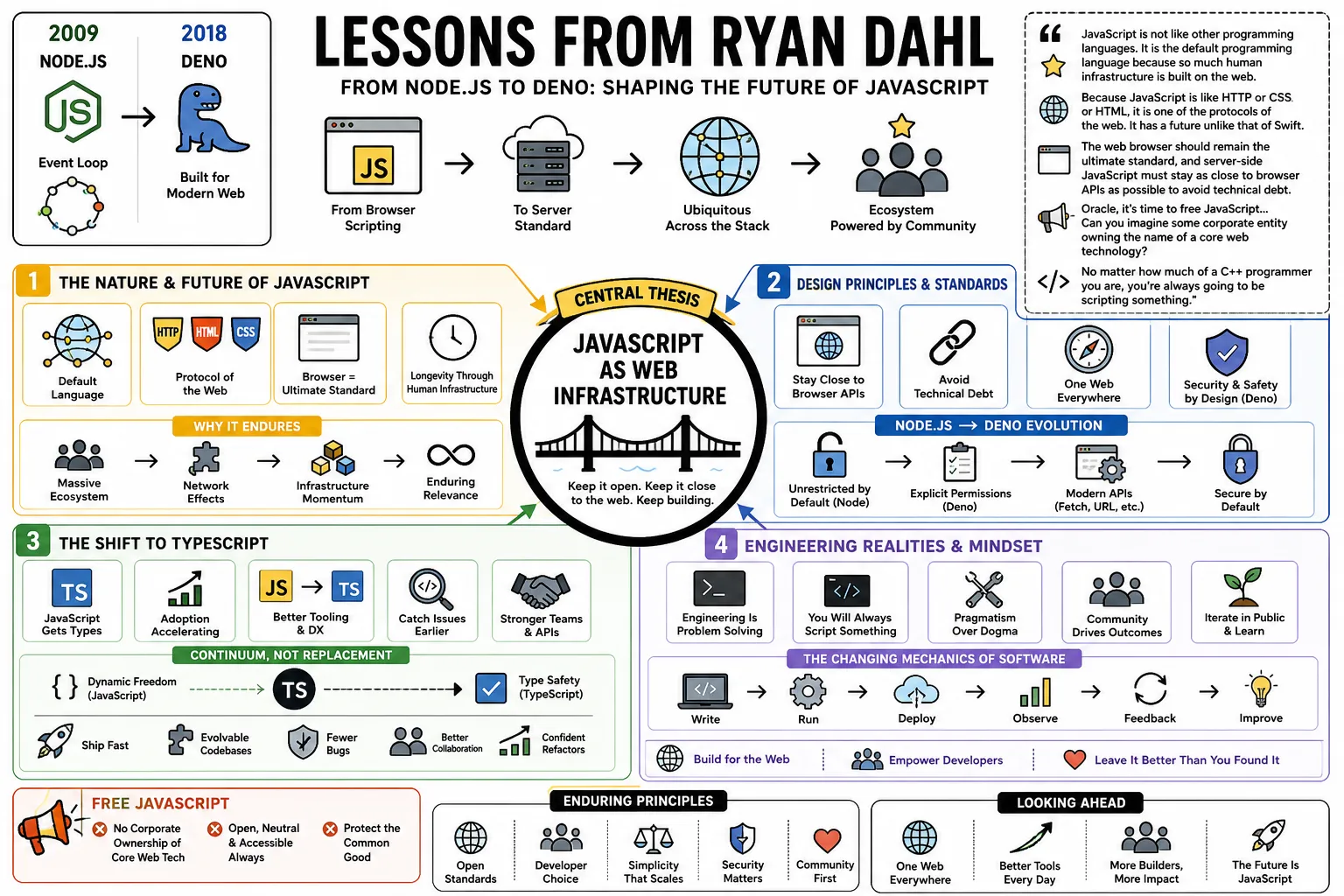
Part 1: The Nature and Future of JavaScript
- On the longevity of JavaScript: "JavaScript is not like other programming languages. It is the default programming language because so much human infrastructure is built on the web." — Source: [The Changelog #610]
- On treating JavaScript as infrastructure: "Because JavaScript is like HTTP or CSS or HTML, it is one of the protocols of the web. It has a future unlike that of Swift." — Source: [The Changelog #610]
- On browser standardization: The web browser should remain the ultimate standard, and server-side JavaScript must stay as close to browser APIs as possible to avoid technical debt. — Source: [Syntax.fm #815]
- On Oracle's trademark: "Oracle, it's time to free JavaScript... Can you imagine some corporate entity owning the name of a core web technology?" — Source: [Open Letter to Oracle]
- On the necessity of dynamic languages: "No matter how much of a C++ programmer you are, you're always going to be scripting some stuff." — Source: [HolyJS 2019 Interview]
- On universal accessibility: "JavaScript is the most successful programming language in history... it's not going anywhere." — Source: [Syntax.fm #537]
- On standardizing APIs: Developing against proprietary, non-standard runtime APIs inevitably creates legacy code that isolates projects from the broader web ecosystem. — Source: [GOTO 2024]
- On the web as the default platform: Code written for the browser has a better chance of running in twenty years than code written for any specific operating system or proprietary platform. — Source: [Syntax.fm #815]
- On the absurdity of trademarking web technologies: It makes as much sense to trademark JavaScript as it does to let Google own HTML or Microsoft own CSS. — Source: [The Changelog #610]
- On the language's lifespan: "JavaScript will be here in 5 years, if not 10, if not 20, if not forever. It is deeply embedded in humanity at this point." — Source: [The Changelog #610]
Part 2: The Node.js Legacy and Regrets
- On his design mistakes: "I have mass with Node because I see bugs that I introduced... I feel like I've made some mistakes in the design of Node that are now very difficult to fix." — Source: [JSConf EU 2018]
- On removing Promises: "I added promises to Node in June 2009 but foolishly removed them in February 2010... Promises are the necessary abstraction for async/await." — Source: [JSConf EU 2018]
- On Node's security model: "By default, the module system in Node.js allows any package to access the file system, network, and environment variables. This poses significant security risks." — Source: [JSConf EU 2018]
- On build systems: "The continued usage of GYP is probably the largest failure of Node core." — Source: [JSConf EU 2018]
- On the concept of packages: "Allowing package.json gave rise to the concept of a 'module' as a directory of files." — Source: [JSConf EU 2018]
- On dependency management: "It massively complicates the module resolution algorithm... I am sorry for this." — Source: [JSConf EU 2018]
- On implicit file extensions: "It's needlessly less explicit... If you look at how the browser works, you always provide the extension." — Source: [JSConf EU 2018]
- On index.js: "I thought it was cute because there was index.html... It needlessly complicated the module system." — Source: [JSConf EU 2018]
- On local tool permissions: "Your linter shouldn't get complete access to your computer and network." — Source: [JSConf EU 2018]
- On the reality of his creation: "Node is not going away... but it's not going to be the perfect system that it could have been." — Source: [JSConf EU 2018]
Part 3: The Origin and Design of Deno
- On Deno's true competitor: "Deno isn't intended to disrupt the Node.js community, but solve the problems of 2018 rather than 2009." — Source: [Syntax.fm #537]
- On the pace of consensus: "I'm not willing to sit in committee for 13 years trying to make [what we built into Deno by default] happen." — Source: [The Changelog #610]
- On web compatibility: "You only link to JavaScript files—like you do in the web." — Source: [JSConf EU 2018]
- On Deno's core runtime goal: "Deno is really the runtime layer... we're trying to solve the basic programming utility problems that you might run into." — Source: [Syntax.fm #537]
- On Node's success versus Deno's goals: "Node's success is my success in many ways... but I also think that it is limited in how far it can go just due to where it's starting." — Source: [Syntax.fm #815]
- On Deno 2's pragmatism: Retreating from pure URL imports to support `npm:` specifiers was a necessary concession to the gravity of the existing ecosystem. — Source: [The Changelog #610]
- On Deno as a drop-in replacement: Deno 2 aims to be a "greatest hits" version that supports the massive NPM ecosystem while maintaining Deno's core principles of security. — Source: [Syntax.fm #815]
- On built-in security: Deno requires explicit permission flags to execute network requests or read files, rejecting the implicit trust model of older runtimes. — Source: [JSConf EU 2018]
- On the necessity of starting over: Sometimes the architectural baggage of an old system is too heavy to refactor internally, requiring a clean slate to implement modern standards. — Source: [Syntax.fm #537]
Part 4: The Rise of TypeScript
- On the language itself: "TypeScript is absolutely beautiful... it allows code to grow and scale from small hacks to large infrastructure." — Source: [Syntax.fm #537]
- On TypeScript as an evolution: TypeScript functions as the natural "V2" of JavaScript, providing the safety needed for enterprise scale without losing the scriptable nature of JS. — Source: [GOTO 2024]
- On native runtime integration: Treating TypeScript as a first-class citizen removes the friction of build steps, making it feel like a dynamic language again. — Source: [DevTools.fm]
- On the TC39 proposal: Allowing type annotations as comments in raw JavaScript is a critical step to let browsers run code without transpilation steps. — Source: [GOTO 2024]
- On developer productivity: For business logic, the development speed of a dynamically typed language with static analysis layers beats the complexity of strict systems languages like Rust. — Source: [The Changelog #610]
- On stripping the build step: The ideal development environment allows you to execute `.ts` files directly, eliminating the need for Webpack or Babel configurations. — Source: [Syntax.fm #815]
- On types in the browser: The browser should eventually ignore type syntax naturally, treating it as metadata rather than an execution blocker. — Source: [GOTO 2024]
- On TypeScript's tooling ecosystem: The language server protocol (LSP) integration provided by TypeScript is the benchmark for how all modern languages should assist developers. — Source: [DevTools.fm]
- On scaling codebases: Without types, large JavaScript applications inevitably degrade into fragile systems where refactoring is feared. — Source: [Syntax.fm #537]
Part 5: The Ecosystem: Packages, JSR, and Tooling
- On returning to centralized registries: "It's unfortunate that there is a centralized (privately controlled even) repository for modules. And now Deno has spawned a registry: JSR." — Source: [The Changelog #610]
- On the purpose of JSR: JSR is not designed to kill npm; it is designed to work alongside it as a superset optimized for TypeScript and modern web standards. — Source: [The Changelog #610]
- On eliminating configuration: Runtimes should provide the linter, formatter, and test runner to eliminate the bewildering array of configuration files needed to start a project. — Source: [Syntax.fm #815]
- On the inevitable end of CommonJS: "The world will move to ESM. It's just a matter of how long it takes to get there... there's no going back." — Source: [Syntax.fm #815]
- On post-install risks: "Post-install scripts have to go... it's a recipe for disaster. There's no world in which this is going to continue to work like this." — Source: [The Changelog #610]
- On JSR transpilation: A modern registry should allow authors to publish raw TypeScript and handle the heavy lifting of generating `.d.ts` files automatically. — Source: [The Changelog #610]
- On avoiding gotchas: "I hope that doesn't happen to our community where you have to have this knowledge of gotchas in order to just get up and running." — Source: [Syntax.fm #815]
- On building runtime-agnostic tools: Tools like JSR are built to serve Node, Bun, and browser environments, recognizing that the ecosystem is now multi-runtime. — Source: [GOTO 2024]
- On standardizing formatting: Built-in formatters prevent teams from wasting hours debating code style in pull requests. — Source: [Syntax.fm #537]
Part 6: The Philosophy of Software Engineering
- On runtime choices: Node is excellent for small to medium-sized servers, but languages like Go are better suited for massive, highly concurrent server architectures. — Source: [Mapping the Journey]
- On sandboxing execution: "V8 by itself is a very good security sandbox... Had I put more thought into how that could be maintained... Node could have had some nice security guarantees." — Source: [JSConf EU 2018]
- On engineering compromises: Engineering often requires making pragmatic concessions, like supporting `node_modules` in Deno, rather than dying on the hill of technical purity. — Source: [The Changelog #610]
- On building tooling in Rust: Writing the underlying infrastructure in systems languages like Rust guarantees the performance required to make dynamic runtimes feel fast to the end user. — Source: [Syntax.fm #537]
- On the developer experience: A developer should be able to open a terminal, create a file, and run it with full capabilities without writing a single configuration file. — Source: [Syntax.fm #815]
- On taking responsibility: A tool creator must be willing to stand on a stage and apologize for the downstream pain caused by early architectural mistakes. — Source: [JSConf EU 2018]
- On simplicity: Complexity in a system usually arises from attempting to guess the user's intent, as seen in complex module resolution algorithms. — Source: [JSConf EU 2018]
- On explicit instructions: Requiring an explicit file extension for imports removes ambiguity and speeds up the module loader dramatically. — Source: [JSConf EU 2018]
- On open source sustainability: Most open-source projects fail, but the value is in the execution and the utility it provides while it exists. — Source: [HolyJS 2019 Interview]
Part 7: AI and the "Post-Coding" Era
- On the shift in the profession: "This has been said a thousand times before, but allow me to add my own voice: the era of humans writing code is over." — Source: [January 2026 Public Statement]
- On developer identity: "Disturbing for those of us who identify as SWEs, but no less true." — Source: [January 2026 Public Statement]
- On the nature of syntax: "That's not to say SWEs don't have work to do, but writing syntax directly is not it." — Source: [January 2026 Public Statement]
- On shifting focus: Engineers will need to shift their focus from the mechanical act of typing syntax to high-level architectural design and system verification. — Source: [January 2026 Public Statement]
- On interacting with systems: The role of the developer is evolving into prompting and guiding AI to generate the underlying implementation details. — Source: [GOTO 2024]
- On the necessity of fundamentals: Despite the rise of AI generation, understanding the fundamental protocols of the web remains critical to debugging the output. — Source: [GOTO 2024]
- On letting go of the typing: Developers must stop conflating their value with their ability to memorize standard library syntax. — Source: [January 2026 Public Statement]
- On the velocity of building: AI tools will allow individuals to build at a scale previously requiring entire teams of syntax-writers. — Source: [GOTO 2024]
- On letting machines write code: Machines are fundamentally better suited to output boilerplate and boilerplate-adjacent syntax than humans are. — Source: [January 2026 Public Statement]
- On accepting reality: Fighting the integration of AI tools into the developer workflow is equivalent to fighting the integration of high-level languages over assembly. — Source: [January 2026 Public Statement]
Part 8: Personal Journey and Learning
- On abandoning his PhD: "Three years into [a PhD in algebraic topology] I thought to myself: 'What am I doing with my life? This is too weird and abstract.'" — Source: [HolyJS 2019 Interview]
- On discovering his career: "I promptly dropped out of that program, ended up travelling around for a while and fell into programming, like many people do." — Source: [HolyJS 2019 Interview]
- On programming as a basic literacy: "It seems like basic programming skills right now or in the near future will be as necessary as math or English or something else everyone studies in the school." — Source: [HolyJS 2019 Interview]
- On his single learning technique: "I have only one learning technique: projects that I'm working on." — Source: [HolyJS 2019 Interview]
- On practical knowledge: "It's very difficult to learn something in detail if you're not actually working with it. I can't tell somebody about Rust and then they would know Rust. You have to actually use it yourself." — Source: [HolyJS 2019 Interview]
- On the uncertainty of projects: "Whether [Deno] is going to survive for five years I have no idea. Probably not, because most things fail." — Source: [HolyJS 2019 Interview]
- On motivation: "But it excites me and I enjoy working on it." — Source: [HolyJS 2019 Interview]
- On avoiding boxes: "I don't wanna be a Javascript person, and I don't wanna be a machine learning person. You know, I think people… it's interesting to just explore what's possible." — Source: [January 2026 Public Statement]
- On the long tail of success: Real success in open source software means you spend the rest of your career maintaining the decisions you made in a hurry a decade ago. — Source: [JSConf EU 2018]