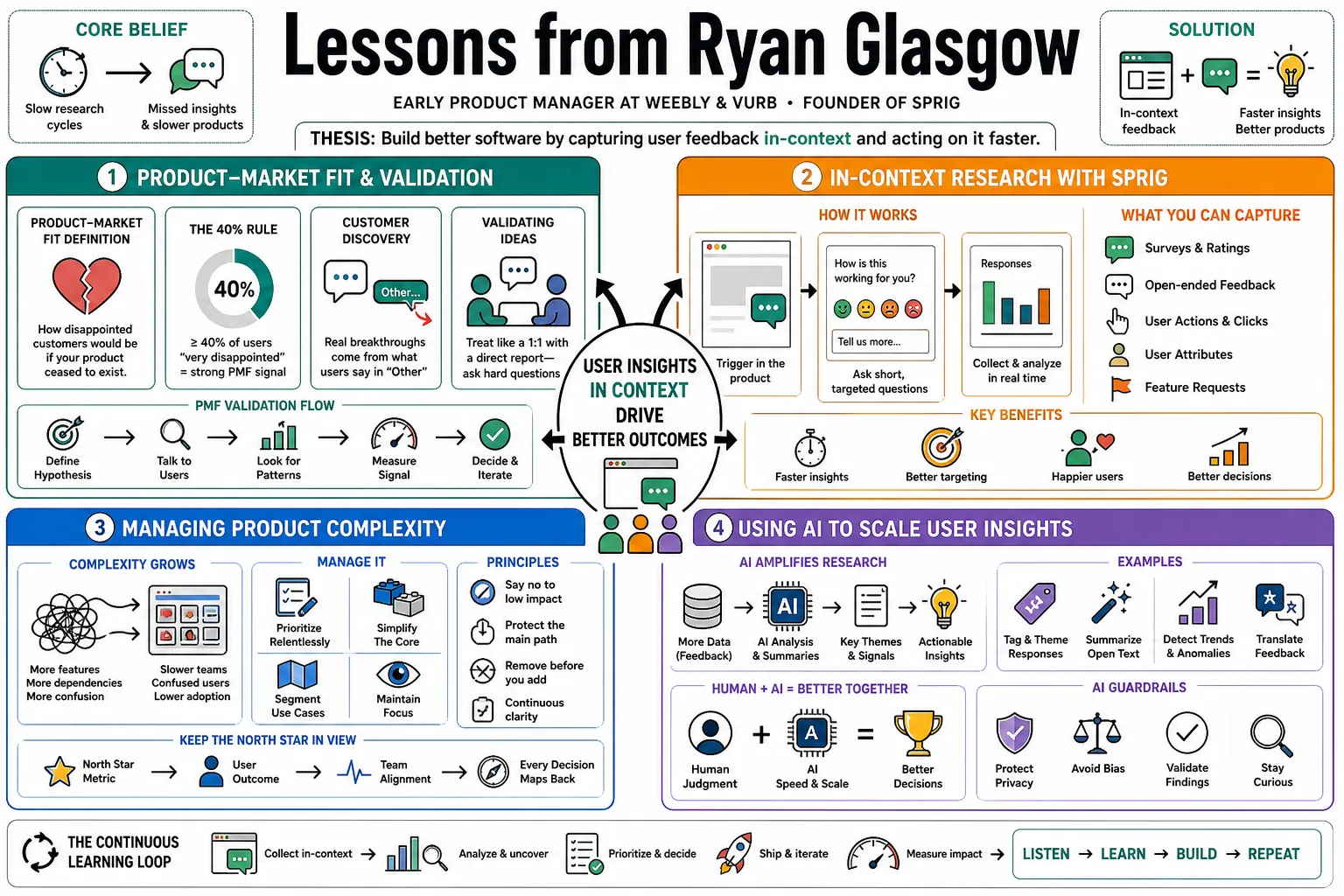
Lessons from Ryan Glasgow
As an early product manager at Weebly and Vurb, Ryan Glasgow saw that slow research cycles were the main bottleneck to building good software. He founded the insights platform Sprig to fix this by capturing user feedback directly inside the product experience. This collection covers his frameworks for in-context research, managing product complexity, and using AI to scale user insights.
Part 1: Product-Market Fit & Validation
- On Product-Market Fit Definition: Glasgow treats product-market fit as something to measure with user consequence, not founder conviction: would the target users meaningfully miss the product if it disappeared? — Reference: First Round Review on Glasgow validating PMF with Sprig surveys
- On The 40% Rule: Glasgow uses the product-market-fit survey as an evidence check: the point is to quantify how many users would be very disappointed without the product, then use that signal to decide whether fit is real. — Reference: First Round Review on Glasgow running a PMF survey in Sprig
- On Customer Discovery: "You cannot read your customers' minds; real breakthroughs come from simply listening to what users say when given an 'Other' option in surveys." — Source: Sprig Blog
- On Validating Ideas: "Treat customer development exactly like a one-on-one with a direct report—your main goal is to ask the hard questions directly." — Source: First Round Review
- On Feature-Market Fit: Glasgow separates broad product love from feature-level evidence: teams need feedback at the moment a user completes, abandons, or struggles with a specific flow. — Reference: Awkward Silences transcript on in-product research at product moments
- On Behavioral Data Limits: Glasgow built Sprig around the gap left by analytics: behavioral dashboards show what happened, but product teams still need user sentiment to understand why it happened. — Reference: Unusual Ventures transcript on behavioral data and missing why questions
- On Proactive Feedback: Glasgow argues that product teams should not accept post-launch radio silence; they need targeted feedback loops after meaningful user moments. — Reference: Awkward Silences transcript on post-launch feedback loops
- On Early Stage Focus: "The success and failure of early-stage companies completely centers around deeply understanding the customer problem." — Source: Kitcaster
- On Asking the Right Questions: "You have to be willing to ask the questions that might invalidate your entire premise." — Source: First Round Review
Part 2: In-Context Research
- On Legacy Tools: "Traditional, quarterly, long-form surveys are too slow and disconnected from the modern product development life cycle." — Source: Dovetail
- On Microsurveys: "Shift toward in-context microsurveys that capture user sentiment exactly when and where they experience the product." — Source: Aurelius Lab
- On Real-Time Insights: "Teams need to collect in-the-moment user insights to inform product decisions, rather than relying on delayed retrospectives." — Source: Sprig Blog
- On Closing the Loop: "Effective research should be fully integrated into the entire product development lifecycle, not treated as an isolated, disconnected event." — Source: Dovetail
- On The Speed of Research: "The speed of modern product development requires research methods that can keep pace without sacrificing quality." — Source: Dovetail
- On Contextual Feedback: "Asking users about their experience three days later via email yields entirely different and less accurate data than asking them in the moment." — Source: Aurelius Lab
- On Event-Driven Architecture: "Use event-driven architecture to trigger research studies based on highly specific user behaviors." — Source: Medium
- On Natural Language Processing: "Using machine learning to group and process natural language responses serves as a massive differentiator over manual survey analysis." — Source: Rimzy
- On Proactive Discovery: Glasgow favors asking while the experience is still fresh: check in after completion, abandonment, or friction instead of waiting for users to complain later. — Reference: Awkward Silences transcript on contextual in-product research
- On Bridging the Gap: Glasgow sees in-product research as a bridge between builders and users: it connects shipped product experiences to the sentiment of the people using them. — Reference: Awkward Silences transcript on bridging builders and users
Part 3: AI as the Eager Intern
- On AI in Research: "Treat AI not as a replacement for researchers, but as an eager, fast intern capable of handling heavy workloads." — Source: User Research Strategist
- On Task Delegation: "By delegating repetitive job steps to AI, researchers can focus their energy entirely on high-impact work." — Source: User Research Strategist
- On AI Capabilities: "AI is highly effective at synthesis, survey creation, and study planning, but it requires strict human oversight." — Source: User Research Strategist
- On Human Oversight: "Even the best AI requires clear direction, review, and a human to ultimately make sense of the nuance." — Source: User Research Strategist
- On Embracing AI: Glasgow frames AI adoption in research as a shift from anxiety to experimentation, especially in synthesis, survey creation, and study planning. — Reference: User Research Strategist episode summary on researchers experimenting with AI
- On Data Synthesis: Glasgow sees AI as a way to turn raw research data, transcripts, open ends, and survey results into queryable insight that stakeholders can explore. — Reference: User Research Strategist episode summary on AI synthesis and raw data sharing
- On AI-Native Workflows: "The future of product research involves fully AI-native workflows that accelerate the path from question to insight." — Source: User Research Strategist
- On Speed vs. Strategy: Glasgow treats AI as a way to move tactical research work faster so humans can spend more time on judgment, interpretation, and higher-impact decisions. — Reference: User Research Strategist episode summary on delegating work to AI
- On Lowering Barriers: "AI helps lower the barrier to entry, allowing product managers, designers, and engineers to conduct high-quality research alongside dedicated researchers." — Source: Aakash Gupta
Part 4: Managing Product Complexity
- On Complexity Debt: "Allowing entropy to be your product manager means taking on technical and complexity debt; you must fight this instinct." — Source: First Round Review
- On Feature Lifespans: "The initial work of implementing a feature is often a tiny fraction of the work required to support that feature over its lifetime." — Source: First Round Review
- On Adding Features: "Your teams should use judgment to decide what should continue to exist, rather than blindly adding everything that used to exist." — Source: First Round Review
- On Marginal Costs: "What takes two weeks to build right now adds a permanent marginal cost to every future engineering project." — Source: First Round Review
- On Product Pruning: "Actively removing features that no longer serve the core user need is as important as building new ones." — Source: First Round Review
- On Building the Wrong Thing: "Building the wrong product efficiently is still a failure; you must validate before you scale." — Source: First Round Review
- On The PM's Dilemma: "The CEO of the product analogy highlights how difficult it is to find good PMs because they must balance so many conflicting forces." — Source: First Round Review
- On Prioritization: "Ruthless prioritization means saying no to good ideas so you can focus entirely on the vital ones." — Source: First Round Review
- On Technical Debt: "Every feature you ship without validating its long-term value is just technical debt waiting to slow you down." — Source: First Round Review
Part 5: Empathy and the Customer Connection
- On User Motivation: Glasgow pushes teams to pair analytics with motivation: knowing that a user dropped off matters less if you do not understand why they did. — Reference: Unusual Ventures transcript on why questions behind user behavior
- On True Customer Understanding: "The success and failure of companies completely centers around deeply understanding the customer." — Source: Kitcaster
- On Listening: "Listening to your customers is not a passive activity; it requires proactive, structured inquiry." — Source: Sprig Blog
- On Unexpected Insights: "Some of our biggest product breakthroughs came from users typing unexpected answers into an open text box." — Source: Sprig Blog
- On Building for Real Needs: Glasgow starts with underserved outcomes: talk to the market, find important needs that existing tools fail to satisfy, and build from that evidence. — Reference: First Round Review on outcome-driven innovation and underserved needs
- On The Why Behind Data: Glasgow treats the why question as the second-order need created by better analytics: once teams know what users did, they need feedback to explain the behavior. — Reference: Unusual Ventures transcript on analytics creating why questions
- On Empathy as a Strategy: "Empathy is not just a design principle; it is a fundamental business strategy for retention." — Source: Churn FM
- On User Frustration: "A frustrated user is often your best source of truth if you ask them the right question at the exact moment of friction." — Source: Aurelius Lab
- On Churn Prevention: "Understanding the early onboarding experience is the most critical lever you have to prevent long-term churn." — Source: Churn FM
- On Continuous Dialogue: Glasgow wants research to become a recurring product habit: teams should be able to ask short, timely questions whenever user behavior creates a learning opportunity. — Reference: Awkward Silences transcript on fast in-product research experiments
Part 6: Evolving the UX Researcher Role
- On Strategic Influence: Glasgow expects researchers to gain leverage by automating lower-level steps and spending more energy on interpretation, influence, and product decisions. — Reference: User Research Strategist episode summary on higher-impact research work
- On Tactical Automation: "As tactical data collection and basic synthesis are automated, the researcher's role becomes fundamentally more analytical." — Source: Fuzzy Math
- On Democratizing Research: "Democratization does not eliminate the researcher; it frees them to focus on the hardest, most ambiguous problems." — Source: Aakash Gupta
- On The Future Researcher: "The modern UX researcher must be as comfortable with AI prompt engineering as they are with traditional interview moderation." — Source: User Research Strategist
- On Scaling Insights: Glasgow breaks the problem into two scale challenges: collecting contextual feedback from many users and analyzing that qualitative data quickly enough to guide product teams. — Reference: Unusual Ventures transcript on scalable data collection and analysis
- On Evidence-Based Decisions: Glasgow wants product decisions grounded in accessible user evidence, not decks that trap insight away from the people making the product calls. — Reference: First Round Review on making qualitative data accessible to PMs
- On Workflow Decomposition: "Break your research workflow into specific job steps and identify exactly where AI can accelerate those discrete tasks." — Source: User Research Strategist
- On Speed to Insight: "The value of research is heavily dependent on the speed at which it can be delivered to the product team." — Source: Fuzzy Math
- On Moving Beyond Surveys: Glasgow is not against surveys; he is against slow, detached surveys. His point is to move research into the product moments where the answer is still contextual. — Reference: Aurelius transcript on contextual surveys versus detached long-form surveys
Part 7: Scaling and Building Products
- On Early Startup Survival: "In the earliest days, your only job is to figure out if you are solving a real problem for a specific group of people." — Source: Webflow
- On The PM Role in Startups: Glasgow shows the early PM role as turning uncertainty into process: segment the market, talk to customers, iterate the MVP, and keep testing the path to fit. — Reference: First Round Review on Glasgow as a PM-turned-founder
- On Scaling Teams: "Scaling a product team from 40 to 400 people requires entirely different communication structures and feedback loops." — Source: The Org
- On Product Velocity: "Slow, fragmented research workflows are often the primary bottleneck to increasing your product velocity." — Source: User Research Strategist
- On Cross-Functional Alignment: Glasgow designs research tooling so PMs, researchers, and designers can all participate without waiting on engineering for every learning loop. — Reference: Awkward Silences transcript on non-technical in-product research setup
- On The Path to Acquisition: "Building a company for acquisition means proving undeniable, scalable value to your core user base over an extended period." — Source: Horizen Capital
- On Finding the Core Value: "At Vurb, the breakthrough came when we realized users valued content curation over the search functionality we initially focused on." — Source: Sprig Blog
- On Launching Sprig: "I founded Sprig specifically because I experienced firsthand the intense difficulty of gathering quick, actionable qualitative feedback at scale." — Source: Webflow
- On Building for Growth: Glasgow built Sprig for high-growth teams that need feedback infrastructure: in-product surveys, session replay, and AI-native analysis that scale with product usage. — Reference: Unusual Ventures transcript on Sprig as AI-powered product feedback infrastructure
- On Continuous Iteration: "The product is never actually finished; it is a continuous cycle of asking, building, measuring, and asking again." — Source: Product School
Part 8: Company Culture and Founding Principles
- On Diversity and Inclusion: "Having a diverse team ensures our employees feel comfortable and valued so that they can bring their whole selves to work." — Source: Rimzy
- On Pricing Models: "We use a usage-based pricing model rather than seat-based because our primary goal is simply to get you to use our product." — Source: Rimzy
- On Company Mission: "Our mission centers on the belief that better user understanding fundamentally leads to better products and better businesses." — Source: Product School
- On Founder Mindset: "Founders must maintain a tight grip on the user problem while remaining entirely flexible on the specific solution." — Source: First Round Review
- On Rebranding: "A rebrand is not just a name change; it reflects an expansion into a much broader vision of product experience insights." — Source: Kitcaster
- On Team Empowerment: "You hire smart people not to tell them what to do, but to give them the data they need to make the right decisions." — Source: First Round Review
- On Embracing Change: Glasgow treats research culture as something that must adapt: static reports give way to living data, AI-supported workflows, and faster insight sharing. — Reference: User Research Strategist episode summary on AI-supported research workflows
- On Customer-Centric Culture: "A customer-centric culture is not built through mission statements, but through the daily habit of looking at actual user feedback." — Source: Product School
- On Long-Term Vision: "We are building an infrastructure that assumes product research will eventually be continuous, automated, and embedded in every app." — Source: User Research Strategist