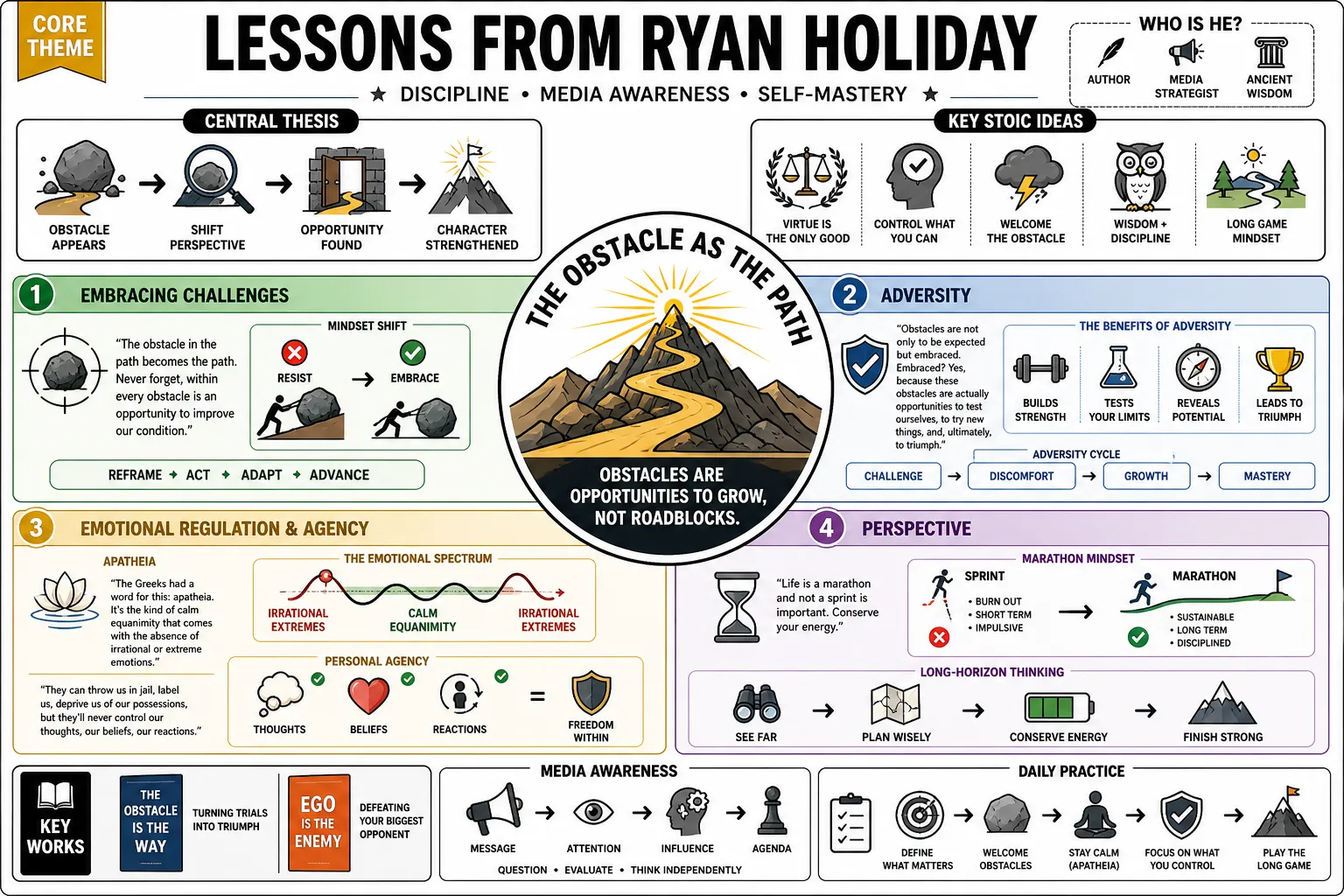
Lessons from Ryan Holiday
Ryan Holiday is an author and media strategist who built a career writing about ancient philosophy and public relations. He brought Stoicism to a mainstream audience with books like The Obstacle Is the Way and Ego Is the Enemy. This profile collects his writing on discipline, media manipulation, and self-mastery into a practical guide.
Part 1: The Obstacle as the Path
- On Embracing Challenges: "The obstacle in the path becomes the path. Never forget, within every obstacle is an opportunity to improve our condition." — Source: [Goodreads]
- On Adversity: "Obstacles are not only to be expected but embraced. Embraced? Yes, because these obstacles are actually opportunities to test ourselves, to try new things, and, ultimately, to triumph." — Source: [Medium]
- On Emotional Regulation: "The Greeks had a word for this: apatheia. It's the kind of calm equanimity that comes with the absence of irrational or extreme emotions." — Source: [SuperSummary]
- On Personal Agency: "They can throw us in jail, label us, deprive us of our possessions, but they'll never control our thoughts, our beliefs, our reactions." — Source: [Goodreads]
- On Perspective: "Life is a marathon and not a sprint is important. Conserve your energy. Understand that each battle is only one of many." — Source: [Goodreads]
- On Panic: "Don't let the negativity in, don't let those emotions even get started. Just say, No, thank you. I can't afford to panic." — Source: [SuperSummary]
- On Stress: "Regardless of how much actual danger we're in, stress puts us at the potential whim of our baser—fearful—instinctual reactions." — Source: [SuperSummary]
- On Objective Judgment: "We must view our problems objectively, stripping away the emotional baggage that makes an obstacle seem larger than it is." — Source: [RyanHoliday.net]
- On Willpower: "True willpower is the cultivation of an inner citadel that cannot be breached by external circumstances, allowing us to endure what we cannot control." — Source: [RyanHoliday.net]
- On Taking Action: "Action requires courage and creativity, turning the negative circumstances into an active step forward rather than remaining paralyzed." — Source: [RyanHoliday.net]
Part 2: Taming the Ego
- On the Nature of Ego: "Ego is the enemy of what you want and what you have: Of mastering a craft. Of real creative insight. Of working well with others." — Source: [Goodreads]
- On the Hidden Path to Success: "History is made by individuals who fought their egos at every turn, who eschewed the spotlight, and who put their higher goals above their desire for recognition." — Source: [SuperSummary]
- On the Danger of Talk: "Talk depletes us. Talking and doing fight for the same resources." — Source: [SuperSummary]
- On Ego's Impact: "Ego is its own worst enemy. It hurts the ones we love too. Our families and friends suffer for it." — Source: [Medium]
- On Sweeping the Floor: "Ego is like a floor that needs to be swept continually; practicing humility once does not mean the ego will stay away forever." — Source: [Elk101]
- On Entitlement: "Ego tells us that we deserve rewards before we have put in the necessary work, setting us up for resentment and failure." — Source: [RyanHoliday.net]
- On Being a Student: "To keep ego at bay, you must always remain a student, willing to learn from others and acknowledge what you do not know." — Source: [RyanHoliday.net]
- On Passion vs. Purpose: "Passion is often driven by ego and emotion; purpose is driven by reason, direction, and a desire to serve something larger than oneself." — Source: [RyanHoliday.net]
- On Failure: "When we fail, ego demands excuses, while true humility demands taking responsibility and learning from the setback." — Source: [RyanHoliday.net]
Part 3: The Power of Stillness
- On Inspiration: "Stillness is what aims the archer's arrow. It inspires new ideas. It sharpens perspective and illuminates connections." — Source: [Goodreads]
- On Progress: "History proves that it is from stillness that new insights and ideas spawn. It is with stillness that perspective sharpens." — Source: [Daily Stoic]
- On Real Needs: "What do we want more of in life? That's the question. It's not accomplishments. It's not popularity. It's moments when we feel like we are enough." — Source: [Big Ben Comedy]
- On Not Defeating Yourself: "Whatever you face, whatever you're doing will require first and foremost, that you don't defeat yourself." — Source: [Goodreads]
- On Being Present: "Stillness is the key to, well, just about everything. Don't dwell or needlessly complicate. Be here. Be all of you." — Source: [Wisdom Quotes]
- On the Illusion of Arrival: "If you believe there is ever some point where you will feel like you've 'made it,' when you'll finally be good, you are in for an unpleasant surprise." — Source: [Big Ben Comedy]
- On Information Diet: "Protecting your peace means carefully curating what information you consume and ignoring the trivial distractions of the modern world." — Source: [Daily Stoic]
- On Leisure: "True leisure is not mindless entertainment, but rather engaging in activities that restore the soul and foster deep thought." — Source: [Daily Stoic]
- On Solitude: "Solitude is necessary for reflection; without periods of physical and mental quiet, we cannot hear our own inner voice." — Source: [Daily Stoic]
- On Letting Go: "Much of stillness comes from letting go of the need to control every outcome, rather than actively trying to force calm." — Source: [Daily Stoic]
Part 4: Courage and Action
- On the Nature of Courage: "The greatest moments in human history all share one thing... The bravery of men and women. People who did what needed to be done." — Source: [Your Aha Life]
- On Self-Reflection: "Waste not a second questioning another man's courage. Put that scrutiny solely on your own." — Source: [Goodreads]
- On Leadership and Impact: "One man with courage makes a majority." — Source: [Goodreads]
- On Fear Versus Being Scared: "We cannot always help feeling scared, which is a physical and emotional response, but we must choose to act in spite of that fear." — Source: [24 Letters]
- On First Steps: "Courage is the willingness to take the first step into the unknown despite feeling terrified." — Source: [RyanHoliday.net]
- On Moral Courage: "Often, the hardest bravery is not facing physical danger, but possessing the moral courage to speak the truth when it is unpopular." — Source: [RyanHoliday.net]
- On Preparation: "Courage is cultivated in the quiet moments of preparation; we train ourselves to be brave by taking small risks daily." — Source: [RyanHoliday.net]
- On Defying the Crowd: "True bravery often looks like standing alone and refusing to compromise your values simply to fit in with the crowd." — Source: [RyanHoliday.net]
- On Taking Responsibility: "The courageous individual does not wait for a savior but asks who will solve the problem if they do not step up." — Source: [RyanHoliday.net]
Part 5: Discipline and Self-Mastery
- On the Win: "Discipline is the win. When you are disciplined about your craft…you win. When you know you put your best into something…you win." — Source: [RyanHoliday.net]
- On Self-Restraint: "Technology, access, success, power, privilege—this is only a blessing when accompanied by the second of the cardinal virtues: self-restraint." — Source: [Bookroo]
- On the Importance of Focus: "In a world of distraction, focusing is a superpower." — Source: [Goodreads]
- On Desire and Freedom: "The less you desire, the richer you are, the freer you are, the more powerful you are." — Source: [Goodreads]
- On Procrastination: "To procrastinate is to be entitled." — Source: [Goodreads]
- On the Standards We Hold: "Who we are, the standards we hold ourselves to, the things we do regularly... are all better predictors of the trajectory of our lives than things like talent or resources." — Source: [RyanHoliday.net]
- On the Morning: "Waking up early and utilizing morning hours for productivity sets the tone for a disciplined life." — Source: [RyanHoliday.net]
- On Responsibility: "Discipline is taking responsibility for one's actions rather than making excuses, focusing entirely on what you control." — Source: [Reddit]
- On Endurance: "True self-mastery is the quiet endurance to keep showing up day after day, rather than relying on brief sprints of intense effort." — Source: [RyanHoliday.net]
- On Boundaries: "Without strict boundaries on our time and attention, our potential is diluted by the endless demands of others." — Source: [RyanHoliday.net]
Part 6: Justice and Character
- On Our Duty to Others: "Our job is to fight to make sure the vulnerable are protected and can live without fear. Because they are us and we are them." — Source: [Goodreads]
- On Integrity: "We keep our word to ourselves—that's discipline. We keep our word to others because it's justice." — Source: [Book Ponder]
- On Character: "Care about others. Treat them as you would wish to be treated. Not just when it's convenient or recognized, but especially when it isn't." — Source: [Book Ponder]
- On Practicing Justice: "Justice is not a thing that happens, it's something that is made, that is continuing to be made, even as you read this." — Source: [Bobby Powers]
- On the Nature of Virtue: "Virtue is something we do. It's something we choose... It's a daily challenge, one we face not once but constantly, repeatedly." — Source: [Bobby Powers]
- On Justice as a Verb: "Justice is a habit that must be exercised daily through our actions, rather than merely a theoretical concept or a legal matter." — Source: [Four Minute Books]
- On Doing Good Anonymously: "The highest moral standard is acting with integrity when there is no recognition, reward, or witness to your deeds." — Source: [Book Ponder]
- On Civic Responsibility: "We are part of a larger community, and true justice requires us to actively participate in making society fairer for all." — Source: [Four Minute Books]
- On Empathy: "Understanding the struggles of others is the first step toward acting justly; empathy is the engine of equitable treatment." — Source: [Four Minute Books]
Part 7: Media and Marketing
- On Reading Intentionally: "When intelligent people read, they ask themselves a simple question: What do I plan to do with this information?" — Source: [Goodreads]
- On Publisher Incentives: "Every decision a publisher makes is ruled by one dictum: traffic by any means." — Source: [Big Ben Comedy]
- On Virality: "The most powerful predictor of what spreads online is anger." — Source: [Big Ben Comedy]
- On False Information: "Not only is the web susceptible to spreading false information, but it can also be the source of it." — Source: [Big Ben Comedy]
- On the Economics of Blogs: "Each blog is its own mini-Ponzi scheme, for which traffic growth is more important than solid financials." — Source: [Big Ben Comedy]
- On Emotional Contagion: "Regardless of the topic, the more an article makes someone feel good or bad, the more likely it is to make the Most E-Mailed list." — Source: [Big Ben Comedy]
- On Legacy Media: "Established media doesn't have this problem... their main concern for their business model is to protect their reputations." — Source: [Big Ben Comedy]
- On Making Great Work: "Promotion is not how things are made great—only how they're heard about." — Source: [Big Ben Comedy]
- On Longevity: "You can't make something that lasts if it's based on things... that themselves won't last, or if it's driven by an amateur's impatience." — Source: [Big Ben Comedy]
Part 8: Stoic Philosophy in Practice
- On Action over Argument: "Waste no more time arguing what a good man should be. Be one." — Source: [YourStory]
- On Internal Control: "You have power over your mind – not outside events. Realize this, and you will find strength." — Source: [YourStory]
- On the Primary Practice: "The single most important practice in Stoic philosophy is differentiating between what we can change and what we can't." — Source: [Book Fave]
- On Fear of Death: "It is not death that a man should fear, but he should fear never beginning to live." — Source: [YourStory]
- On Reactive Emotions: "Getting upset is like continuing the dream while you're awake. The thing that provoked you wasn't real—but your reaction was." — Source: [Shortform]
- On Saying No: "It may take some hard work. But, the more you say no to the things that don't matter, the more you can say yes to the things that do." — Source: [Shortform]
- On Amor Fati: "We cannot choose what happens to us, but we can decide how to respond; loving our fate turns adversity into fuel." — Source: [RyanHoliday.net]
- On Perception: "There is no good or bad without us, there is only perception. There is the event itself and the story we tell ourselves about what it means." — Source: [Goodreads]
- On the Wisdom Loop: "Philosophy requires the active loop of learning, applying, reflecting, and repeating daily, rather than merely reading about ideas." — Source: [Farnam Street]