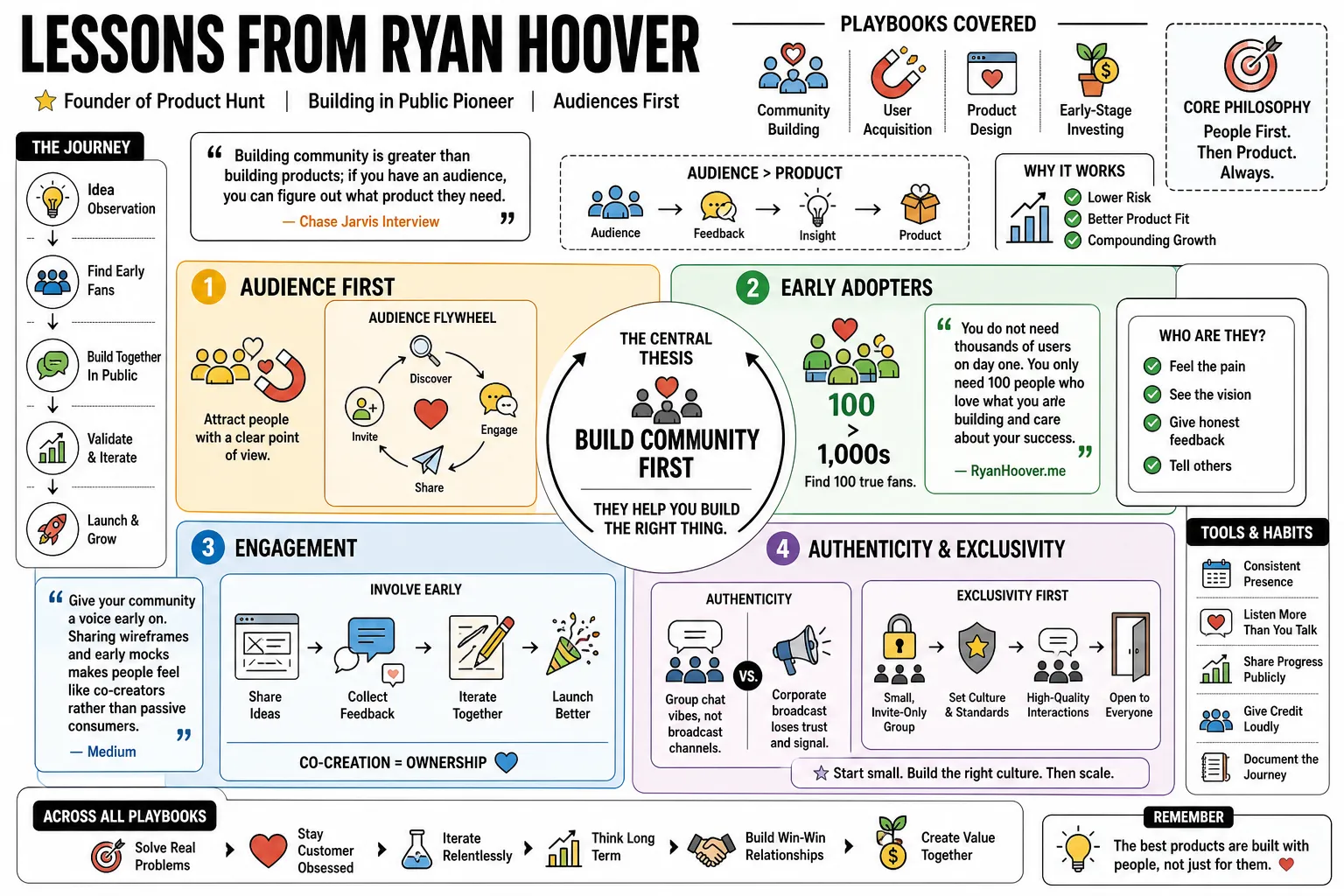
Lessons from Ryan Hoover
Ryan Hoover founded Product Hunt, the internet's primary platform for discovering new software. He popularized building in public and showed founders how to validate ideas with an early audience before writing code. This profile details his playbooks for user acquisition, product design, and early-stage investing.
Part 1: Community Building
- On Audience First: "Building community is greater than building products; if you have an audience, you can figure out what product they need." — Source: Chase Jarvis Interview
- On Early Adopters: "You do not need thousands of users on day one. You only need 100 people who love what you are building and care about your success." — Source: RyanHoover.me
- On Engagement: "Give your community a voice early on. Sharing wireframes and early mocks makes people feel like co-creators rather than passive consumers." — Source: Medium
- On Authenticity: "The best communities feel like a group chat among friends, never a broadcast channel for a corporate brand." — Source: Lenny's Podcast
- On Exclusivity: "Starting with a small, invite-only group sets the culture and ensures high-quality interactions before opening the floodgates." — Source: First Round Review
- On Feedback Loops: "Listen to what your community complains about. Their frustrations form the exact roadmap for your next feature." — Source: Y Combinator Startup School
- On Moderation: "Good community curation is invisible, but the absence of it destroys trust immediately." — Source: Product Hunt Blog
- On Empowering Users: "Highlight the makers and the people contributing the most. When you elevate your best users, they become your strongest evangelists." — Source: Intercom Blog
- On Scaling Culture: "The culture of your platform is dictated by the first 1,000 users. Guard that initial cohort fiercely." — Source: Indie Hackers
- On Retention: "People come for the utility of the product but stay for the relationships they build within the community." — Source: Mercury Founder Stories
Part 2: Product Development & Validation
- On Scratching an Itch: "The best side projects start because you are naturally curious and trying to solve a problem for yourself." — Source: RyanHoover.me
- On The Blog-First Approach: "Before writing a line of code, write a blog post. If you cannot get people to read about the idea, you will not get them to use the app." — Source: Medium
- On Minimum Viable Products: "Product Hunt started as a simple email list via Linkydink. It took 20 minutes to set up and immediately proved people wanted the curation." — Source: Fast Company
- On Fake Progress: "Do not fall into the trap of obsessing over pixel-perfect design when you have not even validated if anyone wants the core feature." — Source: Glasp Quotes
- On Speed: "Speed is a startup's most valuable asset. The faster you ship, the faster you learn what actually matters." — Source: Weekend Fund Blog
- On Simplicity: Hoover warns against design work that does not build on real behavior: in Recode's Vox transcript, he says Product Hunt wasted time on feed redesigns that did not change metrics, and that working products should be expanded from observed behavior. — Reference: Vox/Recode transcript on Product Hunt redesigns, metrics, and building from observed behavior
- On Habit Formation: "Products that win embed themselves into a user's daily routine. You have to understand the specific trigger that brings them back." — Source: Hooked by Nir Eyal
- On Over-engineering: "Founders often build features for imaginary users. Wait until your actual users beg for a feature before you build it." — Source: Y Combinator Podcast
- On Launching: "A launch is never a single day; it is a continuous process of re-engaging the market with new updates and improvements." — Source: Product Hunt Launch Guide
Part 3: Growth & Doing Things That Don't Scale
- On Initial Traction: "We got our first 2,000 users by doing things that do not scale, like personally emailing founders and inviting them to join the conversation." — Source: RyanHoover.me
- On Cold Outreach: "A thoughtful, personalized email to a targeted individual will always outperform a generic blast to thousands." — Source: First Round Review
- On Word of Mouth: "Design your product so that the natural use of it involves inviting others or sharing it publicly." — Source: Medium
- On Early Metrics: "When applying to accelerators, month-over-month growth is the ultimate proof that you are building something people actually want." — Source: Y Combinator
- On Using Existing Networks: "Go where your users already hang out. We shared Product Hunt early on Twitter because that is where the tech community was active." — Source: Indie Hackers
- On Momentum: "Celebrate small milestones publicly. It creates a perception of momentum, and people want to attach themselves to a winning trajectory." — Source: Lenny's Podcast
- On the First 100 Users: "Hand-pick your first users. Their feedback is disproportionately valuable, and their behavior sets the tone for everyone who follows." — Source: Chase Jarvis Interview
- On Re-engagement: "Spend equal energy figuring out why your churned users left and manually bringing them back, rather than focusing purely on acquiring new users." — Source: Intercom Blog
- On Virality: "True virality is never a growth hack; it happens when sharing the product inherently makes the product experience better for the user." — Source: Hooked by Nir Eyal
- On Content as Marketing: "Writing about your process and your industry attracts a highly targeted audience that is primed to become your user base." — Source: Medium
Part 4: Early-Stage Investing & Earned Secrets
- On Sourcing: "The edge in venture capital is shifting. Sourcing and picking matter less; winning the deal by being the investor founders actually want to work with is everything." — Source: RyanHoover.me
- On Earned Secrets: "The best founders have earned secrets, which are deep, non-obvious insights into a market gained through firsthand experience that others simply do not see." — Source: Weekend Fund Blog
- On Consensus: "By definition, if you are doing venture capital right, you are continuously investing in things that are non-consensus at the time of investment." — Source: Glasp Quotes
- On Loss Aversion: "Do not let the fear of a startup failing prevent you from making the bet. You have to take small flyers on innovative things because the outliers drive all the returns." — Source: Ryan Hoover Substack
- On Value Add: "An investor's job extends beyond writing a check. You are there to help founders recruit, navigate crises, and connect with customers." — Source: Mercury Founder Stories
- On LP Updates: "Consistent, transparent updates to LPs act as a tool to utilize a network of experienced operators to help your portfolio." — Source: Weekend Fund Blog
- On Raising a Fund: "Do not start a venture fund for egotistical reasons. Explore scouting or angel investing first before committing to the institutional path." — Source: AngelList Blog
- On Founder Empathy: "Having built a company makes you a better investor because you understand the emotional toll and chaotic reality of the early days." — Source: SuperScout
- On Market Timing: "You can have the right idea and the right team, but if the market timing is wrong, the startup will struggle. Timing is the hardest variable to underwrite." — Source: Lenny's Podcast
Part 5: Startup Operations & Prioritization
- On Focus: "Building a successful startup is primarily about knowing what not to do. You have to aggressively cut distractions." — Source: Medium
- On Doing Shitty Work: "Sometimes prioritization means you need to do the unglamorous, manual tasks because they are what the business actually needs to survive." — Source: Glasp Quotes
- On Agility: "Large companies have resources; startups have speed. If you operate slowly as a startup, you forfeit your only structural advantage." — Source: Y Combinator Podcast
- On Hiring: "Hire people who are intrinsically motivated by the problem you are solving, preferring that over the title or the salary." — Source: First Round Review
- On Delegation: "As a founder, your job evolves from doing everything yourself to building the systems and hiring the people who can do it better than you." — Source: Intercom Blog
- On Remote Work: "Distributed teams succeed when communication is asynchronous by default and documentation is prioritized over meetings." — Source: Product Hunt Blog
- On Saying No: "You have to say no to good ideas so you have the bandwidth to execute on the great ones." — Source: RyanHoover.me
- On Metrics that Matter: "Vanity metrics look great in a pitch deck, but retention and daily active usage are what actually determine if your business is viable." — Source: Indie Hackers
- On Burnout: "Pacing yourself is a strategic necessity. A burned-out founder makes poor decisions that hurt the entire company." — Source: Chase Jarvis Interview
- On Adaptation: "Your original business plan will almost certainly be wrong. Success belongs to those who observe the data and pivot without ego." — Source: Medium
Part 6: Building in Public
- On Transparency: "Sharing your progress openly transforms observers into invested supporters who want to see you win." — Source: Medium
- On Vulnerability: "Share the struggles and the bugs alongside the milestones and revenue graphs. Vulnerability builds deeper trust." — Source: RyanHoover.me
- On Gathering Feedback: "Building in public acts as a continuous feedback loop. You get course correction from the market before you invest heavily in the wrong direction." — Source: First Round Review
- On Audience Capture: "When you build in public, the marketing happens concurrently with the product development, rather than as an afterthought." — Source: Indie Hackers
- On Accountability: "Making public commitments forces you to execute. It uses social pressure to overcome procrastination." — Source: Y Combinator Startup School
- On Serendipity: "By putting your thoughts and unfinished work out into the world, you increase the surface area for unexpected connections and partnerships." — Source: Lenny's Podcast
- On Content Creation: "Your changelog is content. Your product decisions are content. You do not have to invent marketing material when your building process is public." — Source: Ryan Hoover Substack
- On Managing Expectations: "Being transparent about what your product cannot do yet prevents churn caused by misaligned user expectations." — Source: Intercom Blog
- On Launch Day: "If you have built in public effectively, launch day is never a cold introduction; it is a celebration with a community that has been following your journey." — Source: Product Hunt Launch Guide
Part 7: Career & Personal Philosophy
- On Following Curiosity: "Silence the noise and lean into what naturally interests you. That is the most reliable way to increase your odds of getting lucky." — Source: Mercury Founder Stories
- On Preparation and Luck: "Success is often a perfect combination of preparation and luck. You cannot control the luck, but you can control the preparation." — Source: RyanHoover.me
- On Identifying Needs: "Find a need and fill it. It is a simple piece of advice from my father, but it remains the core of entrepreneurship." — Source: Medium
- On Writing: "Writing is the best way to clarify your thinking. If you cannot articulate an idea clearly on paper, you do not understand it well enough yet." — Source: Ryan Hoover Substack
- On Continuous Learning: "The technology industry changes rapidly, but if you optimize for learning rather than immediate payoff, you will always be relevant." — Source: Chase Jarvis Interview
- On Networking: "Do not network by asking for favors. Network by consistently providing value and sharing interesting things without expecting an immediate return." — Source: First Round Review
- On Imposter Syndrome: "Everyone is figuring it out as they go. Acknowledging what you do not know is a strength, never a weakness." — Source: Lenny's Podcast
- On Wealth Creation: "Optimizing for equity and ownership in things you care about is more fulfilling and financially rewarding than optimizing for a salary." — Source: Weekend Fund Blog
- On Perspective: Hoover frames software and investing as ways to help beyond his own time: on The Spl.it, he says software can help people while you sleep, and later describes private health-focused communities as among the most compelling examples of useful community. — Reference: The Spl.it transcript on software leverage, helping founders, and useful health-focused communities
Part 8: The Future of Consumer Tech
- On Human Behavior: On The Spl.it, Hoover argues that AI will change how software is built, but not human psychology: status, human connection, and motivation still matter, so product builders should understand those fundamentals as tools change. — Reference: The Spl.it transcript on AI changing software building while human psychology, status, and connection remain durable
- On Audio and Voice: "Audio is an intimate medium. As voice tech becomes ubiquitous, passive consumption products will see massive growth." — Source: Medium
- On No-Code: "The no-code movement extends beyond saving time; it democratizes creation so anyone with an idea can validate it." — Source: RyanHoover.me
- On Curation vs. Creation: "As the cost of content creation goes to zero, the value of trusted curation goes through the roof." — Source: Weekend Fund Blog
- On Niche Communities: "The internet is fracturing into smaller, highly engaged micro-communities. The next big platforms will not be for everyone; they will be intensely for someone." — Source: Indie Hackers
- On Remote Tooling: "We are still in the early innings of asynchronous work tools. The future of work requires software that replaces the spontaneity of the office." — Source: Product Hunt Blog
- On AI in Consumer Apps: "Artificial intelligence goes beyond optimizing workflows; it acts as an invisible co-pilot that anticipates user intent before they even click." — Source: Ryan Hoover Substack
- On the Creator Economy: "Empowering independent creators with ownership and monetization tools is one of the largest shifts in modern internet history." — Source: Lenny's Podcast
- On Playfulness in Design: Hoover tells Recode that Product Hunt's curation should fit a brand that is "kittenish, like playful," using gifs, funny things, polls, comments, and community participation to keep technology discovery fun and useful. — Reference: Vox/Recode transcript on Product Hunt's playful brand, curation, gifs, polls, comments, and community participation