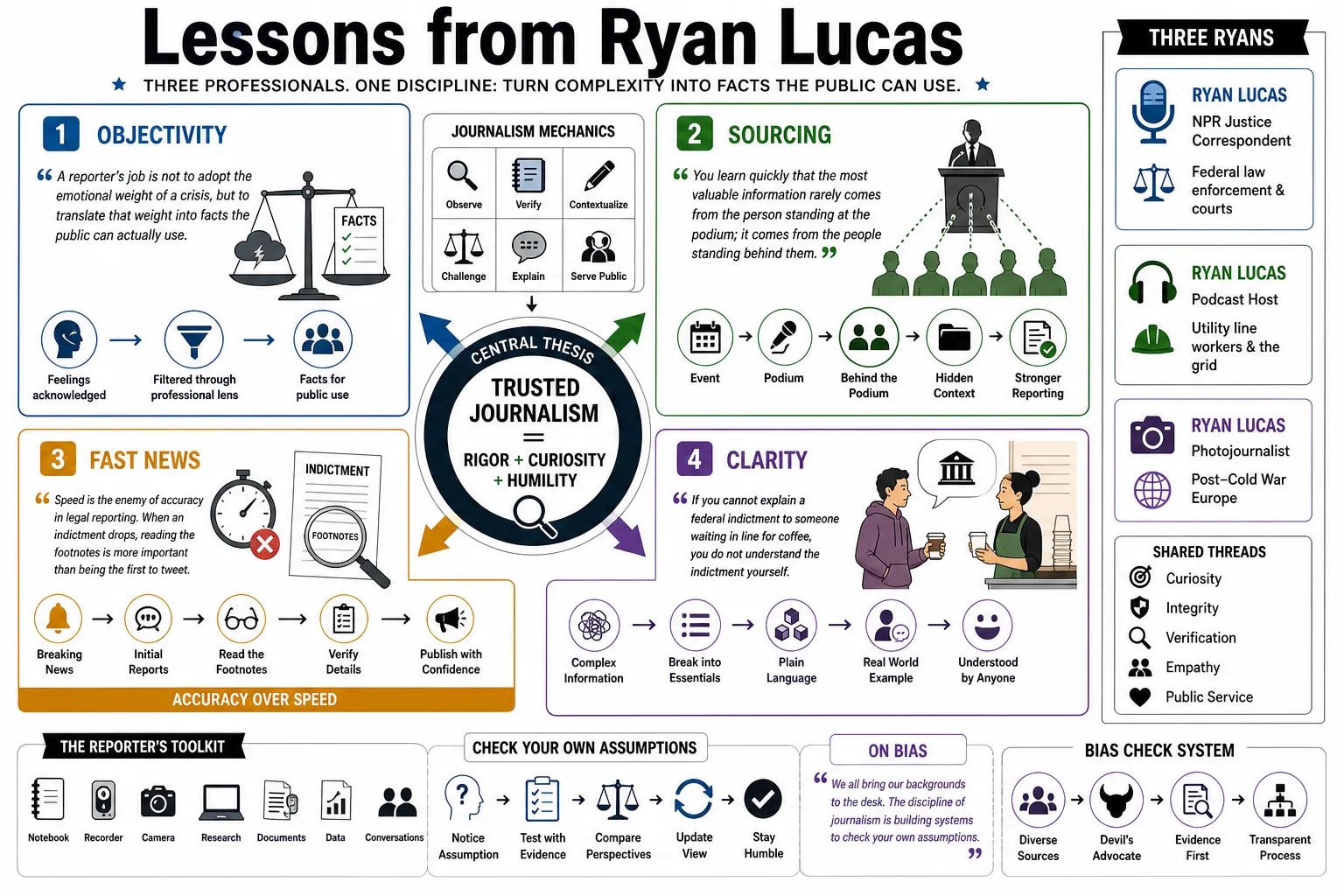
Lessons from Ryan Lucas
Three professionals share the name Ryan Lucas: an NPR Justice correspondent covering federal law enforcement, the host of a podcast about utility line workers, and a photojournalist covering post-Cold War Europe. This profile draws from their broadcasts, interviews, and writings to examine how each approaches the mechanics of their job.
Part 1: Journalism and the Search for Facts
- On Objectivity: "A reporter’s job is not to adopt the emotional weight of a crisis, but to translate that weight into facts the public can actually use." — Source: [NPR]
- On Sourcing: "You learn quickly that the most valuable information rarely comes from the person standing at the podium; it comes from the people standing behind them." — Source: [The Associated Press]
- On Fast News: "Speed is the enemy of accuracy in legal reporting. When an indictment drops, reading the footnotes is more important than being the first to tweet." — Source: [All Things Considered]
- On Clarity: "If you cannot explain a federal indictment to someone waiting in line for coffee, you do not understand the indictment yourself." — Source: [Up First]
- On Bias: "We all bring our backgrounds to the desk. The discipline of journalism is building systems to check your own assumptions before you publish." — Source: [NPR]
- On Press Briefings: "Official statements are the beginning of a story, not the end. They tell you what an institution wants you to believe, which is a data point itself." — Source: [NPR Politics Podcast]
- On Interviewing: "The best questions are often the shortest ones. A simple 'why' often yields a better answer than a heavily researched, three-part inquiry." — Source: [The Associated Press]
- On Anonymous Sources: "Granting anonymity is a contract. You only make that deal if the information is critical to the public interest and unobtainable any other way." — Source: [All Things Considered]
- On Retractions: "Admitting you got it wrong is painful, but it is the only mechanism that keeps the audience trusting you the next time you get it right." — Source: [NPR]
- On Burnout: "Covering constant institutional crisis requires you to eventually put your phone in another room. You cannot effectively cover a story if you never sleep." — Source: [Up First]
Part 2: The Justice Department and Institutional Power
- On Departmental Norms: "The Department of Justice operates on a set of unwritten rules that are often invisible until an administration attempts to break them." — Source: [NPR Politics Podcast]
- On Political Pressure: "Federal prosecutors are trained to ignore the political weather, but when the pressure comes from the top down, the building inevitably feels the strain." — Source: [NPR]
- On Legal Timelines: "The public wants immediate consequences, but the federal justice system is designed to move like a glacier to ensure constitutional protections." — Source: [All Things Considered]
- On Grand Juries: "The secrecy of a grand jury is frustrating for a reporter, but it exists to protect the reputations of people who may never be charged with a crime." — Source: [Up First]
- On White-Collar Crime: "Financial crimes are rarely solved with a smoking gun. They are solved with bankers' boxes of emails and years of forensic accounting." — Source: [NPR]
- On Institutional Memory: "When career attorneys leave the DOJ in large numbers, the department loses the muscle memory of how to handle complex, multi-year investigations." — Source: [All Things Considered]
- On National Security: "Trying a terrorism case in civilian court tests the balance between protecting classified intelligence and ensuring a public, fair trial." — Source: [NPR Politics Podcast]
- On Whistleblowers: "It takes an enormous toll on a person to step out of the ranks in a federal agency. They know their career will never look the same." — Source: [NPR]
- On the Attorney General: "The person sitting in the AG's chair has to navigate being a member of the president's cabinet while simultaneously shielding their investigators from the president's influence." — Source: [Up First]
Part 3: Foreign Correspondence and Conflict Zones
- On War Reporting: "You do not understand a conflict by interviewing generals in the capital; you understand it by talking to the civilians trying to buy bread in the suburbs." — Source: [The Associated Press]
- On Regime Change: "The moment a dictator falls is euphoric, but the power vacuum that opens up the next morning is usually far more dangerous." — Source: [NPR]
- On Local Fixers: "Foreign correspondents get the bylines, but the local journalists and translators are taking on the majority of the physical risk." — Source: [The Associated Press]
- On Authoritarian Tactics: "Information blackouts are a standard tool for suppressing dissent. If the internet goes down in a region, violence usually follows." — Source: [All Things Considered]
- On Refugee Crises: "Numbers numb the audience. To make people care about displacement, you have to tell the story of one family deciding what to pack in ten minutes." — Source: [Up First]
- On Propaganda: "State media does not always try to convince the public of a lie. Sometimes the goal is simply to confuse people enough that they give up on finding the truth." — Source: [NPR]
- On Historical Memory: "In post-conflict zones, history is not in the past. It is an active weapon used by political factions to justify present actions." — Source: [The Associated Press]
- On Trauma: "Journalists are not immune to the things they witness. Acknowledging the psychological toll of conflict reporting is necessary to sustain a career in it." — Source: [NPR]
- On Geopolitics: "Decisions made in air-conditioned rooms in Washington or Brussels translate into very concrete realities for people living in border towns in the Middle East." — Source: [All Things Considered]
Part 4: Blue-Collar Culture and the Trades
- On Trade Apprenticeships: "Learning this job cannot be done from a manual. You only learn how to handle the work by standing next to someone who has done it for twenty years." — Source: [The Powerline Podcast]
- On Blue-Collar Pride: "There is a specific kind of quiet satisfaction that comes from driving past a neighborhood and knowing you are the reason their lights are on." — Source: [The Powerline Podcast]
- On Shift Work: "Storm work requires a different gear. You are running on adrenaline and black coffee, working sixteen-hour shifts while the rest of the state is evacuated." — Source: [The Powerline Podcast]
- On Industry Misconceptions: "People think line work is just brute physical labor. In reality, it requires a deep understanding of electrical theory and mechanical engineering on the fly." — Source: [The Powerline Podcast]
- On Brotherhood: "You trust the person in the bucket with you more than you trust most people in your life, because your physical safety depends entirely on their competence." — Source: [The Powerline Podcast]
- On Recruitment: "We have to do a better job showing high school kids that the trades offer a path to a six-figure income and zero college debt." — Source: [The Powerline Podcast]
- On Public Perception: "Most people never think about the grid until the power goes out. Our job is to be the invisible infrastructure that keeps modern life moving." — Source: [The Powerline Podcast]
- On Family Strain: "The hardest part of the job isn't the electricity. It's missing birthdays and holidays because a hurricane took out the grid three states away." — Source: [The Powerline Podcast]
- On Adaptability: "No two poles are exactly the same. You can have a plan on the ground, but once you get up in the air, you have to be ready to improvise safely." — Source: [The Powerline Podcast]
Part 5: Safety, Risk, and Line Work
- On Complacency: "The day you stop respecting the voltage is the day you need to retire. Routine is the biggest threat to a lineman." — Source: [The Powerline Podcast]
- On PPE (Personal Protective Equipment): "Wearing your gear is non-negotiable. Rubber gloves and sleeves are the only things standing between you and a fatal mistake." — Source: [The Powerline Podcast]
- On Weather Conditions: "You do not get to pick the weather. We do our most dangerous work in the rain, ice, and wind, which means all your margins for error shrink." — Source: [The Powerline Podcast]
- On Communication: "Clear radio traffic is a safety tool. If a crew is yelling or miscommunicating on the ground, the situation in the air is already compromised." — Source: [The Powerline Podcast]
- On Close Calls: "Every near miss needs to be discussed, not hidden. If you survived a mistake, you owe it to the rest of the crew to explain how it happened." — Source: [The Powerline Podcast]
- On Physical Conditioning: "Your body is your primary tool in this trade. If your back or shoulders give out in your thirties, your career in the bucket is over." — Source: [The Powerline Podcast]
- On Mental Focus: "You have to leave your arguments and your stress in your truck. When you clip into your harness, you cannot be distracted by what happened at breakfast." — Source: [The Powerline Podcast]
- On Accountability: "Safety is not just the foreman's job. The newest apprentice on the site has the obligation to stop the job if they see something wrong." — Source: [The Powerline Podcast]
- On Fatigue: "The most dangerous hour of a storm deployment is the final one. That is when people rush to finish and start cutting corners." — Source: [The Powerline Podcast]
- On Training Standards: "We do not lower the testing standards to get more bodies in the field. A poorly trained lineman is a hazard to the entire circuit." — Source: [The Powerline Podcast]
Part 6: Photography and Documenting the Unseen
- On Framing: "What you choose to leave out of the frame is just as important as what you include. Exclusion defines the story." — Source: [West from the Fallen Wall]
- On Access: "A camera is just a piece of metal until someone trusts you enough to let you point it at them during their worst moments." — Source: [West from the Fallen Wall]
- On Black and White: "Removing color from an image forces the viewer to focus entirely on the geometry of the scene and the emotion in the subject's face." — Source: [West from the Fallen Wall]
- On Editing: "You might take a thousand photos on a deployment, but the essay relies on selecting the three images that carry the actual narrative weight." — Source: [West from the Fallen Wall]
- On Ethics in Photography: "Documenting tragedy requires a constant internal check. You have to ask if taking the photo exploits the subject or serves the public record." — Source: [West from the Fallen Wall]
- On Patience: "The best images rarely happen when you first arrive. You have to wait until the subjects forget the camera is there." — Source: [West from the Fallen Wall]
- On Context: "A photograph without proper captioning is vulnerable to misinterpretation. The text grounds the image in reality." — Source: [West from the Fallen Wall]
- On Equipment: "Gear obsessions miss the point. A sharp image of a boring subject is still a boring photograph." — Source: [West from the Fallen Wall]
- On Memory: "Photographs serve as an anchor for history. They prevent societies from denying what happened in their own backyards." — Source: [West from the Fallen Wall]
Part 7: Narrative and the Post-Cold War World
- On Borders: "Lines drawn on maps in the 1990s still dictate the economic realities of millions of people who had no say in the drawing." — Source: [West from the Fallen Wall]
- On Architecture: "The concrete block housing of Eastern Europe tells a story of utility over humanity. It shapes the psychology of the people who grow up inside it." — Source: [West from the Fallen Wall]
- On Generational Trauma: "The children of those who lived through the wall falling inherited the anxiety of sudden change without the memory of what came before." — Source: [West from the Fallen Wall]
- On Short Fiction: "The short story is the ideal form for capturing a fractured society. It allows you to present a sharp slice of life without needing to resolve the larger political crisis." — Source: [West from the Fallen Wall]
- On Nationalism: "When economies falter, populations retreat into old identities. Nationalism is a predictable response to financial insecurity." — Source: [West from the Fallen Wall]
- On Civilian Life in Conflict: "Wars are fought by soldiers, but they are endured by the people trying to keep their corner stores open." — Source: [West from the Fallen Wall]
- On the Military Experience: "The transition from a rigid military structure back into civilian chaos leaves many veterans feeling entirely disconnected from the societies they served." — Source: [West from the Fallen Wall]
- On Nostalgia: "There is a strange, persistent nostalgia for authoritarian stability among those who found the transition to capitalism too brutal to navigate." — Source: [West from the Fallen Wall]
- On Observation: "A writer's primary job is simply to notice the details that everyone else in the room has decided to ignore." — Source: [West from the Fallen Wall]
Part 8: Professional Discipline and Integrity
- On Preparation: "Whether you are climbing a pole, walking into a press conference, or entering a war zone, the work is won or lost in the preparation." — Source: [The Powerline Podcast]
- On Handling Criticism: "If the criticism is about your process, you should listen. If the criticism is just anger about your findings, you have to block it out." — Source: [NPR]
- On Mentorship: "You do not master a craft until you can explain it clearly to a first-year apprentice. Teaching forces you to understand your own mechanics." — Source: [The Powerline Podcast]
- On Adapting to Change: "Industries change, whether it is the shift to digital media or updates to the power grid. Refusing to learn the new tools is a quiet way of retiring." — Source: [NPR]
- On Trust: "Trust takes a decade to build with an audience or a crew, and it takes about ten seconds of carelessness to destroy it entirely." — Source: [The Powerline Podcast]
- On Simplicity: "The hardest thing to do in writing or in physical labor is to remove the unnecessary steps. Amateurs add complexity; professionals strip it away." — Source: [West from the Fallen Wall]
- On Crisis Management: "When things go wrong, volume does not help. The person who lowers their voice and slows down is the one who will solve the problem." — Source: [The Powerline Podcast]
- On Curiosity: "The moment you think you have seen every variation of a story or a task is the moment you become a liability to your team." — Source: [NPR]
- On Physical Toll: "Heavy work and heavy reporting both extract a physical cost. You have to treat your health as a professional requirement, not a hobby." — Source: [The Powerline Podcast]
- On Leaving a Mark: "You do not need to be famous to be effective. The best work is often done by people whose names the public will never know." — Source: [The Associated Press]