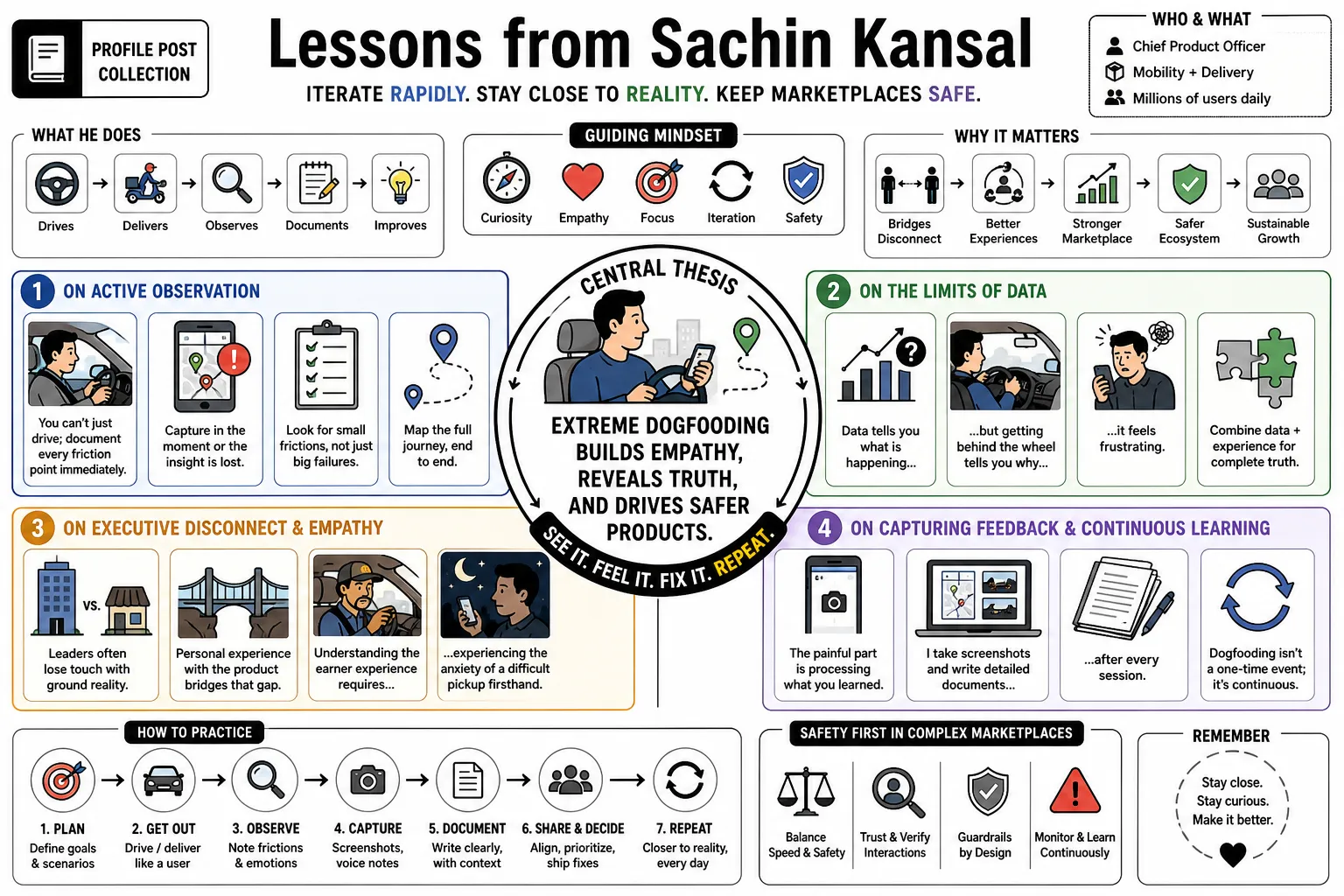
Lessons from Sachin Kansal
As Uber's Chief Product Officer, Sachin Kansal oversees the mobility and delivery products millions use every day. He tests his own work through "extreme dogfooding," personally driving and delivering to find friction points. This collection gathers his advice on iterating rapidly while keeping complex marketplaces safe.
Part 1: Extreme Dogfooding and User Empathy
- On active observation: "You can't just drive; you have to document every friction point immediately, or the insight is lost." — Source: [Lenny's Newsletter]
- On the limits of data: "Data tells you what is happening, but getting behind the wheel tells you why it feels frustrating." — Source: [Lenny's Newsletter]
- On executive disconnect: "Leaders often lose touch with the ground reality; personal experience with the product bridges that gap." — Source: [OfficeChai]
- On capturing feedback: "The painful part is processing what you learned. I take screenshots and write detailed documents after every session." — Source: [OfficeChai]
- On driver empathy: "Understanding the earner experience requires experiencing the anxiety of a difficult pickup firsthand." — Source: [Earning with Uber]
- On continuous learning: "Dogfooding isn't a one-time event; it's a continuous practice required to stay close to the evolving ecosystem." — Source: [Lenny's Podcast]
- On translating experience to product: "The goal of firsthand experience is to move beyond empathy and directly fuel the product roadmap." — Source: [TechOrange]
- On hidden friction: "Many small usability issues never show up in aggregate metrics, but they become obvious when you use the app under pressure." — Source: [Gistr]
- On operational reality: "A feature that looks elegant in a design review might be completely impractical for a courier on a bicycle in the rain." — Source: [Lenny's Newsletter]
- On customer obsession: "True customer obsession means being willing to do the hard, unglamorous work of using the product exactly as your users do." — Source: [Lenny's Podcast]
Part 2: Product Velocity
- On product velocity: "The most important habit a product team can build is the muscle of consistent, rapid delivery." — Source: [Lenny's Newsletter]
- On cutting decision latency: "We use daily stand-ups and rapid reviews to ensure decisions are made in hours, not weeks." — Source: [Lenny's Podcast]
- On two-way doors: "Most product decisions are reversible. Treat them as two-way doors to avoid organizational paralysis." — Source: [Lenny's Newsletter]
- On iterative testing: "We're going to learn a lot as we launch, and as we learn, we will continuously tune the product." — Source: [Digital Defynd]
- On the value of action: "Shipping a flawed feature and fixing it quickly is often better than waiting months for perfection." — Source: [Gistr]
- On fixing identified problems: "Once you identify a friction point through dogfooding, the immediate next step is to ship the fix." — Source: [Gistr]
- On momentum: "A culture of 'ship, ship, ship' creates its own momentum, keeping teams energized and focused on the next challenge." — Source: [Lenny's Newsletter]
- On scaling iteration: "Driving rapid iteration across global teams requires clear communication and a shared commitment to speed." — Source: [Lenny's Podcast]
- On avoiding stagnation: "If you aren't shipping regularly, your product is stagnating and you are losing touch with the market." — Source: [Global Player]
Part 3: Focusing on Inputs Over Outputs
- On controllable metrics: "Obsess over the inputs you can control—the research, the iteration—rather than just staring at the final output metrics." — Source: [Lenny's Newsletter]
- On business outcomes: "Positive outcomes like growth and retention will naturally follow if you rigorously manage the specific operational inputs." — Source: [Lenny's Podcast]
- On defining success: "Success isn't just hitting a revenue target; it's executing the underlying activities that drive that revenue." — Source: [Lenny's Newsletter]
- On problem-solving: "When an output metric is down, the solution is always found by diagnosing the underlying inputs." — Source: [Lenny's Podcast]
- On organizational focus: "Aligning teams around input metrics ensures everyone knows exactly what they need to do today." — Source: [Lenny's Newsletter]
- On personal philosophy: "Focusing on controllable inputs is a mindset that applies just as much to personal growth as it does to product management." — Source: [Lenny's Podcast]
- On reducing anxiety: "You can't mandate an outcome. Focusing on inputs gives the team agency and reduces the anxiety of uncontrollable targets." — Source: [Lenny's Newsletter]
- On deep understanding: "To identify the right inputs, you have to deeply understand the mechanics of your specific marketplace or ecosystem." — Source: [Lenny's Podcast]
- On long-term value: "Optimizing for inputs builds a sustainable engine; optimizing only for outputs often leads to short-term hacks." — Source: [Lenny's Newsletter]
Part 4: Autonomous Vehicles and the Hybrid Network
- On the hybrid approach: "The future is a hybrid network where autonomous vehicles and human drivers coexist to meet diverse rider needs." — Source: [Business Today TV]
- On safety in AVs: "Safety is the absolute most critical aspect and the foundational requirement for the widespread adoption of self-driving technology." — Source: [Business Today TV]
- On complex routing: "Complex scenarios like pooled rides will eventually make sense for autonomous vehicles as the technology matures." — Source: [Kalkine Media]
- On scaling autonomy: "Scaling autonomous technology requires strategic partnerships and a deep understanding of local market dynamics." — Source: [WSJ Bold Names]
- On the role of human drivers: "Human drivers will remain essential for managing complex pickups, navigating edge cases, and providing personalized service." — Source: [Business Today TV]
- On global expansion: "Introducing autonomous ride services in markets like Abu Dhabi demonstrates the global potential of this technology." — Source: [NDTV Auto]
- On seamless integration: "The goal is for an autonomous trip to feel just as reliable and familiar as a standard Uber ride." — Source: [Business Today TV]
- On future capabilities: "As AV technology advances, we will explore new use cases and service models that were previously impossible." — Source: [NDTV Auto]
- On partner collaboration: "Working with leaders like Waymo and Tesla allows us to bring the best autonomous technology to our platform." — Source: [Business Today TV]
Part 5: Platform Safety and Security
- On foundational safety: "Building safety technology is not an afterthought; it must be integrated into the core architecture of the product." — Source: [Washington Post]
- On proactive features: "Features like PIN code verification shift safety from a reactive measure to a proactive layer of security." — Source: [Washington Post]
- On emergency integration: "The ability to seamlessly share trip information with emergency services is critical for rider peace of mind." — Source: [Washington Post]
- On balancing friction: "Good safety product management requires adding necessary friction to enhance security without ruining the user experience." — Source: [Washington Post]
- On continuous improvement: "Safety technology is never finished. It requires constant iteration based on new threats and user feedback." — Source: [Washington Post]
- On driver safety: "Safety features must protect the earner just as much as they protect the consumer." — Source: [Uber Newsroom]
- On trust: "Every safety feature we build is ultimately an investment in the foundational trust between the platform and its users." — Source: [Uber Newsroom]
- On data-driven safety: "We use platform data to identify patterns and proactively build tools that mitigate risk before incidents occur." — Source: [Washington Post]
- On user empowerment: "Safety tools should empower users, giving them control and visibility throughout their entire journey." — Source: [Uber Newsroom]
Part 6: The AI-Augmented Product Manager
- On practical AI: "I view AI primarily as a research assistant, not an infallible oracle that will make decisions for me." — Source: [Business Insider]
- On workflow efficiency: "Using tools like ChatGPT and Gemini helps summarize long reports and streamlines daily product management workflows." — Source: [Business Insider]
- On synthesizing data: "AI is incredibly valuable for processing large volumes of user feedback and identifying underlying themes quickly." — Source: [Lenny's Podcast]
- On human judgment: "While AI can process information, the product manager must still apply intuition and strategic judgment to make the final call." — Source: [Lenny's Newsletter]
- On tool adoption: "Integrating tools like NotebookLM into your workflow is becoming essential for staying productive in a fast-paced environment." — Source: [Business Insider]
- On the limits of AI: "AI cannot replace the deep empathy gained through hands-on experience and direct user interaction." — Source: [Lenny's Podcast]
- On rapid prototyping: "AI tools can accelerate the initial stages of product ideation, allowing teams to explore more concepts quickly." — Source: [Business Insider]
- On continuous learning with AI: "The best product managers will learn how to prompt and collaborate with AI to augment their own capabilities." — Source: [Lenny's Podcast]
- On AI in operations: "Beyond personal productivity, AI has immense potential to optimize complex marketplace operations in real-time." — Source: [Lenny's Newsletter]
Part 7: Earner Experience and Expanding the Platform
- On responsiveness: "We heard from drivers that they wanted an easier way to take a break, so we rolled out a new pause feature based directly on that feedback." — Source: [PR Newswire]
- On the 'Everything Platform': "The goal of adding new features like grocery and retail is to make life easier for you; that’s the future of the platform." — Source: [Business Insider]
- On core principles: "Even as we expand into new verticals, the foundational model remains the same: push a button, get what you need reliably." — Source: [Business Insider]
- On advanced air mobility: "We believe in advanced air mobility to transform cities; integrating electric air taxis will make ground-to-sky travel effortless." — Source: [Joby Aviation]
- On balancing marketplaces: "A healthy platform requires balancing the needs of earners, consumers, and merchants simultaneously." — Source: [Earning with Uber]
- On driver earnings: "Product features must be designed with a clear understanding of how they impact a driver's ability to earn efficiently." — Source: [Earning with Uber]
- On operational complexity: "Expanding from mobility to delivery introduces massive operational complexity that requires highly specialized product solutions." — Source: [Uber Newsroom]
- On partner integration: "Seamlessly connecting different legs of a journey, whether ground or air, requires deep technical integration with our partners." — Source: [Joby Aviation]
- On user convenience: "The ultimate metric for new verticals is whether we have meaningfully reduced the friction in a user's daily life." — Source: [Business Insider]
- On listening channels: "You have to create structured, consistent channels to ensure earner feedback directly influences the product roadmap." — Source: [Earning with Uber]
Part 8: Navigating Strategy and Career Growth
- On maximizing cycles: "To accelerate your growth as a product manager, you need to maximize the number of learning cycles you go through." — Source: [Lenny's Podcast]
- On gut vs. data: "When data points one way but your intuition says another, you have to dig deeper into the qualitative 'why' before deciding." — Source: [Lenny's Newsletter]
- On cultural shifts: "Evolving a company culture to focus on profitability requires a fundamental shift in how every product team measures success." — Source: [Lenny's Podcast]
- On leadership involvement: "The most effective product leaders stay intimately connected to the details of the product, no matter how senior they become." — Source: [Lenny's Podcast]
- On managing pressure: "Product development at scale involves immense pressure; maintaining a sense of humor and perspective is essential for the long haul." — Source: [BuzzInContent]
- On cross-functional alignment: "Shipping quickly at a global scale is impossible without deep, high-trust alignment across engineering, design, and operations." — Source: [Lenny's Newsletter]
- On career trajectory: "Building a career in product requires a willingness to take on complex, ambiguous challenges that don't have obvious answers." — Source: [Lenny's Podcast]
- On mentorship: "The best way to develop junior PMs is to give them ownership of a clear input metric and the autonomy to move it." — Source: [Lenny's Newsletter]
- On resilience: "You will ship things that fail. The key is to learn the right lesson quickly and not let the failure slow your velocity." — Source: [Lenny's Podcast]
- On the ultimate goal: "At the end of the day, our job is to build technology that solves real problems and materially improves people's lives." — Source: [Lenny's Podcast]