Lessons from Sam Chaudhary
Sam Chaudhary is the co-founder and CEO of ClassDojo, an education platform used in most U.S. K-8 schools. He bypassed district sales entirely to build a consumer product directly for teachers, parents, and students. This collection breaks down his approach to creating network effects, running efficient teams, and building classroom communities.
Part 1: Product Philosophy and Bottom-Up Growth
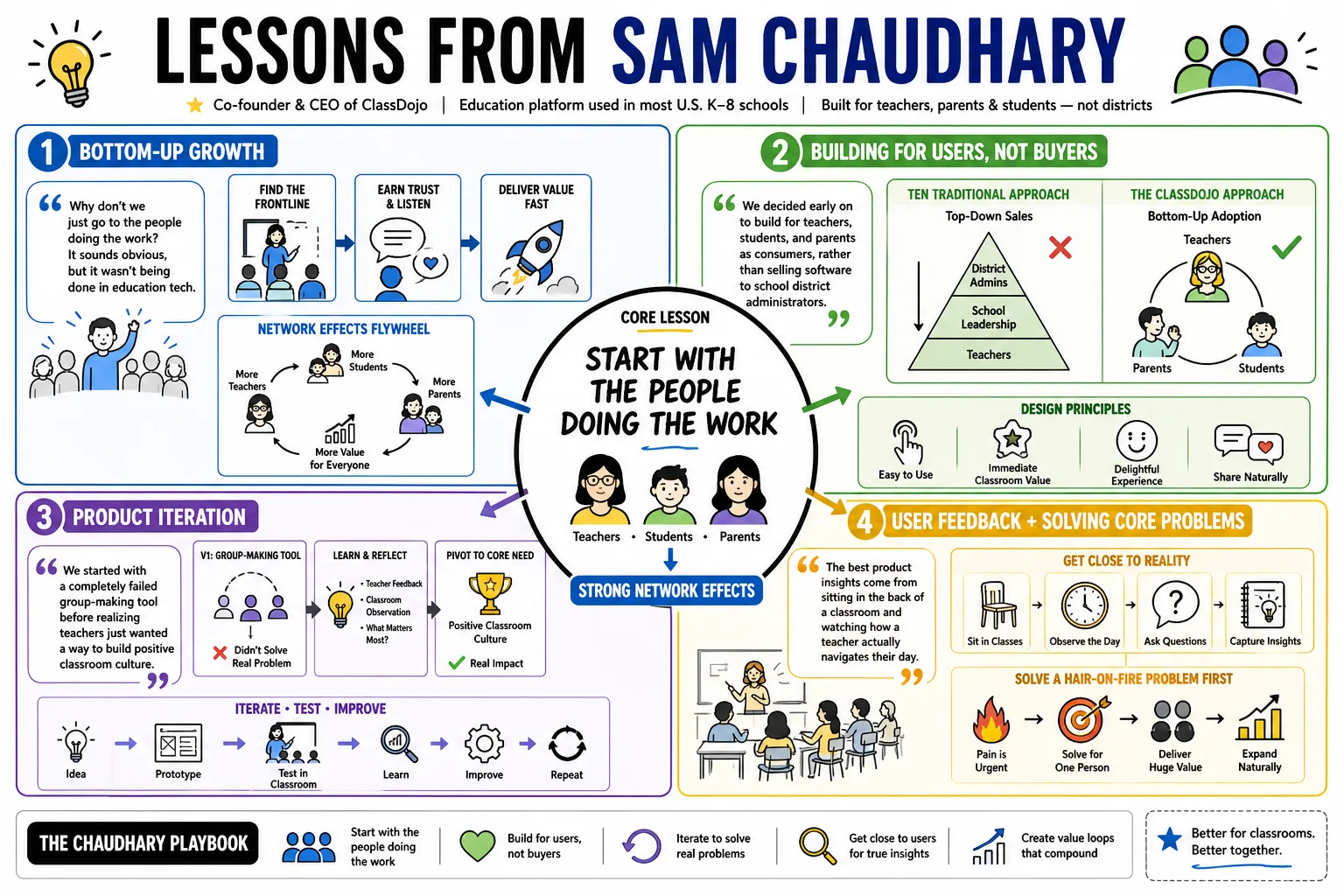
- On Bottom-Up Growth: "Why don't we just go to the people doing the work? It sounds obvious, but it wasn't being done in education tech." — Source: [Forbes]
- On Building for Users, Not Buyers: "We decided early on to build for teachers, students, and parents as consumers, rather than selling software to school district administrators." — Source: [First Round Review]
- On Product Iteration: "We started with a completely failed group-making tool before realizing teachers just wanted a way to build positive classroom culture." — Source: [First Round Review]
- On User Feedback: "The best product insights come from sitting in the back of a classroom and watching how a teacher actually navigates their day." — Source: [First Round Review]
- On Solving Core Problems: "You have to solve a hair-on-fire problem for one person first before you can build a network for everyone else." — Source: [Founders in Arms]
- On Prioritization: "If a feature doesn't directly help a teacher save time or improve student engagement, it doesn't belong in the core product." — Source: [Y Combinator]
- On Consumer Expectations: "Teachers use beautifully designed consumer apps in their personal lives, so they shouldn't have to tolerate clunky enterprise software at work." — Source: [First Round Review]
- On Patience in Monetization: "We chose to prioritize building the user network for seven years before we ever introduced a monetization strategy." — Source: [Founders in Arms]
- On Simplicity: "The product needs to be so simple that a busy teacher can understand its value within the first three minutes of downloading it." — Source: [Y Combinator]
- On Earning Trust: "Trust in the classroom is earned one day at a time, and your product has to respect that dynamic." — Source: [Edtech Insiders]
Part 2: Network Effects and Scaling
- On Three-Sided Networks: "The real magic happens when you connect teachers, parents, and students together; it creates a retention loop that is incredibly hard to break." — Source: [First Round Review]
- On Viral Growth: "Our growth didn't come from paid acquisition; it came from teachers telling other teachers in the staff lounge." — Source: [First Round Review]
- On Organic Expansion: "When parents see the value of the platform in one classroom, they naturally demand it when their child moves to the next grade." — Source: [Founders in Arms]
- On Density Over Spread: "We focused on getting high usage density within individual schools rather than sparse usage across many different districts." — Source: [Y Combinator]
- On Network Defensibility: "Once a school's entire community is communicating on one platform, the switching costs become naturally high due to the shared context." — Source: [First Round Review]
- On Scaling Trust: "You can scale technology quickly, but you cannot shortcut the process of building community trust at scale." — Source: [Edtech Insiders]
- On Frictionless Onboarding: "The barrier to entry must be zero. If a teacher has to ask IT for permission, you've already lost the network effect." — Source: [Y Combinator]
- On Market Skepticism: "When we started, education was considered a 'bad market' by investors because the traditional sales cycles were too long and expensive." — Source: [First Round Review]
- On Bypassing Gatekeepers: "By making the product free for teachers, we bypassed the institutional gatekeepers that historically stifled edtech innovation." — Source: [Forbes]
- On Community as a Moat: "Your strongest competitive advantage is never the software itself; it is the community of users who advocate for it." — Source: [Founders in Arms]
Part 3: Education and The Classroom Village
- On the Importance of Education: "Education is the most important problem in the world. If we could solve it, we'd have a world where everyone grows up with a chance to develop their unique talents." — Source: [GBX Global]
- On Classroom Communities: "The toughest thing during the pandemic was that kids were suddenly apart from their whole village. Classrooms are their village." — Source: [Crunchbase]
- On Behavioral Feedback: "The intent of the app is to redirect student behavior in a positive way, rather than simply acting as a monitoring tool." — Source: [ClassDojo Blog]
- On Group Dynamics: "We wanted to build something to help students work in groups and help them help each other." — Source: [K-12 Dive]
- On Parent Engagement: "When parents are actively involved in the daily micro-moments of learning, student outcomes improve dramatically." — Source: [First Round Review]
- On Emotional Intelligence: "Modern education isn't just about academics; it is fundamentally about developing empathy, resilience, and emotional intelligence." — Source: [Edtech Insiders]
- On Teacher Burnout: "If technology adds even five minutes to a teacher's day, it is failing. Our job is to give them time back." — Source: [First Round Review]
- On Student Agency: "We want to give students ownership over their own learning narrative and how they present their work to their families." — Source: [PressClub]
- On the True Purpose of EdTech: "Technology should fade into the background so that the human relationships in the classroom can take center stage." — Source: [K-12 Dive]
Part 4: Organizational Design and Operations
- On Eliminating 1:1 Meetings: "We ran an experiment to replace traditional 1:1 meetings with better written documentation, and it forced everyone to be more intentional with their time." — Source: [Mochary Method]
- On Asynchronous Communication: "Moving away from synchronous updates allows deep work to happen without constant interruption." — Source: [Mochary Method]
- On Written Culture: "If a decision or a context update isn't written down, it doesn't exist for the rest of the organization." — Source: [Mochary Method]
- On Operational Playbooks: "Using standardized frameworks for internal operations removes the cognitive load of figuring out 'how' we work, letting us focus on 'what' we work on." — Source: [Mochary Method]
- On Meeting Hygiene: "Meetings should be reserved for debate and complex decision-making, never just for sharing status updates." — Source: [Mochary Method]
- On Founder Mindset: "Scaling a company requires the founder to constantly fire themselves from their current job to focus on the next bottleneck." — Source: [Y Combinator]
- On Feedback Loops: "We instituted rigorous 360-degree reviews because candid feedback is the only reliable engine for personal growth." — Source: [Mochary Method]
- On Small Teams: "It's surprising how much small, highly aligned teams can get done when you remove bureaucratic overhead." — Source: [Y Combinator]
- On Process as a Product: "You have to treat your internal company operating system with the same rigor and iteration as your external product." — Source: [Mochary Method]
- On Radical Candor: "Encouraging candor means making it safe for people to point out when an internal process is fundamentally broken." — Source: [ClassDojo Blog]
Part 5: Hiring and Team Autonomy
- On Onboarding by Shadowing: "We have new hires shadow experienced team members for 30 to 90 days so they deeply understand the customer before making decisions." — Source: [Mochary Method]
- On Hiring Exceptional People: "When you bring together exceptional people and give them clarity and trust, they'll invent the future." — Source: [ClassDojo Blog]
- On Top-Down Mandates: "Innovation doesn't come from top-down mandates; it comes from teams with the ownership and freedom to tackle hard problems." — Source: [ClassDojo Blog]
- On Cultural Fit: "We look for people who are obsessed with solving problems for teachers, rather than people who just want to build cool technology." — Source: [First Round Review]
- On Context Over Control: "Our job as leaders is to provide overwhelming context so that teams can make autonomous decisions safely." — Source: [Mochary Method]
- On Early Hires: "The first ten people you hire dictate the DNA of the company for the next thousand." — Source: [Y Combinator]
- On Evaluating Talent: "We index heavily on resourcefulness and the ability to learn quickly, over specific historical domain expertise." — Source: [Founders in Arms]
- On Retention: "People stay when they feel they are doing the most impactful work of their careers alongside people they genuinely respect." — Source: [Y Combinator]
- On Trusting the Team: "If you hire great people and then try to micromanage their output, you have wasted both their talent and your capital." — Source: [ClassDojo Blog]
Part 6: Culture and Experimentation
- On Learning Over Certainty: "We promote a culture of learning over certainty; failures are an important and necessary component of the learning process." — Source: [Medium]
- On Resourcefulness: "In the early days, relentless resourcefulness was our primary survival mechanism against well-funded incumbents." — Source: [First Round Review]
- On Psychological Safety: "You can't have a culture of experimentation if people are terrified of the professional consequences of a failed test." — Source: [ClassDojo Blog]
- On Rapid Prototyping: "The goal is to get a functional prototype into a real classroom as fast as possible to see where it breaks." — Source: [Y Combinator]
- On Ego in Design: "You have to detach your ego from the initial product idea, because the market will inevitably prove your first assumption wrong." — Source: [Founders in Arms]
- On Celebrating Failure: "We publicly discuss what didn't work in our all-hands meetings so that the entire company absorbs the lesson without repeating the mistake." — Source: [Mochary Method]
- On Defaulting to Action: "When faced with an ambiguous product decision, the best approach is to build a lightweight version and let user data settle the debate." — Source: [Y Combinator]
- On Iteration Speed: "The company that iterates the fastest based on direct user feedback will ultimately win the market." — Source: [First Round Review]
- On Intellectual Honesty: "True innovation requires the intellectual honesty to admit when a feature you loved isn't actually helping the user." — Source: [Medium]
Part 7: Consumerizing EdTech
- On Consumer Grade UX: "Educational software has historically looked like tax software. We decided it should look and feel like the best consumer apps." — Source: [First Round Review]
- On Emotional Resonance: "If your product doesn't evoke a positive emotional response from a teacher, they won't advocate for it to their peers." — Source: [Forbes]
- On Building Habits: "We designed the platform to fit seamlessly into the existing daily habits of a classroom, rather than forcing teachers to invent new ones." — Source: [Founders in Arms]
- On App Store Distribution: "The App Store democratized distribution, allowing us to reach millions of teachers directly without a single enterprise sales rep." — Source: [Y Combinator]
- On Character Design: "Using friendly, customizable monster avatars made the platform inherently approachable and removed the anxiety often associated with behavioral feedback." — Source: [K-12 Dive]
- On B2C2B Models: "By securing the love of the end consumer first, you eventually create a mandate that the institution has to support." — Source: [First Round Review]
- On Accessible Language: "We strip out all academic jargon from our interface. It has to be instantly readable by a parent on their phone during a short break at work." — Source: [Edtech Insiders]
- On Mobile-First Development: "We recognized early that the primary computer for most parents, and increasingly teachers, was the phone in their pocket." — Source: [Forbes]
- On Brand Joy: "A brand in education shouldn't be sterile; it should project the natural joy and curiosity of learning." — Source: [PressClub]
Part 8: The Future of Learning
- On Artificial Intelligence: "AI features like Dojo Sparks are designed to augment the teacher's creativity, not replace their core instructional role." — Source: [Edtech Insiders]
- On Educational Gaming: "Environments like Dojo Islands show that gaming mechanics can be harnessed to foster genuine collaborative learning, rather than just screen addiction." — Source: [PressClub]
- On Future Classrooms: "The classroom of the future won't be defined by more hardware, but by deeper, software-enabled connections between the school and the home." — Source: [Edtech Insiders]
- On Personalized Learning: "Technology allows us to move away from a one-size-fits-all curriculum and tailor the educational experience to the unique talents of every child." — Source: [GBX Global]
- On Global Reach: "The fundamental desire of parents to see their children succeed is universal, which is why our platform translated so effectively across international borders." — Source: [First Round Review]
- On Lifelong Skills: "We are shifting the focus from rote memorization toward the soft skills—empathy, teamwork, and persistence—that actually determine long-term success." — Source: [K-12 Dive]
- On Empowering Students: "The next wave of edtech will give students the tools to actively build their own learning portfolios, shifting them from consumers of content to creators." — Source: [PressClub]
- On Tutoring Accessibility: "Tools like Dojo Tutor aim to democratize access to personalized help, bringing a resource that was once a luxury to the broader public." — Source: [Edtech Insiders]
- On the Long Game: "Rebuilding the infrastructure of global education is a generational challenge; you have to measure progress in decades, not quarters." — Source: [Founders in Arms]