Lessons from Sam Schillace
Sam Schillace co-created Writely, the web application that became Google Docs. Across a thirty-year career at Google, Box, and Microsoft, he developed specific frameworks for engineering management and adapting to new technology. This profile gathers his notes on system design, building products with large language models, and the practical value of optimism in software.
Part 1: The Origins of Writely & Google Docs
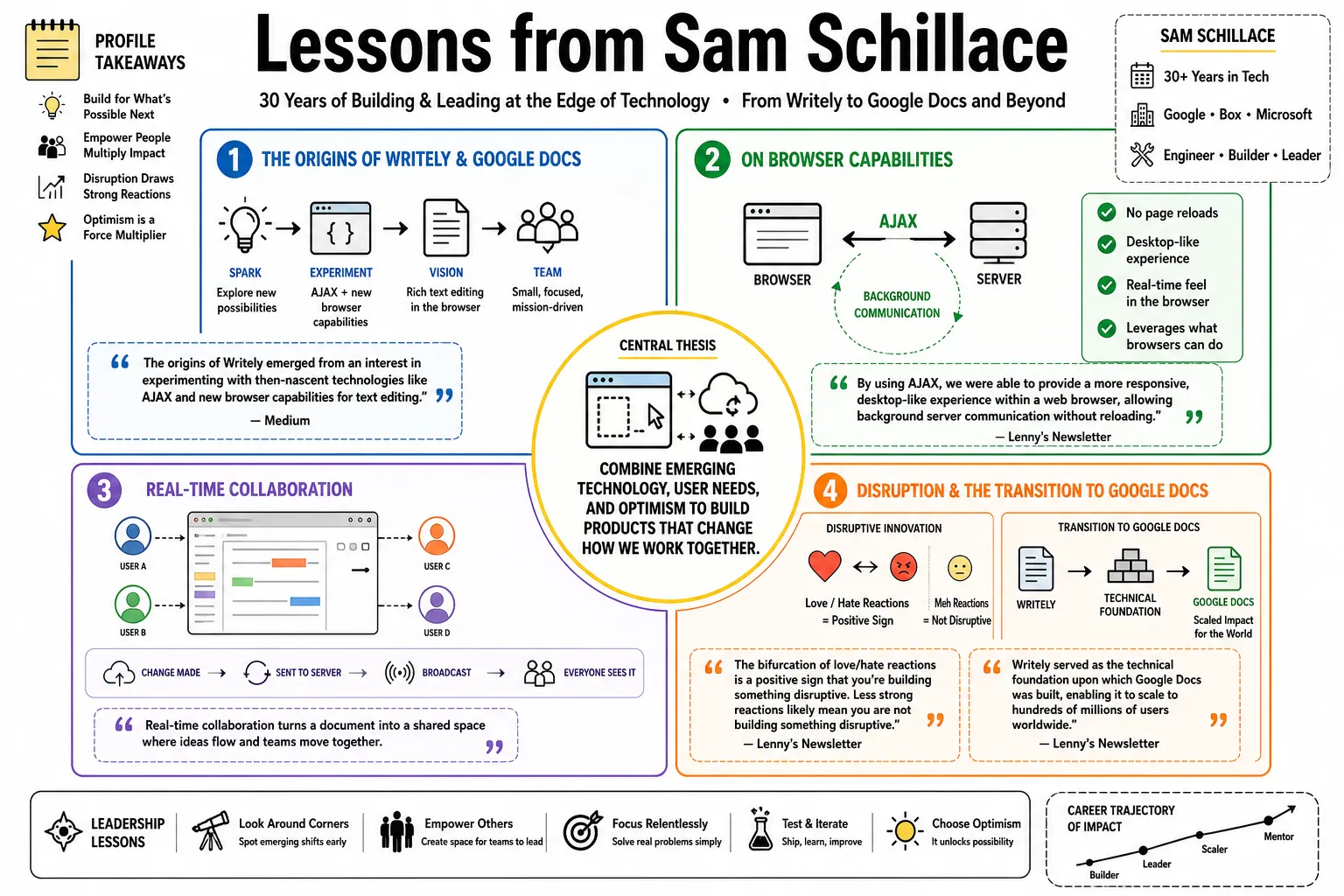
- On Browser Capabilities: "The origins of Writely emerged from an interest in experimenting with then-nascent technologies like AJAX and new browser capabilities for text editing." — Source: Medium
- On Real-Time Collaboration: "By using AJAX, we were able to provide a more responsive, desktop-like experience within a web browser, allowing background server communication without reloading." — Source: Lenny's Newsletter
- On Disruptive Innovation: "The bifurcation of love/hate reactions is a positive sign that you're building something disruptive. Less strong reactions likely mean you are not building something disruptive." — Source: Lenny's Newsletter
- On The Transition to Google Docs: "Writely served as the technical foundation upon which Google Docs was built after the Upstartle acquisition." — Source: Computer Hope
- On Early Web Apps: "The goal was to create an experience that felt just as responsive as a desktop application, but entirely in the browser." — Source: Acquired Podcast
- On Scaling Google Docs: "Leading the teams that developed the spreadsheet application and early drive interface required fundamentally rethinking how people collaborate." — Source: GeekWire
- On Experimentation: Schillace told The Verge that Writely started as an AJAX and browser content-editable experiment, with the team testing whether those barely ready browser capabilities could support a real document editor. — Reference: The Verge interview on Writely as an AJAX and browser-editing experiment
- On Acquisition by Google: "Integrating a startup's product into Google's massive infrastructure was a unique engineering challenge that set the stage for modern cloud collaboration." — Source: Medium
- On Challenging Incumbents: "Building a web-based word processor meant challenging the long-standing dominance of desktop software by offering frictionless sharing." — Source: Next Web
Part 2: The Schillace Laws of Semantic Engineering
- On Code vs. Models: "Code is for syntax and process; models are for semantics and intent." — Source: Microsoft
- On Writing Code: "Don't write code if the model can do it; the model will get better, but the code won’t." — Source: Substack
- On Precision and Leverage: "Trade leverage for precision; use interaction to mitigate." — Source: The Pragmatic CTO
- On System Brittleness: "The system will be as brittle as its most brittle part." — Source: LangChain
- On Prompting: "Ask Smart to Get Smart. The quality of the interaction with the model dictates the quality of the output." — Source: Microsoft
- On Handling Confidence: "Uncertainty is an exception throw. When an LLM lacks confidence, the system should treat it as an error or trigger human intervention." — Source: The Pragmatic CTO
- On Communication Protocols: "Text is the universal wire protocol." — Source: Substack
- On Task Difficulty: "Hard for you is hard for the model. If a task is complex for a human, it will also be complex for the model to get right." — Source: MiniASP
- On Anthropomorphizing AI: "Beware 'pareidolia of consciousness'; the model can be used against itself. Avoid treating models as conscious beings." — Source: AppStream
- On Non-Deterministic Architecture: "Developers must stop viewing AI as a black box and treat it as a new, distinct, non-deterministic component of software architecture." — Source: The New Stack
Part 3: The Philosophy of Optimism & "What If"
- On Choosing Optimism: "I just personally feel like I've missed out on more than I've protected myself from by being pessimistic." — Source: The Jakers
- On The Land of Possibility: "If you want to innovate... you have to break out of that mindset of pessimism and find yourself in the land of possibility and wonder again." — Source: Lenny's Newsletter
- On The 'What If' Framework: "Instead of focusing on current constraints, we must ask: What happens if this new thing is true? What if this works?" — Source: Substack
- On Overcoming Cynicism: "Pessimistic narratives that focus on why a new technology will fail trap us and limit experimentation." — Source: GeekWire
- On Embracing Messiness: "Innovation requires embracing the messiness of creation rather than demanding immediate perfection." — Source: Renaud-Bray
- On Reacting to New Tech: In Lenny's interview, Schillace frames optimism as a deliberate posture: focus on possibilities instead of limitations, make experiments cheap, and stay willing to try uncomfortable ideas before they are obvious. — Reference: Lenny's interview on optimism, what-if questions, and cheap experiments
- On No Prize for Pessimism: "A pessimistic mindset stifles creativity; there is no inherent reward for simply predicting that something will fail." — Source: The Guardian
- On High-Functioning Teams: "High-functioning technical teams prioritize 'what if' questions to push through the initial discomfort of building something new." — Source: Microsoft
- On Future Vision: "Innovators focus on how technology can fundamentally shift how we work, rather than getting stuck on the limitations of early versions." — Source: Lenny's Newsletter
Part 4: The AI Paradigm Shift
- On Product Strategy: "AI isn't a feature of your product. Your product is a feature of AI." — Source: Substack
- On The Urgency of AI: "Speed is even more important than ever. It would be an absolutely fatal error in this moment to worry about things that can be fixed later." — Source: Business Insider
- On AI Metacognition: "Metacognition is susceptible to stochasticity—a fact that makes building autonomous agents incredibly challenging." — Source: Latent Space
- On AI Planning: "The model's good at thinking, but it's not good at planning. So you do planning in code." — Source: Latent Space
- On Being a Mad Scientist: "My role involves exploring how AI can collaborate with humans, acting as a mad scientist to inform future product development." — Source: GeekWire
- On Platform Shifts: Schillace compares generative AI to the early web/cloud shift: after seeing Writely prove the browser could become an application platform, he says AI now gives him the same sense that software and businesses will be rebuilt around a new category. — Reference: Lenny transcript on generative AI as a category shift like the web/cloud era
- On Integrating Memory: "The next generation of tools will require integrating AI with traditional code, long-term memory, and context awareness." — Source: Microsoft
- On The AI Race: "The rapid development of generative AI tools means companies must accelerate deployment to remain competitive." — Source: Business Insider
- On New User Experiences: "We are not just building models; we are focusing on consuming and applying them to create entirely new paradigms of interaction." — Source: Microsoft
Part 5: Taste and Judgment in the AI Era
- On The Devaluation of Coding: "Coding skills that I had 30 years ago, that were rare and valuable, are more or less free now." — Source: Substack
- On The Rise of Taste: "In a world where anyone can do 'anything', what starts to matter more is something like taste, and judgement." — Source: Substack
- On Choosing the Work: "The hard part isn't doing the work now; it's choosing the work. The bottleneck has shifted from execution to decision-making." — Source: Substack
- On Mental Calories: "Having taste in what is healthy to consume intellectually is more important than the raw ability to access information." — Source: Substack
- On Design Differentiators: "When AI makes execution trivial, a person's taste as a designer or architect becomes their primary differentiator." — Source: Substack
- On Valuing Judgment: "What you choose to do is more important now than that you can do it." — Source: Substack
- On The Mechanics of Work: "AI has simplified the mechanics of work, forcing us to rely on our intuitive judgment to create value." — Source: Brxnd.ai
- On Evaluating Output: On First Round's In Depth podcast, Schillace argues that engineers need stronger technical taste and judgment as AI changes the mechanics of building, because knowing what is worth building and what good looks like becomes more important. — Reference: First Round In Depth episode on developing technical taste in the AI era
- On Information Diets: "Just as we must choose healthy food, we must exercise taste in our information diets to avoid consuming empty mental calories." — Source: Substack
- On The Human Edge: "Taste is the one asset that models cannot replicate, as it requires lived human context and subjective preference." — Source: Substack
Part 6: Software Engineering & Simplicity
- On Paranoia in Engineering: "Be Paranoid. Never trust that a system is up, a bug is fixed, or code works as expected without rigorous verification." — Source: Medium
- On Leaky Abstractions: "Don't Lie to the Computer. Avoid leaky abstractions and do not use systems in ways they were not intended." — Source: Medium
- On Simplicity: "Keep It Simple. Just because a problem can be solved doesn't always mean it should be. Focus on utility over over-engineering." — Source: Medium
- On Fixing Bugs: "Fix the Possibility of the Bug. Identify and eliminate the systemic conditions that allowed it to happen so it can never occur again." — Source: Medium
- On Rewrites: "Trying to rewrite something from scratch is a cardinal sin in software engineering. Avoid rewrites." — Source: Effective Engineer
- On Technical Taste: Schillace defines technical taste as accumulated heuristics and judgment: the ability to consolidate experience into an instinct for which technical bets, architectures, and teams are likely to work. — Reference: First Round In Depth transcript excerpt on technical taste as heuristics and judgment
- On System Scaling: "If usage grows by orders of magnitude, rethink the design from first principles rather than just patching it." — Source: Medium
- On Simplicity Winning: "Simple solutions—even if slightly less complete—usually win out over complex, perfect ones." — Source: Substack
- On Verifying Assumptions: "Check your assumptions multiple times and always seek second opinions on critical system architecture." — Source: Medium
- On Utility Over Perfection: "Building useful software is about finding the most direct path to value, not building the most theoretically elegant system." — Source: Lenny's Newsletter
Part 7: Career Building and Risk Taking
- On Finding Your Niche: "Find the thing you feel kinda guilty about being paid for and do the hell out of it." — Source: Microsoft
- On Recognizing Talent: "If you feel kind of guilty that you're getting paid to do something, it probably means you're really good at it, and it's fun for you." — Source: Microsoft
- On Career Strategy: "Get to the edge of something and fuck around. That's the strategy." — Source: The Jakers
- On Capitalizing on Joy: In the Lenny transcript, Schillace advises people to notice the work they feel almost guilty being paid for, then do it intensely when that work is valuable to others and genuinely energizing. — Reference: Lenny transcript on finding joy in valuable work
- On Adapting to Change: "As old skills become commoditized, you must be willing to shift your career focus toward higher-level decision making." — Source: Substack
- On Continuous Experimentation: "The best career moves often come from simply playing with new technologies before they are fully understood." — Source: Lenny's Newsletter
- On First-Principles Thinking: "Applying first-principles thinking to your career allows you to ignore conventional wisdom and pursue what actually works for you." — Source: GitHub
- On Following Curiosity: "Let your natural curiosity guide you to the edges of your industry; that is where the most valuable discoveries are made." — Source: The Jakers
- On Embracing New Paradigms: "The engineers who thrive in the future will be those who eagerly discard outdated skills in favor of learning how to direct AI." — Source: Microsoft
Part 8: Leadership and Scale
- On The Prima Donna Trap: "Avoid the prima donna death spiral by trusting your team and delegating effectively." — Source: Renaud-Bray
- On Leadership Humility: "Effective leadership in technology requires humility and a willingness to trust the expertise of others." — Source: The Guardian
- On Scaling Teams: "Scaling an engineering organization requires transitioning from being the primary problem solver to the architect of a problem-solving culture." — Source: Box Engineering
- On Navigating IPOs: "Guiding a technical team through an IPO involves maintaining focus on long-term R&D despite short-term financial pressures." — Source: Lenny's Newsletter
- On Risk Tolerance: "Taking risks on unproven technologies is the only way to build products that fundamentally change user behavior." — Source: Medium
- On Cultural Infrastructure: "Improving horizontal infrastructure isn't just about code; it's about enhancing the consumer product culture across the entire organization." — Source: GeekWire
- On Encouraging Dissent: "A healthy engineering culture welcomes the love/hate bifurcation, as it indicates the team is pushing boundaries." — Source: Lenny's Newsletter
- On Managing Transitions: "When integrating startups into larger corporations, preserving the agile, experimental mindset is the most difficult but vital leadership task." — Source: Medium
- On The Leader's Role: "The ultimate job of a technical leader is to create an environment where engineers feel safe to ask 'what if' and embrace the messiness of innovation." — Source: Strand Books