Lessons from Sam Walton
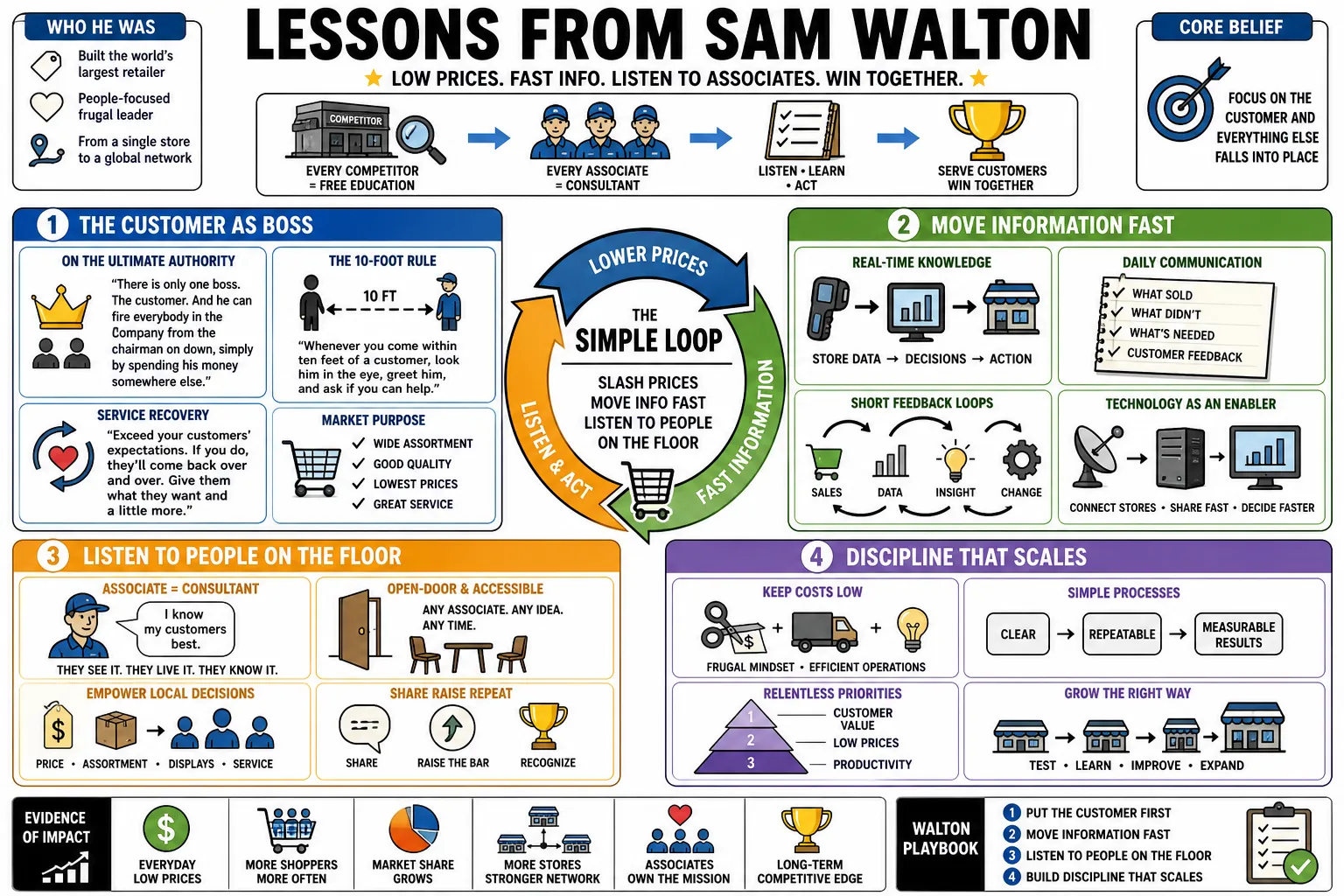
Sam Walton built the world's largest retailer by treating every competitor as a free education and every store associate as a consultant. He skipped corporate formality to focus on a simple loop: slash prices, move information fast, and listen to the people actually stocking the shelves.
Part 1: The Customer as Boss
- On the Ultimate Authority: "There is only one boss. The customer. And he can fire everybody in the company from the chairman on down, simply by spending his money somewhere else." — Source: Walmart Corporate
- On the 10-Foot Rule: "I want you to promise that whenever you come within ten feet of a customer, you will look him in the eye, greet him, and ask him if you can help him." — Source: Walmart World
- On Service Recovery: "Exceed your customers' expectations. If you do, they'll come back over and over. Give them what they want and a little more." — Source: Sam Walton: Made in America
- On Market Purpose: "The secret of successful retailing is to give your customers what they want. And really, if you think about it from the point of view of the customer, you want everything: a wide assortment of good quality merchandise; the lowest possible prices; guaranteed satisfaction with what you buy; friendly, knowledgeable service; convenient hours; free parking; a pleasant shopping experience." — Source: Sam Walton: Made in America
- On Pricing Integrity: "The only way we can keep the customer coming back is to give them the best possible value every day." — Source: PBS Frontline
- On Listening to Feedback: "If you don't listen to your customers, someone else will." — Source: Quotefancy
- On the Value Proposition: "Every time we save the customer a dollar, that puts us one more step ahead of the competition." — Source: Goodreads
- On Meeting Basic Needs: "We'll give the world an opportunity to see what it's like to save and have a better life." — Source: 1992 Presidential Medal of Freedom Speech
- On Customer Loyalty: "Give them what they want—and a little more. Make good on your mistakes and don't make excuses—apologize." — Source: Walmart Museum
- On the Social Mission: "If we work together, we’ll lower the cost of living for everyone... we’ll give the world an opportunity to see what it’s like to save and have a better lifestyle." — Source: Walmart Corporate Archives
Part 2: Frugality and Operational Efficiency
- On Foolish Spending: "Every time Wal-Mart spends one dollar foolishly, it comes right out of our customers' pockets." — Source: Goodreads
- On the Competitive Edge of Cost: "Control your expenses better than your competition. This is where you can always find the competitive advantage." — Source: Walmart Museum
- On Operational Resilience: "You can make a lot of different mistakes and still recover if you run an efficient operation. Or you can be brilliant and still go out of business if you're too inefficient." — Source: Indigo9 Digital
- On Personal Lifestyle: "I don't think that big mansions and flashy cars are what the Wal-Mart culture is supposed to be about." — Source: Sam Walton: Made in America
- On the Iconic Old Truck: "What am I supposed to haul my dogs around in, a Rolls-Royce?" — Source: CNBC
- On Travel Expenses: Walton famously shared hotel rooms with executives on scouting trips to keep costs down. — Source: Fortune Magazine
- On Lean Management: "We're not going to have any more of these fancy offices and plush carpets." — Source: PBS Frontline
- On Avoiding the 'Idle Rich': "I'd hate to see any descendants of mine fall into the category of what I'd call 'idle rich' – a group I've never had much use for." — Source: Sam Walton: Made in America
- On Efficiency as a Moral Duty: For Walton, low prices were not a marketing gimmick but a commitment to help families afford more. — Source: Walmart Museum
- On Supply Chain Speed: "Distribution and transportation have been so successful at Walmart because senior management views this part of the company as a competitive advantage, not as some afterthought." — Source: Uberty
Part 3: Competition and Market Mastery
- On the Passion for Winning: "If I had to single out one element in my life that has made a difference for me, it would be a passion to compete." — Source: Sam Walton: Made in America
- On Learning from Rivals: "I probably visited more headquarters of more companies than anybody ever has. I don't think I ever went in a store without looking for something they were doing better than us." — Source: Fortune
- On Copying Great Ideas: "Most everything I've done, I've copied from someone else." — Source: Harvard Business Review
- On Scouting with a Legal Pad: Walton was famous for visiting competitors like Kmart and Sears to take detailed notes on their pricing and displays. — Source: Walmart Museum
- On Curiosity: "Curiosity doesn't kill the cat; it kills the competition." — Source: Quotefancy
- On Job Security: "Business is a competitive endeavor, and job security lasts only as long as the customer is satisfied. Nobody owes anybody else a living." — Source: Sam Walton: Made in America
- On Small Town Dominance: Early Walmart strategy focused on saturating small towns where Kmart refused to go. — Source: Encyclopedia of Arkansas
- On Price Leadership: "To be a successful discounter, you must have the lowest prices." — Source: PBS
- On Adapting to Scale: "What worked at 10 stores didn't work at 100. We had to keep changing our systems to keep up with the competition." — Source: Sam Walton: Made in America
- On Market Saturation: Walton believed in opening stores in a circle around a distribution center to maintain logistical control over a region. — Source: Value Investing World
Part 4: People, Partnerships, and Profit Sharing
- On the 'Associate' Title: After visiting the John Lewis Partnership in the UK, Walton replaced the word "employee" with "associate." — Source: Wikipedia
- On Profit Sharing: "Share your profits with all your associates, and treat them as partners. In turn, they will treat you as a partner." — Source: Walmart Museum
- On Treating Staff Right: "The way management treats associates is exactly how the associates will treat the customers." — Source: Sam Walton: Made in America
- On Motivation Beyond Money: "Motivate your partners. Money and ownership aren't enough. Set high goals, encourage competition, and then keep score." — Source: Walmart Museum
- On Communication: "Communicate everything you possibly can to your partners. The more they know, the more they'll understand. The more they understand, the more they'll care." — Source: Sam Walton: Made in America
- On Sincere Praise: "Appreciate everything your associates do for the business... sincere words of praise are absolutely free—and worth a fortune." — Source: Walmart Museum
- On Listening to the Front Lines: "The folks on the front lines—the ones who actually talk to the customer—are the only ones who really know what's going on out there." — Source: Sam Walton: Made in America
- On the 1971 Wealth Creation: Walton’s 1971 profit-sharing plan eventually made many long-term, hourly workers wealthy through stock growth. — Source: Wikipedia
- On Helen's Influence: Walton credited his wife, Helen, with pushing him to share profits with employees to ensure long-term loyalty. — Source: Encyclopedia of Arkansas
- On Partnership Reciprocity: "If you treat them as partners, they will perform beyond your wildest expectations." — Source: Walmart Museum
Part 5: Growth, Scaling, and Real Estate
- On Securing the Land: After losing his first store in Newport due to a lease mistake, Walton vowed to always own or secure long-term rights to his real estate. — Source: Rational Walk
- On Aerial Scouting: Walton personally scouted almost every site for the first 130 stores from his private airplane. — Source: Value Investing World
- On Seeing Patterns from Above: "I could see which direction a city was expanding and buy land in the path of that growth before it became expensive." — Source: Reddit /r/investing
- On the 'Wing-Up' Turn: Walton would fly his small plane low and turn it on its side to get a better view of traffic patterns and competitor parking lots. — Source: Sam Walton: Made in America
- On Immediate Action: Once he spotted a prime location from the air, he would land at the nearest airstrip and try to negotiate a deal with the property owner that day. — Source: Business Insider
- On Capital vs. Vision: "Capital isn't scarce; vision is." — Source: Quotefancy
- On Hub-and-Spoke Logistics: Walton required all new stores to be within a one-day drive of a regional distribution center to ensure constant restocking. — Source: Encyclopedia of Arkansas
- On Store Number 18: Returning to Newport, Arkansas, to open a Walmart years after being forced out was a symbolic victory for Walton. — Source: Harvard Business School
- On the Drive to Expand: "We think we’ve just begun." — Source: 1992 Medal of Freedom Speech
Part 6: Innovation, Change, and Systems
- On Swimming Upstream: "Go the other way. Ignore the conventional wisdom. If everyone else is doing it one way, there’s a good chance you can find your niche by going in exactly the opposite direction." — Source: Walmart Museum
- On Information as Power: "Information gives you a certain power, but the degree to which we can retrieve it in our computers really does give us the power of competitive advantage." — Source: Sam Walton: Made in America
- On the Satellite System: Walmart invested in its own satellite system in the 1980s to allow Walton to speak to every store manager simultaneously. — Source: Walmart Corporate
- On Cross-Docking Efficiency: Walton pioneered cross-docking, moving goods from arriving trucks directly to outbound trucks with minimal storage time. — Source: Uberty
- On Technology Scepticism: Despite massive tech investments, Walton insisted that technology must serve the people on the front lines, not the other way around. — Source: Sam Walton: Made in America
- On the Limits of Data: "A computer can tell you down to the dime what you've sold, but it can never tell you how much you could have sold." — Source: Quotefancy
- On the Saturday Morning Meeting: This weekly ritual ensured that data from the stores was analyzed and acted upon before competitors even started their work week. — Source: Talk Business
- On Speed of Implementation: Ideas discussed at the Saturday meeting were often implemented in stores by Monday morning. — Source: Quartz
- On Collaborative Innovation: Walton’s partnership with P&G to share real-time inventory data revolutionized the retail-vendor relationship. — Source: Sam Walton: Made in America
Part 7: Leadership, Communication, and Fun
- On the Walmart Cheer: Walton led the "Give Me a W!" cheer to build energy and unity among associates. — Source: Walmart Museum
- On Celebrating Success: "Celebrate your success. Find some humor in your failures. Don't take yourself so seriously. Loosen up, and everybody around you will loosen up." — Source: Walmart Museum
- On the Wall Street Hula: In 1984, Walton danced the hula on Wall Street in a grass skirt to pay off a bet after associates hit an 8% profit goal. — Source: Getty Images
- On Management by Walking Around: Walton spent most of his time in stores rather than the home office, often arriving unannounced to talk to clerks. — Source: Fortune
- On Humility in Leadership: Walton famously drove an old pickup truck and sat on a stool in the office to stay grounded. — Source: CNBC
- On Enthusiasm: "Show enthusiasm—always." — Source: Walmart Museum
- On Servant Leadership: Walton viewed his role as supporting the store managers, famously saying that the home office was there to serve the stores. — Source: Sam Walton: Made in America
- On Getting People Talking: "Listen to everyone in your company and figure out ways to get them talking." — Source: Sam Walton: Made in America
- On Corporate Culture: "The secret, the key... is that we're all working together." — Source: 1992 Medal of Freedom Speech
Part 8: Persistence, Integrity, and the Long Game
- On Early Hardship: Growing up during the Depression, Walton milked cows and delivered newspapers to support his family, instilling a lifelong work ethic. — Source: Wikipedia
- On Commitment: "Commit to your business. Believe in it more than anybody else." — Source: Walmart Museum
- On Ignoring the Naysayers: Many retail experts predicted Walmart would fail because they opened stores in towns with populations under 5,000. — Source: Encyclopedia of Arkansas
- On the 'Messy' Start: At J.C. Penney, Walton was a great salesman but terrible at paperwork; his manager once told him he was lucky he could sell, or he'd be fired. — Source: Wikipedia
- On Bias for Action: "I've always had a strong bias towards action. We make a decision, then we act on it." — Source: Sam Walton: Made in America
- On the Importance of Focus: "If you get too caught up in that good life, it's probably time to move on, simply because you lose touch with... serving the customer." — Source: Sam Walton: Made in America
- On Building for the Future: Walton’s goal was to build a company that would outlast him by instilling his values in the next generation of leaders. — Source: Walmart Corporate
- On the Ultimate Reward: Receiving the Presidential Medal of Freedom was the "highlight of our entire career, my career, and I think the entire company." — Source: Walmart World