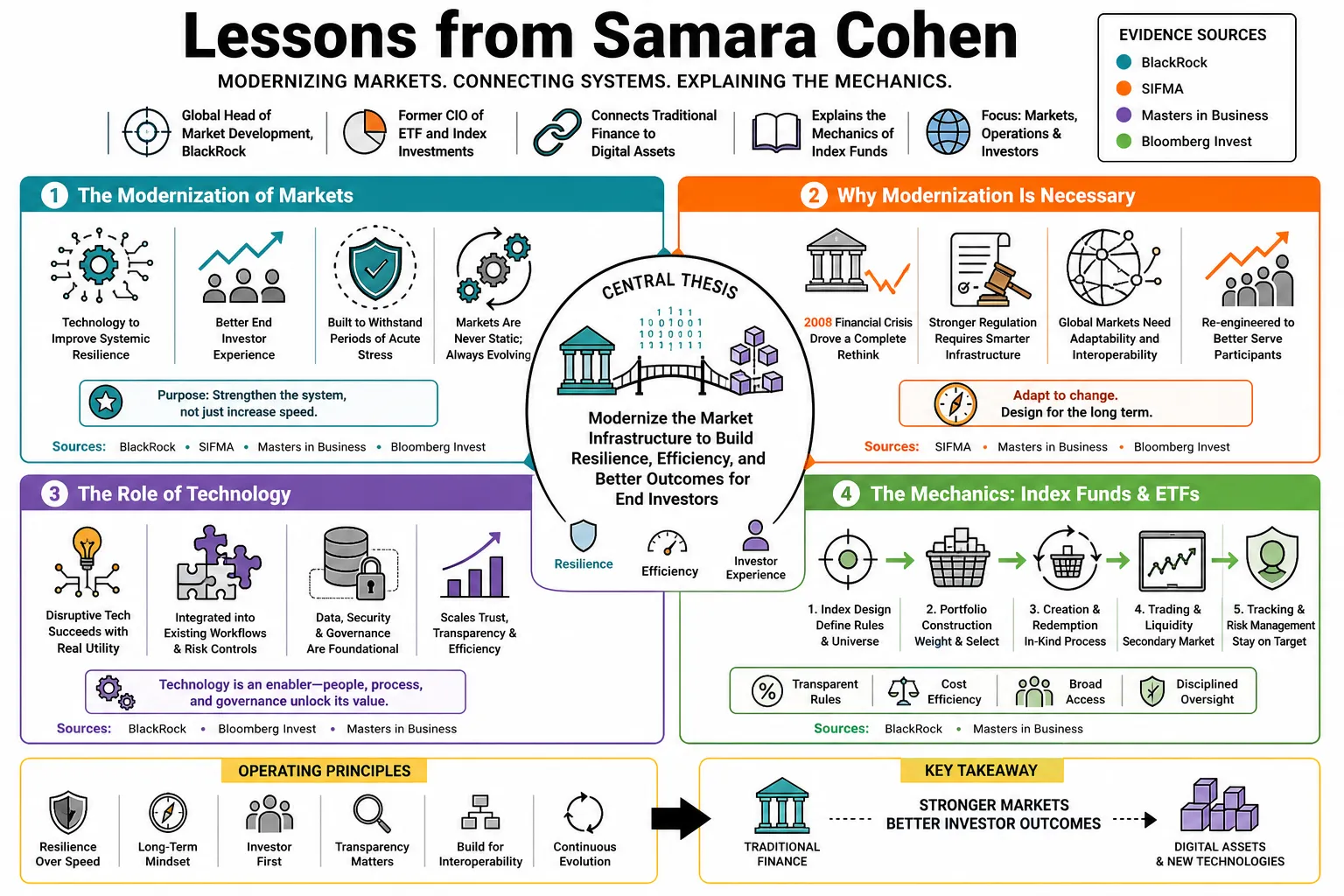
Lessons from Samara Cohen
Samara Cohen is BlackRock’s Global Head of Market Development and former Chief Investment Officer of ETF and Index Investments. She focuses on connecting traditional financial systems to digital assets and explaining the exact mechanics of managing index funds. This profile details her views on modernizing markets and the operational realities of global finance.
Part 1: The Modernization of Markets
- On the nature of modernization: Market modernization means using technology to improve systemic resilience and the end investor experience. — Source: BlackRock
- On adapting to change: The regulatory environment following the 2008 financial crisis necessitated a complete rethinking of how global markets adapt. — Source: SIFMA
- On structural efficiency: Improving market architecture is about building a system that can withstand periods of acute stress rather than simply prioritizing speed. — Source: Masters in Business
- On continuous evolution: BlackRock's leadership bio says Cohen helps shape the evolution of market structure to support investor access and product innovation. That supports the safer lesson that capital markets should keep evolving when new structures can widen access without sacrificing integrity. — Reference: BlackRock bio on shaping market structure evolution for investor access
- On the role of technology: Disruptive technologies in finance only succeed when they solve actual friction points in the existing system. — Source: Bankless
- On transparency: Modern markets require a baseline of transparency that historically existed only in public equities. — Source: Investment Week
- On resilience: The true test of any market innovation is how it behaves when liquidity dries up and volatility spikes. — Source: Masters in Business
- On complex systems: Trading floors function much like large-scale productions; they require intense coordination and a deep understanding of how disparate parts interact. — Source: Masters in Business
- On systemic upgrades: Upgrading the financial system is less about tearing down the old and more about building safer roads on top of it. — Source: BlackRock
Part 2: Demystifying Index Investing
- On the illusion of passivity: "There is absolutely nothing passive about index investing." — Source: Masters in Business
- On investment integrity: Tracking an index requires constant engineering and trading precision to ensure the product matches the promise. — Source: Masters in Business
- On the work behind the scenes: The label "passive" obscures the highly active management of corporate actions and daily liquidity needs. — Source: Leaders Magazine
- On index rebalancing: When major indices rebalance, it triggers massive trading efforts that must be executed flawlessly to avoid disruption. — Source: BlackRock
- On scale and precision: Managing trillions in index assets is an exercise in minimizing tracking error down to the basis point across global time zones. — Source: Masters in Business
- On automation: You cannot manage modern index portfolios at scale without leaning heavily into data science and automated trading infrastructure. — Source: Investment Week
- On market impact: In LEADERS, Cohen says BlackRock judges ETF market quality by liquidity, price discovery, and efficient market access. That supports the narrower lesson that large index platforms should measure their trading footprint by whether it improves market quality for investors. — Reference: LEADERS interview on liquidity, price discovery, and market access
- On the definition of risk: In index investing, risk means deviating from the stated objective of the fund rather than simply picking a bad stock. — Source: Masters in Business
- On the evolution of indexing: What started as a simple way to track the broader market has evolved into a tool for capturing highly specific thematic exposures. — Source: BlackRock
Part 3: The Evolution of ETFs
- On the purpose of ETFs: "At iShares, we are relentless in our pursuit of better ways to invest." — Source: Nasdaq
- On ETFs as technology: The exchange-traded fund is fundamentally a disruptive technology that changed how risk is bundled and traded. — Source: PANews
- On liquidity buffers: During times of stress, ETFs often act as shock absorbers by providing price discovery when the underlying bonds stop trading. — Source: Masters in Business
- On democratization: In the same LEADERS interview, Cohen says ETFs and index funds have lowered barriers to investing and that more than 120 million people globally use BlackRock's products to access markets and build portfolios. That supports the lesson that the ETF wrapper helped push institutional-style market access toward individual investors. — Reference: LEADERS interview on lowering barriers and expanding investor access
- On fixed income ETFs: The digitization of the bond market was largely accelerated by the creation and widespread adoption of fixed income ETFs. — Source: Masters in Business
- On product engineering: Building a successful ETF requires designing a creation and redemption mechanism that incentivizes market makers to keep prices tight. — Source: BlackRock
- On pricing visibility: The daily transparency of ETFs forced a shift in how asset managers justify their fees. — Source: Investment Week
- On global reach: ETFs have made it possible to trade emerging market debt with the ease of buying a single domestic stock. — Source: BlackRock
- On market quality: The health of the ETF ecosystem is directly tied to the health of the authorized participants and market makers that support it. — Source: Masters in Business
Part 4: Tokenization and Digital Assets
- On the definition of tokenization: "Tokenisation is often framed as a new asset class; it is not. It is a change in how ownership is recorded, transferred, and managed." — Source: FI Desk
- On infrastructure over speculation: The real value of blockchain in finance lies in upgrading the plumbing of the system rather than enabling speculative trading. — Source: Bankless
- On public-private integration: Tokenization acts as a bridge that brings the mechanics of public markets to historically illiquid private assets. — Source: MENA Fintech
- On avoiding fragmentation: Digital asset innovations must integrate with existing legal frameworks rather than creating separate markets that fracture liquidity. — Source: BlackRock
- On settlement efficiency: Distributed ledgers offer a pathway to near-instantaneous settlement, fundamentally altering counterparty risk models. — Source: Bankless
- On industry consensus: For tokenization to scale, the industry must develop a common language and standardized protocols. — Source: MEXC
- On regulatory engagement: Building digital asset infrastructure requires active dialogue with regulators to ensure investor protections remain intact. — Source: Cryptopolitan
- On the future of ownership: Representing real-world assets on a blockchain is the next logical step in the digitization of finance. — Source: Bankless
- On user experience: The underlying technology of a tokenized asset should be invisible to the investor; they should only experience the improved efficiency. — Source: iShares
Part 5: The Intersection of TradFi and Crypto
- On the Bitcoin ETF launch: "This is a moment of access for investors who want to invest in bitcoin through the convenience of an ETF." — Source: Nasdaq
- On building bridges: Crypto ETFs serve as essential infrastructure linking the digital asset ecosystem with traditional financial portfolios. — Source: Bankless
- On institutional adoption: BlackRock's crypto episode frames digital assets as something investors should consider as part of a portfolio and says the Bitcoin trust offers exposure through the ease and convenience of an exchange-traded product. That supports the safer lesson that broader institutional use of digital assets tends to come through familiar portfolio wrappers rather than entirely new operating models. — Reference: BlackRock crypto episode on digital assets as part of a portfolio
- On market maturation: The introduction of spot crypto ETFs marked a shift from early-stage speculation to a more mature, regulated market phase. — Source: Bankless
- On converging ecosystems: Traditional finance and decentralized finance are increasingly converging to solve distinct market inefficiencies. — Source: PANews
- On custody and security: The primary hurdle for institutional crypto engagement was always enterprise-grade custody and secure market access. — Source: Bankless
- On the role of stablecoins: Digital fiat representations are a necessary component for enabling fluid transactions on blockchain networks. — Source: PANews
- On client demand: Financial institutions do not build crypto infrastructure in a vacuum; they build it in direct response to evolving client demands. — Source: Bankless
- On educational gaps: BlackRock's advisor page says bitcoin ETPs let advisors offer exposure inside existing brokerage and tax-advantaged accounts, simplifying portfolio implementation. That supports the narrower lesson that advisor adoption depends not only on demand, but also on practical guidance about where the exposure fits and how it is implemented in client portfolios. — Reference: BlackRock advisor page on simplifying portfolio implementation
Part 6: Leadership and the Art of Casting
- On team building: "90% of directing is casting." — Source: Masters in Business
- On positioning talent: A leader’s primary job is to put people in the specific roles where their unique skills will have the highest probability of success. — Source: Masters in Business
- On the theatrical parallel: The collaborative environment of putting on a theater production maps directly to the teamwork required on a trading floor. — Source: Investment Week
- On recognizing potential: Sometimes the best person for a highly technical role is someone with a liberal arts background who knows how to coordinate complex systems. — Source: University of Pennsylvania
- On collective success: The final product relies entirely on the backstage coordination of people who the audience never sees. — Source: Investment Week
- On public speaking: The ability to communicate complex financial concepts clearly is a learned performance skill. — Source: American Banker
- On diverse perspectives: Building a capable team requires hiring people whose mental models of the world differ from your own. — Source: I2 Leadership
- On managing pressure: High-stakes financial transitions require the same emotional regulation and real-time problem-solving as a live stage production. — Source: Masters in Business
- On authentic leadership: You cannot effectively lead a team if you are attempting to play a character; authenticity is the baseline for trust. — Source: Tibi
- On giving credit: A successful product launch is always the result of a massive, unheralded ensemble effort. — Source: Masters in Business
Part 7: Career Trajectories
- On non-linear paths: There is no single correct path to a career in markets; diverse educational backgrounds often provide a distinct edge. — Source: BlackRock
- On the boomerang career: Returning to a former employer can provide a unique vantage point by combining institutional memory with outside experience. — Source: BlackRock
- On early experiences: Interning on a trading floor reveals the actual mechanics of finance in a way that classroom theory cannot replicate. — Source: BlackRock
- On transitioning focus: Moving from transition solutions to ETF indexing required shifting from bespoke problem-solving to scaled systemic engineering. — Source: SIFMA
- On identifying gaps: Career advancement often comes from identifying a structural inefficiency in the market and building a team to solve it. — Source: Masters in Business
- On continuous learning: The shift toward digital assets requires a willingness to learn entirely new technological frameworks mid-career. — Source: Bankless
- On overhyped skills: The industry often overvalues rigid financial modeling while undervaluing adaptability and systemic thinking. — Source: Tibi
- On foundational choices: Studying both theater and economics provided a dual framework for understanding human behavior and market mechanics. — Source: University of Pennsylvania
- On mentorship and support: Navigating complex corporate environments requires actively cultivating relationships with people who will advocate for your specific capabilities. — Source: I2 Leadership
- On personal challenges: Overcoming professional setbacks requires the same structural resilience you would engineer into an investment portfolio. — Source: I2 Leadership
Part 8: The Future of Investor Access
- On structural inclusion: The ultimate goal of market development is to lower the barriers to entry for participants worldwide. — Source: BlackRock
- On global trends: In her Masters in Business transcript, Cohen says the last two years were defined by more savers becoming investors globally, with roughly 40 million individual investor accounts opened in that period. That supports the safer lesson that market infrastructure has to adapt to a more global and self-directed investor base. — Reference: Masters in Business transcript on the global rise of self-directed investors
- On the role of active ETFs: BlackRock's active-ETF overview says active ETFs are growing quickly, now represent a large share of launches, and benefit from the ETF wrapper's transparency and tradability. That supports the lesson that the line between active management and ETF delivery is narrowing as more active strategies move into exchange-traded form. — Reference: BlackRock active ETF overview on active strategies moving into ETF form
- On liquidity networks: In LEADERS, Cohen describes the ETF ecosystem as highly complex and says the work spans trading strategies, education, and engagement with all market participants. That supports the safer lesson that durable liquidity comes from coordinated networks of venues, market makers, and investors rather than any single trading node. — Reference: LEADERS interview on the ETF ecosystem and participant coordination
- On technological abstraction: The end investor should not need to understand the plumbing of blockchain; they should only see an efficient portfolio. — Source: iShares
- On regulatory alignment: Expanding access requires working proactively with global regulators to ensure that new products fit within safe, understood frameworks. — Source: SIFMA
- On democratizing private markets: The next frontier of financial access involves taking historically locked-up asset classes and making them safely available to a broader base. — Source: MENA Fintech
- On data utilization: Better data science will allow for more personalized index solutions that cater to the specific values or tax needs of individual investors. — Source: Investment Week
- On the permanence of change: In the Ritholtz transcript, Cohen calls the recent period a fast-moving stream and says markets are better when they have the transparency, resilience, and agility to bring more people off the sidelines. That supports the lesson that the direction of travel in finance is ongoing adaptation toward broader access and more transparent market structure. — Reference: Masters in Business transcript on a fast-moving market and investor access
- On the ultimate mission: Every upgrade to market structure should ultimately serve the purpose of helping end investors achieve better long-term outcomes. — Source: BlackRock