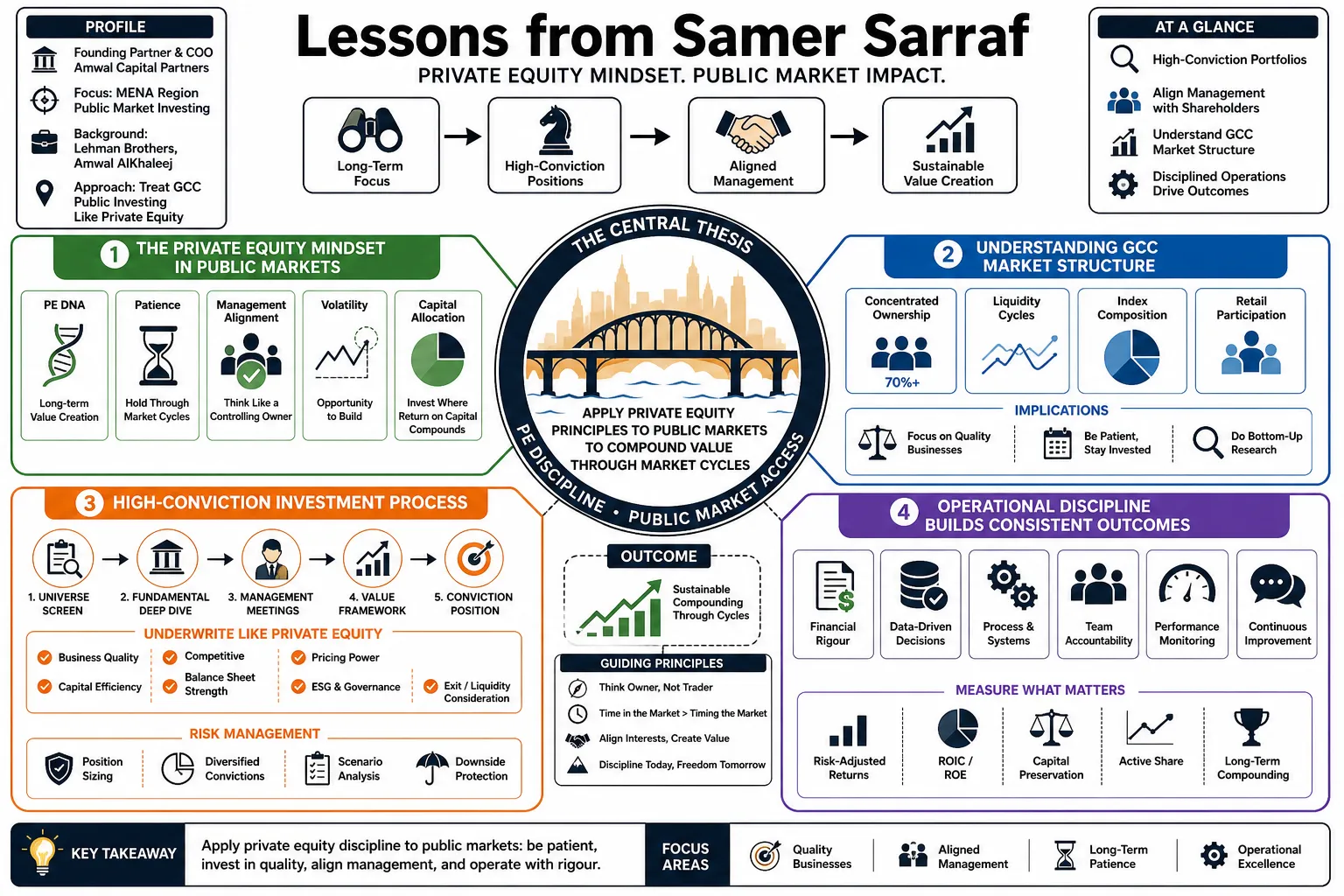
Lessons from Samer Sarraf
Samer Sarraf is a founding partner and Chief Operating Officer of Amwal Capital Partners, an independent investment firm focused on the MENA region. Drawing on his early career at Lehman Brothers and Amwal AlKhaleej, he treats GCC public market investing like private equity. This profile details his thinking on high-conviction portfolios, regional market structure, and disciplined financial operations.
Part 1: The Private Equity Mindset in Public Markets
- On PE DNA: "Applying a private equity framework to public markets allows us to focus on long-term value creation rather than reacting to short-term market noise." — Source: [Amwal Capital Partners]
- On patience: "The structural advantage of a private equity background is the willingness to hold fundamentally sound assets through market cycles." — Source: [Value Investing with Legends]
- On management alignment: "We underwrite public companies as if we were taking a controlling stake, ensuring management's incentives align with minority shareholders." — Source: [Amwal Capital Partners]
- On market volatility: "When you view a public stock as a private business, volatility becomes an opportunity to build a position rather than a reason to sell." — Source: [Value Investing with Legends]
- On capital allocation: "A core tenet of the private equity mindset is rigorously evaluating how a company's leadership chooses to deploy excess cash." — Source: [Amwal Capital Partners]
- On due diligence: "Public market research often stops at financial models; our process requires understanding the granular unit economics of the business." — Source: [Value Investing with Legends]
- On business quality: "We are not simply trading tickers; we are seeking partial ownership in highly cash-generative enterprises." — Source: [Amwal Capital Partners]
- On regional challenges: "The traditional private equity model faced specific structural hurdles in the GCC, which made applying that same discipline to liquid equities a more attractive alternative." — Source: [Value Investing with Legends]
- On active monitoring: "Our relationship with a company does not end at the purchase; we track operational milestones just as closely as a private equity sponsor would." — Source: [Amwal Capital Partners]
- On exit strategies: "Even in public markets, having a clear underwriting thesis means knowing exactly what catalysts will drive your eventual exit." — Source: [Value Investing with Legends]
Part 2: Lessons from the 2008 Financial Crisis
- On systemic risk: "Working in London during the 2008 crisis taught me that liquidity can evaporate much faster than financial models predict." — Source: [Value Investing with Legends]
- On institutional survival: "The most valuable lesson from the Lehman era was understanding how excess debt can transform a standard market correction into an existential threat." — Source: [Value Investing with Legends]
- On counterparty exposure: "You have to look past your immediate investments to understand the health of the institutions clearing and holding your assets." — Source: [Value Investing with Legends]
- On market psychology: "In a true panic, fundamental valuation takes a backseat to the immediate need for capital preservation." — Source: [Value Investing with Legends]
- On real estate cycles: "My early exposure to global real estate underscored how asset bubbles are often built on assumptions of permanent liquidity." — Source: [Amwal Capital Partners Profile]
- On margin of safety: "Experiencing a global financial collapse early in your career permanently ingrains the necessity of a wide margin of safety." — Source: [Value Investing with Legends]
- On stress testing: "We do not just model for base cases; we stress test our portfolios against the kind of systemic shocks I witnessed in 2008." — Source: [Value Investing with Legends]
- On debt structures: "The type and maturity of debt a company holds is often more critical to its survival than its current profitability." — Source: [Amwal Capital Partners Profile]
- On risk management: "True risk management isn't about avoiding drawdowns entirely; it's about ensuring you have the staying power to survive them." — Source: [Value Investing with Legends]
Part 3: Gulf Cooperation Council (GCC) Market Dynamics
- On regional transformation: "The market structure in Saudi Arabia and the UAE has matured rapidly, creating a more stable environment for institutional investors." — Source: [Value Investing with Legends]
- On regulatory tailwinds: "Understanding top-down regulatory changes is a competitive advantage when selecting bottom-up investments in the GCC." — Source: [Value Investing with Legends]
- On macro integration: "You cannot invest in the MENA region strictly on a bottom-up basis; macroeconomic insights are essential for contextualizing company performance." — Source: [Amwal Capital Partners]
- On capital markets depth: "The increasing depth and liquidity of local exchanges have made it viable to deploy concentrated capital at scale." — Source: [Value Investing with Legends]
- On the UAE economy: "The UAE's diversification away from oil dependence is creating highly investable public champions in sectors like logistics and infrastructure." — Source: [Value Investing with Legends]
- On Saudi Vision 2030: "The structural reforms in Saudi Arabia are generating unprecedented privatization opportunities for public market investors." — Source: [Amwal Capital Partners Profile]
- On information asymmetry: "The GCC markets still exhibit inefficiencies that a disciplined, on-the-ground research team can exploit." — Source: [Value Investing with Legends]
- On local nuances: "Succeeding in this region requires an appreciation for local business culture and the unwritten dynamics of corporate stewardship." — Source: [Amwal Capital Partners]
- On retail dominance: "The historical retail dominance in regional exchanges often creates mispricings that institutional, long-term capital can capture." — Source: [Value Investing with Legends]
- On foreign inflows: "As global index providers upgrade regional exchanges, the structural inflow of foreign capital changes the valuation baseline." — Source: [Amwal Capital Partners Profile]
Part 4: High-Conviction Portfolio Strategy
- On concentration: "We do not believe in broad index tracking; our strategy relies on high-conviction positions in fundamentally attractive businesses." — Source: [Amwal Capital Partners]
- On avoiding dilution: "If you have done the rigorous work to identify a great company, diluting that position with your twentieth best idea destroys alpha." — Source: [Amwal Capital Partners Profile]
- On tracking error: "A long-biased, concentrated strategy inherently means accepting tracking error relative to regional benchmarks." — Source: [Amwal Capital Partners]
- On conviction building: "Conviction is built over months of research and tested through direct engagement with management." — Source: [Amwal Capital Partners Profile]
- On position sizing: "Capital should be allocated disproportionately to the ideas where our informational advantage and margin of safety are highest." — Source: [Amwal Capital Partners]
- On market noise: "A concentrated portfolio forces you to ignore daily price fluctuations and focus entirely on the underlying business fundamentals." — Source: [Amwal Capital Partners Profile]
- On holding periods: "We evaluate our investments with a multi-year horizon, allowing the compounding nature of these businesses to materialize." — Source: [Amwal Capital Partners]
- On portfolio overlap: "We ensure our concentrated positions do not share the same underlying macroeconomic vulnerabilities." — Source: [Amwal Capital Partners Profile]
- On benchmark constraints: "Constraining yourself to benchmark sector weightings is counterproductive when your goal is absolute return generation." — Source: [Amwal Capital Partners]
Part 5: Operational Excellence and Firm Growth
- On technological agility: "As we expand our product offerings and set our sights on new asset classes, modern solutions provide our business with the agility we need." — Source: [Broadridge Press Release]
- On scalable architecture: "A firm’s growth plans are only possible if its operational foundation is scalable enough to handle increasing complexity." — Source: [Broadridge Press Release]
- On streamlining processes: "Implementing modern technology platforms helps us successfully streamline our operations across the entire trade lifecycle." — Source: [Broadridge Press Release]
- On client delivery: "Operational efficiency directly allows us to continue delivering on each of our clients' individual requirements." — Source: [Broadridge Press Release]
- On execution speed: "The implementation of institutional-grade infrastructure must be quick and precise to minimize disruption to the investment team." — Source: [Broadridge Press Release]
- On operational risk: "As COO, my priority is ensuring that our back and middle offices are as rigorous and disciplined as our investment front office." — Source: [Amwal Capital Partners]
- On multi-asset expansion: "Moving across equities, fixed income, and private credit requires a unified operational framework to manage risk effectively." — Source: [Amwal Capital Partners]
- On vendor partnerships: "The support from a technology partner post-implementation is just as critical as the initial software deployment." — Source: [Broadridge Press Release]
- On continuous improvement: "Operational excellence is not a static achievement; it requires constant upgrades to keep pace with global best practices." — Source: [Amwal Capital Partners]
Part 6: ESG and Corporate Governance
- On governance premiums: "In the MENA region, we find that companies with superior corporate governance consistently trade at a premium over time." — Source: [Amwal Capital Partners]
- On ESG integration: "Environmental, Social, and Governance considerations are not an overlay for us; they are fully integrated into our equity and credit research." — Source: [Amwal Capital Partners]
- On minority protections: "We heavily scrutinize a board's historical treatment of minority shareholders before committing capital to a public entity." — Source: [Amwal Capital Partners Profile]
- On transparent reporting: "A company's willingness to improve its financial transparency is often a leading indicator of future operational improvements." — Source: [Amwal Capital Partners]
- On sustainable practices: "We assess environmental risks beyond basic compliance, viewing them as a core factor in long-term capital expenditure planning." — Source: [Amwal Capital Partners Profile]
- On social impact: "Businesses that align their operations with the broader social development goals of the GCC are better positioned for regulatory support." — Source: [Amwal Capital Partners]
- On board independence: "We look for boards that demonstrate genuine independence and the capacity to challenge executive management." — Source: [Amwal Capital Partners Profile]
- On capital stewardship: "Governance ultimately boils down to how management stewards shareholder capital during both boom and bust cycles." — Source: [Amwal Capital Partners]
- On Shariah compliance: "Offering Shariah-compliant investment options requires an added layer of ethical and financial screening that complements our ESG framework." — Source: [Amwal Capital Partners]
Part 7: Fundamental Research and Due Diligence
- On on-the-ground research: "You cannot effectively invest in this region from a desk thousands of miles away; local presence is mandatory." — Source: [Value Investing with Legends]
- On channel checks: "Our research process involves extensive channel checks with suppliers, competitors, and customers to validate management's claims." — Source: [Amwal Capital Partners]
- On financial modeling: "A model is only as good as the qualitative inputs driving its assumptions." — Source: [Amwal Capital Partners Profile]
- On identifying catalysts: "Finding a cheap stock is insufficient; we must identify the specific operational or regulatory catalyst that will unlock its value." — Source: [Value Investing with Legends]
- On competitive moats: "We search for businesses possessing durable competitive advantages that protect margins in a region prone to rapid development." — Source: [Amwal Capital Partners]
- On management quality: "We spend significant time evaluating the track record and strategic vision of the executive team before initiating a position." — Source: [Amwal Capital Partners Profile]
- On cross-capital structure: "Analyzing a company's fixed income and private credit profiles provides deeper insights into its equity valuation." — Source: [Amwal Capital Partners]
- On avoiding value traps: "Disciplined due diligence helps us separate temporary mispricings from companies in structural decline." — Source: [Value Investing with Legends]
- On historical context: "Understanding a company's historical capital allocation decisions is the best predictor of its future behavior." — Source: [Amwal Capital Partners Profile]
- On continuous underwriting: "Our thesis on a company is never static; it is constantly re-underwritten as new fundamental data emerges." — Source: [Amwal Capital Partners]
Part 8: Sector Insights: Logistics, Resources, and Engineering
- On Abu Dhabi Ports: "Assets like Abu Dhabi Ports represent generational investments in the region's long-term industrial and logistics infrastructure." — Source: [Value Investing with Legends]
- On engineering origins: "Starting my career in engineering and construction gave me a fundamental appreciation for how hard assets are built and valued." — Source: [Value Investing with Legends]
- On natural resources: "My time in Lehman's Natural Resources Group highlighted how commodity cycles dictate the broader economic tempo in emerging markets." — Source: [Amwal Capital Partners Profile]
- On supply chain shifts: "The global rewiring of supply chains presents a massive tailwind for logistics operators situated in the GCC." — Source: [Value Investing with Legends]
- On infrastructure monopolies: "Regulated infrastructure assets offer the type of cash flow visibility that allows for highly concentrated, long-term capital deployment." — Source: [Value Investing with Legends]
- On industrial diversification: "The region's push toward industrial diversification is creating new public champions outside the traditional petrochemical sectors." — Source: [Amwal Capital Partners Profile]
- On real asset valuation: "Evaluating real estate and infrastructure requires understanding replacement costs and local regulatory barriers to entry." — Source: [Amwal Capital Partners Profile]
- On cyclicality: "Investors must structurally differentiate between secular growth compounders and highly cyclical resource extractors." — Source: [Value Investing with Legends]
- On port economics: "The true value of a port asset extends beyond raw cargo volume, found within the sticky, high-margin industrial zones that develop around it." — Source: [Value Investing with Legends]