Sandhya Hegde is a General Partner at Unusual Ventures and the former Executive Vice President of Marketing and Growth at Amplitude, where she helped scale the company's revenue fifty-fold. She is best known for her practical frameworks on product-led growth, implementing North Star metrics, and designing rigorous evaluation systems for enterprise AI. This profile gathers her core insights on building resilient teams, navigating early-stage startup chaos, and aligning product strategy with go-to-market execution.
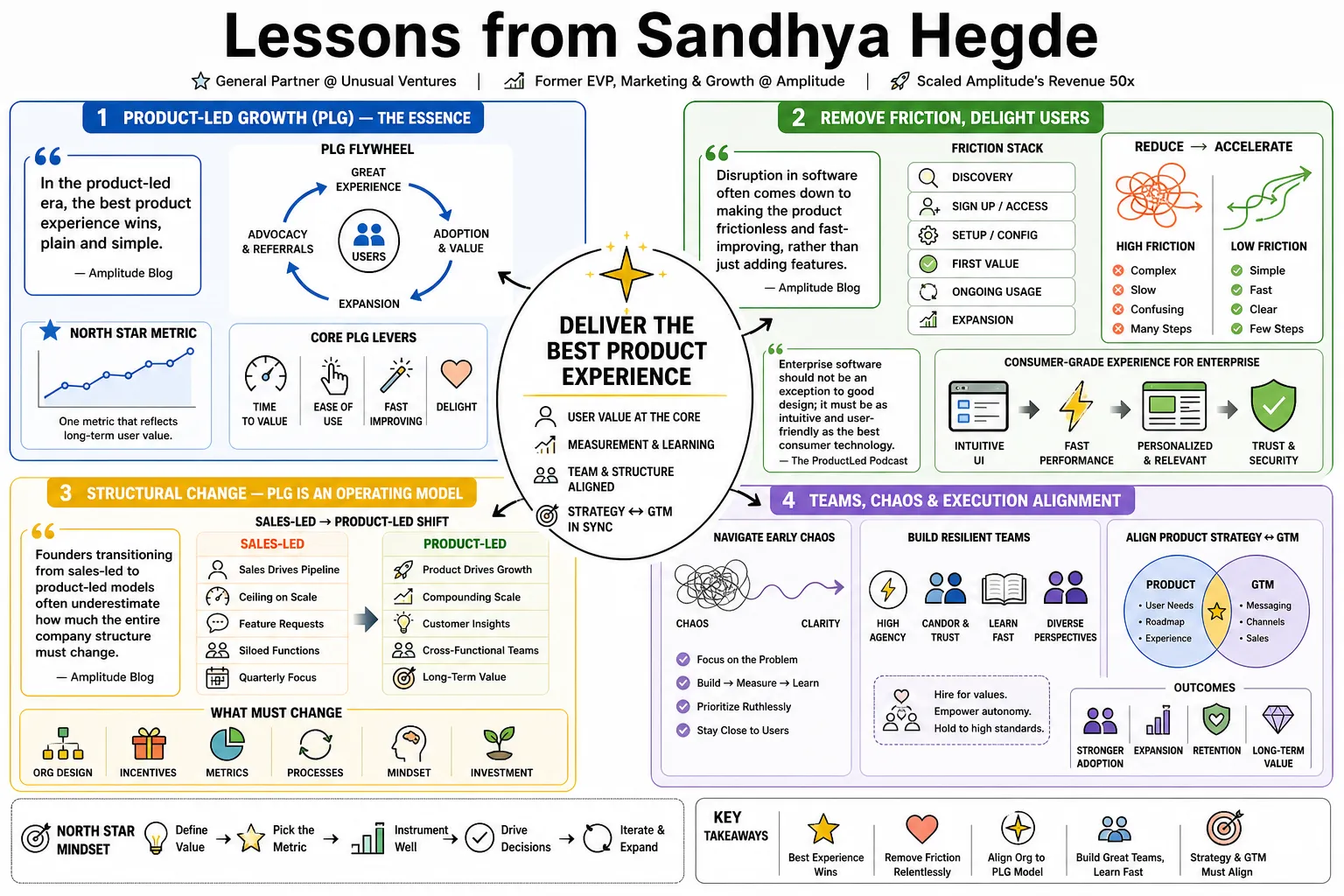
Part 1: Product-Led Growth (PLG)
- On the essence of PLG: "In the product-led era, the best product experience wins, plain and simple." — Source: Amplitude Blog
- On removing friction: "Disruption in software often comes down to making the product frictionless and fast-improving, rather than just adding features." — Source: Amplitude Blog
- On enterprise software: "Enterprise software should not be an exception to good design; it must be as intuitive and user-friendly as the best consumer technology." — Source: The ProductLed Podcast
- On structural changes: "Founders transitioning from sales-led to product-led models often underestimate how much the entire company structure must change to support self-serve users." — Source: The ProductLed Podcast
- On early personalization: "A great product-led experience feels personalized from the first interaction, guiding the user to value before they ever speak to a sales rep." — Source: Amplitude Blog
- On demonstrating value: "Your product is your best salesperson, but only if it clearly demonstrates value in the first five minutes of usage." — Source: Unusual Ventures
- On vanity metrics: "Going viral is overrated if it doesn't lead to sustainable growth and retention. Focus on engaged users, not just signups." — Source: Amplitude Blog
- On onboarding: "Onboarding is not a one-time tutorial; it is an ongoing process of progressively revealing value to the user as their needs grow." — Source: Unusual Ventures
- On finding fit: "Every overnight success in the world of software happens after years of hard work finding product-market fit." — Source: The Startup Field Guide
- On sales efficiency: "A common misconception is that product-led growth means you don't need a sales team. In reality, it makes your sales team infinitely more efficient." — Source: The ProductLed Podcast
Part 2: Product Analytics & The North Star Metric
- On defining the metric: "A North Star Metric is the key measure of success for a product team, bridging the gap between customer problem-solving and business revenue." — Source: Medium
- On alignment: "The true purpose of a North Star Metric is to provide clarity and align teams on what to optimize, shifting the focus from merely shipping features to driving business impact." — Source: Medium
- On the nature of analytics: "While Business Intelligence tools focus on historical, audited reporting, product analytics requires real-time, self-serve, exploratory data." — Source: Amplitude Blog
- On the need for speed: "In a 'move-fast' culture, the ability to analyze user behavior immediately and understand why users return is a massive competitive advantage." — Source: Amplitude Blog
- On organizational culture: "Building a data-informed culture is the hardest part of product analytics; tools are easy to buy, but changing how people make decisions is difficult." — Source: Amplitude Blog
- On tracking features: "You need to be able to understand exactly how a specific feature release impacts the overall user experience, not just guess based on high-level trends." — Source: Amplitude Blog
- On leading indicators: "Revenue is a lagging indicator. Product teams must measure the leading indicators of value creation to know if they are on the right track." — Source: Medium
- On team accountability: "A well-defined North Star Metric ensures accountability across the organization by making the connection between daily work and company success explicit." — Source: Medium
- On empowering managers: "Product managers need the freedom to ask 'why' and explore data without waiting weeks for a data science team to write custom SQL queries." — Source: Amplitude Blog
- On the limits of quantitative data: "Data tells you what is happening, but you still need empathy and qualitative research to understand why it is happening." — Source: Medium
Part 3: Startup Foundations & Decision Making
- On commitment: In her Unusual Ventures early-team interview, Hegde says most startup decisions are reversible and that companies suffer when teams cannot commit strongly enough to move forward. — Reference: Unusual Ventures early-team interview with Sandhya Hegde
- On speed: The same interview frames decision quality around how quickly a team can decide, commit, and change course if new information arrives. — Reference: Unusual Ventures early-team interview with Sandhya Hegde
- On early feedback: "Founders must prioritize getting their product in front of real users as quickly as possible, even if it feels uncomfortably early." — Source: Unusual Ventures
- On the nature of a pivot: "A pivot is not a failure; it is a rapid realization that the current path isn't working, followed by a decisive shift toward a better opportunity." — Source: The Startup Field Guide
- On synthesizing clarity: "Early-stage startups are defined by ambiguity. The best founders are those who can synthesize clarity out of chaos for their team." — Source: Unusual Ventures
- On market timing: "Being too early is often functionally identical to being wrong. You have to survive long enough for the market to catch up to your vision." — Source: The Startup Field Guide
- On resource constraints: "Constraints force creativity. When you don't have unlimited capital, you are forced to solve problems through ingenuity rather than spending." — Source: Unusual Ventures
- On competitive obsession: "Obsess over your customers, not your competitors. If you are constantly reacting to competitors, you are letting them dictate your roadmap." — Source: The Startup Field Guide
- On the zero-to-one transition: "Going from zero to one requires a completely different mindset than scaling from one to ten. It requires sheer force of will and a willingness to do unscalable things." — Source: Unusual Ventures
- On strategic focus: "The biggest risk for an early-stage startup is dying of indigestion, not starvation. You have to say no to almost everything to succeed at the one thing that matters." — Source: The Startup Field Guide
Part 4: Early Team Hiring & Culture
- On hiring listeners: Hegde advises founders not to hire someone they will not listen to, because the point of an early hire is to add judgment the founder genuinely wants in the room. — Reference: Unusual Ventures early-team interview with Sandhya Hegde
- On title-chasing: Hegde calls a title bump one of the worst reasons to join a startup and suggests founders test motivation by asking whether the candidate would still join without the vanity title. — Reference: Unusual Ventures early-team interview with Sandhya Hegde
- On deep motivation: Her early-team guidance distinguishes superficial status motives from the stronger reasons to join a startup: making something from nothing and doing the work a young company actually needs. — Reference: Unusual Ventures early-team interview with Sandhya Hegde
- On foundational culture: Hegde's advice that early hires must work across bottlenecks supports a culture lesson: the first team sets whether the company rewards ownership or narrow lane-keeping. — Reference: Unusual Ventures early-team interview with Sandhya Hegde
- On diagnosing growth: "The best way to understand growth blockers is not just through financial spreadsheets but by understanding the people and ensuring they are hired, led, and incentivized correctly." — Source: Crunchbase
- On intellectual honesty: "You need a team that is comfortable with intellectual friction and willing to tell the founder when an idea isn't working." — Source: Unusual Ventures
- On team composition: Hegde says the first hiring wave should be generalist doers who can pivot to the company's bottleneck; specialist doers come later when the problem is clearer. — Reference: Unusual Ventures early-team interview with Sandhya Hegde
- On defining fit: "Cultural fit doesn't mean hiring people who are exactly like you; it means hiring people who share your foundational values and work ethic." — Source: Unusual Ventures
- On correcting mistakes: The interview treats early hiring as a sequence of avoidable mistakes around timing, role shape, and fit, supporting a cautious lesson about correcting mismatches before they slow the company. — Reference: Unusual Ventures early-team interview with Sandhya Hegde
Part 5: Leadership & The CEO Role
- On the reality of the job: Hegde describes the CEO role as unusually inflexible: the CEO has to become what the company needs rather than simply choosing the work they enjoy. — Reference: Unusual Ventures early-team interview with Sandhya Hegde
- On losing autonomy: Her CEO-role advice is explicit that founders do not get much personal choice; the company's current needs should determine where the CEO spends attention. — Reference: Unusual Ventures early-team interview with Sandhya Hegde
- On scaling leadership: "The role of the CEO changes every time the company doubles in size. What made you successful at ten people will break at fifty." — Source: Unusual Ventures
- On setting boundaries: "The leader sets the ceiling for the organization's ambition and the floor for its acceptable behavior." — Source: The Startup Field Guide
- On founder communication: "Founders must strike a delicate balance between being transparent about challenges and projecting enough confidence to keep the team motivated." — Source: The Startup Field Guide
- On self-management: "A founder's most difficult task is often managing their own psychology and maintaining emotional resilience through the inevitable lows." — Source: Unusual Ventures
- On scaling output: "You cannot scale yourself unless you learn to delegate outcomes, not just tasks, to leaders you trust." — Source: The Startup Field Guide
- On ego and learning: "The best CEOs are voracious learners who are constantly seeking feedback and adjusting their mental models." — Source: Unusual Ventures
- On pure endurance: "Endurance is often more important than intellect. The founders who win are usually the ones who simply refuse to quit when things get hard." — Source: The Startup Field Guide
Part 6: Artificial Intelligence & Enterprise SaaS
- On agent adoption: "For AI agents to succeed in enterprise settings, teams must move beyond vanity metrics and implement rigorous systems to measure performance." — Source: Reforge
- On evaluation frameworks: "You need rigorous evaluation frameworks to understand whether the AI is actually performing 'good work' and delivering tangible value." — Source: Maven
- On shifting software value: In highCalibre, Hegde argues that AI agents threaten incumbent SaaS workflows by changing software utilization, manual workflow economics, and where defensible value sits. — Reference: highCalibre essay on AI agents and ServiceNow
- On pricing innovation: Hegde's AI pricing essay argues that most high-growth AI startups still use seat and consumption pricing, and that good packaging should align with the customer's unit of value without artificial complexity. — Reference: highCalibre essay on AI pricing
- On true automation: "The real opportunity in AI isn't just generating text; it's automating complex, multi-step workflows that currently bog down knowledge workers." — Source: highCalibre
- On trust and compliance: "Enterprise adoption of AI will hinge on trust and predictability. If an AI agent hallucinating can cause a compliance breach, adoption will stall." — Source: highCalibre
- On defensibility: "In an AI-first world, your proprietary data and how you use it to fine-tune models become your most defensible moat." — Source: highCalibre
- On ignoring the hype: "Founders need to look past the hype cycle of foundation models and focus obsessively on solving specific, painful user problems." — Source: highCalibre
- On passive versus active software: "AI is going to turn many software applications from passive tools that require user operation into active agents that operate on behalf of the user." — Source: highCalibre
Part 7: Go-To-Market & Growth Strategy
- On knowing the buyer: "Selling to product teams requires a completely different playbook than traditional B2B marketing; it necessitates deep research into how they actually make buying decisions." — Source: Amplitude Blog
- On structural alignment: "Your GTM strategy must be tightly coupled with your product capability. A product built for self-serve will fail with an enterprise-heavy sales motion." — Source: Unusual Ventures
- On evangelism: "Creating a category means building a community of practitioners who champion your approach, much like what was done with the 'Amplify' conference." — Source: Crunchbase
- On writing copy: "Your messaging should focus on the exact transformation your customer will undergo by using your product, rather than a list of technical features." — Source: Unusual Ventures
- On finding the first users: "Early on, you aren't looking for a large market; you are looking for a small group of desperate users who are willing to overlook your product's flaws." — Source: The Startup Field Guide
- On early metrics: "Cost of Customer Acquisition and Lifetime Value only matter once you have repeatable sales. Before that, focus entirely on usage and retention." — Source: Unusual Ventures
- On internal alignment: "The classic tension between sales and marketing usually stems from a misalignment on what constitutes a qualified lead and how it should be followed up on." — Source: Unusual Ventures
- On sustainable loops: "You cannot hack your way to sustainable growth. True growth is a system of compounding loops based on core product value." — Source: Amplitude Blog
- On proactive retention: "When customers churn, don't just ask them why they are leaving. Look at the data to see what they stopped doing weeks before they made the decision to cancel." — Source: Amplitude Blog
Part 8: Venture Capital & Investing
- On operational involvement: "Early-stage founders deserve more than just capital. They need deep, operational support and high-integrity partnerships to navigate the hardest phases of company building." — Source: Unusual Ventures
- On the investor's job: "Venture firms should actively help build companies, acting as true operational partners rather than just passive financiers sitting on a board." — Source: Unusual Ventures
- On investment goals: "The goal of venture investing is to find and support companies that set new industry standards for both customer value and employee impact." — Source: Crunchbase
- On breaking patterns: "Firms must be willing to disrupt the entrenched problems of Silicon Valley culture to find the best founders from all backgrounds." — Source: Crunchbase
- On assessing pitches: "When evaluating an early-stage pitch, I am looking for a founder's unique insight into a market problem that others have fundamentally misunderstood." — Source: Startup Intros
- On operator experience: "Investors who have actually operated and scaled a company bring a battle-tested perspective that is invaluable when a startup inevitably hits roadblocks." — Source: Unusual Ventures
- On independent thinking: "Venture capital is a game of outliers. You have to be willing to have high conviction on an unconventional idea when the rest of the market is skeptical." — Source: Venture Capital Journal
- On the seed round: "The seed stage is less about the financials and almost entirely about the founder's grit, clarity of thought, and capacity to attract exceptional talent." — Source: Unusual Ventures
- On the investor-founder relationship: "A venture investment is a ten-year marriage. Both sides need to be completely honest about their expectations and values before signing the term sheet." — Source: Unusual Ventures