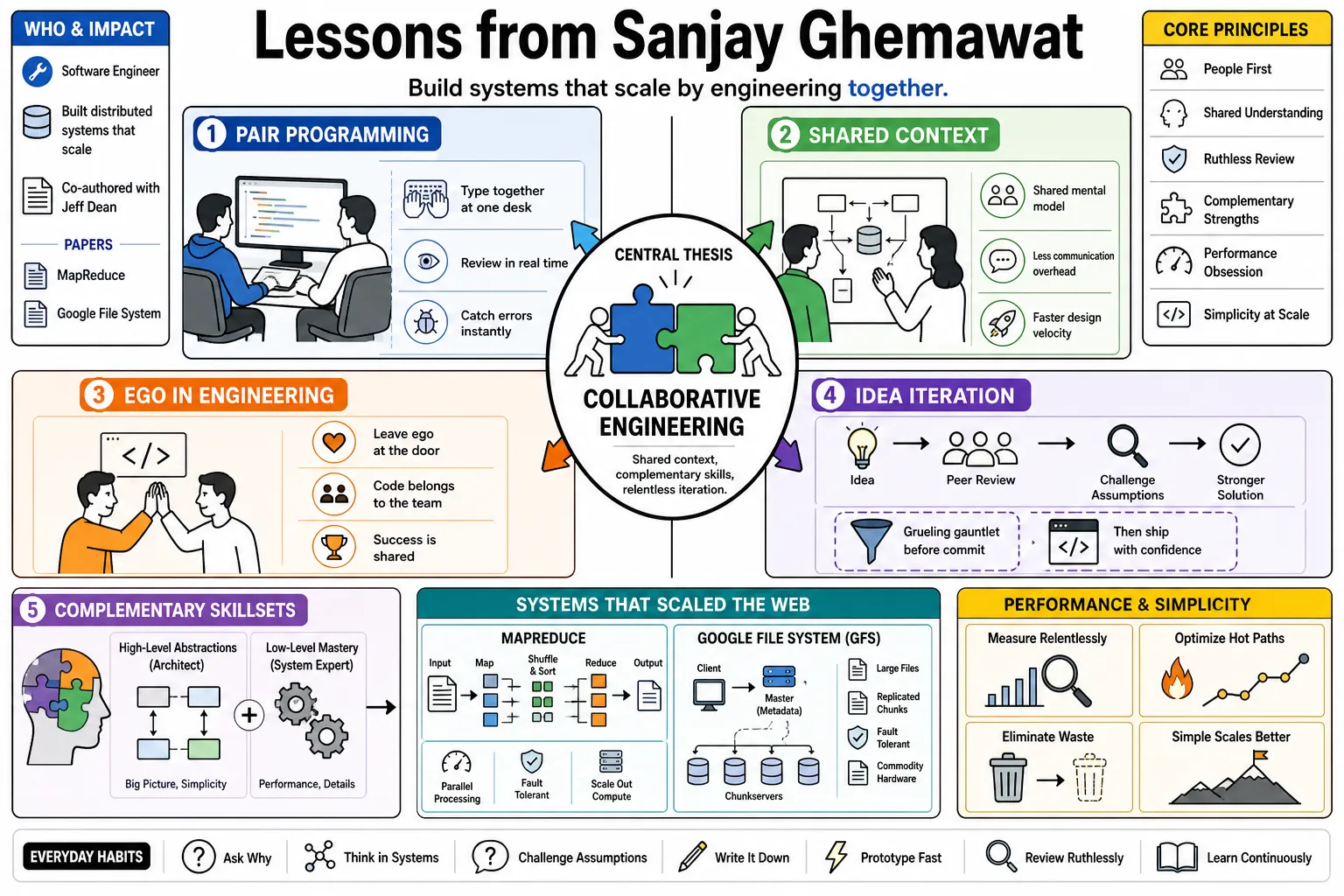
Lessons from Sanjay Ghemawat
Software engineer Sanjay Ghemawat built the distributed systems that let Google scale. He co-authored the MapReduce and Google File System papers with Jeff Dean, creating the practical abstractions needed to process internet-scale data. This profile catalogs his approaches to pair programming, system design, and performance optimization.
Part 1: Collaborative Engineering
- On Pair Programming: "Coding simultaneously at the same desk allows one person to actively type while the other constantly reviews, catching errors instantly." — Source: [The New Yorker]
- On Shared Context: "Maintaining a shared mental model of a complex system drastically reduces communication overhead and accelerates design." — Source: [The New Yorker]
- On Ego in Engineering: "True collaboration requires shedding ego; the code belongs to the team, rather than the individual who typed it." — Source: [Software Engineering at Google]
- On Idea Iteration: "The best ideas survive a grueling gauntlet of peer review where assumptions are relentlessly challenged before a single line is committed." — Source: [ACM Interview]
- On Complementary Skillsets: "A great engineering partnership thrives when one person excels at high-level abstractions while the other masters low-level memory management." — Source: [The New Yorker]
- On Brainstorming: "We routinely sketch architectures on whiteboards for hours, refining the data flow until the simplest possible solution emerges." — Source: [Stephen Ibaraki Podcast]
- On Trust: "Deep technical partnerships are built on absolute trust in the other person's technical judgment and commitment to the project." — Source: [The New Yorker]
- On Code Review: "Immediate, over-the-shoulder code review eliminates the latency of asynchronous feedback loops." — Source: [Software Engineering at Google]
- On Working Rhythms: "Finding a partner whose coding rhythm matches yours creates a compounding effect on overall productivity." — Source: [The New Yorker]
Part 2: System Design Philosophy
- On Practical Problem Solving: "The main motivation behind the development of much of Google's infrastructure was the practical challenge of keeping up with ever-growing data sets." — Source: [High Scalability]
- On Simplicity: "Systems should be designed with the simplest abstractions that can possibly satisfy the immediate requirements of the user." — Source: [Software Engineering at Google]
- On Back-of-the-Envelope Math: "Engineers must rely on basic arithmetic and latency numbers to validate architectural decisions before writing code." — Source: [Stanford CS345 Lecture]
- On Avoiding Premature Abstraction: "Building overly generic systems often leads to bloated software that fails to serve its primary use case efficiently." — Source: [Performance Hints]
- On Hardware Constraints: "Software architecture cannot be divorced from physical hardware limits; understanding disk seek times and network bandwidth is mandatory." — Source: [The Google File System]
- On Fault Tolerance: "At scale, component failure is the norm, not the exception. Systems must be designed to automatically recover from hardware crashes." — Source: [The Google File System]
- On API Design: "An API should be so intuitive that client developers can integrate it without constantly consulting the documentation." — Source: [Software Engineering at Google]
- On System Evolution: "Successful systems are rarely designed perfectly from the start; they evolve through painful lessons learned in production environments." — Source: [Bigtable: A Distributed Storage System]
- On Simulation: "Mentally simulating the data flow and potential failure states of a system is a prerequisite to implementation." — Source: [The New Yorker]
- On Reading the Metal: "A high-level systems engineer must still understand what the CPU cache is doing during core execution paths." — Source: [Performance Hints]
Part 3: The Origins of MapReduce
- On Programming Models: "MapReduce is a programming model and an associated implementation for processing and generating large datasets that is amenable to a broad variety of real-world tasks." — Source: [MapReduce Paper]
- On Hiding Complexity: "MapReduce succeeds because it abstracts away the messy details of parallelization, fault tolerance, and load balancing from the application developer." — Source: [MapReduce Paper]
- On Functional Inspiration: "Our abstraction was directly inspired by the map and reduce primitives present in Lisp and other functional languages." — Source: [MapReduce Paper]
- On Locality: "Moving compute to the data is orders of magnitude faster than moving massive amounts of data to the compute nodes." — Source: [MapReduce Paper]
- On Scalability: "By automatically handling machine failures and task scheduling, the framework allows developers to focus entirely on data processing logic." — Source: [MapReduce Paper]
- On Developer Productivity: "By standardizing the processing model, we reduced the time it took to write large-scale data analysis jobs from weeks to hours." — Source: [MapReduce Paper]
- On Straggler Mitigation: "Implementing backup tasks for the remaining in-progress computations significantly reduces the time to complete a large MapReduce operation." — Source: [MapReduce Paper]
- On Internal Adoption: "The model was so successful internally that it quickly became the default standard for generating search indices and processing logs." — Source: [The New Yorker]
- On Academic Pushback: "Despite criticism from the traditional database community, the system proved its worth through raw operational success at an unprecedented scale." — Source: [MapReduce Paper Responses]
- On Legacy: "While Google eventually moved on to Flume and Cloud Dataflow, the mental model of MapReduce permanently altered how the industry approaches large datasets." — Source: [Software Engineering at Google]
Part 4: Large-Scale Distributed Storage
- On Commodity Hardware: "Building a reliable file system on top of cheap, unreliable hardware requires treating node failure as a daily occurrence to be handled in software." — Source: [The Google File System]
- On File Sizes: "Traditional file systems are optimized for small files, but our workloads consisted of multi-gigabyte files, requiring a completely new chunking architecture." — Source: [The Google File System]
- On Master Nodes: "Centralizing metadata in a single master node simplifies the system design, provided the master is kept out of the actual data transfer path." — Source: [The Google File System]
- On Append Operations: "Optimizing for large, sequential appends rather than random writes was a necessary trade-off that matched our actual data ingestion patterns." — Source: [The Google File System]
- On Bigtable's Data Model: "Bigtable is a sparse, distributed, persistent multidimensional sorted map, designed to store Petabytes of data across thousands of commodity servers." — Source: [Bigtable Paper]
- On SSTables: "Using immutable Sorted String Tables as the underlying storage format allows for highly efficient reads and massive write throughput." — Source: [Bigtable Paper]
- On Flexibility: "Clients need the ability to dynamically control whether data is stored in memory or on disk to optimize for different access latencies." — Source: [Bigtable Paper]
- On Distributed Locks: "Building a reliable lock service like Chubby is a prerequisite for managing the metadata and leader election in a system like Bigtable." — Source: [Bigtable Paper]
- On System Abstractions: "GFS and Bigtable demonstrated that highly specialized, proprietary storage layers could out-perform general-purpose databases for indexing." — Source: [Software Engineering at Google]
Part 5: Scaling Databases Worldwide
- On Global Consistency: "Spanner is the first system to distribute data at global scale and support externally-consistent distributed transactions." — Source: [Spanner Paper]
- On Time Uncertainty: "Handling clock uncertainty explicitly in the API allows developers to build systems that guarantee strict serializability across continents." — Source: [Spanner Paper]
- On TrueTime: "The TrueTime API, backed by GPS and atomic clocks, was the hardware innovation needed to solve the software problem of distributed consensus." — Source: [Spanner Paper]
- On Relational Semantics: "After years of NoSQL, we realized that developers actually want strong consistency and SQL query languages, lacking only the traditional scaling limits." — Source: [Spanner Paper]
- On Replication: "Synchronous replication across datacenters ensures that even if an entire region goes offline, no committed data is ever lost." — Source: [Spanner Paper]
- On Transaction Latency: "The commit wait rule in Spanner ensures that no client can see the result of a transaction until the clock uncertainty window has passed." — Source: [Spanner Paper]
- On Sharding: "Automatic, dynamic resharding of data across servers prevents hot spots and reduces manual operational overhead for database administrators." — Source: [Spanner Paper]
- On Legacy Constraints: "Building Spanner taught us that replacing a legacy system like MegaStore requires matching its complex feature set while delivering better performance." — Source: [Spanner Paper]
- On CAP Theorem: "Spanner practically operates as a CA system most of the time, accepting that network partitions are rare enough to prioritize consistency and availability." — Source: [Spanner Paper]
Part 6: Performance Tuning
- On Optimization Philosophies: "The famous quote about premature optimization being evil is true, but it should not be an excuse to ignore the 3% of code that drives system performance." — Source: [Performance Hints]
- On Memory Allocation: "In high-throughput systems, excessive object allocation and garbage collection pauses become the primary bottlenecks; reusing objects is essential." — Source: [Performance Hints]
- On Profiling Tools: "You cannot optimize what you cannot measure. Continuous profiling in production is necessary to understand actual workload behavior." — Source: [Software Engineering at Google]
- On Caching: "Caching is a powerful tool for reducing latency, but managing cache invalidation at scale introduces some of the hardest bugs in computer science." — Source: [High Scalability]
- On Protocol Buffers: "Using compact, strongly-typed binary serialization formats drastically reduces network overhead compared to parsing verbose text formats like XML." — Source: [Software Engineering at Google]
- On Tail Latency: "At scale, the 99.9th percentile latency matters. A request that fans out to thousands of servers will be bound by the slowest single node." — Source: [The Tail at Scale]
- On Concurrency: "Designing lock-free data structures is difficult, but often necessary to fully utilize modern multi-core processors without thread contention." — Source: [Performance Hints]
- On Disk I/O: "Sequential disk reads are orders of magnitude faster than random seeks; systems should be designed to stream data rather than hop across the platter." — Source: [The Google File System]
- On Code Simplicity vs Speed: "Sometimes the most performant code is slightly more complex, but that complexity must be isolated behind a clean, simple interface." — Source: [Performance Hints]
Part 7: Managing Complexity at Scale
- On Monorepos: "Storing all of a company's code in a single massive repository simplifies dependency management and allows for sweeping, cross-project refactoring." — Source: [Software Engineering at Google]
- On Tooling: "Investing heavily in internal developer tools like fast build systems and code search pays dividends in overall engineering velocity." — Source: [Software Engineering at Google]
- On Backwards Compatibility: "When designing infrastructure, you must plan for it to live for a decade or more, making rigorous API versioning a strict requirement." — Source: [Software Engineering at Google]
- On Technical Debt: "Deprecating old systems is as important as building new ones; maintaining multiple overlapping platforms drains engineering resources." — Source: [Software Engineering at Google]
- On Testing: "Unit tests serve a purpose beyond correctness; they act as living documentation that explains how complex subsystems are intended to behave." — Source: [Software Engineering at Google]
- On Outages: "Post-mortems should be blameless. The goal is to identify systemic flaws and add programmatic safeguards, avoiding punishment for the engineer who triggered the bug." — Source: [Software Engineering at Google]
- On Infrastructure as a Platform: "Application developers should not have to think about machine provisioning; they should interface with logical clusters and let the system handle the rest." — Source: [The New Yorker]
- On Code Readability: "Code is read far more often than it is written. Optimizing for readability ensures that future maintainers can safely modify the system." — Source: [Software Engineering at Google]
- On Incremental Rollouts: "Never deploy a core infrastructure change globally all at once. Gradual, monitored rollouts prevent localized bugs from becoming catastrophic outages." — Source: [Software Engineering at Google]
Part 8: Career and Culture
- On Finding the Right Problems: "Impactful engineering work comes from identifying the systemic bottlenecks that hold back entire product teams." — Source: [ACM Interview]
- On Focus: "Deep technical work requires long blocks of uninterrupted time; minimizing context switching is essential for tackling foundational problems." — Source: [The New Yorker]
- On Continuous Learning: "The best engineers read research papers voraciously, constantly looking for old academic ideas that can solve modern scaling challenges." — Source: [ACM Interview]
- On Institutional Knowledge: "Senior engineers serve as the memory of the organization, transmitting the hard-won lessons of past failures to the next generation." — Source: [Software Engineering at Google]
- On Choosing Colleagues: "Finding work you enjoy is important, but finding colleagues you genuinely like working with is the true key to a fulfilling career." — Source: [Stephen Ibaraki Podcast]
- On Open Environments: "Innovation thrives in transparent engineering cultures where design docs are shared broadly and anyone can respectfully challenge an architecture." — Source: [Software Engineering at Google]
- On Human Impact: "Progress is a modern idea. The conviction that the future can be changed for the better through individual advancement drives the growth of technology." — Source: [High Scalability]
- On Staying Grounded: "Even as a Senior Fellow, remaining closely connected to the codebase prevents architectural decisions from becoming disconnected from reality." — Source: [The New Yorker]
- On Titles and Hierarchy: "In a healthy engineering culture, influence is derived from the quality of your code and design arguments, not your title on an org chart." — Source: [Software Engineering at Google]
- On Long-Term Vision: "True engineering legacy involves building systems that empower thousands of other developers to solve future problems." — Source: [The New Yorker]