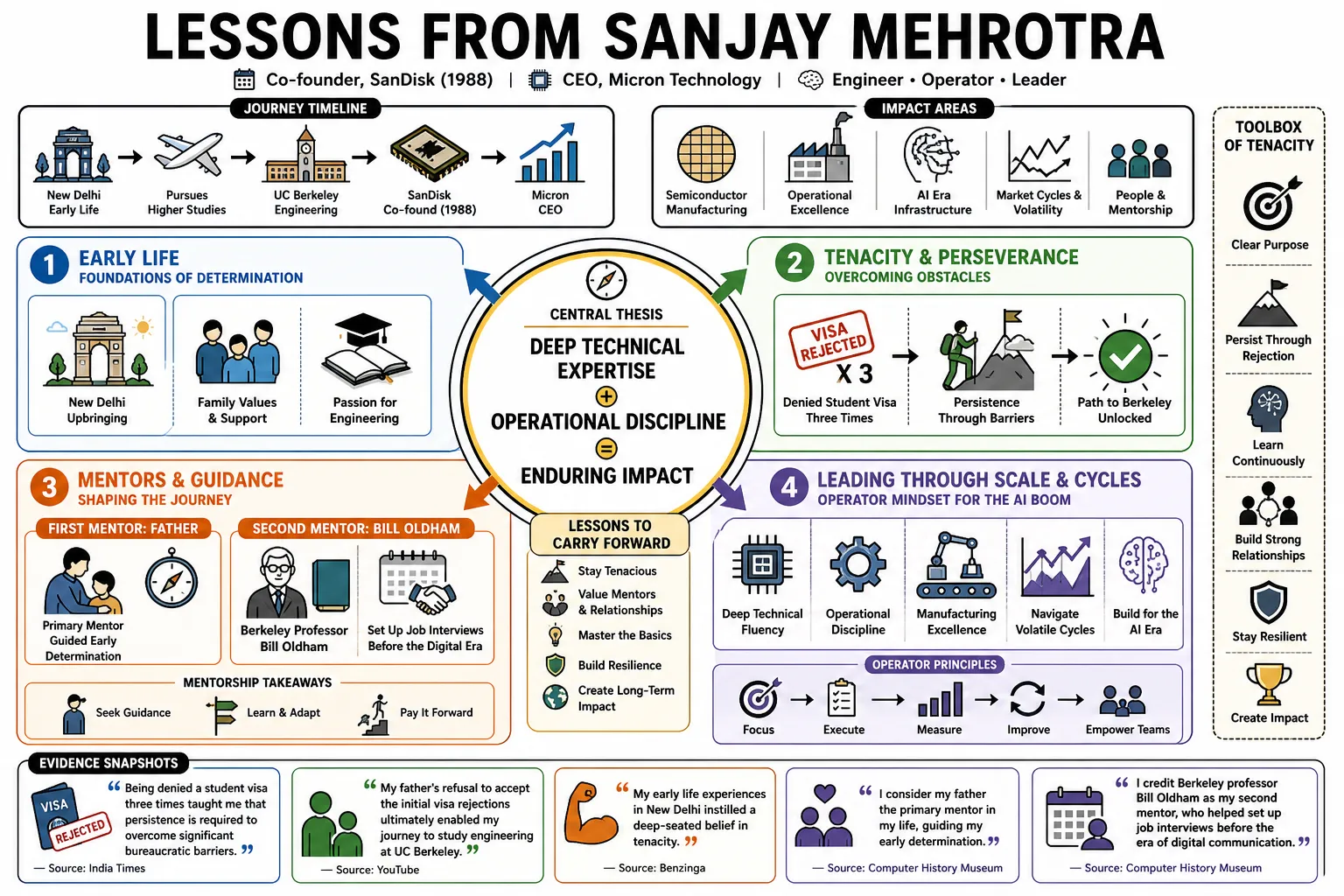
Lessons from Sanjay Mehrotra
Sanjay Mehrotra co-founded SanDisk in 1988 and later became CEO of Micron Technology. He pairs deep technical knowledge with the operational discipline required to steer massive hardware companies through the demands of the AI boom. This profile collects his insights on semiconductor manufacturing and the practical realities of surviving volatile market cycles.
Part 1: Early Life, Tenacity & Perseverance
- On facing rejection: "Being denied a student visa three times taught me that persistence is required to overcome significant bureaucratic barriers." — Source: India Times
- On family influence: "My father's refusal to accept the initial visa rejections ultimately enabled my journey to study engineering at UC Berkeley." — Source: YouTube
- On building resilience: "My early life experiences in New Delhi instilled a deep-seated belief in tenacity." — Source: Benzinga
- On his first mentor: "I consider my father the primary mentor in my life, guiding my early determination." — Source: Computer History Museum
- On academic guidance: "I credit Berkeley professor Bill Oldham as my second mentor, who helped set up job interviews before the era of digital communication." — Source: Computer History Museum
- On sports as a metaphor: "Witnessing Berkeley's legendary football finish known as 'The Play' shaped the resilient mindset I brought to my career." — Source: Benzinga
- On not giving up: "Success requires an absolute refusal to concede defeat when faced with repeated professional rejection." — Source: India Times
- On playing until the end: "A mindset that refuses to stop or concede until the final whistle is essential in high-stakes business environments." — Source: Benzinga
- On early challenges: "The journey from India to Silicon Valley required navigating complex immigration systems that tested my resolve." — Source: YouTube
- On foundational experiences: "My early struggles with the educational system laid the groundwork for my future leadership resilience." — Source: India Times
Part 2: Founding and Building SanDisk
- On co-founding SanDisk: "We established the company originally known as SunDisk in 1988 to explore the potential of non-volatile memory." — Source: Forbes
- On strategic shifts: "During my tenure as CEO, we directed SanDisk's product focus toward solid-state drive solutions." — Source: Reddit
- On enterprise markets: "We recognized the need to move our focus away from consumer electronics and directly into data centers." — Source: Reddit
- On company value: "I guided SanDisk until its acquisition by Western Digital for approximately $19 billion in 2016." — Source: Indiaspora
- On wearing multiple hats: "I held various roles at SanDisk over decades, moving from engineering leadership to Chief Operating Officer." — Source: AAEOY
- On the origins of flash memory: "Co-founding SanDisk positioned us to participate directly in the commercialization of flash memory." — Source: Forbes
- On scaling a startup: "Growing the company required a transition from creative engineering concepts to strict operational execution." — Source: SVJP
- On long-term vision: "The shift toward SSDs was a multi-year play that ultimately defined the enterprise value of the company." — Source: Reddit
- On concluding a chapter: "The sale to Western Digital marked the culmination of my leadership at the company I co-founded." — Source: Indiaspora
Part 3: Leadership and Management Style
- On perspective: "Great leaders know when to zoom out and when to dive into the details." — Source: YouTube
- On micromanagement: "I occasionally veer into micromanagement, viewing it as a necessary trade-off to understand underlying technical complexities." — Source: YouTube
- On technical decision-making: "Leaders need a deep understanding of their product architecture to make informed decisions." — Source: YouTube
- On data-driven management: "My communication style is heavily anchored in specific performance metrics." — Source: Phemex
- On clear metrics: "I prefer framing strategy against specific benchmarks like yield-curve milestones and bit-density improvements." — Source: Phemex
- On continuous learning: "Reflecting on my early days at Intel, I viewed the company as a wonderful university." — Source: Computer History Museum
- On the learner's mindset: "Regardless of seniority, an executive's focus should remain on continuous education." — Source: Computer History Museum
- On dedication to mastery: "In my early career, I spent many nights mastering new technical challenges." — Source: Computer History Museum
- On character in leadership: "Character, values, and a calm approach are as important to a leader's success as strategic vision." — Source: YouTube
- On deep focus: "Early mentors taught me to maintain a persistent focus on the technical details of product design." — Source: Computer History Museum
Part 4: Leading Micron Technology
- On transforming culture: "Micron's goal isn't to follow the industry. It's to lead it." — Source: YouTube
- On the need for evolution: "What got us here won't get us there." — Source: Micron
- On shifting mindset: "We focus on fostering a team environment that is relentlessly driven to succeed in highly competitive markets." — Source: YouTube
- On execution: "We prioritize the disciplined execution required to bring complex technologies to market." — Source: YouTube
- On the CHIPS Act: "I have been a vocal proponent of federal legislation to advance domestic memory chip manufacturing." — Source: Micron
- On leveling the playing field: "Government support is necessary to bring leading-edge memory manufacturing back to the United States." — Source: YouTube
- On massive investments: "Micron committed to multi-billion dollar plans to expand domestic manufacturing capacity in Idaho and New York." — Source: Micron
- On future readiness: "Expanding domestic capacity is a key strategy to meet the exploding demand for memory components." — Source: Forbes
- On building a winning team: "A culture centered on a drive to win is necessary to shift an organization from a follower to a leader." — Source: YouTube
Part 5: The Future of Memory and AI
- On the AI competition: "The artificial intelligence boom requires a race for storage capacity alongside computing power." — Source: Moomoo
- On system limitations: "Memory has become an overlooked bottleneck in modern artificial intelligence systems." — Source: Futunn
- On strategic value: "Memory and storage must be viewed as strategic assets in the age of AI." — Source: Benzinga
- On supply and demand: "We currently do not have line of sight as to when memory supply will be able to catch up with increasing demand." — Source: Benzinga
- On robotics and automation: "Exciting possibilities enabled by robotics and humanoids portend a strong long-term demand environment." — Source: The Motley Fool
- On autonomous vehicles: "Fully autonomous vehicles will be a significant driver for hardware memory demand." — Source: The Motley Fool
- On High Bandwidth Memory: "Innovations in HBM are necessary to address the non-linear memory demand created by AI applications." — Source: Substack
- On data center requirements: "The infrastructure boom requires unprecedented scaling of memory capacity within data centers." — Source: Apple Podcasts
- On computing architectures: "Memory is central to the architectural shifts in computing driven by artificial intelligence." — Source: Plymouth University
- On the memory supercycle: "The AI era represents a fundamental shift in how memory is valued and consumed across industries." — Source: Seeking Alpha
Part 6: Innovation, R&D, and Execution
- On R&D investment: "Long-term investment in innovation is required to stay ahead of architectural shifts in computing." — Source: Plymouth University
- On operational discipline: "I believe in instilling significant capital expenditure discipline within the companies I lead." — Source: Plymouth University
- On capex strategy: "Aggressive investment commitments must align with pre-projected yield milestones rather than speculative demand." — Source: Phemex
- On product engineering: "A deep understanding of product testing and design is fundamental to successful execution." — Source: Computer History Museum
- On node transitions: "Success in the semiconductor industry requires flawless execution on node transitions." — Source: Phemex
- On the balance of creativity and rigor: "Innovation must be paired with the disciplined execution required to bring complex products to scale." — Source: YouTube
- On measuring success: "Strategy should be evaluated against hard metrics rather than high-level narratives." — Source: Phemex
- On long-term bets: "Heavy R&D spending is non-negotiable for companies that intend to lead in the memory sector." — Source: Plymouth University
- On technological foresight: "Anticipating the hardware requirements for next-generation applications is key to a successful strategy." — Source: TechSurge Podcast
Part 7: Diversity, Inclusion & STEM Education
- On workforce development: "Promoting STEM education is necessary to inspire the next generation of engineers." — Source: Micron
- On diverse talent: "Building a strong future workforce requires drawing talent from all backgrounds." — Source: Boise Chamber
- On inclusive workplaces: "We are committed to building a welcoming and inclusive workplace at Micron." — Source: Clay
- On empowering teams: "A diverse workforce must be empowered to contribute their unique perspectives to technical challenges." — Source: Clay
- On educational outreach: "Companies have a responsibility to invest in education to secure the future of the semiconductor industry." — Source: Micron
- On global perspectives: "My own international journey highlights the importance of welcoming global talent to drive innovation." — Source: YouTube
- On mentorship programs: "Fostering mentorship within organizations is necessary for developing the next generation of leaders." — Source: Computer History Museum
- On community engagement: "Corporate success should be tied to investments in local communities and educational institutions." — Source: Boise Chamber
- On the value of inclusion: "Inclusivity is a strategic necessity for solving complex engineering problems." — Source: Clay
Part 8: Navigating the Semiconductor Industry
- On industry cycles: "The semiconductor industry requires resilience to navigate intense boom-and-bust cycles." — Source: Morningstar
- On global competition: "The push for domestic manufacturing is essential for maintaining U.S. competitiveness in the global market." — Source: YouTube
- On supply chain resilience: "Federal grants are a step toward securing a domestic supply chain for memory chips." — Source: Micron
- On market volatility: "Leaders must maintain a calm approach when dealing with the inherent volatility of the memory sector." — Source: YouTube
- On structural shifts: "Tight memory supply is indicative of a broader structural shift in market demand driven by AI." — Source: Substack
- On capital intensity: "Operating in the memory space requires navigating massive capital requirements and long facility construction timelines." — Source: CoStar
- On geopolitical factors: "Geopolitics now plays a central role in the strategic planning and manufacturing footprint of semiconductor companies." — Source: Apple Podcasts
- On economic impact: "The expansion of domestic chip manufacturing acts as a catalyst for local job creation and economic growth." — Source: Idaho Statesman
- On the ultimate goal: "Our objective is to build a resilient organization capable of shaping the future of global technology infrastructure." — Source: Micron