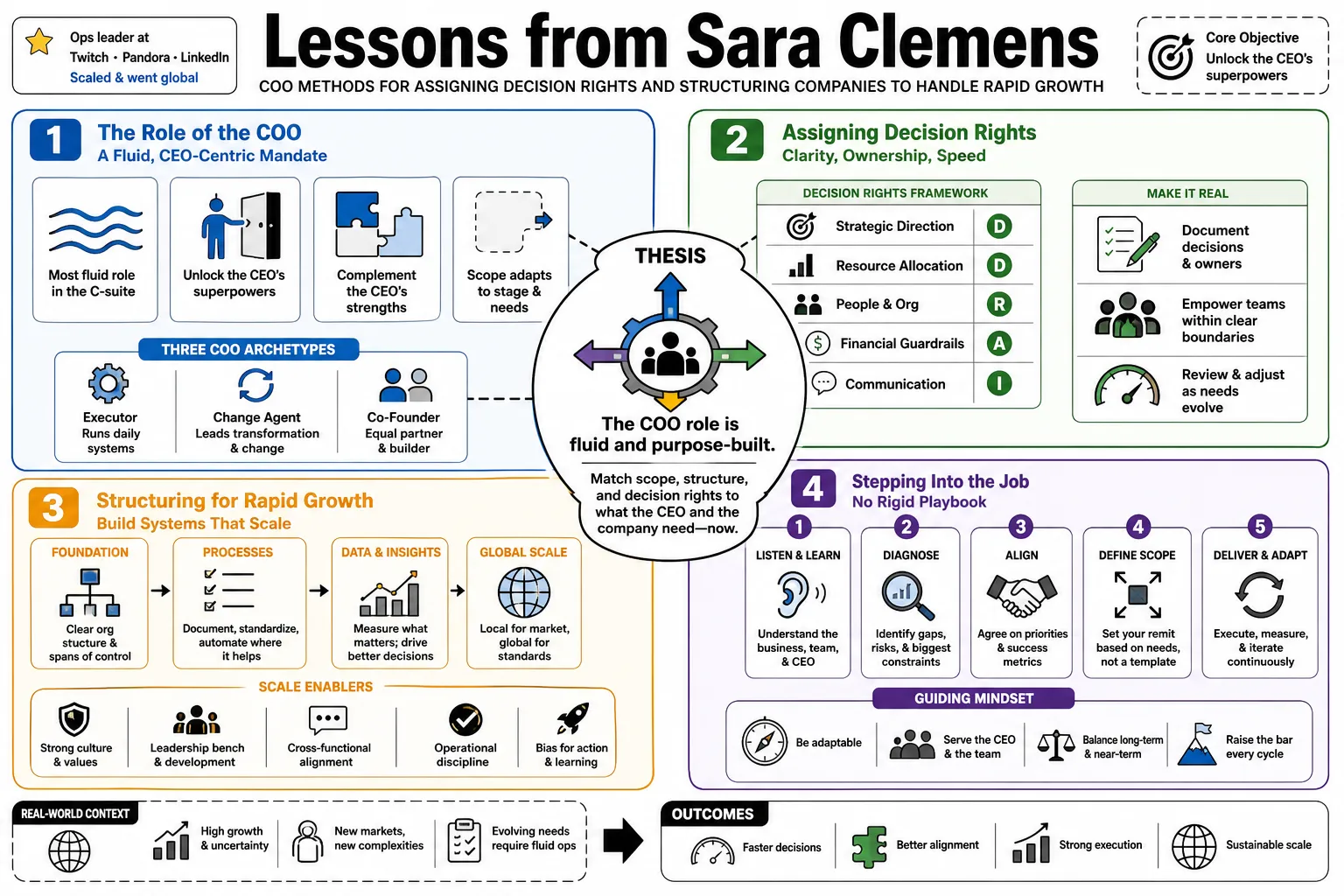
Lessons from Sara Clemens
Sara Clemens ran operations at Twitch, Pandora, and LinkedIn while they scaled and expanded internationally. She treats the COO role as a flexible job built around what a company and its founders actually need. This profile covers her methods for assigning decision rights and structuring companies to handle rapid growth.
Part 1: The Role of the COO
- On the fluid nature of operations: Clemens describes the COO role as unusually adaptive: it changes with the company, the stage, and especially the strengths and needs of the CEO. — Reference: First Round interview on the COO role changing by company and CEO
- On the core objective: "You are not hired to run the business in parallel; you are hired to unlock the CEO's superpowers and give them the space to do what they do best." — Source: Airtree Ventures
- On identifying archetypes: Clemens clusters COO roles into patterns such as classic operations, new-business building, and the leader who runs go-to-market and corporate functions alongside a product/engineering CEO. — Reference: First Round interview on three COO archetypes
- On stepping into the job: "When you take on the COO role, you cannot bring a rigid playbook. You must adapt your functional scope to the exact stage and needs of the business at that moment." — Source: Airtree Ventures
- On CEO alignment: "The relationship between a CEO and COO must be built on absolute, unshakeable trust. If there is friction at the top, it instantly ripples through the rest of the company." — Source: Airtree Ventures
- On measuring success: Clemens evaluates COO performance by whether strategy is clear, teams are organized against it, and the right leaders and talent are in place to execute. — Reference: First Round interview on COO performance dimensions
- On managing expectations: "Founders need to understand that hiring an operations chief won't solve systemic product issues; it solves execution and scaling issues." — Source: Airtree Ventures
- On ego management: "To excel in operations, you have to be comfortable amplifying the efforts of others rather than needing to be the one in the spotlight." — Source: Global Women
- On balancing the present and future: A strong COO helps turn strategy into operating reality, keeping the organization aligned while still adapting as a hypergrowth company learns new information. — Reference: First Round interview on strategy, execution, and adaptability
- On dispelling myths: "The biggest misconception is that operations is primarily about cost-cutting and efficiency; at high-growth companies, it is mostly about creating the frameworks that allow revenue to scale." — Source: Airtree Ventures
Part 2: Global Expansion and Market Entry
- On international strategy: "Entering a new geographic market is rarely a matter of translating your app; it requires a fundamental re-evaluation of how your product fits local consumer behavior." — Source: University of Canterbury
- On the China market: "Leading LinkedIn's entry into China taught me that success requires a delicate balance of maintaining your core global identity while adapting to deeply entrenched local regulatory and cultural norms." — Source: University of Canterbury
- On early Xbox expansion: "When taking gaming hardware to global audiences, we had to look beyond the technology and understand the specific entertainment ecosystems of each region." — Source: Business Ninjas
- On market timing: "You can have the perfect localized product, but if you attempt market entry before the underlying infrastructure or consumer readiness is there, you will burn capital for nothing." — Source: Business Ninjas
- On local leadership: Clemens treats international expansion as an operating problem that requires real debate, local context, and alignment on the options before a company commits. — Reference: COO 101 transcript on international strategy discussions
- On regulatory hurdles: "Navigating international regulations is never merely a legal compliance task; it is a core strategic capability that dictates your product roadmap." — Source: University of Canterbury
- On prioritizing regions: Clemens looks for operators who can prioritize the company as a system, even when that means sacrificing the needs of one function or market for the whole business. — Reference: COO 101 transcript on prioritizing the organization as a system
- On cultural translation: "It is crucial to translate the value proposition of your service. What works as a selling point in the US might be entirely irrelevant in Asia." — Source: University of Canterbury
- On mitigating expansion risk: "Always define clear exit criteria before you enter a new market. Know what failure looks like so you can pull out before it drains the broader organization." — Source: Airtree Ventures
- On global scale: Scaling requires the COO to keep redesigning the operating system so teams, leaders, and processes match the company ambition rather than last stage organization chart. — Reference: First Round interview on organizing the business to scale
Part 3: Fostering a No-Blame Culture
- On building psychological safety: Clemens frames no-blame culture as a tactical operating discipline: teams need to learn from failures without turning the review into personal blame. — Reference: First Round episode notes on creating a no-blame culture
- On handling failure: "Treat missteps as raw data. If you penalize honest mistakes, your team will simply stop taking the risks required for hypergrowth." — Source: Global Women
- On post-mortems: Her no-blame approach points incident reviews toward process, decisions, and system design rather than toward finding a person to punish. — Reference: First Round episode notes on no-blame culture
- On management reactions: Clemens treats communication as part of operating culture: leaders have to bring the company along in a way that preserves trust while the business changes. — Reference: First Round interview on communication and culture
- On direct feedback: "Direct feedback is a gift, but it only works if it is delivered in an environment where the recipient knows you are fundamentally invested in their success." — Source: MarketingSherpa
- On systemic issues: When a scaling company struggles, Clemens looks at the operating system around the work: leaders, processes, finance, people, legal, and the fundamentals that may no longer fit. — Reference: COO 101 transcript on building operating fundamentals
- On resilience: "A culture that tolerates calculated failure bounces back from market shocks much faster than a culture paralyzed by the fear of making the wrong move." — Source: Global Women
- On transparency: "When leaders openly share their own mistakes and what they learned, it gives everyone else the permission to be honest about their struggles." — Source: Airtree Ventures
- On speed versus caution: Clemens wants hypergrowth companies to be nimble without becoming unstable: use new information quickly, but keep enough structure that the business can absorb change. — Reference: First Round interview on nimble but stable adaptation
Part 4: Leadership and Decision Making
- On decision rights: As a company doubles, Clemens wants decision rights made explicit so momentum does not disappear into confusion over who owns the call. — Reference: First Round episode notes on decision rights
- On trusting intuition: "Data will only take you so far when disrupting traditional markets. At a certain point, leaders must trust their gut instinct to make pivotal leaps." — Source: Global Women
- On the limits of consensus: Clemens emphasizes alignment and decision clarity: the company needs shared priorities, but it also needs a clear owner for moving work forward. — Reference: First Round interview on strategy alignment and decision rights
- On problem solving: "The best leaders look past the problem in front of them to solve the underlying condition that caused the problem to surface in the first place." — Source: Airtree Ventures
- On adaptability: Clemens calls great CEOs and operators corporate chameleons: they adapt as the organization matures and hire deeper experts as the company outgrows the old shape. — Reference: COO 101 transcript on adapting leadership as the company matures
- On managing complexity: "The role of the executive is to absorb complexity from the market and translate it into simple, actionable directives for the team." — Source: Business Ninjas
- On delegating authority: As the company matures, Clemens expects leaders to bring in executives with deeper functional expertise and let the operating model become less founder-centered. — Reference: COO 101 transcript on hiring deeper executives as the company matures
- On leading through change: "When pushing through a major organizational shift, over-communication is impossible. You have to repeat the rationale until you are tired of hearing yourself say it." — Source: Airtree Ventures
- On maintaining focus: Clemens treats strategy as operating clarity: define the mission, the execution path, the deliverables, and the priorities the company will align behind. — Reference: First Round interview on strategy and aligned priorities
Part 5: Scaling Businesses
- On the Twitch ecosystem: Clemens frames Twitch around direct creator-fan connection: fans want a relationship with creators, and that relationship can become a meaningful economic engine. — Reference: Wired article quoting Clemens on Twitch and creator-fan relationships
- On transitioning Pandora: At Pandora, Clemens worked on moving the company beyond radio toward a broader personalized music service that connected artists with fans at scale. — Reference: CorpDev profile of Clemens at Pandora
- On operational drag: Clemens warns that fast growth breaks old operating habits: companies need new people, finance, legal, and leadership systems when the previous stage stops working. — Reference: COO 101 transcript on rebuilding operating fundamentals
- On building infrastructure: "You have to build operational infrastructure for the company you will be in eighteen months, rather than the company you are today." — Source: Airtree Ventures
- On customer-centric growth: For Clemens, new operating structure has to serve the business ambition and the user-facing strategy, not just make the org chart look tidier. — Reference: First Round interview on organizing against company ambitions
- On navigating hypergrowth: "During periods of rapid expansion, the biggest risk is that the company culture becomes diluted. You have to deliberately institutionalize your core values." — Source: Airtree Ventures
- On cross-functional alignment: Clemens sees the COO as a cross-functional alignment role: strategy, teams, leaders, and communication all have to point in the same direction. — Reference: First Round interview on aligning strategy and teams
- On adapting the business model: "At Pandora, integrating acquisitions like Ticketfly meant moving from a singular audio service to a comprehensive platform connecting artists directly with fans." — Source: University of Canterbury
- On managing cash burn: "Scaling efficiently means understanding exactly which levers drive growth and pouring fuel only on the fires that generate measurable return." — Source: Business Ninjas
Part 6: Navigating Ambiguity and Risk
- On embracing the unknown: Hypergrowth requires comfort with new information: Clemens wants operators who can adapt quickly without making the business feel unstable. — Reference: First Round interview on nimble adaptation in hypergrowth
- On facing early adversity: "Relocating to Paris just before 9/11 and facing sudden redundancy taught me that professional survival relies entirely on resilience and the ability to pivot without panic." — Source: Global Women
- On career transitions: "Do not be afraid to take roles that force you out of your functional expertise; growth happens in the spaces where you feel slightly underqualified." — Source: Global Women
- On calculated risks: "Taking risks is mandatory, but they must be calculated. Understand the worst-case scenario and ensure you have the operational buffer to survive it." — Source: Airtree Ventures
- On redefining failure: "The only true failure is a mistake you did not learn from. Everything else is the cost of iterating toward the right answer." — Source: Global Women
- On industry volatility: Twitch operating work had to respond to fast changes in streaming behavior, including periods of record engagement as more people watched from home. — Reference: CNBC interview page on Twitch record engagement
- On personal resilience: "The ability to absorb professional shocks without letting them destroy your personal confidence is the defining trait of long-term executives." — Source: Global Women
- On challenging the status quo: Clemens expects operators to keep iterating the business as they learn, especially when the company is scaling too quickly for old assumptions to hold. — Reference: First Round interview on iterating the business
- On operating without a net: "Sometimes you have to make structural decisions before you have all the data. Waiting for perfect information will always make you too late." — Source: Airtree Ventures
Part 7: Building and Managing Teams
- On hiring philosophies: Clemens puts talent at the center of COO performance: the company needs the right leaders, the right team structure, and people who can scale with the strategy. — Reference: First Round interview on talent and leadership
- On diverse perspectives: "Building inclusive teams is a strategic necessity. Homogeneous teams have fatal blind spots when building global consumer products." — Source: Global Women
- On retaining talent: "High performers leave when they stop learning or when they lose faith in the leadership's vision. Your job is to constantly provide both challenge and clarity." — Source: Airtree Ventures
- On middle management: Clemens treats operators and functional leaders as the translation layer between strategy and execution, especially as the company becomes too large for informal alignment. — Reference: COO 101 transcript on strategic operators leading large teams
- On onboarding executives: "The onboarding of a senior leader must be deliberate. If you hand them the keys and walk away, the organizational tissue will reject them." — Source: Airtree Ventures
- On defining roles: Role clarity is part of scale: Clemens wants teams organized against company ambitions, with decision rights clear enough that work does not stall. — Reference: First Round interview on organization and decision rights
- On cultural addition: "Stop hiring for cultural fit, which often means people who look and think like you. Hire for cultural addition—people who bring a perspective your team currently lacks." — Source: Global Women
- On managing performance: Clemens starts performance from clarity: people can only execute well when strategy, priorities, roles, and communication are explicit. — Reference: First Round interview on COO performance dimensions
- On team autonomy: "Give your teams the resources they need, set the strategic direction, and then get out of their way. Micromanagement scales poorly." — Source: Airtree Ventures
Part 8: Product and Platform Strategy
- On creator economies: Clemens sees Twitch as early proof that direct fan support can become real work: even a focused base of supportive fans can help creators build a career. — Reference: Wired article quoting Clemens on creator careers
- On early hardware innovation: "Working on the founding team for HoloLens demonstrated that defining a new computing paradigm requires integrating hardware engineering with an entirely new language of user experience." — Source: University of Canterbury
- On platform evolution: "A product becomes a platform the moment third parties can extract more value from it than the parent company does in isolation." — Source: Business Ninjas
- On listening to users: Clemens values new information from the market and organization, because good operators use those signals to iterate the business faster. — Reference: First Round interview on learning and iteration
- On live interaction: Twitch proved that real-time recognition changes media: viewers do not just consume; they interact, support, and look for a relationship with the creator. — Reference: Wired article on Twitch real-time creator-fan connection
- On strategic partnerships: "Acquisitions and partnerships are only valuable if they seamlessly integrate into the core user journey, rather than feeling like a bolted-on afterthought." — Source: University of Canterbury
- On managing product debt: Clemens applies the same operating logic to product and process: keep adapting the system as the company learns, instead of letting old choices become permanent drag. — Reference: First Round interview on adapting the business
- On shifting consumer habits: Clemens saw Twitch at a moment when streaming behavior was accelerating, with record engagement showing how quickly audience habits can move. — Reference: CNBC interview page on Twitch record engagement
- On competing for attention: "In the modern entertainment landscape, you are competing against sleep and every other app on the user's phone, not just your direct rivals." — Source: Business Ninjas
- On sustaining relevance: Twitch relevance depends on creator success: the platform benefits when creators can monetize, focus on streaming, and build stronger relationships with fans. — Reference: Wired article on Twitch creator monetization