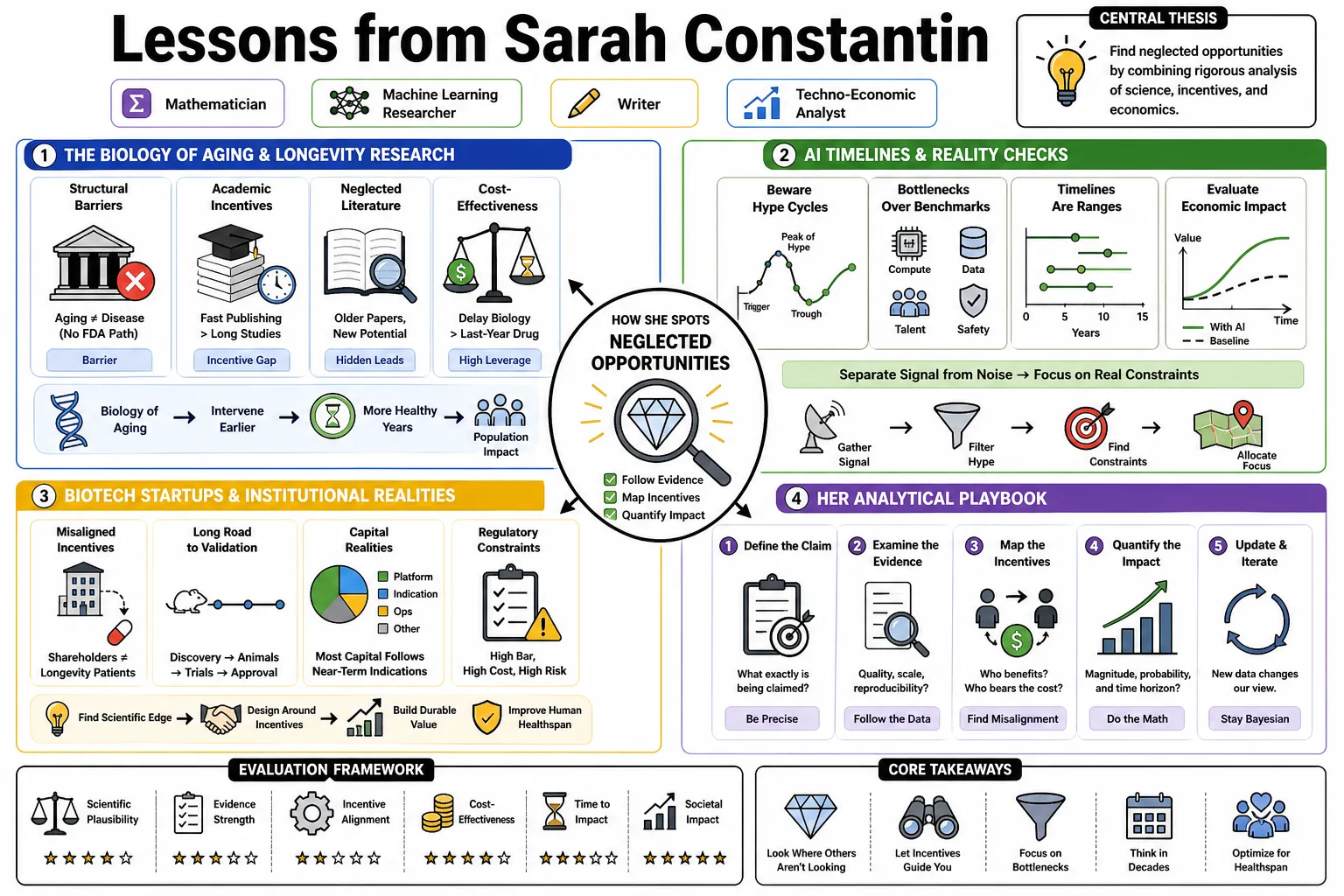
Lessons from Sarah Constantin
Sarah Constantin is a mathematician, machine learning researcher, and writer who applies techno-economic analysis to emerging technologies. Her essays cover cognitive decoupling, the bottlenecks in aging research, and the realities of AI timelines and biotech startups. This profile looks at how she evaluates scientific claims and institutional failures to spot neglected opportunities in biology and software.
Part 1: The Biology of Aging and Longevity Research
- On structural barriers to aging research: "Because the FDA does not classify aging as a disease, pharmaceutical companies lack a clear commercial path to develop longevity drugs." — Source: Sarah Constantin's Blog
- On academic incentives: "Academic biology prioritizes fast-paced publishing over the rigorous, long-term studies required to validate lifespan-extending compounds in animals." — Source: Longevity Research Institute
- On neglected literature: "Many older publications in aging research contain promising candidate interventions that remain uninvestigated because they fall outside current academic trends." — Source: Rough Diamonds
- On cost-effectiveness: "Interventions that delay the biology of aging are highly cost-effective when measured by Disability-Adjusted Life Years, often matching or exceeding traditional global health interventions." — Source: Effective Altruism Forum
- On mortality predictors: "Biomarkers like epigenetic clocks vary significantly in their ability to accurately discriminate between populations with high and low mortality risk." — Source: Nintil
- On healthspan versus lifespan: "Extending human lifespan is only meaningful if it is coupled with delaying the onset of age-related conditions like cardiovascular disease and cancer." — Source: Sarah Constantin's Blog
- On independent validation: "To overcome institutional bottlenecks, the longevity field needs independent organizations to commission replication studies on promising compounds rather than relying solely on academia." — Source: Longevity Research Institute
- On animal model limitations: "Compounds that successfully extend the lives of mice and invertebrates often fail to translate to human biology, requiring more precise mechanistic understanding." — Source: Rough Diamonds
- On the science generalist approach: "Approaching aging research as a generalist allows one to spot methodological flaws and structural gaps that specialists entrenched in specific subfields might miss." — Source: Roots of Progress
- On disease overlap: "Most major causes of human mortality are downstream consequences of the same fundamental cellular aging processes." — Source: Sarah Constantin's Blog
Part 2: Artificial Intelligence and Machine Learning
- On AGI timelines: "Developing agentic Artificial General Intelligence will likely require conceptual breakthroughs in causal inference and world modeling, rather than just scaling existing architectures." — Source: LessWrong
- On AI doomerism: "The narrative that AI will inevitably lead to near-term catastrophe often ignores the concrete engineering limitations and friction involved in deploying physical technologies." — Source: Rough Diamonds
- On language models in science: "Large language models show promise in accelerating literature reviews and synthesizing biological data, even if they lack true causal understanding." — Source: Rough Diamonds
- On cultural crossover: "The AI industry has increasingly blurred the lines between software engineering and speculative science fiction world-building." — Source: LessWrong
- On machine learning in drug discovery: "Applying machine learning to biological screening shifts the bottleneck from target identification to physical automation and assay scaling." — Source: Sarah Constantin's Blog
- On the limits of deep learning: "Current deep learning paradigms excel at pattern matching but struggle with the open-ended reasoning required for independent scientific discovery." — Source: Rough Diamonds
- On evaluating AI startups: "Assessing the value of an AI company requires looking past the foundational model to see how well it solves a specific, bounded economic problem." — Source: Sarah Constantin's Blog
- On causal inference: "Without the ability to build and test causal models of the world, AI systems remain dependent on human intelligence for verifying facts." — Source: LessWrong
- On technological friction: "Software scales instantly, but AI applications that interact with the physical world, like robotics and biotech, face slow iteration cycles." — Source: Rough Diamonds
- On automation: "The most immediate economic impact of machine learning is in automating high-volume, low-complexity knowledge work rather than replacing specialized human reasoning." — Source: Sarah Constantin's Blog
Part 3: Cognitive Decoupling and Rationality
- On cognitive decoupling: "Cognitive decoupling is the ability to block out context and prior knowledge in order to follow formal, abstract rules. This trait is strongly correlated with performance on intelligence tests." — Source: LessWrong
- On intelligence testing: "Performance on many standardized cognitive tests is largely a measure of a person's willingness and ability to decouple from contextual reality." — Source: LessWrong
- On the Rationalist community: "The rationalist community in Berkeley functions in practice as a haven for outcasts, unified by a core value of unconditional tolerance for weirdos." — Source: LessWrong
- On bohemian intellectualism: "Social groups based on mutual support and intellectual fun serve a distinct purpose for people who do not easily fit into mainstream social structures." — Source: LessWrong
- On errors versus bugs: "Treating mistakes as structural bugs in a system rather than personal moral failings is a more effective way to improve human performance." — Source: LessWrong
- On the concept of stupidity: "Stupidity is often just a localized failure of mental models, which can be debugged and corrected once the underlying error is identified." — Source: LessWrong
- On aesthetic judgments: "It is difficult to change your mind about what you find beautiful or compelling because aesthetic preferences resist formal linguistic description." — Source: LessWrong
- On contextualizing vs. decoupling: "While some thinkers naturally isolate variables to solve problems, others instinctively contextualize by bringing in outside information, leading to different modes of conflict." — Source: LessWrong
- On formal logic: "Being good at formal logic does not automatically translate to sound judgment in situations where the premise itself is flawed or incomplete." — Source: Sarah Constantin's Blog
- On community boundaries: "Groups defined by extreme tolerance eventually face structural crises when forced to manage bad actors who exploit that same tolerance." — Source: LessWrong
Part 4: Epistemology and Sense-Making
- On scientific due diligence: "Properly evaluating a new technology requires reading the underlying literature directly rather than relying on press releases or secondary summaries." — Source: Rough Diamonds
- On techno-economic analysis: "To judge a scientific project's viability, you must quantify its expected cost, its theoretical performance limits, and its advantage over the current default." — Source: Rough Diamonds
- On public datasets: "There is an enormous amount of alpha available simply by systematically analyzing public datasets that academics have ignored or failed to contextualize." — Source: Rough Diamonds
- On the striver mindset: "Individuals seeking to maximize their impact should approach problems with a hypothesis-driven mindset rather than waiting for institutional consensus." — Source: Rough Diamonds
- On contradictory literature: "When scientific papers disagree, the resolution is rarely found by averaging their conclusions; it usually requires examining the specific differences in their experimental setups." — Source: Sarah Constantin's Blog
- On hypothesis generation: "The bottleneck in science is often not a lack of data, but a lack of coherent, testable hypotheses generated from existing data." — Source: Rough Diamonds
- On evaluating progress: "Technological progress is measured by the reduction of friction and cost in physical reality, rather than by the generation of novel ideas." — Source: Roots of Progress
- On intellectual independence: "Relying on credentialed consensus is a poor strategy for identifying underrated opportunities in emerging scientific fields." — Source: Rough Diamonds
- On clear writing: "Writing about complex science should clarify the mechanics of the system rather than obfuscate them with academic jargon." — Source: Sarah Constantin's Blog
Part 5: Biotech Innovation and Strategy
- On drug discovery automation: "Automating the physical processes of biotech research is necessary to keep pace with computational advances in molecular screening." — Source: Sarah Constantin's Blog
- On market analysis in biotech: "A scientifically brilliant mechanism will fail commercially if it targets a disease where the standard of care is already cheap, safe, and effective." — Source: Sarah Constantin's Blog
- On startup failure modes: "Many biotech startups fail because they solve a biological puzzle without designing a workable go-to-market strategy for the resulting therapeutic." — Source: Rough Diamonds
- On evaluating drug targets: "The strongest drug targets are those validated by human genetics, rather than those that only show efficacy in highly controlled mouse environments." — Source: Rough Diamonds
- On neglected diseases: "Rare or difficult-to-model diseases often remain unfunded not because the science is impossible, but because the economic incentives do not justify the clinical trial costs." — Source: Sarah Constantin's Blog
- On the role of nonprofits: "Nonprofit organizations can derisk experimental therapies by funding the initial validation studies that venture capital firms consider too early-stage." — Source: Longevity Research Institute
- On interdisciplinary teams: "The most effective biotech teams merge software engineers who understand scale with biologists who understand the physical limitations of assays." — Source: Sarah Constantin's Blog
- On hardware bottlenecks: "Advances in synthetic biology are currently constrained more by the precision and speed of liquid handling hardware than by algorithmic design." — Source: Rough Diamonds
- On clinical trial design: "Innovations in how we design and run clinical trials are just as necessary as innovations in the molecules we test." — Source: Rough Diamonds
Part 6: Institutions and Social Dynamics
- On simple rules: "In low-trust environments, demanding fair play is often a losing strategy, because those in power will simply ignore the rules when convenient." — Source: LessWrong
- On selective enforcement: "Rigid organizational rules are rarely applied equally; they are more often used as a mechanism to scapegoat individuals when things go wrong." — Source: LessWrong
- On institutional gaslighting: "When institutions selectively enforce policies, they force individuals to navigate a false reality where the stated rules do not match the actual incentives." — Source: LessWrong
- On discretion: "Effective organizations rely on the localized discretion of competent individuals rather than attempting to codify every action into a universal policy." — Source: LessWrong
- On systemic failure: "When a system fails repeatedly, the fault usually lies with the incentive structures governing the participants, rather than the moral character of the individuals." — Source: Sarah Constantin's Blog
- On organizational trust: "Trust is built when leaders consistently align their private actions with the public protocols of the group." — Source: Rough Diamonds
- On institutional neutrality: "True institutional neutrality is difficult to maintain because the pressure to adopt specific political or social stances is often tied to funding and prestige." — Source: Rough Diamonds
- On shared realities: "A functional society requires shared protocols and agreements about baseline facts, which become brittle in highly polarized environments." — Source: LessWrong
- On navigating bureaucracy: "The most effective way to achieve a goal within a bureaucracy is often to find the specific individual who has the authority to bypass the formal process." — Source: Rough Diamonds
Part 7: Consciousness and the Mind
- On making sense of consciousness: "Approaching consciousness systematically requires breaking it down into observable phenomena like perception, attention, and working memory." — Source: Rough Diamonds
- On perception: "Perception is not a passive recording of reality, but an active process of predictive modeling where the brain continuously updates its expectations against sensory inputs." — Source: Rough Diamonds
- On volition: "The subjective feeling of agency and volition is closely tied to the brain's motor planning systems and its ability to predict the outcomes of its own actions." — Source: Rough Diamonds
- On the concept of the self: "The self is a useful cognitive construct that allows an organism to distinguish its own internal state from the external environment." — Source: Rough Diamonds
- On physical interventions: "Technologies like ultrasound neuromodulation demonstrate that subjective cognitive states can be altered through precise, non-invasive physical stimuli." — Source: Undertone Podcast
- On computational models: "Viewing the brain strictly as a computer is a limited metaphor; it is better understood as a biological system optimized for survival and metabolic efficiency." — Source: Rough Diamonds
- On philosophy and neuroscience: "Philosophical debates about the mind are most useful when they generate specific, testable hypotheses for neurobiology." — Source: Rough Diamonds
- On subjective experience: "The hard problem of consciousness may eventually be dissolved as we map the precise neurobiological correlates of subjective states." — Source: Rough Diamonds
- On attention: "Attention functions as a filter that determines which sensory inputs and internal models are granted access to the global workspace of conscious thought." — Source: Rough Diamonds
Part 8: Progress, Philanthropy, and the Future
- On underrated opportunities: "The greatest returns in science and technology often come from investigating fields that are considered unglamorous or have fallen out of academic fashion." — Source: Rough Diamonds
- On human enhancement: "Viewing the human body as an engineered system allows us to systematically design interventions that improve baseline physical and cognitive performance." — Source: Rough Diamonds
- On advanced manufacturing: "Rebuilding physical infrastructure and improving manufacturing processes is just as important for technological progress as software innovation." — Source: Sarah Constantin's Blog
- On effective altruism: "When allocating philanthropic capital, evaluating the structural bottlenecks of a specific field is as important as calculating the theoretical impact." — Source: Effective Altruism Forum
- On funding science: "We need alternative funding models that reward researchers for verifying existing claims and building public tools, rather than just publishing novel results." — Source: Longevity Research Institute
- On speculative ambition: "Ambitious technological goals, like reversing aging or building advanced robotics, require a willingness to engage in long-term, high-risk engineering." — Source: Roots of Progress
- On building durable systems: "A resilient future depends on engineering systems that can tolerate localized failures and bad actors without collapsing entirely." — Source: Rough Diamonds
- On techno-optimism: "Optimism about the future is only justified if it is paired with the difficult, unglamorous work of executing on scientific and economic details." — Source: Rough Diamonds
- On high-impact action: "The most effective individuals find the exact point where their specialized skills intersect with a neglected problem." — Source: Rough Diamonds