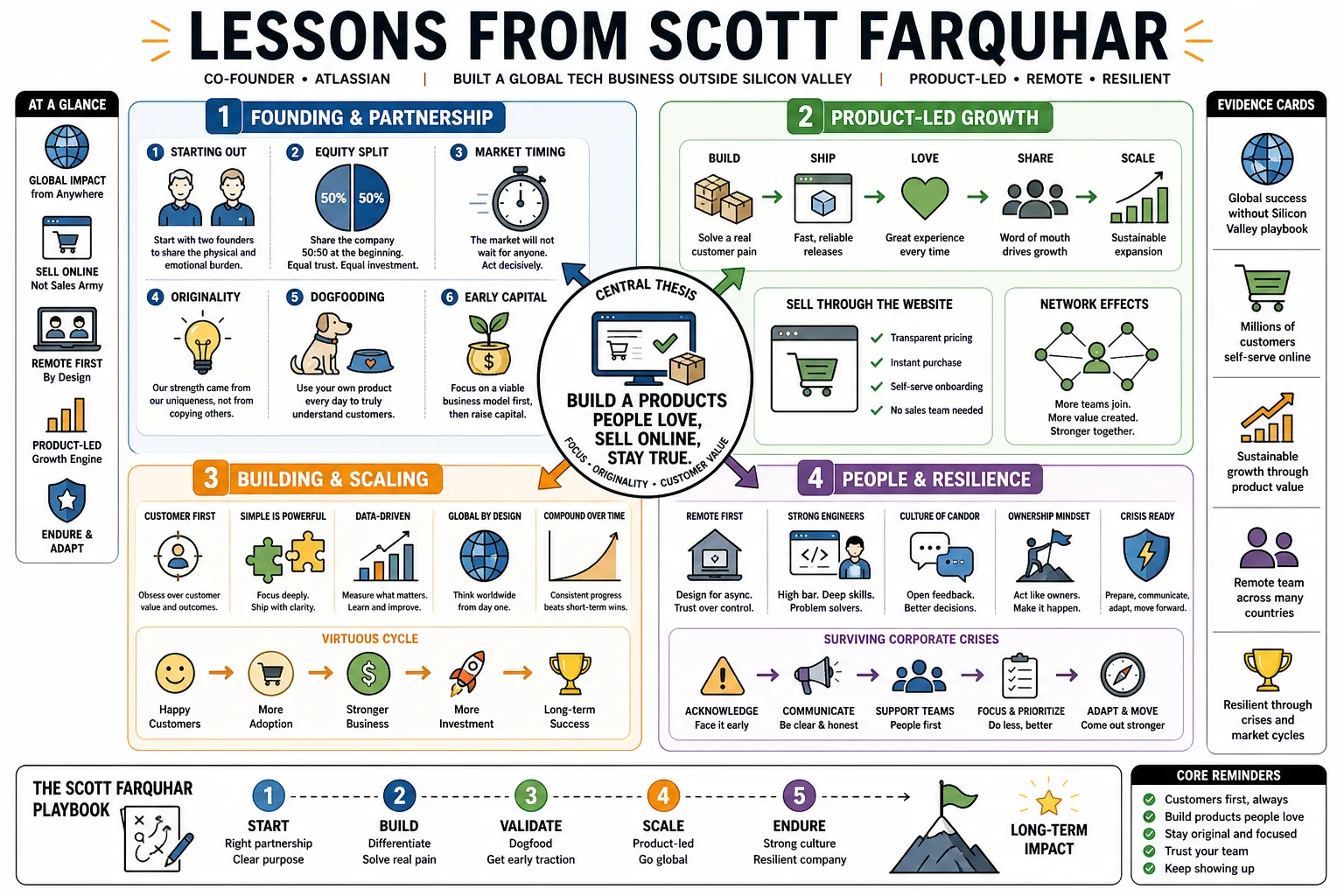
Lessons from Scott Farquhar
Scott Farquhar co-founded Atlassian and built a global tech business outside Silicon Valley by selling enterprise software directly through a website instead of a traditional sales team. This profile outlines his approach to product-led growth and remote work, alongside practical advice on early-stage startup mechanics, assessing engineering talent, and surviving corporate crises.
Part 1: Founding and Partnership
- On Starting Out: "Start with two founders to share the physical and emotional burden of the business from day one." — Source: Business of Software
- On Equity Split: "Share the company 50:50 at the beginning. It sets a foundation of equal trust and investment." — Source: Business of Software
- On Market Timing: "The market will not wait for anyone. You have to embrace challenges and act decisively." — Source: Cub Club
- On Originality: "Our strength came from our uniqueness, not from trying to be the best at what others were already doing." — Source: Cub Club
- On Dogfooding: "If you want to understand the customer experience, you have to use your own product every day." — Source: Business of Software
- On Early Capital: "We focused on a viable business model and profitability early instead of chasing venture capital immediately." — Source: The Twenty Minute VC
- On Co-founder Dynamics: "Having a partner to share the highs and lows is necessary for navigating the intense pressure of scaling." — Source: Business of Software
- On Action: "Over my career, I've always preferred doing rather than talking. Building things, solving problems, creating new ventures." — Source: National Press Club Address
- On Imitation: "Do not simply try to be the next version of an existing success story." — Source: Cub Club
Part 2: Company Culture and Values
- On Core Values: "Treat values as a core technical requirement, not a soft skills formality." — Source: Ophyai Interview Guide
- On Honesty: "Our value of 'Open Company, No Bullshit' means we share information internally by default." — Source: Atlassian Culture Hub
- On Balance: "'Build with Heart and Balance' is about recognizing that employees have lives outside of the office." — Source: Atlassian Culture Hub
- On Customer Focus: "'Don't #@!% the Customer' is our blunt reminder to always prioritize the user's experience." — Source: Atlassian Culture Hub
- On Resilience: "Resilience is a key life skill when you face the highs and lows of a twenty-year journey." — Source: Thought Economics
- On Openness: "Transparency isn't just about sharing good news; it is about being open when things go wrong." — Source: Atlassian Work Life
- On Team Dynamics: "A great culture isn't about ping-pong tables; it is about how the team handles conflict and failure." — Source: The Twenty Minute VC
- On Living the Values: "You must be able to share specific, honest examples of how you embody the company principles." — Source: Ophyai Interview Guide
- On Corporate Culture: "Culture is defined by who you hire, who you fire, and who you promote." — Source: Atlassian Work Life
- On Alignment: "We dedicate an entire interview round to values alignment because it is non-negotiable." — Source: Ophyai Interview Guide
Part 3: Hiring and Talent
- On Problem Solving: "We care more about your problem-solving process than just the final output." — Source: Medium Candidate Guide
- On Technical Interviews: "Explain your trade-offs, like readability versus optimization, and ask clarifying questions early." — Source: Substack Interview Prep
- On Constraints: "A perfect solution that ignores constraints or edge cases is viewed less favorably than a well-thought-out, collaborative approach." — Source: Leetcode Discussions
- On Autonomy: "We look for people who are self-directed and capable of high productivity without physical supervision." — Source: Medium Candidate Guide
- On Curiosity in Candidates: "Be prepared to discuss how you have handled challenges or setbacks with an attitude of learning and curiosity." — Source: 20VC
- On Communication: "Communicating your thought process and asking for clarifications is just as important as solving the technical problems." — Source: Gagan's Blog
- On Continuous Learning: "We want people who view learning as a lifelong, essential process." — Source: Cub Club
- On Potential: "Our mission is to unleash the potential of every team, and we look for candidates who want to do the same." — Source: Pledge 1 Percent
- On Assessing Talent: "Technical rounds start simple and add complexity to see how candidates think under pressure." — Source: Plain English Guide
Part 4: The "Team Anywhere" Philosophy (Remote Work)
- On Distributed Work: "Work is a vocation, not a location." — Source: Medium Interview Overview
- On Remote Productivity: "We trust our employees to do their best work from wherever they feel most productive." — Source: Atlassian Team Anywhere
- On Asynchronous Communication: "To make remote work function, you have to be comfortable with asynchronous communication and writing things down." — Source: Atlassian Team Anywhere
- On the Future of Offices: "Offices are for connection and collaboration, not for sitting at a desk doing heads-down work." — Source: Fear and Greed
- On Global Talent: "By removing location requirements, we can hire the best talent regardless of where they live." — Source: Atlassian Work Life
- On Trust: "Team Anywhere is fundamentally built on trusting our employees to manage their own time." — Source: Atlassian Team Anywhere
- On Commuting: "In the future adults will no longer get up at all hours of the morning to go to work... the computer will be linked to a main computer at their work." — Source: National Press Club Address
- On Flexibility: "Flexibility in where and how you work leads to a more engaged and balanced workforce." — Source: Medium Candidate Guide
- On Managerial Adaptation: "Managers have to shift from measuring hours at a desk to measuring output and impact." — Source: Gagan's Blog
Part 5: Product-Led Growth and Business Strategy
- On Sales Models: "We focused our resources on building a high-quality product and selling it at an affordable price directly through our website." — Source: Musixmatch Case Study
- On Traditional Sales: "We decided to forgo a traditional, expensive sales team in the early days to invest more in product development." — Source: Business of Software
- On Frictionless Adoption: "Make it as easy as possible for a customer to try the software, see the value, and purchase it with a credit card." — Source: Atlassian Growth Model
- On Word of Mouth: "If you build a product that teams love, they will spread it to other teams within the organization." — Source: The Twenty Minute VC
- On Pricing: "Transparent, flat pricing removes the friction of negotiation and builds trust with the buyer." — Source: Atlassian Growth Model
- On Customer Feedback: "Use your own product to understand the customer experience intimately." — Source: Business of Software
- On Product Development: "Listen to the users, but understand the underlying problem they are trying to solve, not merely the feature they ask for." — Source: Atlassian Work Life
- On Scaling: "You have to continually adapt your processes as the company grows; what works for ten people breaks at one hundred." — Source: The Twenty Minute VC
- On Competition: "Do not focus obsessively on competitors; focus on your customers and how to serve them better." — Source: Cub Club
- On the Long Game: "We make decisions based on what will build long-term value, not short-term revenue spikes." — Source: The Twenty Minute VC
Part 6: Leadership and Resilience
- On Facing Crises: "Be realistic about your struggles; acknowledging them is part of building a resilient company culture." — Source: The Twenty Minute VC
- On Product Failures: "We shut down our competitor to Slack, Stride. It was a tough decision, but recognizing when to cut your losses is necessary." — Source: 20VC
- On Continual Growth: "Even when you feel you have mastered a subject or a business stage, there is always more to learn to maintain growth." — Source: Cub Club
- On Insatiable Curiosity: "A leader must maintain an insatiable curiosity about how things work and how they can be improved." — Source: 20VC
- On CEO Responsibilities: "The jobs of a CEO change at every stage of the company, and you have to reinvent yourself constantly." — Source: The Twenty Minute VC
- On Vulnerability: "Sharing the near-death experiences of the company helps build trust and shows that perfection is not expected." — Source: Business of Software
- On Making Mistakes: "We've had roadblocks, catastrophes, and cock-ups. What matters is how you recover from them." — Source: Business of Software
- On Delegation: "As you scale, you have to transition from doing the work to managing the people doing the work, to managing the managers." — Source: The Twenty Minute VC
- On Decision Making: "Do not overthink every decision. Gather enough information, make a call, and adjust as you go." — Source: Cub Club
- On Ego: "Keep your ego in check. The company's success is about the team, not just the founders." — Source: Thought Economics
Part 7: Technology and Artificial Intelligence
- On the AI Revolution: "I believe Australia is standing at the edge of the next great industrial revolution. One powered not by steam or electricity, but by artificial intelligence." — Source: National Press Club Address
- On Infrastructure: "Why host your foreign data in any other country when you could host it with cheaper power and faster build times." — Source: The Nightly Report
- On Data Sovereignty: "We could be the provider of choice for every government in the region and for every business that needs a Southeast Asian data centre." — Source: The Nightly Report
- On Competitive Edge: "Startups today must be ready to lean into transformative technologies like AI to maintain a competitive edge." — Source: 20VC
- On Automation: "AI will automate the mundane parts of software development, allowing engineers to focus on higher-level problem solving." — Source: Fear and Greed
- On the Future of Software: "The tools we use to build software will become increasingly intelligent, acting as co-pilots rather than just text editors." — Source: Atlassian Work Life
- On Embracing Change: "Companies that resist technological shifts will be left behind; you have to adapt your product to the new reality." — Source: Cub Club
- On Data Utility: "The value of a software platform increases exponentially when you can use data to provide actionable insights to the user." — Source: Atlassian Engineering Blog
- On National Tech Strategy: "We need a coordinated effort to build the technical infrastructure that will support the next wave of innovation." — Source: Paul Fletcher Site
Part 8: Long-term Vision and Philanthropy
- On Legacy: "My ultimate legacy would be to retire from Atlassian one day and see it going on to bigger and better things in twenty, forty, or fifty years after me!" — Source: Thought Economics
- On Giving Back: "Through Pledge 1%, we committed equity, product, and time to charitable causes from the very beginning." — Source: Pledge 1 Percent
- On Corporate Responsibility: "Businesses have a responsibility to contribute positively to the communities in which they operate." — Source: Pledge 1 Percent
- On Sustainable Growth: "We aim to build a company that endures, which means prioritizing sustainable practices and long-term thinking." — Source: Thought Economics
- On the Australian Tech Ecosystem: "I want to see Australia transition from a resource-based economy to a knowledge-based economy." — Source: National Press Club Address
- On Investing in Education: "We must invest in STEM education to ensure the next generation has the skills needed for the future workforce." — Source: National Press Club Address
- On Environmental Impact: "Tech companies must take the lead in addressing climate change by committing to renewable energy and sustainable operations." — Source: Atlassian Sustainability Report
- On Success: "Success isn't just about financial metrics; it is about the positive impact you have on your employees, customers, and society." — Source: Thought Economics
- On the Next Generation: "I hope my journey shows aspiring founders that you can build a global technology company from anywhere." — Source: Cub Club