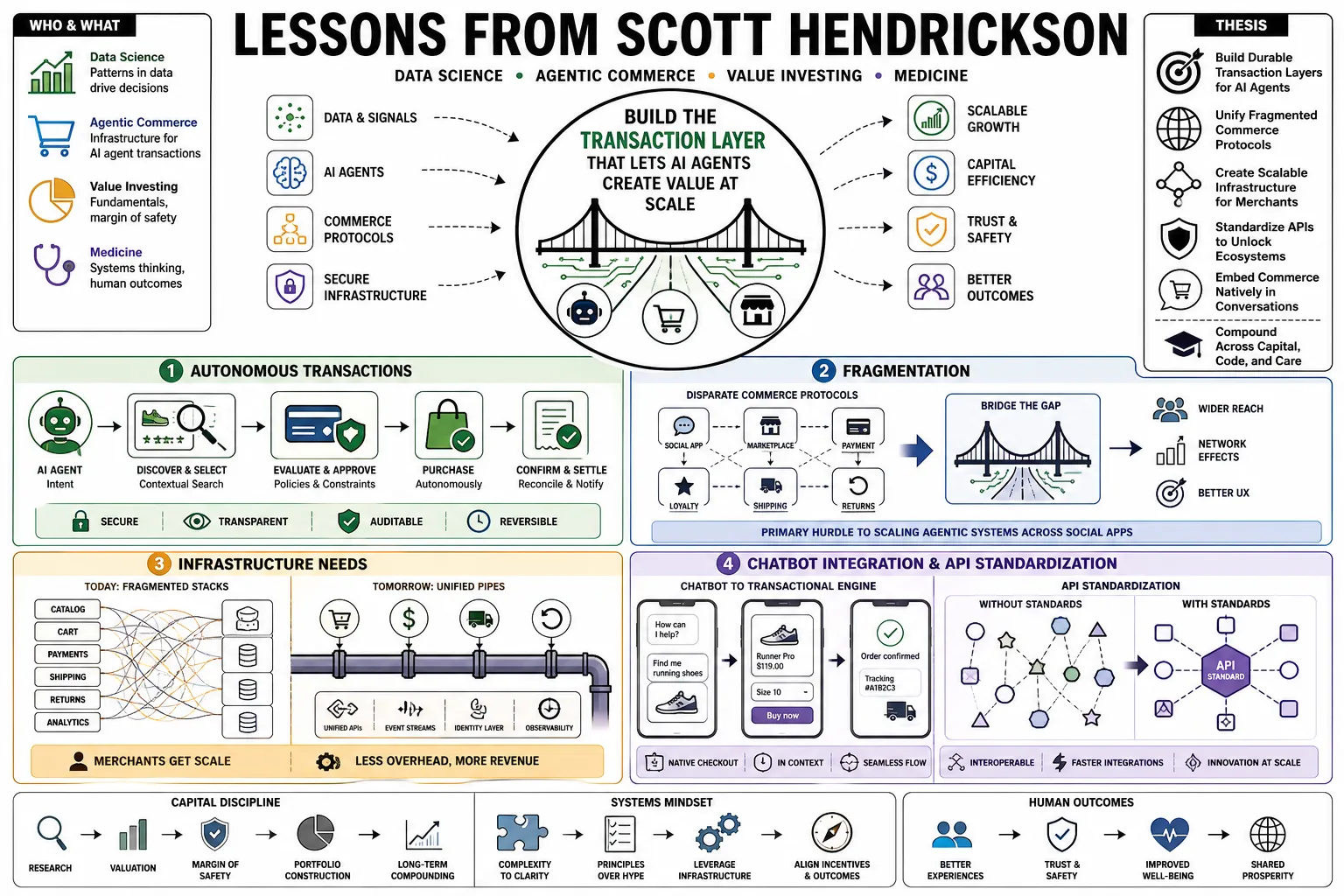
Lessons from Scott Hendrickson
Scott Hendrickson’s work spans data science, agentic commerce, value investing, and medicine. He builds transaction layers for AI agents and applies fundamental analysis to global equities. This profile collects his writing to trace his approach to capital, digital infrastructure, and organizational scale.
Part 1: Agentic Commerce and Retail Infrastructure
- On Autonomous Transactions: "The next evolution of retail relies on building a secure transaction layer where AI agents can execute purchases without constant human intervention." — Source: firmly.ai
- On Fragmentation: "Bridging the gap between disparate commerce protocols is the primary hurdle in scaling agentic systems across social apps." — Source: firmly.ai
- On Infrastructure Needs: "Merchants need unified technological pipes to handle agent-driven commerce without adding massive technical overhead to their existing stacks." — Source: firmly.ai
- On Chatbot Integration: "Moving a chatbot from a conversational interface to a transactional engine requires embedding native checkout capabilities directly into the chat flow." — Source: firmly.ai
- On API Standardization: "Without standardized APIs, AI agents cannot reliably navigate the infinite variations of merchant checkout pages." — Source: firmly.ai
- On Payment Security: "Delegating purchasing power to an AI agent necessitates a fundamental shift in how we authenticate and authorize digital payments." — Source: firmly.ai
- On Frictionless Commerce: "The goal of agentic commerce is the complete removal of checkout friction at the exact moment of consumer intent." — Source: firmly.ai
- On Platform Independence: "A functional agentic transaction layer must operate independently of any single social media platform or digital walled garden." — Source: firmly.ai
- On Merchant Adoption: "Retailers will only adopt agentic commerce tools if they can do so without disrupting their existing inventory management systems." — Source: firmly.ai
- On the Future of Shopping: "We are moving from a paradigm where users search for products to one where agents curate and procure products based on continuous user context." — Source: firmly.ai
Part 2: Data Privacy and AI Ethics
- On AI Surface Area: Hendrickson's data-science lens treats AI privacy risk as a data-access problem: the more systems infer from personal traces, the harder it becomes for people to remain meaningfully anonymous. — Reference: Moral Repair episode on data science, consent, and anonymity
- On Data Consent: Hendrickson's consent point is that data systems need more than passive collection defaults; people need clearer ways to understand, limit, and revoke how their data is used. — Reference: Moral Repair episode on data and consent
- On Cooperative Ethics: Hendrickson's ethics frame links data work to reciprocity: systems should be designed around relationships, mutual benefit, and the communities affected by the data. — Reference: Moral Repair episode on cooperative ethics from nature
- On Algorithmic Bias: Hendrickson connects technical systems to history, arguing that data work has to examine whose assumptions, institutions, and power structures are being carried forward. — Reference: Moral Repair episode on colonialism in tech development
- On Compliance Risks: Hendrickson's privacy concerns sit close to real-world data exposure: political profiling, deletion rights, and sensitive-health contexts all show why collection choices become governance risks. — Reference: Moral Repair episode show notes on personal-data risks
- On Privacy by Design: Hendrickson's premise makes privacy an architectural constraint, because data systems built for total visibility make later consent or deletion fixes much harder. — Reference: Moral Repair episode on data access and anonymity
- On Data Minimization: Hendrickson's data-safety lesson is to reduce unnecessary collection and retention, especially when personal information can expose people in political, religious, health, or location contexts. — Reference: Moral Repair episode show notes on deleting and protecting personal data
- On Transparency: Hendrickson's transparency concern is practical: people cannot give meaningful consent if they cannot see how tracking, profiling, and data reuse shape their options. — Reference: Moral Repair episode on tracking, targeting, and consent
- On Regulatory Lag: Hendrickson's discussion points to the lag between data extraction and public safeguards; law and institutional norms usually arrive after harm has already become visible. — Reference: Moral Repair episode show notes on data deletion and consent norms
- On Model Unlearning: Hendrickson's deletion-rights theme translates directly to AI systems: the harder data is to trace through a pipeline, the harder it is to honor a person's request to be removed. — Reference: Moral Repair episode show notes on personal-data deletion
Part 3: Value Investing and Capital Management
- On Management Quality: Hendrickson puts management quality at the center of underwriting because leadership determines whether research conviction can survive real operating complexity. — Reference: Value Investing with Legends episode on management quality
- On Long/Short Strategies: Hendrickson frames long and short work as different diligence problems: longs need durable quality, while shorts need a clear framework for why the business or expectations can break. — Reference: Value Investing with Legends episode on longs, shorts, and short frameworks
- On Capital Allocation: Hendrickson studies capital allocation through management behavior, especially whether leaders can make acquisitions, cost decisions, and reinvestment choices that improve the business. — Reference: Value Investing with Legends episode on management and acquisitions
- On Market Psychology: Hendrickson's process tries to separate market noise from diligence-able facts, using research depth to decide whether pessimism reflects a fixable issue or a structural problem. — Reference: Value Investing with Legends episode on value-added research
- On Earnings Quality: Hendrickson's quality work looks past headline numbers toward business metrics, cost structure, and whether reported performance reflects durable economics. — Reference: Value Investing with Legends episode on business quality metrics
- On Competitive Advantage: Hendrickson links competitive advantage to measurable quality: the business has to show traits that management can defend and compound over time. — Reference: Value Investing with Legends episode on business quality
- On Portfolio Concentration: Hendrickson's portfolio construction uses ranking discipline so position size follows relative conviction rather than a generic desire to own more names. — Reference: Value Investing with Legends episode on portfolio construction
- On Institutional Imperatives: Hendrickson's teaching role reinforces the need to question investor habits directly, because process discipline can erode when firms simply copy accepted industry behavior. — Reference: Columbia faculty profile and Value Investing with Legends episode
- On Risk Management: Hendrickson treats risk management as process design: define the short framework, size positions through conviction, and keep revisiting what could make the thesis wrong. — Reference: Value Investing with Legends episode on short risk management
- On Information Arbitrage: Hendrickson's edge is less about simply finding facts first and more about doing research deep enough to turn available information into stronger conviction. — Reference: Value Investing with Legends episode on value-added research and conviction
Part 4: Construction Technology and Robotics
- On Industry Adoption: "The construction sector has historically lagged in digital adoption, making it one of the most fertile grounds for immediate technological ROI." — Source: ENR Critical Path Podcast
- On Robotics on Site: "Deploying robotics in construction is about augmenting worker safety and precision rather than replacing human labor." — Source: ENR Critical Path Podcast
- On Data in Design: "Building Information Modeling is only as useful as the field data that flows back into it during the construction phase." — Source: ENR Critical Path Podcast
- On Energy Integration: "New energy technologies require construction firms to act simultaneously as builders and power systems engineers." — Source: ENR Critical Path Podcast
- On Prefabrication: "Shifting work off-site to controlled manufacturing environments drastically reduces schedule variance and material waste." — Source: ENR Critical Path Podcast
- On Drone Surveying: "Drones have transformed site surveying from a multi-day manual process into an automated, high-resolution daily routine." — Source: ENR Critical Path Podcast
- On Supply Chain Visibility: "Real-time tracking of materials from factory to site is essential for maintaining lean construction schedules." — Source: ENR Critical Path Podcast
- On Predictive Maintenance: "Installing IoT sensors during the build phase turns static infrastructure into responsive assets that predict their own maintenance needs." — Source: ENR Critical Path Podcast
- On Change Management: "Introducing new tech on a job site requires gaining the trust of the field superintendents first; if they reject it, the deployment fails." — Source: ENR Critical Path Podcast
Part 5: Cloud Architecture and Enterprise Scale
- On Research Computing: "Higher education requires cloud environments that can seamlessly burst to handle massive, intermittent research workloads." — Source: AWS Architecture Blog
- On Data Lakes: "A data lake without rigorous governance quickly devolves into a data swamp where no insights can be reliably extracted." — Source: AWS Architecture Blog
- On Serverless Architectures: "Moving to serverless is about reallocating engineering hours from maintenance to feature development." — Source: AWS Architecture Blog
- On AI Product Strategy: "Successful AI products solve specific, bounded problems rather than attempting to be generalized oracles." — Source: AWS Architecture Blog
- On Security Perimeters: "The traditional network perimeter is dead; security must now be enforced at the identity and API level." — Source: AWS Architecture Blog
- On Grant Research Automation: "Using AI agents to navigate the labyrinth of federal grant funding can save institutions thousands of hours of administrative friction." — Source: AWS Architecture Blog
- On Cloud Migration: "Lifting and shifting legacy applications to the cloud merely relocates technical debt without realizing the platform's native benefits." — Source: AWS Architecture Blog
- On Microservices: "Decomposing monoliths into microservices increases organizational velocity but introduces immense operational complexity in debugging." — Source: AWS Architecture Blog
- On Cost Optimization: "Cloud economics require engineers to treat infrastructure costs as a primary metric, equal in importance to latency and uptime." — Source: AWS Architecture Blog
Part 6: Literary History and Intellectual Networks
- On Cultural Translation: "Juan Eusebio Nieremberg's work demonstrates how intellectual concepts were translated and adapted across the Spanish Empire." — Source: Brill Publishers
- On the Spanish Golden Age: "The literary enterprise of the 17th century was intrinsically linked to the theological and political priorities of the Habsburg court." — Source: Brill Publishers
- On Intellectual Polymaths: "Scholars of the era did not recognize the modern boundaries between natural philosophy, theology, and literature." — Source: Brill Publishers
- On Censorship and Publication: "Navigating the Inquisition required authors to employ sophisticated rhetorical strategies to present novel scientific ideas." — Source: Brill Publishers
- On Archival Research: "Understanding historical texts requires situating them within the physical and economic constraints of the early modern printing press." — Source: Brill Publishers
- On Global Jesuit Networks: "The Society of Jesus functioned as one of the first global information networks, facilitating the exchange of botanical and cultural knowledge." — Source: Brill Publishers
- On Mysticism and Science: "In the early modern period, mystical theology and empirical observation were often viewed as complementary paths to understanding creation." — Source: Brill Publishers
- On Patronage: "The success of a literary enterprise was largely determined by an author's ability to secure and maintain aristocratic patronage." — Source: Brill Publishers
- On Historical Humanism: "Studying early modern polymaths reminds us that the pursuit of knowledge has always been a deeply human, flawed, and collaborative endeavor." — Source: Brill Publishers
Part 7: Medical Practice and Patient Outcomes
- On Preventive Care: "Routine gastroenterological screening remains one of the most effective yet underutilized tools in preventive oncology." — Source: Cancer Treatment Centers of America
- On Patient Communication: "Explaining a diagnosis is about ensuring the patient understands their active role in the treatment plan." — Source: Cancer Treatment Centers of America
- On Multidisciplinary Treatment: "Complex gastrointestinal cancers require a coordinated approach where surgeons, oncologists, and nutritionists operate as a single unit." — Source: Cancer Treatment Centers of America
- On Dietary Interventions: "Nutrition is not secondary to treatment; for GI patients, targeted dietary management is a primary medical intervention." — Source: Cancer Treatment Centers of America
- On Endoscopic Innovation: "Advancements in minimally invasive endoscopy have drastically reduced recovery times and improved diagnostic accuracy." — Source: Cancer Treatment Centers of America
- On Fellowship Training: "Mentoring the next generation of physicians requires balancing rigorous clinical oversight with the space for independent clinical judgment." — Source: Cancer Treatment Centers of America
- On Managing Complications: "The hallmark of an experienced clinician is recognizing and managing inevitable complications early." — Source: Cancer Treatment Centers of America
- On Quality of Life: "Extending survival must be carefully balanced with preserving the patient's daily quality of life and dignity." — Source: Cancer Treatment Centers of America
- On Evidence-Based Practice: "Clinical intuition is valuable, but it must always be anchored by the latest peer-reviewed outcome data." — Source: Cancer Treatment Centers of America
Part 8: Brand Strategy and Consumer Trust
- On Direct-to-Consumer Models: "Brands that surrender their direct consumer relationships to third-party marketplaces ultimately erode their long-term equity." — Source: Talk Commerce Podcast
- On Brand Identity: "In an era of automated commerce, maintaining a distinct brand voice is the only way to prevent your product from becoming a commoditized API call." — Source: Talk Commerce Podcast
- On Customer Retention: "Acquisition costs will continually rise; sustainable growth is entirely dependent on frictionless post-purchase experiences." — Source: Talk Commerce Podcast
- On Omnichannel Reality: "Consumers do not think in channels; they expect a continuous conversation with a brand whether they are on social media, email, or in-store." — Source: Talk Commerce Podcast
- On Trust and Automation: "Consumers will only allow AI agents to make purchases on their behalf if the brand has established a baseline of absolute trust." — Source: Talk Commerce Podcast
- On Data Ownership: "Merchants must aggressively protect their first-party data; it is the currency that will power their future personalized marketing efforts." — Source: Talk Commerce Podcast
- On Social Commerce: "The integration of native checkouts into social feeds collapses the marketing funnel, turning inspiration instantly into conversion." — Source: Talk Commerce Podcast
- On Personalization: "Effective personalization is invisible; it removes friction without making the consumer feel like they are under surveillance." — Source: Talk Commerce Podcast
- On the Subscription Economy: "A subscription is not a product feature; it is a commitment by the brand to deliver recurring, indispensable value." — Source: Talk Commerce Podcast