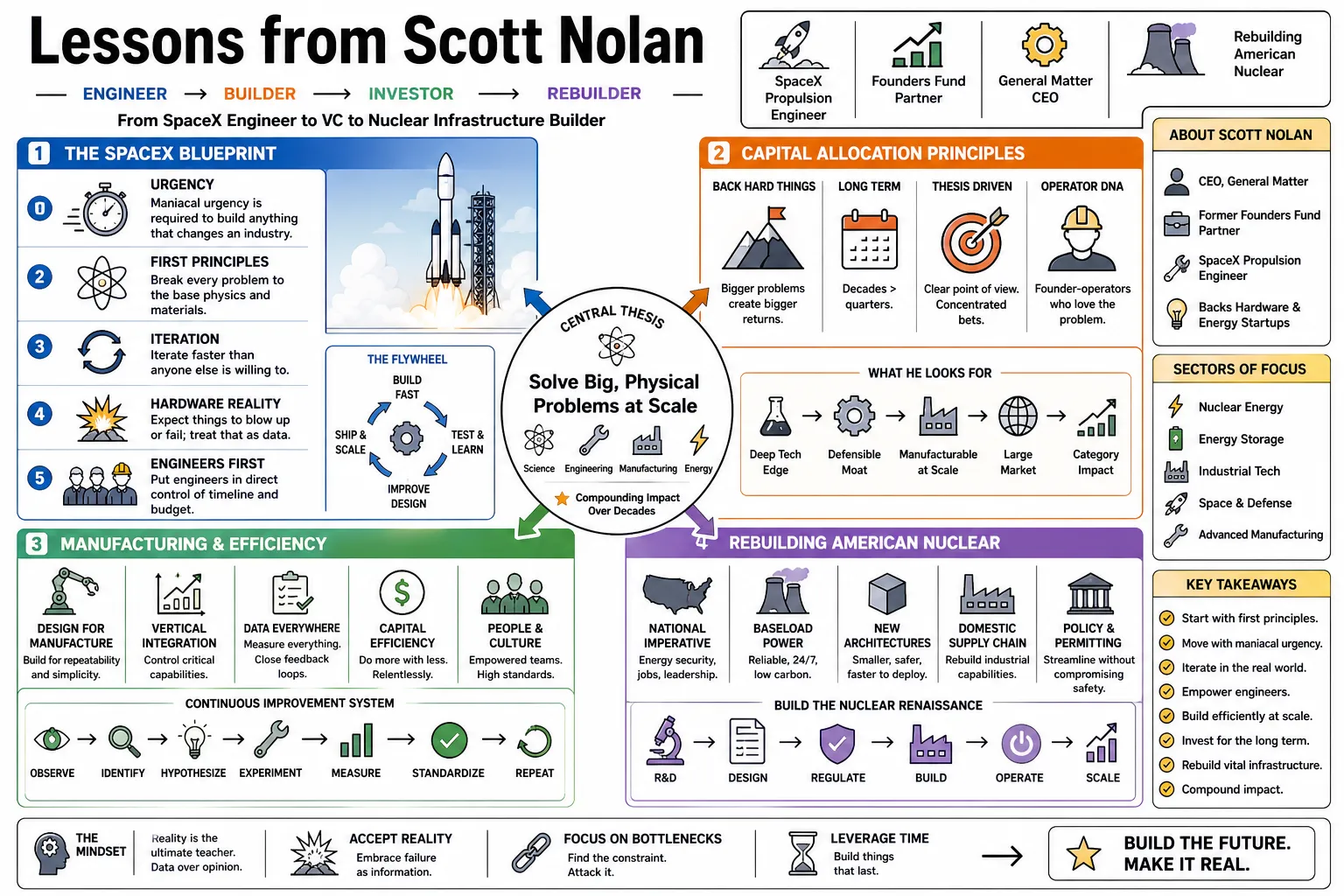
Lessons from Scott Nolan
Scott Nolan is the CEO of General Matter and a former Founders Fund partner who began his career engineering propulsion systems at SpaceX. He later shifted to venture capital to back hardware and energy startups. This profile gathers his public commentary on capital allocation, manufacturing efficiency, and the push to rebuild American nuclear infrastructure.
Part 1: The SpaceX Blueprint
- On Urgency: "Maniacal urgency is required to build anything that actually changes the trajectory of an industry." — Source: [Invest Like the Best]
- On Engineering First Principles: "You have to break down every problem to the base physics and materials; if it doesn't violate a law of physics, the bottleneck is just human effort." — Source: [Shawn Ryan Show]
- On Iteration: "The goal isn't to design the perfect system on the first try, but to iterate faster than anyone else is willing to." — Source: [Invest Like the Best]
- On Hardware Development: "Building in the physical world requires accepting that things will blow up or fail on the test stand, and treating that as data rather than defeat." — Source: [LA Venture Podcast]
- On the Role of Engineers: "The most effective teams put engineers in direct control of the timeline and the budget, removing the layers of management that slow down decisions." — Source: [Upfront Summit]
- On Risk Tolerance: "If you aren't pushing the hardware to the point of failure, you don't actually know where the margins are." — Source: [Shawn Ryan Show]
- On Breaking Conventional Rules: "Most industry standards exist because someone made a compromise decades ago; you have to be willing to ignore them to make a leap forward." — Source: [Invest Like the Best]
- On Mission Alignment: "When everyone in the building knows exactly what the overriding goal is, you don't need to micromanage the daily decisions." — Source: [Founders Fund]
- On Extreme Ambition: "You have to choose problems that sound almost impossible to the outside world to attract the caliber of people required to solve them." — Source: [LA Venture Podcast]
Part 2: The Founders Fund Philosophy
- On Contrarian Investing: "The best investments look like bad ideas to most people at the time they are made, otherwise the market would have already priced them in." — Source: [Invest Like the Best]
- On Identifying Gaps: "We spend a lot of time looking for the massive problems that absolutely have to be solved, but that no one is currently working on." — Source: [Founders Fund]
- On Incubating Solutions: "If we search the market for a company solving a structural bottleneck and find nothing, the logical next step is to start it ourselves." — Source: [Invest Like the Best]
- On Peter Thiel's Influence: "Working alongside Peter teaches you to constantly question the default trajectory of technology and society." — Source: [Shawn Ryan Show]
- On Objectivity vs. Passion: "An investor must remain entirely objective about the market, but a founder has to fall irrationally in love with the specific problem they are solving." — Source: [Invest Like the Best]
- On the Role of Venture Capital: "Venture capital should be directed toward building the future rather than funding incremental software optimizations." — Source: [TechCrunch]
- On Backing Hard Problems: "The companies that take on the highest technical risk often face the lowest market risk, because if they succeed, they have a monopoly." — Source: [Upfront Summit]
- On Valuation and Up-Rounds: "The steeper the up-round, the greater the undervaluation." — Source: [Founders Fund]
- On Long-Term Horizons: "You cannot build foundational infrastructure if your fund is optimizing for a quick exit in three years." — Source: [LA Venture Podcast]
Part 3: The Burn Rate Fallacy
- On Burn Rate as a Vanity Metric: "Burn rate is a vanity metric; alone, it tells you nothing about whether a startup is actually on track to succeed." — Source: [TechCrunch]
- On Low Burn Traps: "Striving for a low burn rate can be dangerous because it often stifles the necessary progress required to build something meaningful." — Source: [Medium]
- On Cash Conversion: "The most important companies aggressively convert cash into assets and ambitious R&D milestones." — Source: [TechCrunch]
- On Speed vs. Efficiency: "Burn rate should simply be viewed as the speed at which you are hitting milestones multiplied by the cost of those milestones." — Source: [TechCrunch]
- On R&D Milestones: "If you are burning money but generating massive technical leaps that put you years ahead of competitors, that is capital well spent." — Source: [Founders Fund]
- On Profitability Timing: "Cash-flow-positive businesses early in their lifecycle often lack sufficient ideas on how to productively deploy more capital." — Source: [TechCrunch]
- On Capital as a Tool: "Capital is just a tool to buy time and speed; hoarding it at the expense of development is a failure of strategy." — Source: [Medium]
- On the Cost of Slowness: "The real risk isn't running out of money by moving too fast; it's moving so slowly that the market passes you by." — Source: [Founders Fund]
- On Measuring Real Progress: "Investors should evaluate a company's long-term strategy and use of capital, rather than panicking over the net cash outflow per month." — Source: [TechCrunch]
Part 4: The Idiot Index
- On the Idiot Index Definition: "The idiot index is simply the cost of the finished component divided by the cost of the raw materials inside it." — Source: [Shawn Ryan Show]
- On High Markups: "If the index is super high, it implies that the producer is doing something wrong and there is massive room for cost compression." — Source: [Invest Like the Best]
- On Vertical Integration: "The best way to lower the idiot index is to bring the manufacturing in-house and cut out the layers of suppliers adding arbitrary margins." — Source: [Shawn Ryan Show]
- On Supply Chain Bloat: "Traditional aerospace and defense supply chains are full of middlemen who pass along costs without adding proportionate value." — Source: [Founders Fund]
- On Component Costs: "You have to ask why a part that contains fifty dollars worth of aluminum costs five thousand dollars to purchase." — Source: [Upfront Summit]
- On In-House Manufacturing: "When you control the manufacturing floor, you control the pace of innovation and the final cost structure." — Source: [LA Venture Podcast]
- On Design Simplification: "Often, a high index means the part is over-designed; the solution is to engineer the complexity out of the component." — Source: [Invest Like the Best]
- On Challenging Conventional Wisdom: "Just because an industry has accepted a certain price point for decades does not mean that price is tied to reality." — Source: [Shawn Ryan Show]
- On Continuous Cost Compression: "The goal of any mature engineering organization should be to continually push the idiot index closer to one." — Source: [Invest Like the Best]
Part 5: Hard Tech and Atoms Over Bits
- On Hard Tech: "We have to shift our focus back to the physical world if we want to drive actual, structural economic growth." — Source: [Founders Fund]
- On Physical World Innovation: "Software has eaten the world, but the physical world is where the primary bottlenecks to human progress now remain." — Source: [Upfront Summit]
- On American Industrial Capacity: "The U.S. lost its ability to build massive industrial projects; regaining that muscle memory is a matter of national survival." — Source: [Shawn Ryan Show]
- On Software vs. Hardware: "Hardware is unforgiving, but it also creates moats that are nearly impossible for a competitor to replicate with code." — Source: [LA Venture Podcast]
- On the El Segundo Ecosystem: "The South Bay has become the epicenter for hard tech because it retains the dense engineering talent required to build complex machines." — Source: [LA Venture Podcast]
- On Rebuilding Infrastructure: "We cannot rely on fifty-year-old infrastructure to power the next century of technological advancement." — Source: [Founders Fund]
- On National Security: "Industrial capacity and manufacturing independence are the actual foundations of national security." — Source: [Shawn Ryan Show]
- On Manufacturing Resurgence: "There is a new generation of founders applying startup urgency to heavy industry, and it is going to reshape the American economy." — Source: [Upfront Summit]
- On Capital-Intensive Sectors: "If a sector requires hundreds of millions of dollars to reach the first product, that is a feature, not a bug, for keeping out unserious competitors." — Source: [Invest Like the Best]
- On Operator-Driven VC: "You cannot effectively evaluate a hard tech company if you have never been on a factory floor or test stand." — Source: [Founders Fund]
Part 6: The Energy Bottleneck
- On the AI Energy Squeeze: "Electricity, specifically reliable baseload power, is now the primary bottleneck for the growth of AI compute." — Source: [Invest Like the Best]
- On Baseload Power: "Data centers cannot run on intermittent energy; they require power sources that operate continuously without weather dependencies." — Source: [Upfront Summit]
- On Grid Constraints: "The public power grid simply does not have the capacity to absorb the massive demands of the next generation of data centers." — Source: [Shawn Ryan Show]
- On Data Center Demands: "We are moving into an era where individual data centers will require gigawatts of power, comparable to the demand of entire cities." — Source: [Invest Like the Best]
- On Nuclear as the Solution: "Nuclear energy is the only technology that provides the strict uptime, scale, and carbon-free profile required for advanced AI infrastructure." — Source: [Upfront Summit]
- On Bring Your Own Energy: "Data center developers will increasingly have to secure their own energy supply and co-locate with generation sources." — Source: [Founders Fund]
- On Uptime Requirements: "If your data center loses power, the cost is measured in millions of dollars per minute; the energy source has to be bulletproof." — Source: [Shawn Ryan Show]
- On Co-locating Power: "Building the reactor next to the compute facility bypasses the transmission bottlenecks that are holding back grid expansion." — Source: [Invest Like the Best]
- On National Competitiveness: "The country that solves the energy bottleneck for AI will dictate the technological leadership of the next fifty years." — Source: [Upfront Summit]
- On Overcoming Bottlenecks: "We have to treat energy generation as a direct path to artificial intelligence instead of a utility problem." — Source: [Founders Fund]
Part 7: Reviving Nuclear Capabilities
- On the Uranium Enrichment Gap: "Just like car engines need fuel, nuclear reactors need fuel. Right now the U.S. is completely dependent on other countries for enrichment." — Source: [World Nuclear News]
- On Russian Dependency: "Relying on foreign adversaries for the fuel that powers our core infrastructure is an unacceptable strategic vulnerability." — Source: [Shawn Ryan Show]
- On Founding General Matter: "I spent over a year at Founders Fund searching for an American enrichment company to invest in, only to find there wasn't one. So we built our own." — Source: [Nuclear Engineering International]
- On HALEU Shortages: "The next generation of advanced reactors requires High-Assay Low-Enriched Uranium, and the domestic supply chain for it essentially does not exist." — Source: [Invest Like the Best]
- On the Paducah Facility: "This plant led the US in commercial enrichment until 2013; it is the last place that's done enrichment, and it makes sense as the next place that enrichment happens." — Source: [NPR]
- On the 1980s Decline: "In the 1980s, the U.S. produced 80% of global enriched uranium; today that number is zero." — Source: [Invest Like the Best]
- On Strategic Independence: "Rebuilding America's nuclear fuel capabilities is necessary for strengthening our industrial base and reducing our reliance on foreign providers." — Source: [World Nuclear News]
- On Executive Orders: "Recent executive orders and import bans are paving the way for the U.S. to regain its lead in the nuclear fuel cycle." — Source: [The White House]
- On Next-Generation Reactors: "We cannot deploy the advanced reactors of the future if we do not first solve the fundamental chemistry and physics of fueling them." — Source: [Upfront Summit]
- On Taking on Hard Tasks: "We chose to do this not because it is easy, and not because it is hard, but because it needs doing." — Source: [Nuclear Engineering International]
Part 8: Building the Future
- On the Founder's Mindset: "A founder has to possess a near-delusional level of belief that they can bend reality to their will." — Source: [Founders Fund]
- On Falling in Love with an Idea: "You have to be so obsessed with the problem that you are willing to spend the next decade of your life fighting through the misery to solve it." — Source: [Invest Like the Best]
- On Doing What Needs Doing: "When you identify a gap that threatens the future of the country, you lose the luxury of waiting for someone else to step up." — Source: [Shawn Ryan Show]
- On Institutional Inertia: "Large organizations are structurally designed to minimize risk, which inevitably means they stop doing anything important." — Source: [LA Venture Podcast]
- On Transforming Trajectories: "We are undertaking an engineering challenge which, if successful, will fundamentally improve the trajectory of our nation." — Source: [World Nuclear News]
- On the Role of Technology: "The innovation ecosystems that produce and apply technology will prove divisive in achieving a favorable outcome for society." — Source: [CSIS]
- On the Importance of the Team: "You cannot solve physics problems with mediocre talent; you have to assemble the absolute best engineers in the world." — Source: [Upfront Summit]
- On Pushing Boundaries: "Comfort is the enemy of progress; if the work doesn't feel exceptionally difficult, you are probably working on the wrong thing." — Source: [Founders Fund]
- On the Future: "The future is not something that just happens to us; it is a physical reality that we have to actively build with our own hands." — Source: [Invest Like the Best]