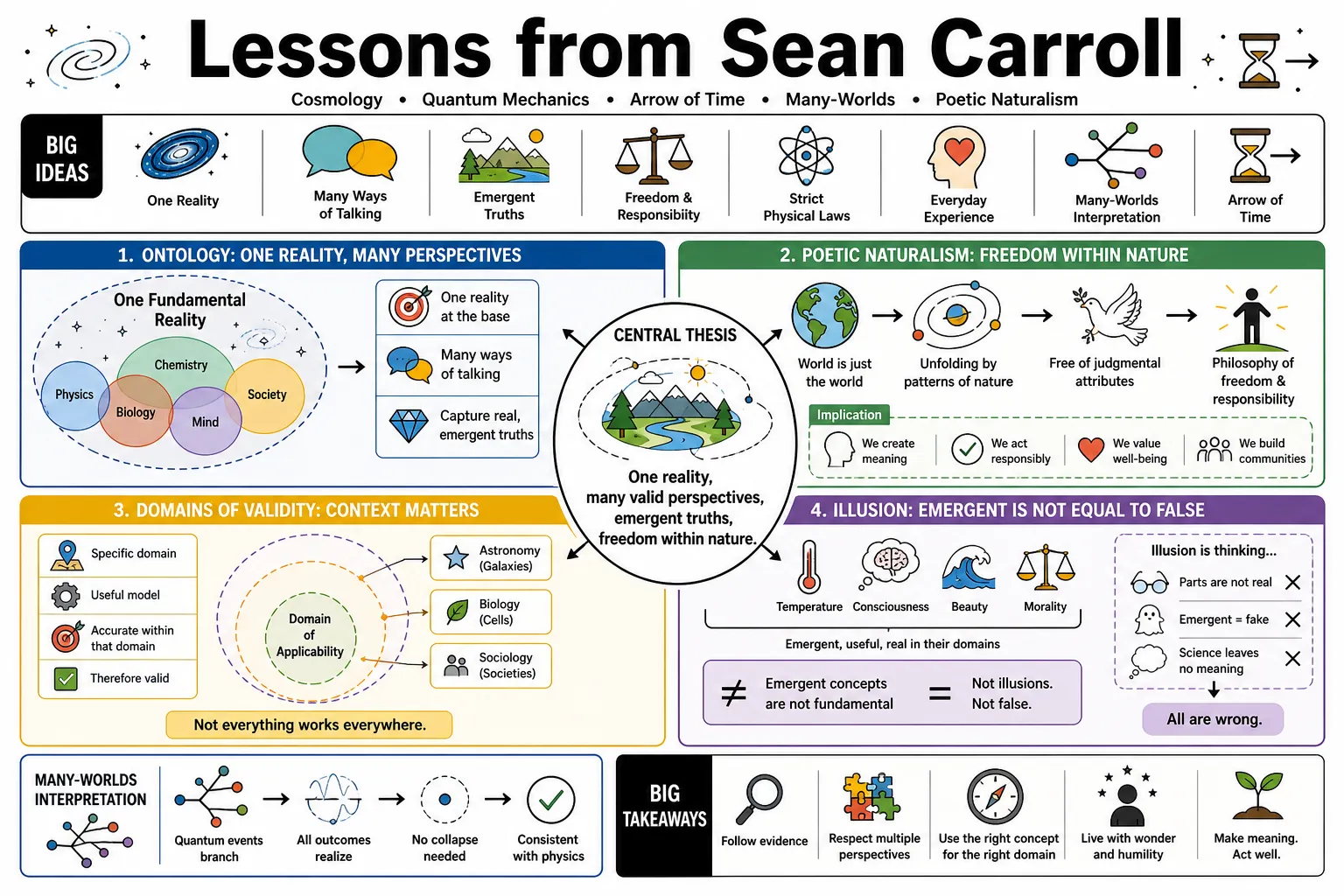
Lessons from Sean Carroll
Theoretical physicist and philosopher Sean Carroll studies cosmology, quantum mechanics, and the arrow of time. He is a prominent defender of the Many-Worlds interpretation and advocates for "poetic naturalism" to reconcile strict physical laws with everyday human experience. This collection tracks his arguments for how reality actually works.
Part 1: Poetic Naturalism and Reality
- On Ontology: "There is only one fundamental reality, but there are many different ways of talking about it that capture real, emergent truths." — Source: [The Big Picture]
- On Poetic Naturalism: "Poetic naturalism is a philosophy of freedom and responsibility. The world is just the world, unfolding according to the patterns of nature, free of any judgmental attributes." — Source: [The Big Picture]
- On the Physical World: "The universe is not a miracle. It simply is, unguided and unsustained, manifesting the patterns of nature with scrupulous regularity." — Source: [The Big Picture]
- On Domains of Validity: "A way of talking about the world is valid if it provides a useful, accurate model of some portion of reality within a specific domain of applicability." — Source: [The Big Picture]
- On Illusion: "Just because a concept like temperature or consciousness is emergent rather than fundamental does not mean it is an illusion; it means it is a higher-level description." — Source: [The Big Picture]
- On Naturalism: "Naturalism asserts that there is only the natural world—no supernatural realm, no spiritual dimension beyond the physical universe." — Source: [The Big Picture]
- On the Soul: "There is no physical mechanism by which a soul could interact with the particles of our body without violating the known laws of physics." — Source: [The Big Picture]
- On Vocabulary: Each level of description, from particles up to human behavior, can be talked about on its own terms, in its own vocabulary, without needing the full detail of the level below it. — Source: [Mindscape Podcast]
- On Reductionism: "Reductionism is true in the sense that larger things are made of smaller things, but it fails as a methodology because calculating the behavior of complex systems from fundamental particles is practically impossible." — Source: [The Big Picture]
- On Truth: "Truth is a relationship between our maps of the world and the world itself; a description is true if it accurately models what happens." — Source: [The Big Picture]
Part 2: The Arrow of Time and Entropy
- On Time's Direction: "The arrow of time is not an intrinsic feature of fundamental physics, but a consequence of the universe starting in a state of very low entropy." — Source: [From Eternity to Here]
- On the Big Bang: "To explain why time flows forward, we must explain why the Big Bang was a highly ordered state, which remains one of the great unsolved mysteries of cosmology." — Source: [From Eternity to Here]
- On Memory: "We remember the past and not the future solely because entropy is increasing, which allows records of past events to form and persist." — Source: [From Eternity to Here]
- On Aging: "Aging and decay are simply statistical inevitabilities driven by the Second Law of Thermodynamics; there are vastly more ways to be broken than to be whole." — Source: [From Eternity to Here]
- On Reversibility: "The fundamental equations of classical mechanics and quantum mechanics are entirely symmetric with respect to time; they do not distinguish between forwards and backwards." — Source: [From Eternity to Here]
- On Entropy and Information: "Entropy is a measure of our ignorance about the microscopic state of a system when we only know its macroscopic properties." — Source: [From Eternity to Here]
- On the Multiverse and Time: "One possible explanation for our low-entropy beginning is that our observable universe is just an offshoot of a larger multiverse where time is symmetric on a grand scale." — Source: [From Eternity to Here]
- On the End of the Universe: "Eventually, the universe will reach a state of maximum entropy, a thermal equilibrium where no more complex structures can form and the arrow of time will cease to exist." — Source: [From Eternity to Here]
- On Causality: "Causes precede their effects entirely because of the macroscopic arrow of time; at the fundamental level, the past and future constrain each other equally." — Source: [The Biggest Ideas in the Universe]
Part 3: Quantum Mechanics and Many-Worlds
- On the Measurement Problem: "The measurement problem is the scandal of quantum mechanics. We have a theory that works perfectly, yet we cannot agree on what it actually means when no one is looking." — Source: [Something Deeply Hidden]
- On Everettian Quantum Mechanics: "The Many-Worlds interpretation is just quantum mechanics taken seriously, without adding any new rules to collapse the wave function." — Source: [Something Deeply Hidden]
- On Branching: "Every time a quantum system in a superposition becomes entangled with the environment, the universe branches into multiple distinct realities." — Source: [Something Deeply Hidden]
- On the Wave Function: "The wave function is not just a mathematical tool for calculating probabilities; it is a direct representation of reality itself." — Source: [Something Deeply Hidden]
- On Occam's Razor: "Many-Worlds is the simplest interpretation because it uses the fewest postulates, even though it predicts the largest number of universes." — Source: [Something Deeply Hidden]
- On Schrodinger's Cat: "The cat is never both alive and dead in the same world; there is one world where the cat is alive and a separate, non-interacting world where the cat is dead." — Source: [Something Deeply Hidden]
- On Entanglement: "Entanglement is the fundamental feature of quantum mechanics that distinguishes it from classical physics; it is what weaves the universe together." — Source: [Something Deeply Hidden]
- On Ignorance of the Theory: "Most working physicists simply ignore the foundations of quantum mechanics, adopting a shut up and calculate mentality that avoids the deep ontological questions." — Source: [Something Deeply Hidden]
- On Quantum Gravity: "To successfully merge quantum mechanics with gravity, we likely need to start from the quantum wave function and derive spacetime from entanglement, rather than starting with spacetime and trying to quantize it." — Source: [Something Deeply Hidden]
- On Parallel Selves: "The other versions of you in parallel branches are real, but they are no longer you; they are distinct individuals sharing a common past." — Source: [Something Deeply Hidden]
Part 4: Cosmology and the Expanding Universe
- On Dark Matter: "Dark matter is not a wild guess; it is the most straightforward, conservative explanation for the gravitational behavior we observe in galaxies and the cosmic microwave background." — Source: [The Biggest Ideas in the Universe]
- On Dark Energy: "The accelerating expansion of the universe tells us that empty space possesses its own inherent energy, which pushes galaxies apart." — Source: [The Biggest Ideas in the Universe]
- On the Size of the Universe: "The observable universe is vast, containing hundreds of billions of galaxies, yet it is only a finite patch of an environment that is likely infinite." — Source: [The Big Picture]
- On Cosmic Insignificance: "We live on a small rock orbiting a standard star in a quiet suburb of an ordinary galaxy, but our ability to comprehend the cosmos gives us a unique significance." — Source: [The Big Picture]
- On General Relativity: "Einstein’s great insight was that gravity is not a force propagating through space, but the curvature of spacetime itself, dictating how matter moves." — Source: [The Biggest Ideas in the Universe]
- On the Multiverse: The multiverse is not a separate theory on its own -- it emerges as a prediction of inflationary models, since most versions of inflation imply that the process never fully ends, continually generating new regions of space. — Source: [Preposterous Universe Blog]
- On Fine-Tuning: "The apparent fine-tuning of the universe for life might just be an anthropic selection effect; if the laws were different, we wouldn't be here to observe them." — Source: [The Big Picture]
- On the Big Bang Singularity: "The Big Bang might not be the absolute beginning of time; it is just the boundary of our current theoretical understanding, where classical general relativity breaks down." — Source: [From Eternity to Here]
- On Cosmic Horizons: "Because the universe is expanding at an accelerating rate, distant galaxies will eventually cross our cosmic horizon, disappearing from our view forever." — Source: [The Biggest Ideas in the Universe]
Part 5: Meaning, Morality, and Human Existence
- On Meaning: "Meaning is not written into the fabric of the universe; it is something we construct and bring to the world through our choices and values." — Source: [The Big Picture]
- On Morality: "Moral rules are not objective physical facts; they are agreements and constructs built by humans to enable flourishing in a complex social environment." — Source: [The Big Picture]
- On Purpose: "The universe does not have a purpose, but that does not mean life is purposeless; humans are purpose-creating machines." — Source: [The Big Picture]
- On Existentialism: "Accepting a naturalistic worldview frees us from external dictates and places the responsibility squarely on us to determine what matters." — Source: [The Big Picture]
- On Caring: Because the universe itself does not hand us meaning or caring, that responsibility falls back on us -- we are the ones who have to build meaningful, caring lives for each other. — Source: [Mindscape Podcast]
- On Constructivism: "Our values are not out there to be discovered like prime numbers; they are created like works of art." — Source: [The Big Picture]
- On Human Exceptionalism: "We are not made of different stuff than the rest of the cosmos, but the specific, complex way our stuff is arranged allows for consciousness, reflection, and joy." — Source: [The Big Picture]
- On Death: "Understanding that our lives are finite and that there is no afterlife makes the time we have infinitely more precious." — Source: [The Big Picture]
- On Empathy: "Empathy arises naturally from our evolutionary history as social animals, serving as the biological foundation for our moral frameworks." — Source: [The Big Picture]
- On Awe: "Science does not diminish the wonder of the universe; knowing how a star works or how life evolved only deepens the awe we feel." — Source: [The Big Picture]
Part 6: Epistemology and the Scientific Method
- On Bayesian Updating: "We should view our beliefs not as absolute certainties, but as probabilities that we constantly update as we acquire new evidence." — Source: [The Big Picture]
- On Doubt: Science is not built on certainty -- its methodology runs on ignorance, failure, and uncertainty, with the most interesting research happening right at the boundary of what we do and do not know. — Source: [Mindscape Podcast]
- On the Role of Philosophy: Philosophy pushes physicists to examine their reasoning for hidden assumptions, cognitive biases, and logical leaps, sharpening the concepts and interpretations behind the science. — Source: [Preposterous Universe Blog]
- On Falsifiability: Falsifiability is a useful guideline, but it does not precisely mark the boundary between science and non-science; what matters more is whether a theory best explains the data. — Source: [Preposterous Universe Blog]
- On Thought Experiments: "Thought experiments are crucial tools in physics because they allow us to test the logical consistency of our theories beyond the limits of current technology." — Source: [The Biggest Ideas in the Universe]
- On Simplicity: "We prefer simpler theories not because nature is inherently simple, but because simpler theories are more easily falsifiable and have higher predictive power." — Source: [The Big Picture]
- On Mathematics: "Math is the language we use to ensure our physical theories are logically rigorous, but the math itself must always be anchored to physical reality." — Source: [The Biggest Ideas in the Universe]
- On Knowledge vs Reality: "Our theories are maps, and we must constantly remind ourselves not to confuse the map with the territory it describes." — Source: [The Big Picture]
- On Cognitive Bias: "Because human brains are wired to find patterns and seek agency, we must use the rigors of the scientific method to correct our natural cognitive biases." — Source: [The Big Picture]
Part 7: Particle Physics and the Core Theory
- On the Core Theory: "The physics underlying everyday life is completely understood; the Core Theory of quantum field theory and general relativity explains everything you interact with on a daily basis." — Source: [The Big Picture]
- On the Higgs Boson: "The discovery of the Higgs boson was the final piece of the Standard Model, confirming the mechanism by which fundamental particles acquire mass." — Source: [The Particle at the End of the Universe]
- On Quantum Field Theory: "The universe is not made of particles; it is made of fields. Particles are merely the quantized vibrations of these underlying, ubiquitous fields." — Source: [The Particle at the End of the Universe]
- On Completeness: "While there is physics beyond the Standard Model, any new particles or forces must interact so weakly that they are irrelevant to biological or chemical processes." — Source: [The Big Picture]
- On Symmetries: "Symmetries are the guiding principles of modern physics, dictating the conservation laws and the interactions of all fundamental forces." — Source: [The Biggest Ideas in the Universe]
- On Empty Space: "Empty space is not truly empty; it is boiling with quantum fluctuations and permeated by fields that contain non-zero energy." — Source: [The Particle at the End of the Universe]
- On Antimatter: "The fact that our universe is made entirely of matter and almost no antimatter is a profound asymmetry that physics has yet to fully explain." — Source: [The Particle at the End of the Universe]
- On the Large Hadron Collider: "The LHC represents one of the greatest triumphs of human collaboration, built to probe the universe at energies not seen since fractions of a second after the Big Bang." — Source: [The Particle at the End of the Universe]
- On Effective Field Theories: "We don't need a theory of everything to do physics; effective field theories allow us to make incredibly precise predictions at low energies without knowing the ultimate high-energy laws." — Source: [The Biggest Ideas in the Universe]
Part 8: Complexity, Emergence, and Life
- On Complexity: "Complexity arises in the transition period between the low entropy of the Big Bang and the high entropy of the universe's final state; it is a temporary, beautiful phase." — Source: [From Eternity to Here]
- On Life as a Process: "Life is not a substance, like water or rock; it is a process, like fire or a wave crashing on the shore, sustained by extracting free energy from the environment." — Source: [The Big Picture]
- On Emergence: "Emergent phenomena like fluid dynamics or human consciousness operate by their own autonomous rules, independent of the specific behavior of their microscopic constituents." — Source: [The Big Picture]
- On Information Processing: "Living systems are distinct because they encode information about their environment, allowing them to anticipate changes and react in ways that non-living matter cannot." — Source: [The Big Picture]
- On Free Will: "Free will is a perfectly real, emergent feature of human decision-making; the fact that we are made of particles obeying deterministic laws does not invalidate our capacity to choose." — Source: [The Big Picture]
- On Determinism: "At the fundamental level, the laws of physics may be deterministic or probabilistic, but at the macroscopic level of human behavior, we must act as though choices matter." — Source: [The Big Picture]
- On Consciousness: "Consciousness is not an ethereal essence added to matter; it is what happens when physical matter is arranged in a highly complex, interacting structure." — Source: [The Big Picture]
- On Evolution: "Natural selection is a mechanism that naturally drives localized pockets of matter toward greater complexity, entirely consistent with the overall increase in entropy." — Source: [The Big Picture]
- On the Mind-Body Problem: "The mind is exactly what the brain does; there is no explanatory gap that requires invoking new, non-physical phenomena to understand subjective experience." — Source: [The Big Picture]