Sean Ellis is an entrepreneur, investor, and the author of Hacking Growth, best known for coining the term "growth hacking" in 2010. By developing frameworks like the ICE prioritization method and the 40% product-market fit test, he shifted startup marketing away from traditional advertising and toward data-driven experimentation. This compilation explores his specific methods for user activation, retention, and building sustainable acquisition engines for early-stage companies.
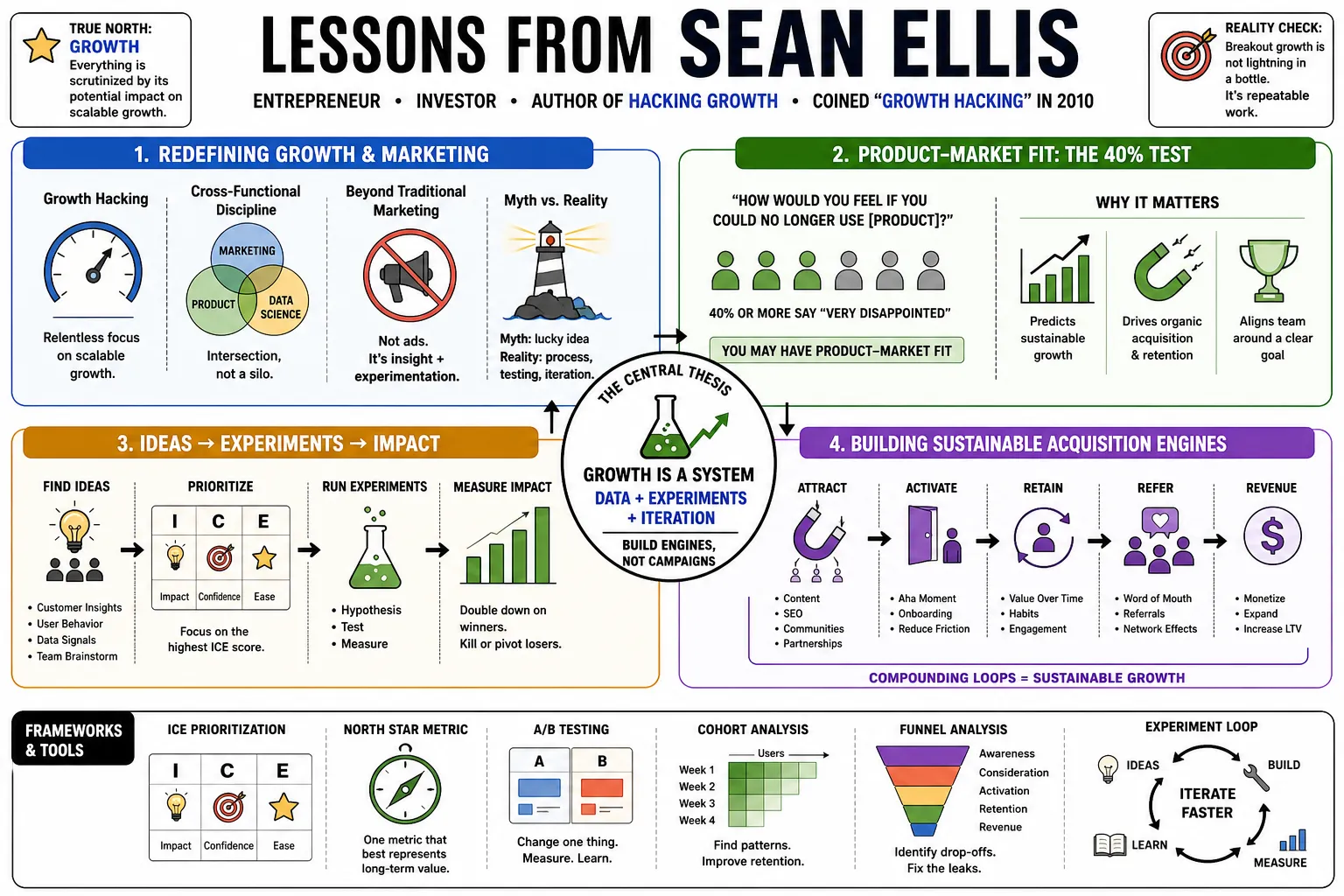
Part 1: Redefining Growth and Marketing
- On Growth Hacking: "A growth hacker is a person whose true north is growth. Everything they do is scrutinized by its potential impact on scalable growth." — Source: Sean Ellis on Medium
- On Traditional Marketing vs. Growth: "Growth is a cross-functional discipline. It is not a marketing sub-category; it is the intersection of marketing, product development, and data science." — Source: Sprints & Sneakers
- On the Reality of Success: "The popular mythology about the breakout growth of these companies is that they simply came up with a business idea that was lightning in a bottle. Yet that version of history is patently false." — Source: Hacking Growth on Goodreads
- On Misconceptions: "A major mistake is believing growth hacking is about finding a magic bullet or a single clever trick. It requires a sustained, methodological approach to optimization." — Source: Entrevestor
- On the Customer Journey: "Growth hacking focuses on the entire customer journey, including activation, retention, revenue, and referral, rather than just acquisition." — Source: Medium
- On Resource Constraints: "Growth teams use rapid experimentation to find the most effective and efficient ways to grow a business when capital or time is limited." — Source: DotControl
- On the True Goal: "The ultimate objective is to build a self-perpetuating marketing machine that reaches millions of users automatically." — Source: Hacking Growth
- On Skill Sets: "A growth hacker relies on analytical rigor, technical fluency, and creative problem-solving to unlock new acquisition channels." — Source: GrowthHackers
- On Customer Understanding: "Success depends on understanding the underlying reason behind customer behavior and ensuring product messaging aligns exactly with the provided value." — Source: Medium
- On Breaking Silos: "You cannot achieve breakout success when product and marketing operate in isolated silos. Growth requires absolute integration." — Source: Medium
Part 2: Achieving Product-Market Fit
- On the First Rule of Growth: "One of the cardinal rules of growth hacking is that you must not move into the high-tempo growth experimentation push until you know your product is must-have." — Source: Hacking Growth on Goodreads
- On the Sean Ellis Test: "To determine product-market fit, ask users: 'How would you feel if you could no longer use this product?'" — Source: Lenny's Newsletter
- On the 40% Benchmark: "If 40% or more of your users answer that they would be 'very disappointed' without your product, it is a strong indicator that you have achieved product-market fit." — Source: PMF Survey
- On Scaling Prematurely: Ellis warns that scaling growth before product-market fit can kill a startup, while waiting too long after fit can waste the chance to accelerate sustainable growth. — Reference: Sean Ellis on product-market fit before scaling growth
- On Identifying the Core User: "Survey only those who have experienced the core of the product, have used it at least twice, and have interacted with it recently." — Source: Product Coalition
- On Acting on Feedback: "By analyzing the open-ended feedback from those who were somewhat disappointed, companies can identify what features or segment tweaks might move them closer to the 40% threshold." — Source: Learning Loop
- On Leading Indicators: "The product-market fit survey is intended to be a leading indicator. It is a tool for validation and iteration rather than definitive proof of success." — Source: PMF Survey
- On Retention Validation: "While surveys provide early signals, cohort data provides the definitive proof of whether users are truly sticking with the product over time." — Source: Medium
- On Avoiding False Positives: He treats retention as the reality check behind growth: the product-market fit survey is a leading indicator, but retention cohorts ultimately show whether growth can be sustainable. — Reference: Sean Ellis on PMF surveys and retention cohorts
- On Focus: "Before accelerating acquisition spend, you must verify the product delivers genuine utility to a definable, reachable audience." — Source: GrowthHackers
Part 3: Identifying the North Star Metric
- On Definition: "The North Star Metric is the single metric that best captures the core value that your product delivers to customers." — Source: RevelX
- On Alignment: "The metric serves as a shared compass for an entire organization, aligning teams from product to engineering around a singular focus." — Source: Growth Method
- On Lagging vs Leading Indicators: "Unlike revenue, which is a lagging indicator of past success, a well-chosen metric acts as a leading indicator of long-term sustainable growth." — Source: Si Labs
- On Value Creation: "If the product consistently delivers value to the customer, as measured by the North Star Metric, revenue and retention will naturally follow." — Source: Gust de Backer
- On Simplifying Strategy: "The concept helps companies abandon vanity metrics, simplify internal meetings, and ensure every team's daily efforts connect back to a measurable user outcome." — Source: Medium
- On Functional Conflict: "When you lack a North Star Metric, marketing pushes for signups and product pushes for features, often at the expense of the actual user experience." — Source: Mixpanel
- On Metric Selection: "The chosen metric must be tightly correlated with the specific moments that users experience the core value of your platform." — Source: Amplitude
- On Short vs Long Term: "The North Star Metric represents long-term health, whereas a One Metric That Matters is a tactical, shorter-term goal used by specific teams." — Source: Si Labs
- On Shared Accountability: "A company-wide metric ensures that distinct departments remain aligned and prevents functional silos from working at cross-purposes." — Source: Medium
- On Daily Actions: "A functional North Star Metric breaks down into smaller, operational inputs that individual contributors can impact on a daily basis." — Source: Growth Method
Part 4: The ICE Framework and Prioritization
- On Scoring Ideas: "The ICE framework ranks growth ideas based on three numerical criteria: Impact, Confidence, and Ease." — Source: Growth Method
- On Impact: "Impact measures how much a specific experiment will improve your target metric if it proves successful." — Source: Itamar Gilad
- On Confidence: "Confidence asks how sure you are that this idea will have the predicted impact, based on data, past experience, or evidence." — Source: Grow With Ward
- On Ease: "Ease assesses how simple or fast it is to implement the idea, acting as the inverse of effort, resources, or cost." — Source: Medium
- On Decision Speed: "ICE is a minimally viable prioritization framework designed to keep teams moving quickly without getting bogged down in weeks of analysis." — Source: ProductPlan
- On Objectivity: "By assigning numerical scores, ICE turns subjective team debates and personal opinions into structured, evidence-based conversations." — Source: Umbrex
- On Backlog Management: "Practitioners use these scores to sort their experiment backlog, forcing the team to focus strictly on the highest-scoring ideas first." — Source: Itamar Gilad
- On Reducing Bias: "Define clear rubrics for what a score of one versus ten looks like for each category before scoring to ensure consistency across the team." — Source: Growth Method
- On Adaptability: "While originally built for growth marketing experiments, ICE is widely adopted by product managers to prioritize feature rollouts." — Source: Productfolio
Part 5: High-Tempo Testing and Experimentation
- On Velocity: "In the early phase of growth, craft a strategy for running experiments that will generate the greatest learning in the least amount of time." — Source: Hacking Growth on Goodreads
- On Abandoning Failure: "What a startup ought to do is abandon a failed experiment quickly and move on to the next potentially higher-impact one." — Source: Hacking Growth on Goodreads
- On Systematic Growth: Ellis defines growth hacking as a rigorous test-and-learn process that analyzes data, experiments across the customer journey, and applies learning to unlock growth. — Reference: Product Compass interview transcript on the science of growth
- On Data over Intuition: "Scale is driven by data-informed decisions rather than intuition alone. Growth requires rigorous, mathematical analysis." — Source: Bookey
- On Iterative Learning: "Instead of searching for a single viral hack, teams should run rapid, iterative tests to identify which mechanics actually resonate with users." — Source: Sprints & Sneakers
- On Avoiding Perfectionism: "Prioritize rapid learning and act on early data insights rather than waiting to formulate perfect, comprehensive plans." — Source: Goodreads
- On Scaling Winners: His high-velocity process is meant to turn experiments into compounding learning: analyze the situation, generate ideas, prioritize them, test impact, and scale what works. — Reference: Userpilot recap of Ellis on rapid iterative experimentation
- On Process over Tactics: "Growth hacking is not a set of tools. It is a systematic, repeatable process of testing and optimizing for customer value." — Source: Graham Mann
- On Building a Testing Culture: "A core component of a functional startup culture is applying a high-tempo approach to testing across the entire customer journey." — Source: SaaStr
Part 6: Activation and The "Aha!" Moment
- On the Aha Moment: "The Aha! moment occurs when the utility of the product clicks for the users; when they clearly realize why they need it." — Source: Amplitude
- On Onboarding Goals: "The primary purpose of user onboarding is to lead new signups to this core realization as quickly as possible." — Source: Userpilot
- On First Impressions: "I spend most of my early time getting the messaging right and structuring the onboarding to drop someone into the correct product experience instantly." — Source: Product Compass
- On Activation's Importance: "If a product fails to deliver this moment of realization, user retention will suffer regardless of how massive your acquisition budget is." — Source: Userpilot
- On Reverse Engineering: At Dropbox, Ellis focused heavily on onboarding because users arrived through many paths; the goal was to help the right users reach the product experience that created durable value. — Reference: Intercom interview on Dropbox onboarding experiments
- On Reducing Friction: "Analyze the user journey to remove steps and ensure users reach the must-have experience without facing unnecessary hurdles." — Source: Appcues
- On Qualitative Feedback: "Analytics alone are insufficient. When users fail to activate, you must seek direct feedback to understand the underlying friction." — Source: Bryce York
- On Early Iteration: Ellis frames activation as a high-impact growth lever: define the product's aha moment, reduce the time it takes users to reach it, and keep iterating on the onboarding path. — Reference: Userpilot recap on activation, aha moment, and onboarding
- On The First Customer Experience: "The most successful companies invest heavily in the first customer experience, because there is zero opportunity for a second experience if the first one fails." — Source: Medium
Part 7: Viral Loops and Referral Engines
- On Core Growth Engines: "Companies achieving breakout scale typically feature a referral loop integrated directly into their core product engine." — Source: Medium
- On Sustainable Acquisition: "Unlike traditional marketing channels that become expensive over time, product-driven referral loops provide a cost-efficient path to massive acquisition." — Source: Medium
- On Product Mechanics: "By creating a mutually beneficial incentive, like extra storage for both users, you convert your existing user base into a primary distribution channel." — Source: Startups.com
- On Prerequisites: "Viral loops are not magic tricks. You must deliver high value and achieve undeniable product-market fit before asking users to invite their friends." — Source: The Garage Group
- On Understanding Motivation: "A successful referral program aligns intimately with user motivation, whether that revolves around personal financial gain, exclusive access, or social status." — Source: Medium
- On Loops vs. Funnels: "Funnels track the linear customer journey, but loops create the self-reinforcing cycles necessary for long-term, exponential growth." — Source: Substack
- On Organic Passion: "Identify what drives intense passion in existing power users and refine your messaging to ensure new users encounter that exact same value proposition." — Source: Appcues
- On Experimenting with Virality: "Instead of launching a massive referral program blindly, teams must run rapid experiments to identify which specific incentive structures actually drive behavior." — Source: Viral Loops
- On Compounding Effects: "Focus on building repeatable, data-informed systems where the software naturally prompts users to invite others, compounding your growth rate over time." — Source: Sprints & Sneakers
Part 8: Leadership, Culture, and Cross-Functional Teams
- On Interdisciplinary Teams: "A dedicated growth team must include permanent members from marketing, product management, engineering, and data analysis." — Source: Solid Growth
- On Executive Buy-In: "For growth teams to function, they require strong executive sponsorship and the explicit authority to work across normal organizational boundaries." — Source: Summrize
- On Accountability: "Teams must maintain strict accountability for the results of their experiments, operating in an environment where they extract learnings from failures continuously." — Source: Mixpanel
- On Breaking the Mold: "Effective scaling requires abandoning traditional, siloed organizational structures in favor of a transparent, cross-functional growth culture." — Source: SeanEllis.me
- On Overcoming Resistance: "Implementing this structural shift in established enterprises will face resistance. Avoid gradual rollouts, which usually lead to teams reverting to old habits." — Source: Medium
- On Empowering Engineering: "Work directly with company leadership to bypass departmental silos and secure dedicated engineering resources specifically for growth tests." — Source: Medium
- On Shared Goals: "Strict alignment on a single North Star Metric prevents distinct functional teams from arguing over territory or working at cross-purposes." — Source: SeanEllis.me
- On Evidence-Based Culture: Ellis pushes teams to replace opinion-as-fact with hypotheses, testing habits, and a data-driven culture that can support company-wide growth work. — Reference: Product Compass interview on testing habits and data-driven growth culture
- On Holistic Integration: "Growth is a cross-company effort that touches every part of the product and customer experience, rather than a tactic executed by a single department." — Source: StartUs