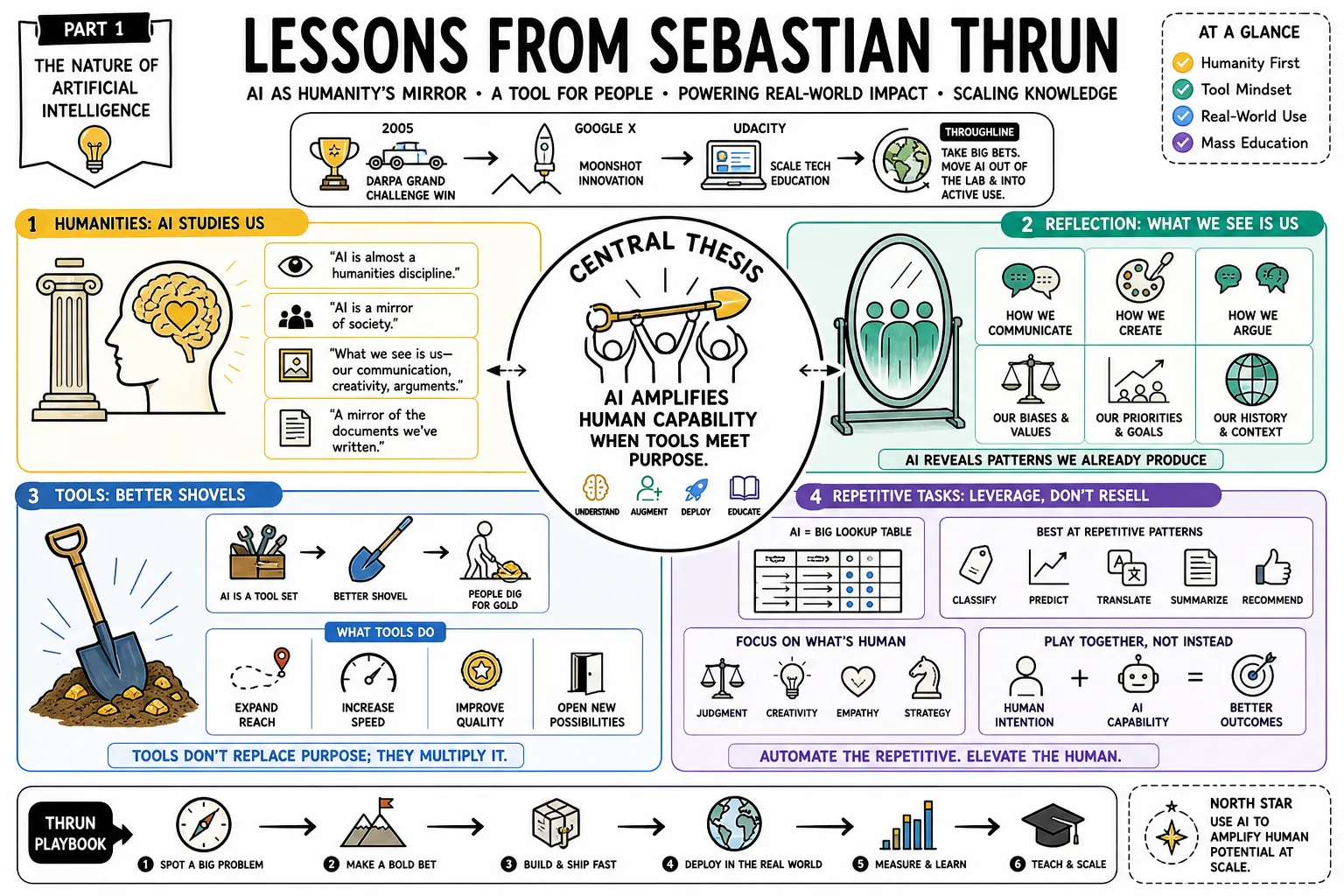
Sebastian Thrun led the Stanford team that won the 2005 DARPA Grand Challenge, founded Google X, and launched Udacity. His work focuses on forcing autonomous systems out of academic labs and into active use. This profile outlines his approaches to taking massive engineering bets, augmenting human capability, and scaling technical education.
Part 1: The Nature of Artificial Intelligence
- On Humanities: "Nobody phrases it this way, but I think that artificial intelligence is almost a humanities discipline. It's really an attempt to understand human intelligence and human cognition." — Source: [Stanford]
- On the Mirror of Society: "AI is just a mirror of society. It's a mirror of the documents we've written. Nothing more." — Source: [Happiness.info]
- On Reflection: "What we see is not technology, what we see is us—the way we communicate, the way we paint, the way we are creative, the way we argue." — Source: [Happiness.info]
- On Tools: "To me, AI is just a tool set, a bit like a shovel. It's a better shovel, but it's still people who dig for gold with that shovel." — Source: [Swisslife]
- On the Lookup Table: "AI is really a big lookup table." — Source: [Stanford]
- On Repetitive Tasks: "Artificial intelligence is really a technology that helps us do repetitive things." — Source: [Quora]
- On the Steam Engine: "Artificial intelligence is to the human brain what the steam engine has been to the human muscle." — Source: [PBS]
- On Autonomy and Machines: "The notion that machines that do things for us take away our autonomy comes from a zero-sum mindset. That's the fundamental mistake." — Source: [PBS]
- On Adding Ability: "Some technologies just add to our ability to make our own decisions." — Source: [YouTube]
- On Consciousness: "The last thing I want is for my AI to have consciousness. I don't want to come into my kitchen and have the refrigerator just fallen in love with the dishwasher." — Source: [TED]
Part 2: Autonomous Driving & Safety
- On the Middle Ages: "I think we're going to look back and find that driving a car is just like the same way the Middle Ages look from today's perspective." — Source: [YouTube]
- On Ridiculous History: "I'm really looking forward to a time when generations after us look back and say how ridiculous it was that humans were driving cars." — Source: [Business Insider]
- On Human Overconfidence: "We humans usually feel that we are the best at everything we do, that we can safely drive ourselves. But tens of thousands of people die every year." — Source: [AZQuotes]
- On Embracing Assistance: "We need to be open to having technology assist us, to find ways in which technology makes us safer." — Source: [QuoteFancy]
- On Shared Learning: "If you power a car with AI and that car makes a mistake, then the car will learn from it and so will all the other cars." — Source: [YouTube]
- On the Unborn Cars: "The car will learn from it and so will all the other cars... including all the future unborn cars." — Source: [YouTube]
- On Machine Consistency: "A self-driving car doesn't text, it doesn't fatigue, it looks in all directions, it's never drunk." — Source: [PBS]
- On Traffic Fatalities: "We kill over a million people every year in this world using traffic accidents. And that's an intolerably high number." — Source: [PBS]
- On the Push of a Button: Robotics must transition from working once for a video to working "always, on the push of a button." — Source: [AAAI]
Part 3: The Philosophy of Moonshots (Google X)
- On Audacity: "Surprisingly, in Silicon Valley, building something crazy audacious is easier than building something incremental." — Source: [Happiness.info]
- On Aiming High: "If you don't aim high, you won't shoot high." — Source: [Happiness.info]
- On Avoiding Mistakes: "Avoiding mistakes is more dangerous than pursuing correctness." — Source: [36kr]
- On the Universal Law of Innovation: Innovation requires building a prototype quickly, breaking it to find limits, and iterating on the failure. — Source: [YouTube]
- On Radical Solutions: A moonshot requires a huge problem, a radical solution sounding like science fiction, and a glimmer of hope that the technology exists. — Source: [Roland Berger]
- On Killing Projects: Reward teams for "killing" their own projects when they realize the technology won't work. — Source: [YouTube]
- On Science Fiction: "Robotic cars aren't just science fiction fantasies anymore." — Source: [TED]
- On Breaking Rules: "You can't change the world without a certain amount of healthy willingness to break the rules." — Source: [AZQuotes]
- On Disrespecting Authority: "I have a strong disrespect for authority and for rules. Including gravity. Gravity sucks." — Source: [AZQuotes]
Part 4: Democratizing Education (Udacity)
- On Doubling GDP: "If we can bring education to everyone, if we can truly democratize education, then we can double the world's GDP." — Source: [Startup Grind]
- On Human Rights: "Our vision at Udacity is to make high-quality education a basic human right." — Source: [Medium]
- On the Human Element: "Education is emotional and requires having people on your side. Computers can help, but education is a human thing." — Source: [PCMA]
- On Unbalanced Access: "It became clear how unbalanced the world was, how important education has become but also how access to education is still so bad." — Source: [Startup Grind]
- On Lifelong Habit: "I want learning to be as pervasive as brushing your teeth twice a day for five minutes." — Source: [YouTube]
- On Institutional Consolidation: "In 50 years, there will be only 10 institutions in the world delivering higher education and Udacity has a shot at being one of them." — Source: [QuoteFancy]
- On Active Learning: "We have this strong belief that you can only learn when you do something yourself and that you can't really learn by watching somebody else talking at you." — Source: [Udacity]
- On Gamification: "Student engagement is a key factor in learning and the way to do this we steal from video games... constant assessment is absolutely paramount." — Source: [YouTube]
- On the Value Proposition: "At the end of the day, the true value proposition of education is employment." — Source: [AZQuotes]
- On the Speed of Change: "If you work with the existing providers, you are beholden to their rate of innovation." — Source: [YouTube]
Part 5: Human Augmentation & Work
- On Complementing Humans: "Artificial intelligence will not replace us, it will complement us. It gives people new abilities and a perfect memory." — Source: [Bernard Marr]
- On Human Potential: "I believe all of us are insanely creative... [AI] will empower us to turn creativity into action." — Source: [TED]
- On Augmentation History: "AI has always been an augmentation of people. It's been the augmentation of us to make us stronger." — Source: [TED]
- On Repetitive Labor: "What if we can take anything repetitive and make ourselves a hundred times as efficient?" — Source: [YouTube]
- On Future Workloads: "In 20 years from now, AI will be doing most of our work today... most of our work today is repetitive." — Source: [Quora]
- On Job Selection: "Don't worry about what job you have to pick because your job picks you. Let your job pick you." — Source: [WhatShouldIReadNext]
- On Replacing Barriers: "AI doesn't replace teachers, it replaces barriers." — Source: [Stanford]
- On the Target Audience: "The biggest revolution will come for people that normally would not attend college and in lifelong learning." — Source: [YouTube]
- On Continuous Readiness: "Learning has to be lifelong. It can't be that we have this one college degree and then are prepared for all the challenges in life." — Source: [YouTube]
Part 6: Robotics & Constructive Intelligence
- On Studying Intelligence: "I ultimately got into robotics because for me, it was the best way to study intelligence." — Source: [HappyScribe]
- On Constructive Perspectives: "The robots today are still very brittle, but it's fascinating to study intelligence from a constructive perspective and build it." — Source: [HappyScribe]
- On Learning by Example: "We teach [machines] by example, and they form their own rules." — Source: [HappyScribe]
- On Trial and Error: "Look at how children, in their first year of life, discover the pattern that ensures a stable gait through trial and error." — Source: [HappyScribe]
- On Reverse Engineering: "If we study learning as a data science, we can reverse engineer the human brain and tailor learning techniques to maximize the chances of student success." — Source: [AZQuotes]
- On Hardware and Software: "The hardware-software divide is the robotics industry's most overlooked problem." — Source: [Quora]
- On Building the Impossible: "Whatever you think is impossible, it becomes possible just a year later." — Source: [Stanford]
- On Dangerous Designs: "It's a stupid business to build something unsafe." — Source: [Quora]
- On Adapting Algorithms: The use of probabilistic algorithms was essential to making systems robust enough to handle unpredictable desert terrain safely. — Source: [AAAI]
Part 7: Innovation, Failure, & Ambition
- On the One Percent: "I deeply believe that only 1% of interesting things have been invented yet. And 99% of stuff has not been invented yet." — Source: [Happiness.info]
- On Process: "My process is learn, decide, and do. I've never seen a problem that couldn't be solved this way." — Source: [Quora]
- On the True Failure: "Be fearless, be curious, and develop a growth mindset. For those who learn, there is no such thing as failure." — Source: [Quora]
- On Failing to Learn: "It is the failure to learn that is the true failure in life." — Source: [Quora]
- On Learning Environments: "I don't want to be in the job I'm good at, because if I'm in a job that I'm good at, the chance for me to learn something interesting is actually minimized." — Source: [HappyScribe]
- On Choosing Hard Tasks: "So I want to be in a job I'm bad at." — Source: [HappyScribe]
- On Corporate Survival: "In 10 years, only two kinds of companies will exist—those using AI and those out of business." — Source: [Stanford]
- On Human Errors: "I assume you drive a car so do I... we tend to learn from our mistakes. But nobody else does... The reason why we lose 1.2 million people every year in car accidents is because we keep making the same mistake over and over." — Source: [YouTube]
- On Coaching: "As a college professor, the wonderful thing you do all the time is to empower other people, like your job is to make your students look great." — Source: [HappyScribe]
- On Leadership Focus: "That's all you do. You're the best coach." — Source: [HappyScribe]
Part 8: The Future of Mobility (Flying Cars)
- On Belief: "The latest thing is going to be flying cars — it's completely crazy, and no one person in the world believes in it." — Source: [Business Insider]
- On Free Space: "The air is so free of stuff and unused compared to the ground." — Source: [Business Insider]
- On Straight Lines: "I envision a future where you hop in a thing, go in the air, and fly in a straight line." — Source: [Business Insider]
- On Commuting Costs: "With an electric flying vehicle you could do it [a 1-hour commute] in less than two minutes on perhaps 10 cents of energy costs." — Source: [The Guardian]
- On Transformational Travel: "It would be transformational to almost every person I know." — Source: [The Guardian]
- On Unpiloted Safety: "If you build a plane without pilots, you're universally safer than with pilots." — Source: [CoinGeek]
- On the Unknown Reality: "The world doesn't know it yet, but it's absolutely correct." — Source: [CoinGeek]
- On Misnomers: "'Flying car' might be a bit of a misnomer – more of an attention grabber... these are not cars, they have no wheels, they just fly." — Source: [Sourceable]
- On Constant Travel: "Just imagine travelling at 80 miles an hour in a straight line at any time of day without ever having to stop." — Source: [The Guardian]