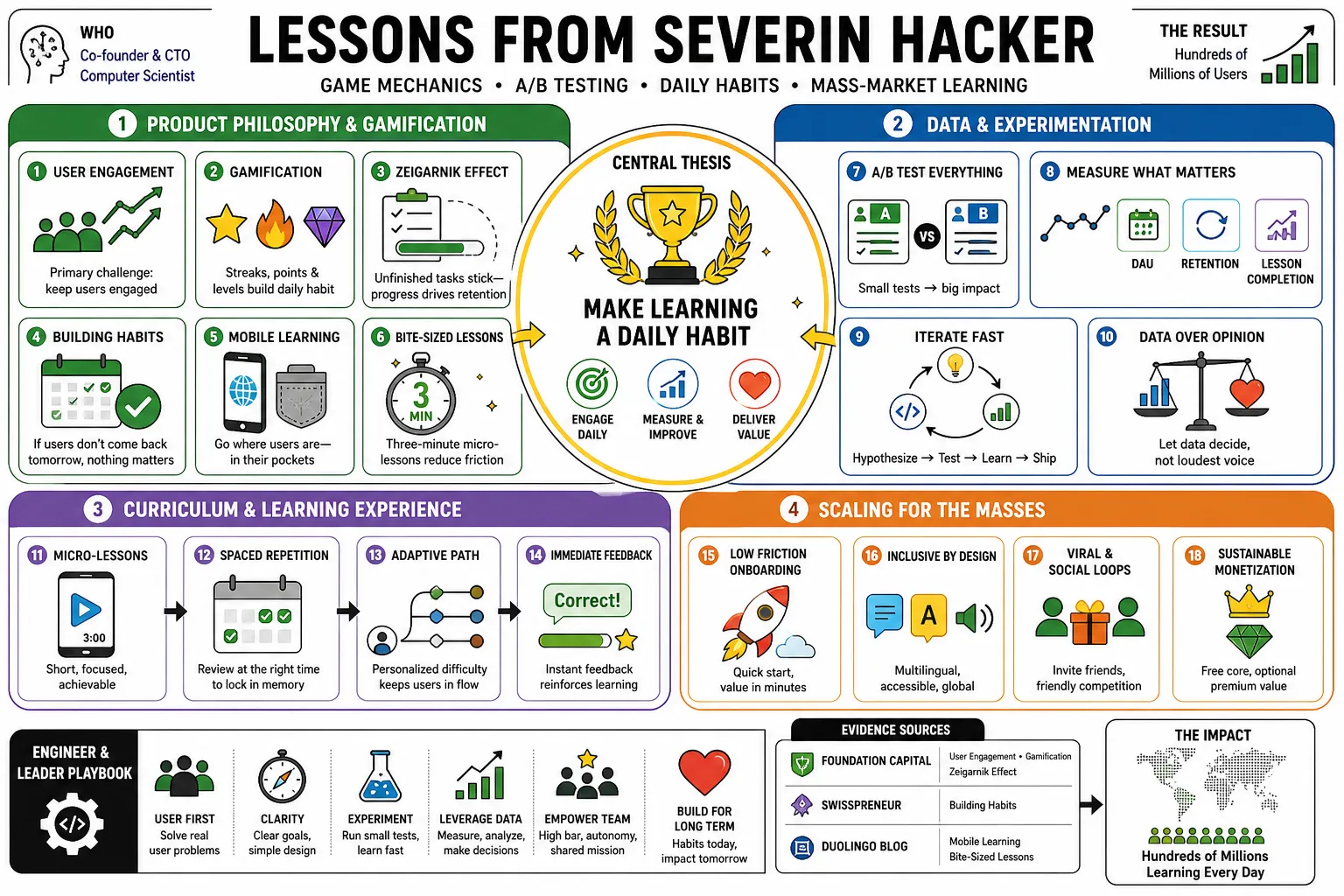
Lessons from Severin Hacker
As co-founder and CTO of Duolingo, computer scientist Severin Hacker used game mechanics and A/B testing to scale the platform to hundreds of millions of users. This profile collects his insights on managing engineers and building a mass-market learning tool that actually retains its audience.
Part 1: Product Philosophy and Gamification
- On User Engagement: "The primary challenge in education is not the quality of content, but keeping users engaged." — Source: Foundation Capital
- On Gamification: "Adding game mechanics like streaks and points is essential to building a daily habit for learners." — Source: Foundation Capital
- On The Zeigarnik Effect: "Unfinished tasks stick in people's minds, which is why progress bars and daily goals drive retention so effectively." — Source: Foundation Capital
- On Building Habits: "If the user doesn't come back tomorrow, the effectiveness of the curriculum doesn't matter." — Source: Swisspreneur
- On Mobile Learning: "Education had to transition to the devices people already carry in their pockets to achieve true scale." — Source: Duolingo Blog
- On Bite-Sized Lessons: "Breaking complex topics into three-minute micro-lessons reduces the cognitive friction of starting." — Source: The Twenty Minute VC
- On User Motivation: "You have to compete for attention against social media and mobile games, not just other educational tools." — Source: Foundation Capital
- On Intrinsic vs. Extrinsic Reward: In Founders Forum, Hacker says the real battle in language learning is retention, which is why Duolingo leans on streaks, points, and other game mechanics to get learners back often enough for real fluency work to compound. — Reference: Founders Forum profile on Severin Hacker and Duolingo
- On Product Friction: "Any unnecessary click in the onboarding flow costs a significant percentage of potential long-term learners." — Source: Swisspreneur
- On Expanding Beyond Language: Duolingo's launch note for Math and Music says the company wants one app where learners can move across subjects that, like language, improve opportunity and are best taught through its bite-sized, gamified method. — Reference: Duolingo announcement on bringing Math and Music into the main app
Part 2: Data-Driven Engineering
- On A/B Testing: "Relying on tens of thousands of A/B experiments is always better than relying solely on product intuition." — Source: Foundation Capital
- On Metric Selection: "You must choose your north star metrics carefully, because an engineering team will optimize exactly for what you measure." — Source: The Twenty Minute VC
- On Iteration Speed: "The faster you can run an experiment and get statistical significance, the faster the company learns." — Source: Swisspreneur
- On Failed Experiments: "A failed A/B test isn't wasted effort; it prevents you from shipping something that degrades the user experience." — Source: Foundation Capital
- On Data Over Ego: "Even if a founder loves a feature, if the data shows it hurts retention, it gets cut." — Source: Business Insider
- On Scaling Infrastructure: "Engineering for millions of concurrent users means designing systems that degrade gracefully under pressure." — Source: The Twenty Minute VC
- On Machine Learning in Production: "Personalizing lesson difficulty for every user required building an infrastructure that could evaluate learner models in real time." — Source: Duolingo Blog
- On Metric Trade-offs: "Sometimes an experiment increases monetization but hurts long-term retention; we always default to protecting retention." — Source: Swisspreneur
- On Feature Flags: "Deploying code behind feature flags allows us to decouple engineering releases from product launches." — Source: The Twenty Minute VC
- On Intuition vs. Data: "Intuition generates the hypothesis, but data decides the outcome." — Source: Foundation Capital
Part 3: Leadership and Delegation
- On Time Management: "One of my principles is reduce, automate, delegate." — Source: Business Insider
- On Eliminating Tasks: "If you just don't do a particular task, is it the end of the world? Often, the answer is no." — Source: Business Insider
- On Founder Mode: "Transitioning from writing code every day to managing managers requires a complete reset of how you measure your own productivity." — Source: The Twenty Minute VC
- On Delegating Operations: "Handing off day-to-day engineering operations allows a CTO to focus on high-level strategy and future technology shifts." — Source: Business Insider
- On Organizational Hierarchy: "Hierarchy is necessary for scale, but it shouldn't become a barrier to good ideas reaching the leadership team." — Source: The Twenty Minute VC
- On Hiring Engineers: "We look for engineers who care as much about the company mission as they do about the technical stack." — Source: Swisspreneur
- On Internal Tooling: "Investing in developer productivity tools pays massive dividends as the engineering organization grows." — Source: The Twenty Minute VC
- On Meeting Culture: "If a meeting doesn't result in a decision or a clear action item, it should probably be an email." — Source: Business Insider
- On Letting Go: "The hardest part of scaling a startup is accepting that someone else might solve a problem differently than you would have." — Source: Swisspreneur
Part 4: Artificial Intelligence and the Future of Education
- On AI Strategy: "Shifting to an AI-first approach means rethinking everything from internal workflows to user-facing features." — Source: Business Insider
- On Generative AI: Duolingo's engineering write-up says large language models now help its teaching experts generate lesson content far faster, giving the company a practical way to scale new material without giving up human review. — Reference: Duolingo engineering post on using AI to create lessons faster
- On AI Roleplay: Duolingo Max describes Roleplay as an AI-powered exercise where learners practice real-world conversations with in-app characters and then receive feedback on the accuracy and complexity of their responses. — Reference: Duolingo Max announcement
- On Engineering Tools: "Using AI-native development environments helps maintain engineering velocity as codebases become more complex." — Source: The Twenty Minute VC
- On AI's Role in Education: "Technology won't replace human teachers, but it will scale high-quality tutoring to anyone with a smartphone." — Source: Duolingo Blog
- On Automation: "We actively look for internal processes that AI can handle so our team can focus on creative problem-solving." — Source: Business Insider
- On Personalization: Duolingo's Video Call engineering post explains that the system remembers learner-specific facts from prior conversations and uses them in later calls, reflecting Hacker's broader push toward more adaptive practice rather than one-size-fits-all instruction. — Reference: Duolingo engineering post on Video Call with Lily
- On Content Creation: "AI dramatically accelerates our ability to launch new courses and add depth to existing ones." — Source: The Twenty Minute VC
- On The Future of Degrees: "As AI changes how we write code, computer science education will need to focus more on systems thinking and less on syntax." — Source: The Twenty Minute VC
Part 5: Growth and the Freemium Model
- On The Freemium Flywheel: "Providing a high-quality free product attracts users, whose data then improves the product for everyone." — Source: Duolingo Blog
- On Monetization Timing: "We delayed monetization for years to focus entirely on growth and building an undeniable user habit." — Source: Swisspreneur
- On Ad Revenue: "Integrating ads into the free tier allowed us to keep the educational content universally accessible without paywalls." — Source: Swisspreneur
- On Subscription Value: "A premium subscription has to offer tangible conveniences, like offline access, rather than withholding core educational material." — Source: The Twenty Minute VC
- On Mission vs. Margin: "A freemium model proves you don't have to choose between having a social mission and building a highly profitable business." — Source: Duolingo Blog
- On Word of Mouth: "If you build a product that people genuinely love, organic word of mouth will always outperform paid user acquisition." — Source: Swisspreneur
- On Global Reach: Duolingo's strategy post says the company started with language learning because it drives economic opportunity, and notes that English learners represent the vast majority of language learners worldwide, shaping how Hacker thinks about scale and access. — Reference: Duolingo company strategy post
- On Pricing Strategy: "Pricing must be localized to reflect the purchasing power of different regions if you want truly global adoption." — Source: The Twenty Minute VC
- On Independence: "By prioritizing sustainable revenue, we reached a point where the company became too expensive to be acquired." — Source: Swisspreneur
Part 6: Design and User Experience
- On Design's Importance: Duolingo's design-team write-up makes clear that craft, storytelling, micro-interactions, copy, and sound are treated as core parts of the learner experience, not decorative polish layered on after engineering work is done. — Reference: Duolingo design post on Duologues
- On Team Structure: The Duologues post describes Duolingo design as a cross-functional discipline that invests in mentorship, strategic thinking, and leadership support, showing the company treats design as a real organizational capability rather than a narrow service team. — Reference: Duolingo design post on Duologues
- On Visual Identity: "A cohesive, playful visual identity makes the intimidating task of learning a new language feel approachable." — Source: Duolingo Blog
- On Animation: "Micro-animations and character interactions provide the immediate feedback loops necessary for habit formation." — Source: Foundation Capital
- On Simplicity: "The interface must remain clean and intuitive, even as the underlying machine learning models become incredibly complex." — Source: The Twenty Minute VC
- On Founder Involvement: Business Insider reports that Hacker still spends most of his day on Duolingo's AI question and other high-level product bets even after delegating day-to-day engineering, a sign that founder attention remains concentrated on the company's most consequential experience shifts. — Reference: Business Insider profile on Hacker's leadership style
- On The Mascot: "An interactive mascot creates an emotional connection that standard push notifications can't achieve." — Source: Duolingo Blog
- On Accessibility: "Good design means ensuring the app is usable on older devices and slow networks globally." — Source: Swisspreneur
- On Copywriting: "The tone of our error messages and notifications is engineered to be encouraging rather than punitive." — Source: Foundation Capital
- On Sound Design: "Auditory cues for correct and incorrect answers reinforce learning at a subconscious level." — Source: The Twenty Minute VC
Part 7: Entrepreneurship and Building a Startup
- On Academic Roots: "You should only pursue a PhD if you want to become a professor. It's not necessary for entrepreneurship." — Source: Swisspreneur
- On Starting Out: Duolingo's strategy page says Hacker and Luis von Ahn began as Carnegie Mellon engineers who wanted to use technology to transform education, starting with language because they saw it as a direct lever for opportunity. — Reference: Duolingo company strategy post
- On Cross-Pollination: "Innovation often arises from bringing ideas from different fields together, like combining language translation with gaming mechanics." — Source: ETH Zurich Foundation
- On Co-founder Dynamics: "A successful co-founder relationship relies on complementary skills and absolute trust in each other's domain expertise." — Source: The Twenty Minute VC
- On Focus: "In the early days, you have to ignore almost every distraction and focus entirely on making the core loop work." — Source: Swisspreneur
- On IPO Preparation: "Going public changes your compliance and reporting, but it shouldn't change how you build the product." — Source: Swisspreneur
- On Solving Hard Problems: "If you are going to dedicate a decade of your life to a company, make sure it solves a problem that actually matters." — Source: ETH Zurich Foundation
- On Early Hires: "The first ten engineers set the cultural DNA for the next thousand." — Source: The Twenty Minute VC
- On Tech Debt: Duolingo's engineering team describes revisiting core app architecture as the product scaled, including redesigning startup metadata fetches and write patterns so growth in features and personalization would not quietly slow the learner experience. — Reference: Duolingo engineering post on scaling app performance and personalization
- On User Feedback: "Listen to what users do, not just what they say they want." — Source: Foundation Capital
Part 8: Perspective and Mindset
- On Ambition: "It's just as important to have the ambition to build something great and not to get sidetracked by false ideas of modesty." — Source: ETH Zurich Foundation
- On Courage: "You must have the courage not to be perfect in your expression." — Source: ETH Zurich
- On Swiss Roots: "Growing up in Switzerland instilled an appreciation for precision and reliability that translates well into engineering." — Source: Swisspreneur
- On Continuous Learning: "The moment you stop learning new frameworks or understanding new user behaviors, you start becoming obsolete." — Source: The Twenty Minute VC
- On Gaming: "My early interest in computers was sparked by a desire to build my own video games, which fostered a 'learning by doing' approach." — Source: Wikipedia
- On Patience: "Building a generational company takes time; you cannot shortcut the process of building user trust." — Source: Swisspreneur
- On Resilience: "When servers crash or experiments fail, maintaining a calm demeanor sets the tone for the entire engineering department." — Source: Business Insider
- On Legacy: "True success isn't just a high valuation; it's knowing that millions of people accessed education they otherwise couldn't afford." — Source: Duolingo Blog