Lessons from Shane Parrish
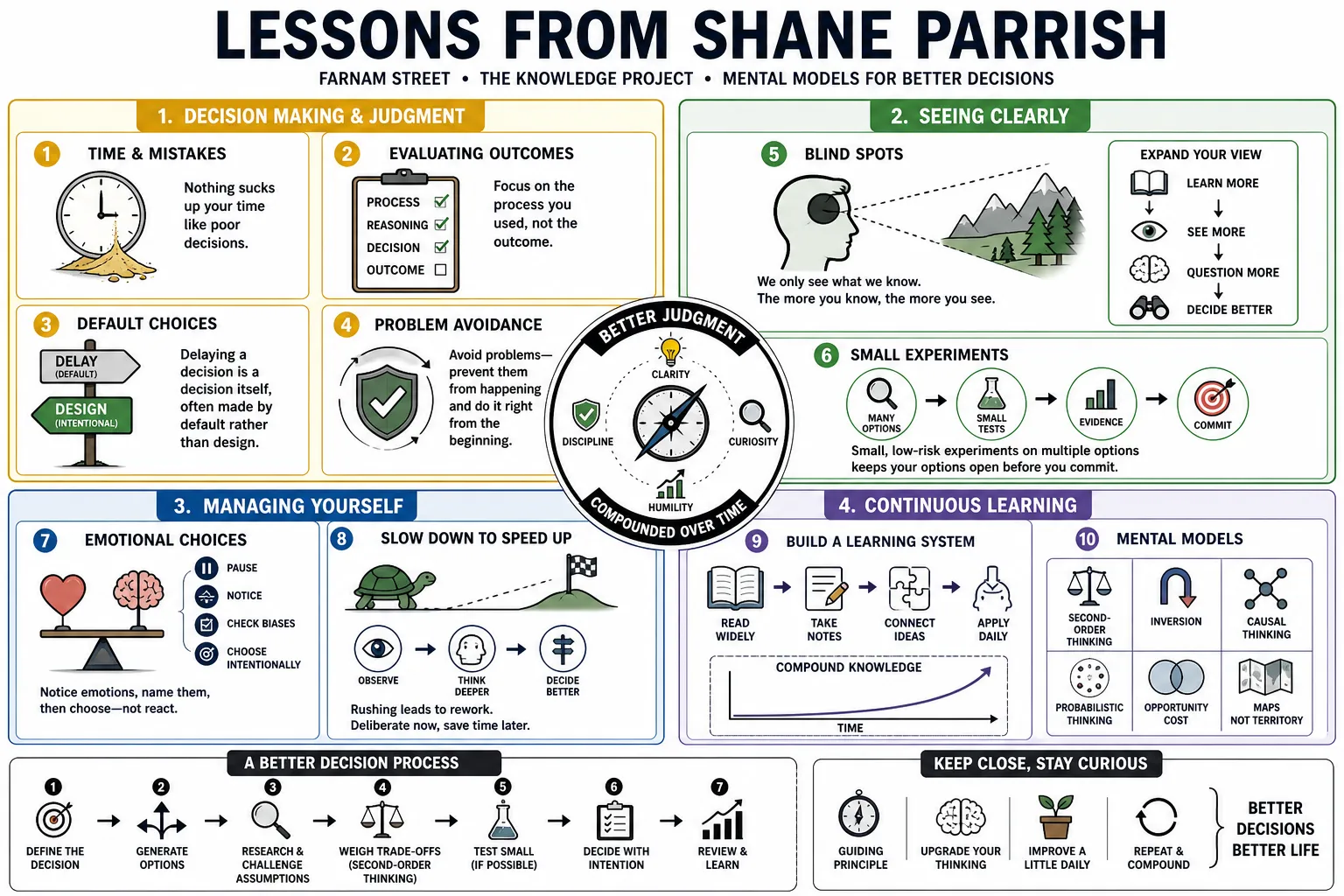
Through Farnam Street and The Knowledge Project, Shane Parrish explores mental models and decision-making. He translates concepts like second-order thinking and inversion into practical tools for daily life. This collection gathers his insights on judgment and continuous learning.
Part 1: Decision Making & Judgment
- On Time and Mistakes: "Nothing sucks up your time like poor decisions." — Source: [Farnam Street
- On Evaluating Outcomes: "When you evaluate a decision, focus on the process you used to make the decision and not the outcome." — Source: [Clear Thinking
- On Default Choices: "Delaying a decision is a decision itself, often made by default rather than design." — Source: [Farnam Street
- On Problem Avoidance: "I don't want to be a great problem solver. I want to avoid problems—prevent them from happening and doing it right from the beginning." — Source: [The Knowledge Project
- On Blind Spots: "We only see what we know. The more you know, the more you see." — Source: [Farnam Street
- On Small Experiments: "Performing small, low-risk experiments on multiple options keeps your options open before you commit." — Source: [Clear Thinking
- On Emotional Choices: "Never make a permanent decision based on a temporary emotion." — Source: [Farnam Street
- On Clear Thinking: "The quality of your decisions is directly related to the quality of your thoughts." — Source: [Clear Thinking
- On Options: "The person with the most options usually wins, but only if they know how to value them." — Source: [Farnam Street
- On Opportunity: "You get paid linearly for analyzing and solving problems. You get paid non-linearly for spotting and seizing opportunities." — Source: [Clear Thinking
Part 2: Mental Models & Frameworks
- On The Map vs Territory: "The map is not the territory. The model is not reality. The closer you look at a map, the more you realize it's a reduction of what it represents." — Source: [The Great Mental Models
- On Inversion: "Instead of trying to be brilliant, try to avoid being stupid. Invert, always invert." — Source: [Farnam Street
- On Circle of Competence: "Understanding what you don't know is more important than being brilliant." — Source: [The Great Mental Models
- On Second-Order Thinking: "First-order thinking looks for the immediate result. Second-order thinking looks for the result of the result." — Source: [Farnam Street
- On Hanlon’s Razor: "Never attribute to malice that which is adequately explained by stupidity or carelessness." — Source: [Farnam Street
- On Occam’s Razor: "Among competing hypotheses, the one with the fewest assumptions should be selected." — Source: [The Great Mental Models
- On Thought Tools: "You can't use the same mental model to solve every problem. To a man with a hammer, everything looks like a nail." — Source: [Farnam Street
- On Entropy: "Without effort, things decay. Maintaining order requires constant energy and attention." — Source: [The Great Mental Models
- On First Principles: "Strip away the assumptions and conventions until you are left with the fundamental truths." — Source: [Farnam Street
- On Probabilistic Thinking: "The world isn't black and white. It's a series of probabilities. We must learn to think in bets." — Source: [The Great Mental Models
Part 3: Learning & Reading
- On Reading Books: "A book is a conversation with the author. If you aren't talking back, you're just listening, not learning." — Source: [Farnam Street
- On Quitting Books: "Start more books. Quit most of them. Read the great ones twice." — Source: [Farnam Street
- On Accumulating Knowledge: "Read to build a latticework of mental models in your head, not just to collect facts." — Source: [The Great Mental Models
- On Timeless Wisdom: "Focus on mastering the best of what other people have already figured out." — Source: [Farnam Street
- On Retaining Information: "The best way to remember what you read is to take notes as if you have to teach it to someone else." — Source: [Farnam Street
- On Information Diet: "The quality of your thoughts is directly related to the quality of your information." — Source: [Clear Thinking
- On Re-reading: "The book remains the same, but you change. Re-reading a great book reveals things you missed the first time." — Source: [Farnam Street
- On Half-Life of Knowledge: "Focus on knowledge that doesn't expire. What will still be true in twenty years?" — Source: [The Knowledge Project
- On Note-Taking: "Don't just highlight text. Write a brief summary of the argument in your own words." — Source: [Farnam Street
- On Lifelong Learning: "If you stop learning the moment you leave school, you are going to fall behind the moment you step into the real world." — Source: [Farnam Street
Part 4: Habits & Consistency
- On Showing Up: "Intensity makes a good story. Consistency makes progress." — Source: [Brain Food
- On Environment: "Your chosen environment rather than your willpower alone will help nudge you towards the best choices." — Source: [Clear Thinking
- On Small Wins: "Small improvements applied consistently yield extraordinary results over time through compounding." — Source: [Farnam Street
- On Willpower: "Willpower is a depreciating asset. Design systems that don't require you to use it." — Source: [Clear Thinking
- On Defaults: "Make the desired behavior the default behavior. Reduce the friction to doing the right thing." — Source: [Farnam Street
- On Friction: "If you want to break a bad habit, add friction. Make it harder to do the wrong thing." — Source: [Farnam Street
- On Trajectory: "It's not where you are that matters, it's the trajectory you're on." — Source: [Farnam Street
- On Compounding: "Compounding works in habits, relationships, and knowledge, not just money." — Source: [Brain Food
- On Daily Routines: "Your daily routine is the clearest indicator of your future success." — Source: [Farnam Street
Part 5: Positioning & Preparation
- On Starting Position: "The greatest aid to judgment is starting from a good position." — Source: [Clear Thinking
- On Talent vs Preparation: "What looks like talent is often good positioning and the best way to put yourself in a good position is with good preparation." — Source: [Clear Thinking
- On Reacting: "A good position allows you to think clearly rather than be forced by circumstances into a decision." — Source: [The Knowledge Project
- On Margin of Safety: "Always build in a margin of safety. You can't predict the future, but you can prepare for the unexpected." — Source: [The Great Mental Models
- On Optionality: "Maintain optionality. Avoid decisions that lock you into a single, irreversible path if you can avoid it." — Source: [Farnam Street
- On Anticipation: "The best operators don't react faster; they anticipate sooner." — Source: [Farnam Street
- On Safeguards: "We've set our trip wires, we've empowered people to act on them, and we've tied our hands so that we can't undo all our good work in a moment of stress." — Source: [Clear Thinking
- On Resilience: "Resilience isn't just about bouncing back; it's about positioning yourself so you don't get knocked down in the first place." — Source: [Farnam Street
- On Being Forced: "If you have to make a decision because you are forced to, you've already lost the advantage." — Source: [Farnam Street
Part 6: Ego & Self-Accountability
- On Admitting Fault: "When you screw up, you should be strong enough to look in the mirror and say so." — Source: [Clear Thinking
- On Self-Deception: "You can't improve if you don't know what you're doing wrong." — Source: [Clear Thinking
- On The Mirror: "Your honest judgments about yourself are more important than anyone else's." — Source: [Clear Thinking
- On Protecting Ego: "When we fail, we're less concerned with outcomes and more concerned with protecting our egos." — Source: [Clear Thinking
- On Arrogance: "Our ego tempts us into thinking we're more than we are, blinding us to our own ignorance." — Source: [Clear Thinking
- On Responsibility: "Self-accountability means taking responsibility for your abilities, your inability, and your actions." — Source: [Farnam Street
- On Criticism: "Seek out people who are willing to tell you when you are wrong, and listen to them without getting defensive." — Source: [The Knowledge Project
- On Self-Reflection: "The most difficult skill is the ability to objectively evaluate your own performance." — Source: [Farnam Street
- On Overconfidence: "Confidence is useful, but overconfidence is a hidden tax on your future." — Source: [Farnam Street
Part 7: Relationships & Communication
- On Trust: "Trust is built in drops and lost in buckets." — Source: [Brain Food
- On Listening: "Most people do not listen with the intent to understand; they listen with the intent to reply." — Source: [Farnam Street
- On Disagreement: "If you can't state the opposing argument better than your opponent, you have no right to hold an opinion." — Source: [Farnam Street
- On Changing Minds: "You can't reason someone out of a position they didn't reason themselves into." — Source: [Farnam Street
- On Networking: "The best network isn't a list of contacts. It's a group of people who trust you and whom you trust deeply." — Source: [The Knowledge Project
- On Feedback: "Feedback is only a gift if you have the humility to accept it and the discipline to apply it." — Source: [Farnam Street
- On Character: "One measure of a person is the degree to which they'll do the right thing when it goes against popular belief." — Source: [Clear Thinking
- On Surrounding Yourself: "Spend time with people who challenge your assumptions and force you to raise your standards." — Source: [The Knowledge Project
- On Empathy: "True empathy is the ability to see the map of the world exactly as someone else sees it, without judgment." — Source: [Farnam Street
Part 8: Life & Philosophy
- On Time: "You can always make more money, but you can never make more time. Treat it accordingly." — Source: [Farnam Street
- On Ordinary Moments: "What happens in ordinary moments determines your future." — Source: [Clear Thinking
- On True Wisdom: "Real wisdom doesn't come from chasing success but from building character." — Source: [Clear Thinking
- On Simplicity: "The hardest thing to do is to keep things simple. Complexity is often a sign of confused thinking." — Source: [Farnam Street
- On Meaning: "A meaningful life isn't about avoiding pain; it's about finding pain that is worth enduring." — Source: [The Knowledge Project
- On Focus: "You can do anything, but you can't do everything. True focus requires saying no to good ideas." — Source: [Farnam Street
- On Happiness: "Happiness is a byproduct of a life well-lived, not a target you can aim at directly." — Source: [Farnam Street
- On Boredom: "Boredom is the necessary space where creativity and deep thought can flourish." — Source: [Farnam Street
- On Legacy: "Your legacy isn't what you leave for people, but what you leave in people." — Source: [Brain Food