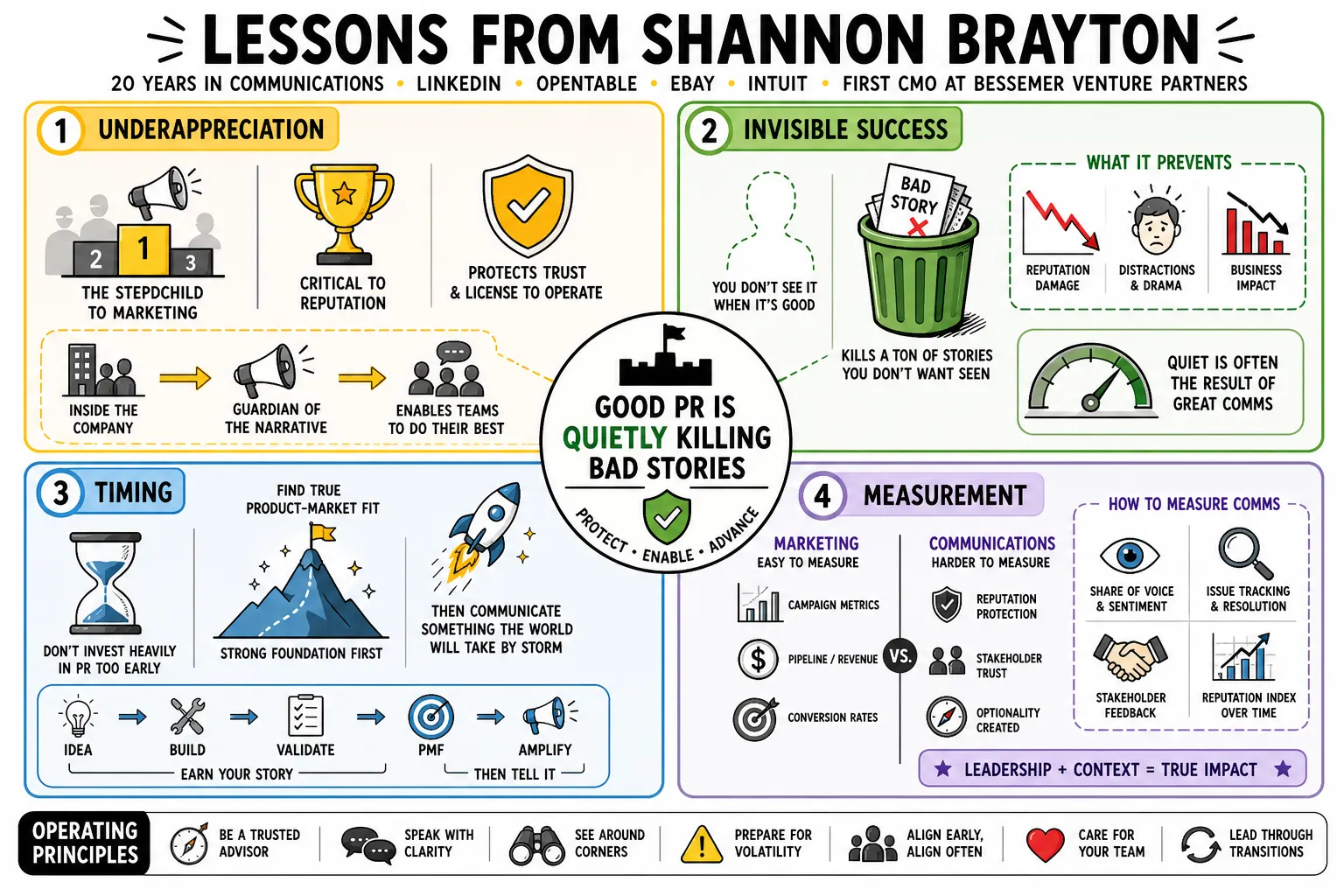
Lessons from Shannon Brayton
Shannon Brayton spent two decades running communications for companies like LinkedIn, OpenTable, eBay, and Intuit before becoming the first CMO at Bessemer Venture Partners. She operates on the practical belief that good PR is often just quietly killing bad stories instead of chasing vanity headlines. This collection covers her rules for handling volatile media relationships and leading teams through transitions.
Part 1: The Function of Communications
- On Underappreciation: "Communications is one of the most under-appreciated functions inside of a company, historically treated as the stepchild to marketing." — Source: First Round Review
- On Invisible Success: "When people do comms really well, you almost don't know because it means they've killed a ton of stories along the way that people didn't want seen." — Source: First Round Review
- On Timing: Do not invest heavily in PR before finding true product-market fit; wait until you have a product that will genuinely take the world by storm. — Source: First Round Review
- On Measurement: The historic dominance of marketing over comms stems from the fact that marketing is easy to measure, whereas the highest echelon of comms is incredibly hard to quantify. — Source: First Round Review
- On Misplaced Blame: "What [companies like Facebook] have is not a comms problem; they have a business problem that the comms team is constantly trying to chase." — Source: First Round Review
- On Shifting Stature: The comms profession has evolved rapidly from a purely functional task to one that is central to business strategy. — Source: Mixing Board
- On Business Value: Communications professionals must move past traditional PR perceptions and demonstrate how their work contributes to the company's overall business value. — Source: The Path Podcast
- On Agility: Comms leaders must show agility by participating in broader business discussions, because internal corporate matters inevitably evolve into public issues. — Source: The Path Podcast
- On Board Representation: More heads of communications will secure board seats in the future because their unique vantage point on how company issues play out across different audiences is a valuable asset. — Source: Mixing Board
Part 2: Managing Reporters & Media
- On Media Relationships: Reporters are not your friends and they are not there to do you a favor; you can build friendly relationships, but you must remember they are always looking for a great story. — Source: First Round Review
- On Trust: Lying to a reporter is the absolute worst thing a PR person can do; it takes years to rebuild that reputation across the industry. — Source: First Round Review
- On Following Through: Never screw a reporter over an exclusive; if you set terms at the beginning of a feature, you must deliver on them even if another outlet approaches you. — Source: First Round Review
- On Closing Doors: When declining a story, it is fine to close a door, but you must always open a little window by offering to work with them on a different piece in the near future. — Source: First Round Review
- On Pre-empting Crises: A negative story that is already fully baked by a reporter is incredibly difficult to kill; it is much easier to reshape a story born from a cocktail party rumor. — Source: First Round Review
- On Defusing Narratives: Providing concrete evidence to the contrary of a reporter's opinion is the most effective way to make a speculative, negative story go away. — Source: First Round Review
- On Privacy Headlines: Anytime a reporter calls with a privacy or security question, assume the resulting story is not going to end up great for the company. — Source: First Round Review
- On the Modern News Cycle: Social media means a Friday night call from a reporter can turn into a published story with viral tweets in 20 minutes, leaving PR teams with significantly less control. — Source: First Round Review
- On International Nuance: Media cultures vary wildly; British reporters tend to be highly direct and critical, whereas reporters in other regions might be highly polite in person but still publish harsh reviews. — Source: First Round Review
Part 3: Narrative & Storytelling
- On Corporate Vanity: Many founders default to wanting corporate PR and funding announcements, which often satisfy ego but do absolutely nothing for product usage or business growth. — Source: First Round Review
- On Clear Objectives: You must know your objective before pitching; if the goal is acquiring users, you must prioritize the type of coverage that actually reaches them. — Source: First Round Review
- On Elevator Pitches: If a founder cannot explain their company, who they are targeting, and how they make money within the first ten minutes, they will lose the interest of both reporters and investors. — Source: First Round Review
- On Gobbledygook: A major mistake in storytelling is defaulting to technical jargon and API talk; to be accessible, you must explain your product in language the average person understands. — Source: First Round Review
- On Competing with Giants: When unseating a major incumbent, you must use creative, guerrilla tactics that a stodgy older company would never attempt. — Source: First Round Review
- On Exploiting Weaknesses: The best PR strategy against a large competitor is to identify their specific Achilles heel and push against it mercilessly. — Source: First Round Review
- On Category Creation: If you are trying to create a new category, the CEO must become a massive spokesperson and mouthpiece for both the company and the space itself. — Source: First Round Review
- On Brand Cementation: Once a brand becomes deeply associated with a specific demographic, it is incredibly difficult to climb out of that positioning to reach younger users. — Source: First Round Review
- On Pitching Creativity: A great communications professional avoids writing standard blog posts for launches; they think creatively about all the new digital methods available to make a story travel. — Source: First Round Review
Part 4: Integrating Marketing & Comms
- On Functional Convergence: The narrative of a company now requires that brand, communications, and social media be unified under a single leader rather than operating in silos. — Source: Mixing Board
- On the Comms-to-CMO Pipeline: Communications professionals are increasingly ascending to the CMO role because their expertise in managing the holistic corporate narrative maps perfectly to modern marketing needs. — Source: First Round Review
- On Vulnerability in Leadership: When stepping into a CMO role from a comms background, you must be honest with your team about the marketing functions you do not understand. — Source: First Round Review
- On Reverse Mentoring: To learn unfamiliar disciplines like demand gen, bring junior experts into your office and have them present four slides on what they do, what's working, what's broken, and what they would change with a magic wand. — Source: First Round Review
- On Skipping the Hierarchy: Reverse mentoring allows a senior executive to bypass middle management, build relationships with junior talent, and get the unvarnished truth about team operations. — Source: First Round Review
- On Breaking Silos: If HR, comms, and marketing are not highly dependent on one another, a company risks making catastrophic brand errors, such as executing layoffs that destroy a lifestyle brand's image. — Source: First Round Review
- On Internal-External Blur: Internal employee communications can no longer be treated as private; they are inherently public documents that will drive external headlines. — Source: First Round Review
- On Intertwined Disciplines: The modern career path in communications is non-linear because PR, social media, and product marketing are becoming indistinguishably intertwined. — Source: The Path Podcast
- On Scaling Go-To-Market: Ramping a cloud GTM engine requires marketing and comms to work in lockstep to ensure the narrative supports sales targets without feeling disjointed. — Source: Bessemer Atlas
Part 5: Crisis Management & Transformation
- On Bad Layoffs: Laying people off in a two-minute mass video call is the corporate equivalent of breaking up with someone via text message. — Source: First Round Review
- On Reorg Choreography: When changing organizational structure, utilize a rigorous spreadsheet to map out exactly who talks to whom, ensuring that every impacted employee gets a one-on-one conversation. — Source: First Round Review
- On Avoiding Surprises: Never drop a massive reorganization on your team out of the blue; buy credibility by bringing them along in your thinking process early on. — Source: First Round Review
- On Transparent Uncertainty: If you are planning a change but don't have the final answer yet, it is better to openly tell your team the date you hope to decide rather than remaining entirely silent. — Source: First Round Review
- On the Cost of Care: Delivering hard news personally is significantly more time-consuming and emotional, but that personal touch makes all the difference in how the change lands. — Source: First Round Review
- On 24/7 Operations: As a company scales globally and faces continuous crises, implement a system where international comms teams hand off issues across time zones so no one burns out. — Source: First Round Review
- On Controlling the Room: In high-stakes board meetings regarding massive transitions, presenting the facts in a calm, neutral voice is far more persuasive than forcing an emotional opinion. — Source: First Round Review
- On Setting Context: When delivering feedback or initiating a difficult conversation, be explicitly clear about the topic in advance so the recipient doesn't spend hours stewing in anxiety. — Source: First Round Review
- On Tracing Rumors: When confronted with a sweeping claim like 'everyone is upset,' a strong leader will immediately force the issue to figure out exactly who is upset, how many people, and why they said it. — Source: First Round Review
- On Defusing Office Gossip: A leader must never let casual negative claims cement themselves into assumed truths without rigorously teasing apart the data behind the emotion. — Source: First Round Review
Part 6: Managing Teams & People
- On Mutual Expectations: When taking on new direct reports, present a simple two-slide deck on day one covering what they can expect from you and what you expect from them. — Source: First Round Review
- On the First Day Conversation: Most managers fail because they dive straight into the work without having a foundational heart-to-heart about working styles and communication preferences. — Source: First Round Review
- On Meeting Outcomes: Radically improve meetings by starting with the phrase, "This meeting will be a success if..." to ensure everyone is anchored to a specific outcome. — Source: First Round Review
- On Slide Presentations: Never bring slides into a meeting just to read off them verbatim; it is the most surefire way to lose your audience's attention within two minutes. — Source: First Round Review
- On Learning from the Worst: You can often learn more about how to be an effective manager by surviving a terrible, manipulative boss than you can from working under a great one. — Source: First Round Review
- On Toxic Leadership Traits: Secrecy, cliquiness, gossiping, and blind-copying emails are the fastest ways to destroy psychological safety on a team. — Source: First Round Review
- On Managerial Empathy: A core tenet of management is ensuring you never send an email that causes a direct report to lose sleep over its ambiguity. — Source: First Round Review
- On Asking for Promotion: No one is going to tap you on the shoulder to promote you; you must proactively ask for the timeline and the exact requirements needed over the next six months. — Source: PowerSpeaking
- On Interview Tactics: Taking prospective hires out for casual meals is a highly effective way to bypass rehearsed answers and gauge their genuine personality and character. — Source: Fast Company
- On Weight of Words: When you are a trusted advisor to a CEO, your casual opinions about personnel carry massive weight; ensure your feedback is rigorously grounded in data to avoid harming someone's career. — Source: First Round Review
Part 7: Executive Presence & Leadership
- On the Charisma Myth: Charisma cannot be taught, and the tech industry's obsession with it is misguided; you can be a phenomenal leader through intelligence, clear communication, and deep care for your team. — Source: First Round Review
- On Faking Persona: Trying to coach an uncharismatic executive to act charismatic usually backfires, making them appear completely fake and misaligned. — Source: First Round Review
- On Executive Preparation: Regardless of how well a CEO knows their subject matter, they must always undergo mock interviews before speaking to the press. — Source: First Round Review
- On Reducing Anxiety: The true value of a mock interview is not just scripting answers, but simulating the pacing and potential curveballs of a real broadcast to eliminate the executive's nerves. — Source: First Round Review
- On Board Transitions: A major hurdle for operators joining boards is fighting the urge to leave the meeting with a to-do list; your job is to guide, not execute. — Source: First Round Review
- On Strategic Value: The best board members offer value by pattern matching from past corporate experiences, closing candidates, and asking difficult strategic questions. — Source: First Round Review
- On Receptiveness: The most effective CEOs are those who actively invite critique, incorporate the feedback, and continuously check in to see if their adjustments are working. — Source: First Round Review
- On Delivering Hard Truths: When advising executives, you must be willing to deliver unvarnished feedback, but it should be done with compassion rather than cruelty. — Source: First Round Review
- On Knowing When to Leave: If you reach a point where you are no longer learning or being challenged, it is time to have a direct conversation with your leadership about moving on or finding a radically new role. — Source: First Round Review
- On Building a Kitchen Cabinet: Every leader needs a personal board of directors, a small, trusted group of peers who will punch you with a velvet glove when you are making a mistake. — Source: First Round Review
Part 8: Career Navigation & Growth
- On Global Perspective: Accepting an international role will profoundly change your career, stripping away the illusion that everything important in tech revolves around Silicon Valley. — Source: First Round Review
- On Cultural Adaptation: Working globally forces you to aggressively audit your own default behaviors, such as realizing that an ultra-fast, highly direct American communication style can alienate international teams. — Source: First Round Review
- On Choosing Leaders: When deciding on a new job, heavily scrutinize the senior executive team; if you sense that the CEO tolerates or enables bad behavior, walk away. — Source: First Round Review
- On Product Passion: Never accept a PR job for a product you do not care about; if you cannot organically champion the company's mission, your communications will always fall flat. — Source: First Round Review
- On Running Toward vs. Away: When evaluating a career move, ensure you are running toward an exciting opportunity rather than simply fleeing a bad boss. — Source: First Round Review
- On Stage Fit: The ideal time to join a startup as its first major comms hire is when it hits 75-100 people and has proven product-market fit; this is when the foundational narrative needs to be established. — Source: First Round Review
- On Stepping Up: A mid-level professional at a massive tech giant can successfully transition into the top leadership role at a smaller company, provided they build a network to lean on when they hit blind spots. — Source: First Round Review
- On Continuous Reinvention: True longevity in Silicon Valley requires letting go of past paradigms; the most successful leaders refuse to rely on the functional playbooks they used 15 years prior. — Source: First Round Review
- On the Value of Time: Your time is your most scarce resource; vetting a company's ethics and product deeply before joining is the most important investment strategy of your career. — Source: First Round Review