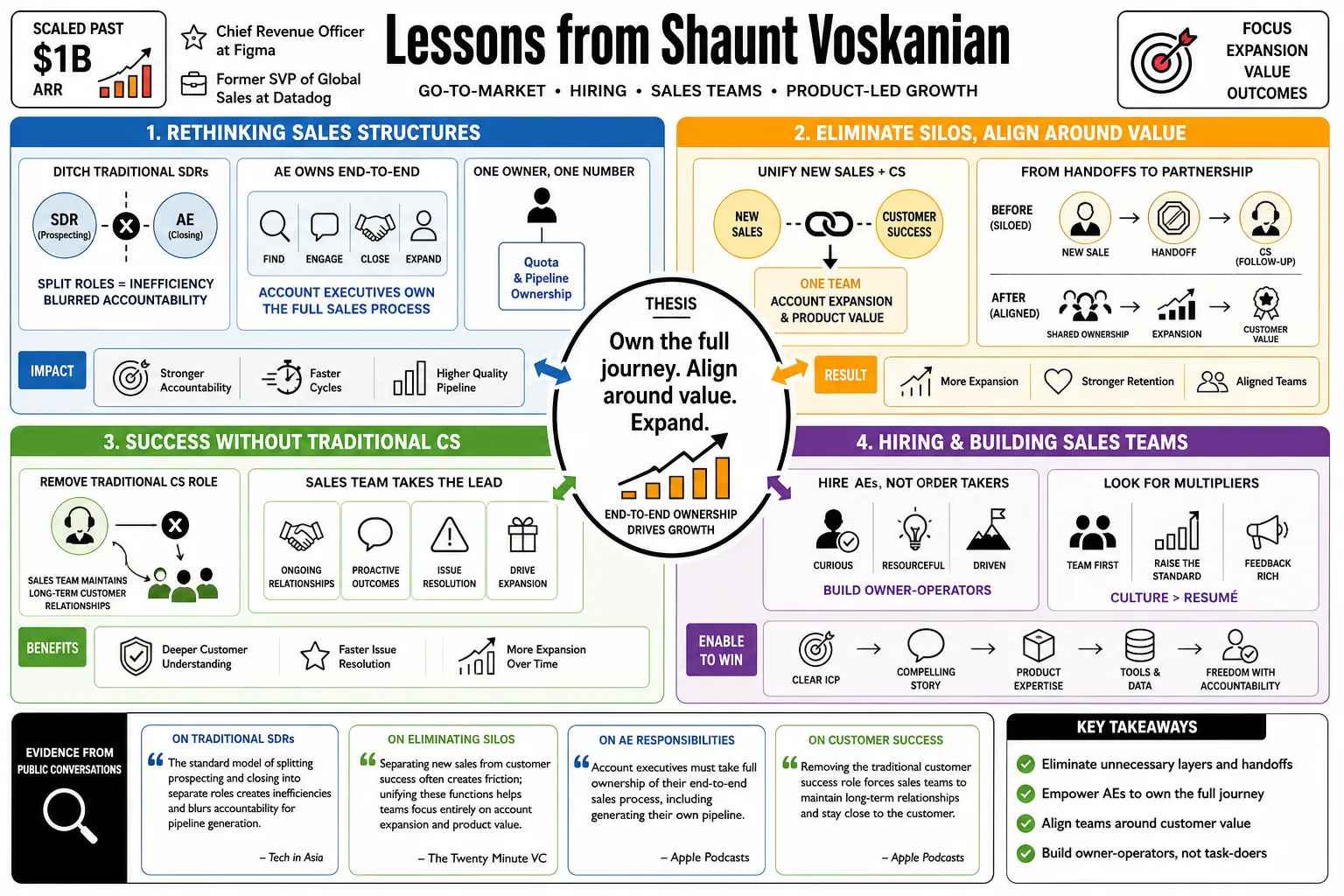
Lessons from Shaunt Voskanian
As Chief Revenue Officer at Figma and former SVP of Global Sales at Datadog, Shaunt Voskanian helped scale both companies past $1 billion in annual recurring revenue. He built a reputation for discarding standard software sales conventions, specifically by cutting traditional sales development roles and rethinking quotas for product-led companies. This profile compiles his public advice on go-to-market strategy, hiring, and building sales teams.
Part 1: Rethinking Sales Structures
- On traditional SDRs: "The standard model of splitting prospecting and closing into separate roles creates inefficiencies and blurs accountability for pipeline generation." — Source: Tech in Asia
- On eliminating silos: Voskanian’s Figma model removes some classic handoff boundaries: AEs own pipeline and expansion is treated as proactive account work rather than a separate customer-success maintenance function. — Reference: BigGo summary of Figma eliminating traditional CS and restructuring GTM
- On AE responsibilities: At Figma, AEs own pipeline generation rather than relying on a separate outbound function, which keeps strategic sellers closer to the full account motion. — Reference: BigGo summary of Figma AEs owning pipeline generation
- On customer success: Voskanian does not frame expansion as passive relationship maintenance; Figma treats it as a hunting motion that identifies gaps between current deployment and optimal usage. — Reference: BigGo summary of Figma no-CS and expansion model
- On specialization: Voskanian splits Figma’s GTM around three motions: pure self-serve, PLG-driven SMB, and sales-led mid-market, enterprise, and strategic accounts. — Reference: BigGo business highlight on Figma GTM motions
- On the value of SDRs: "If you cannot clearly measure the incremental value an SDR brings to a deal, the role itself needs to be questioned." — Source: Tech in Asia
- On organizational design: Figma’s sales structure follows how customers buy and expand, with different motions for credit-card self-serve, PLG upgrades, and complex enterprise accounts. — Reference: BigGo summary of Figma sales-team structure
- On handoffs: Voskanian’s structure reduces handoffs by keeping ownership close to the account, especially where expansion and product adoption require context. — Reference: BigGo summary of Figma no-SDR/no-CS model
- On expansion teams: Expansion at Figma is active selling: teams map accounts, find deployment gaps, and build champions through insights rather than waiting for renewal conversations. — Reference: BigGo summary of Figma expansion as a hunting motion
- On accountability: "When you eliminate the SDR function, you remove the ability for account executives to blame marketing or junior staff for a lack of pipeline." — Source: Tech in Asia
Part 2: Quotas and Compensation Philosophies
- On overinflated quotas: Voskanian rejects the idea that quota coverage alone de-risks the year; too much assigned quota can create false comfort instead of better execution. — Reference: BigGo quote from Voskanian on quota coverage
- On standard quota models: "Traditional sales targets often push representatives to prioritize fast, easy wins over the complex work required for long-term growth." — Source: Tech in Asia
- On lower quotas for strategic work: Figma intentionally sets easier enterprise quotas than industry norms because the work is complex, strategic, and insight-driven. — Reference: BigGo summary of Figma 3-4x OTE enterprise quota philosophy
- On OTE ratios: Voskanian is comfortable with roughly 3-4x OTE for enterprise reps when the role demands complex, strategic account work. — Reference: BigGo business highlight on Figma enterprise quotas
- On compensation alignment: His quota philosophy is behavioral: targets should reward the strategic work Figma needs, not simply create arbitrary coverage against a revenue plan. — Reference: BigGo quick take on quotas rewarding strategic work
- On volume versus quality: Voskanian’s enterprise model favors deeper account work and educational insight over forcing strategic reps into a high-transaction motion. — Reference: BigGo summary of Figma enterprise account strategy
- On skill-based incentives: "Incentives should reflect the difficulty of the sale and the specific skills required to navigate a complex enterprise procurement process." — Source: Tech in Asia
- On forecasting: His quota skepticism also affects forecasting: a plan is not safer just because more quota was assigned; the underlying work and account reality still have to be credible. — Reference: BigGo quote on false comfort from quota coverage
- On rep retention: Voskanian’s easier-quota stance reflects respect for the difficulty of strategic enterprise work; unrealistic targets can punish the very behavior the company wants. — Reference: BigGo quote on easier quotas for hard strategic work
- On target psychology: Figma wants quotas that feel connected to the real work, so enterprise reps can focus on quality, discovery, and account strategy rather than chasing arbitrary coverage math. — Reference: BigGo summary of Figma quota-setting philosophy
Part 3: Product-Led Growth (PLG) Strategy
- On PLG basics: "A product-led motion relies on the software itself being so intuitive that users adopt it independently before speaking to sales." — Source: Figma
- On transitioning from PLG: Voskanian treats product-led growth as one motion inside a broader revenue system: self-serve adoption matters, but enterprise growth needs deliberate sales coverage around larger accounts. — Reference: BigGo summary of Figma revenue motions
- On user value: In Figma's model, sales is meant to help customers reach a fuller deployment of the product, using account insight and education rather than simply pushing another feature. — Reference: BigGo notes on deployment gaps and educational insights
- On inbound demand: "High inbound demand is a massive advantage, but it can make a sales organization lazy if they do not also learn how to hunt." — Source: Tech in Asia
- On product usage data: Voskanian wants reps to understand how Figma is actually deployed inside an account, where the gaps are, and what an optimal configuration would look like. — Reference: BigGo summary of account mapping and deployment gaps
- On selling to users versus buyers: Figma has to serve both individual product users and enterprise buyers, so Voskanian separates self-serve adoption from the larger enterprise sales motion. — Reference: 20VC episode page on Figma PLG and enterprise revenue
- On reducing friction: "The goal of the sales team should be to remove friction from the buying process, not to insert themselves as a mandatory checkpoint." — Source: Figma
- On community adoption: Bottom-up usage can create demand, but Voskanian still builds an enterprise motion to turn scattered adoption into an intentional company-wide deployment. — Reference: BigGo summary of self-serve, PLG SMB, and enterprise segments
- On hybrid models: Figma's revenue machine is hybrid by design: self-serve, PLG-driven SMB, and enterprise selling each need their own operating logic. — Reference: BigGo summary of Figma revenue segmentation
Part 4: The Outbound Motion and Interception
- On interception timing: Voskanian leans toward engaging promising PLG customers earlier rather than later, because expansion conversations often need several rounds before the customer is convinced. — Reference: BigGo excerpt on when to intercept PLG customers
- On thoughtful outreach: Since Figma makes AEs own pipeline generation, outbound has to be account-specific and insight-led rather than a generic sequence layered on top of product usage. — Reference: BigGo summary of AE-owned pipeline generation
- On enterprise outbound: "Enterprise outbound requires identifying the executive buyer who can consolidate hundreds of individual free accounts into a single corporate agreement." — Source: Tech in Asia
- On creating urgency: Expansion comes from showing the gap between current deployment and better company-wide use, so the seller gives the customer a concrete reason to move beyond free or partial adoption. — Reference: BigGo summary of expansion as a hunting motion
- On data-driven prospecting: Voskanian's version of prospecting starts with account reality: where Figma is deployed, where adoption is incomplete, and which champions can help expand usage. — Reference: BigGo notes on account mapping and deployment gaps
- On shifting mindsets: Moving beyond inbound means asking sellers to generate pipeline themselves and treat expansion as active account work, not as a handoff to another function. — Reference: BigGo summary of AE pipeline ownership
- On executive engagement: "Sales must elevate the conversation from individual features to how the software impacts the company's broader business objectives." — Source: Figma
- On mapping accounts: Enterprise reps have to map the account before they sell into it, identifying deployment gaps, current champions, and where the product could be used more completely. — Reference: BigGo summary of account mapping
- On proactive selling: "You cannot wait for the customer to ask to buy; you have to show them why consolidating their usage is in their financial interest." — Source: Tech in Asia
Part 5: Hiring, Culture, and Talent
- On the top sales trait: Voskanian screens for curiosity through discovery work, because enterprise sellers need to investigate the customer context instead of just presenting a rehearsed pitch. — Reference: BigGo notes on discovery exercises testing curiosity
- On prescriptiveness: Curiosity is not enough on its own; Figma also values sellers who can turn discovery into useful guidance, educating champions and helping customers see the right path forward. — Reference: BigGo summary of educational insights and discovery methodology
- On missionaries vs. mercenaries: Voskanian is wary of shallow career signals, screening for deal experience, grit, and curiosity rather than people who look like they are simply chasing the next sales title. — Reference: BigGo notes on hiring screens and job-hopping patterns
- On interview signals: The hiring process looks for investigative energy: candidates are tested through discovery work so Figma can see whether they probe, reason, and stay curious under pressure. — Reference: BigGo notes on take-home discovery exercises
- On consultative selling: "We hire people who can act as business consultants to our customers, rather than order-takers who process transactions." — Source: Tech in Asia
- On product affinity: "A sales representative must actually use and understand the software they are selling; lack of product knowledge instantly destroys credibility." — Source: Figma
- On resilience: Voskanian prioritizes candidates who have actually worked complex deals, because enterprise selling requires patience, follow-through, and comfort with long strategic processes. — Reference: BigGo summary of complex enterprise deals and hiring for deal experience
- On coaching: Voskanian does not reduce performance to hiring quality alone; he argues that environment, coaching, and enablement shape whether sales talent actually succeeds. — Reference: BigGo summary of coaching and enablement
- On team dynamics: Voskanian evaluates not just outcomes but how reps show up: collaboration matters because a lone-wolf seller can weaken the broader sales system even when individual numbers look good. — Reference: 20VC transcript on behaviors, competencies, and collaboration
Part 6: Sales in the AI Era
- On AI and efficiency: Voskanian does not treat efficiency as the only goal; with a large customer base already covered by a lean team, he still argues for more strategic sales work where it produces customer value. — Reference: 20VC transcript on efficiency and strategic sales headcount
- On automated prospecting: Figma's outbound motion is not generic cold email; reps work from existing customer context and bring proactive insights about how the account could use the product better. — Reference: 20VC transcript on outbound into existing customers
- On the SDR role's future: "The rise of AI tools accelerates the obsolescence of the traditional SDR, as software can now handle basic lead qualification more efficiently." — Source: Tech in Asia
- On AI as a copilot: Voskanian sees room to improve the sales tech stack, especially around making customer stories, CRM context, and enablement knowledge easier for reps to search and use. — Reference: 20VC transcript on sales technology adoption and knowledge systems
- On human connection: In Figma's enterprise motion, reps create value by building champions, bringing insight, and navigating complex relationships across the account. — Reference: 20VC transcript on champions and multi-stakeholder selling
- On workflow automation: The operational problem Voskanian names is knowledge friction: sales teams need cleaner systems for finding customer stories, market updates, CRM context, and enablement material. — Reference: 20VC transcript on sales communication and searchability gaps
- On predictive analytics: "AI allows revenue leaders to predict pipeline risks and accurately forecast revenue with a level of precision that was previously impossible." — Source: Tech in Asia
- On adapting to change: Voskanian admits future sales-tool adoption needs more attention, because execution pressure can keep a revenue leader from lifting their head to invest in the next operating system. — Reference: 20VC transcript on future sales-tool adoption
- On strategic value: The human value in Figma's sales motion is strategic judgment: reps understand businesses, bring useful insights, build relationships, and manage complex multi-stakeholder deals. — Reference: 20VC transcript on strategic enterprise sales work
Part 7: Enterprise Scaling and Growth
- On scaling to $1B ARR: As Figma scaled, Voskanian restructured revenue work around distinct motions: self-serve, PLG-driven SMB, and larger sales-led enterprise accounts. — Reference: BigGo summary of Figma revenue restructuring
- On organizational complexity: Voskanian keeps coming back to focus: if one rep is asked to do too many jobs, the organization should redesign roles so each motion can be executed well. — Reference: 20VC transcript on focus and specialization
- On upmarket transitions: "Moving upmarket means selling to the C-suite, which requires a completely different messaging framework compared to selling to end-users." — Source: Tech in Asia
- On procurement: For large enterprise deals, Voskanian values reps who have lived through long, multi-stakeholder cycles, built champions, and reached economic buyers. — Reference: 20VC transcript on complex enterprise deal experience
- On market expansion: Figma's sales motion changed as the company became global and split its coverage across SMB, mid-market, enterprise, and strategic accounts. — Reference: 20VC transcript on global segmentation
- On data infrastructure: Voskanian is candid that knowledge systems are a scaling bottleneck: CRM, Slack, enablement, and customer stories need to be easier for reps to search and trust. — Reference: 20VC transcript on CRM and knowledge-system gaps
- On cross-functional alignment: "Sales, marketing, and product must operate as a single revenue engine; isolated departments will stall growth." — Source: Tech in Asia
- On land and expand: "A successful enterprise strategy relies on landing small teams quickly and having a systematic playbook to expand across the entire organization." — Source: Figma
- On customer retention: In Figma's model, retention and expansion are strategic revenue work: BigGo notes that net retention improved from 131% to 136% while expansion was treated as proactive account hunting. — Reference: BigGo summary of net retention and expansion
- On maintaining agility: Voskanian keeps the revenue org adjustable, regularly reconsidering where SDR-like resources, AEs, and transactional renewal work should sit. — Reference: 20VC transcript on tinkering with sales-resource deployment
Part 8: Leadership and Management Principles
- On leadership accountability: Voskanian treats quota misses as partly systemic, not just individual failure, and warns that judging reps only by lagging quota outcomes creates lazy leadership. — Reference: 20VC transcript on quota and lazy leadership
- On radical candor: When a high performer damages the team, Voskanian favors direct feedback and coaching first, followed by decisive action if the behavior persists. — Reference: 20VC transcript on feedback, coaching, and toxic performers
- On leading by example: Voskanian keeps leadership tied to the market through customer stories, product launches, ecosystem changes, and the realities reps are facing in strategic accounts. — Reference: 20VC transcript on market updates and customer stories
- On strategic focus: "Management must ruthlessly prioritize what the sales team focuses on, clearing away administrative distractions so they can sell." — Source: Tech in Asia
- On managing high performers: Voskanian sees performance as a combination of talent and environment, so leaders need to coach, enable, and hold people accountable before reducing the issue to hiring quality. — Reference: 20VC transcript on coaching, enablement, and accountability
- On defining success: Figma defines performance across results, behaviors, and competencies, so quota is only one part of a broader operating framework. — Reference: BigGo summary of Figma performance framework
- On hiring managers: Voskanian treats title-seeking as a warning sign, distinguishing healthy ambition for growth from a shallow desire to collect status. — Reference: 20VC transcript on title fixation and mercenary signals
- On dealing with failure: "A lost deal is only a complete loss if the organization fails to analyze why it happened and adjust the playbook." — Source: Tech in Asia
- On building trust: Voskanian wants targets to match the actual job: when reps are doing hard strategic work, Figma sets more favorable quotas so the system rewards the behavior it needs. — Reference: 20VC transcript on quota philosophy and strategic work