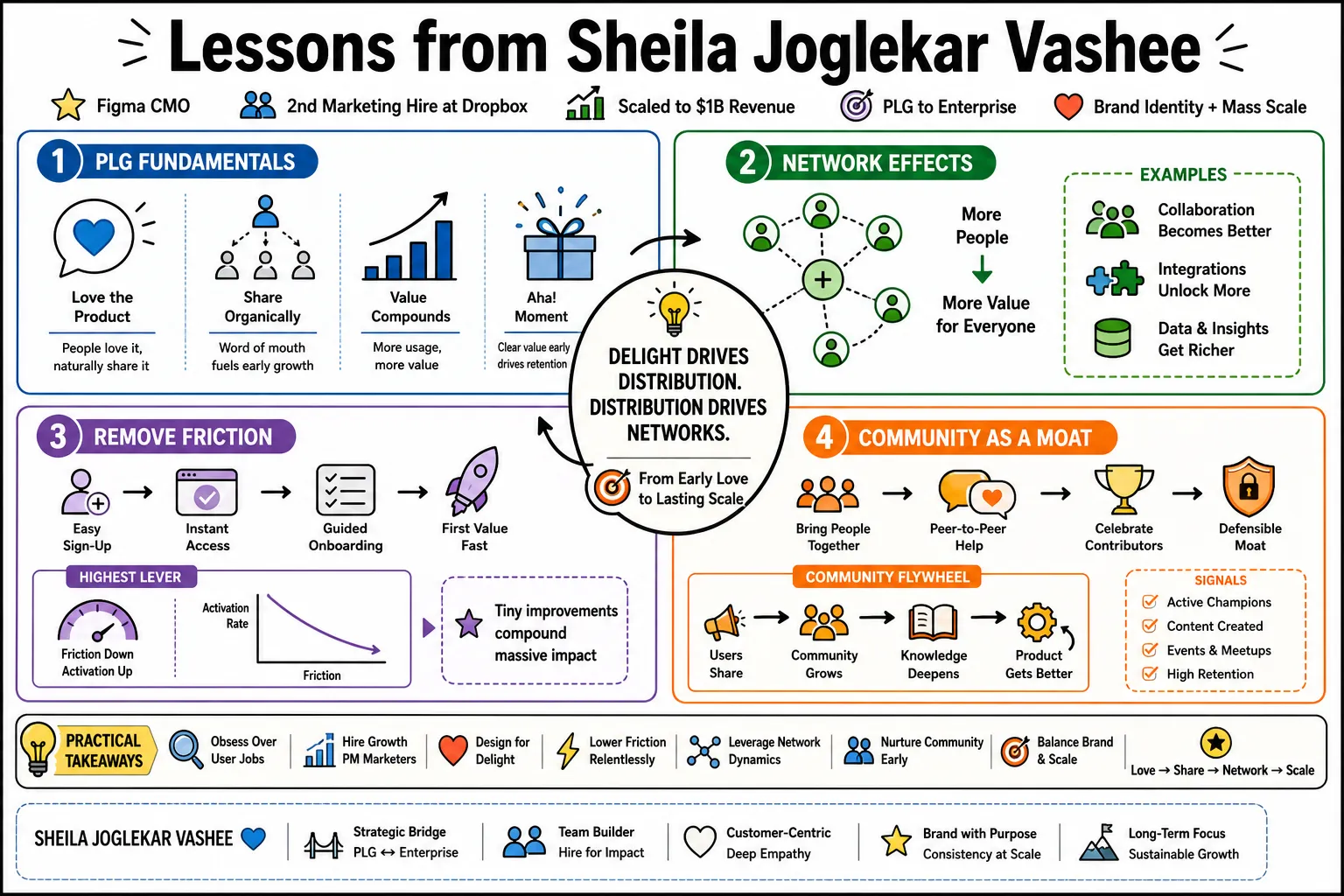
Lessons from Sheila Joglekar Vashee
Figma CMO Sheila Joglekar Vashee was the second marketing hire at Dropbox, where she helped scale the company to $1 billion in revenue. She specializes in managing the shift from product-led growth to enterprise sales and balancing brand identity with mass scale. This profile covers her practical methods for marketing, building teams, and engaging customers.
Part 1: Product-Led Growth (PLG)
- On PLG Fundamentals: "Product-led growth begins with a product that people fundamentally love and naturally want to share." — Source: Amplitude
- On the First Hires: "When building a PLG motion, your first marketing hires should act as growth product managers who understand the user funnel deeply." — Source: Amplitude
- On Network Effects: GTMnow's episode notes that Figma's customer obsession, Friends of Figma chapters, and product-led motion helped turn usage into a compounding brand and enterprise advantage. — Reference: GTMnow episode notes on Figma customer community and PLG-to-enterprise motion
- On Friction: "Removing friction in the sign-up and onboarding process is the single highest leverage activity for early PLG marketing teams." — Source: Basis Set Ventures
- On Community as a Moat: "A passionate community isn't just a byproduct of a good product; it is a defensive moat that drives sustained product-led growth." — Source: FOM Podcast
- On PLG Metrics: "Don't just track sign-ups; track the time it takes for a new user to experience the core value of the product." — Source: Amplitude
- On Self-Serve: "The goal of a self-serve motion is not to replace sales, but to ensure that sales only talks to customers when they can add strategic value." — Source: GTMnow
- On Virality: "True virality is rare; most B2B products grow through deliberate collaboration loops rather than viral consumer mechanics." — Source: GTMnow
- On Freemium: "A freemium model only works if the free tier solves a real problem while naturally teasing the value of the paid features." — Source: Amplitude
- On PLG vs. Marketing: "In a true PLG company, the line between product and marketing blurs entirely at the top of the funnel." — Source: Basis Set Ventures
Part 2: Brand Building & Identity
- On Brand Definition: "Brand is not just a logo or visual identity; it is the sum total of every experience a user has with a company." — Source: GTMnow
- On Brand vs. Growth: "Growth should always be secondary to building a beloved brand, because growth hacks fade, but brand affinity compounds." — Source: Marketers That Matter
- On Maintaining Coolness: First Round quotes Vashee using the retail lesson that ubiquity can erode coolness, then points to Harley Davidson and Apple as examples of keeping relevance at scale. — Reference: First Round summary on ubiquity, challenger energy, and brand relevance
- On Brand Perception: Vashee warns in First Round that quick-hit, spammy growth tactics can win attention in the moment while damaging long-term brand perception. — Reference: First Round summary on spammy advertising and brand perception
- On Category Creation: In her Peak XV conversation on product versus brand marketing, Vashee frames positioning around target, pain, and differentiation rather than simply adding features. — Reference: Peak XV video on product positioning and differentiation
- On Visual Identity: "A strong visual identity should evoke an emotional response and reflect the core utility of the product." — Source: Figma
- On Consistency: "Every touchpoint, from an enterprise sales deck to a support email, must sound like it came from the exact same company." — Source: Worth
- On Differentiation: "If you remove your logo from your website, a customer should still be able to tell it's you based on the tone and experience." — Source: GTMnow
- On Brand as a Compass: "When faced with difficult product trade-offs, a clear brand identity acts as the ultimate decision-making compass." — Source: Marketers That Matter
- On Mass Market Appeal: First Round describes Vashee studying companies like Apple and Harley Davidson to understand how large brands can preserve cultural relevance as usage broadens. — Reference: First Round summary on Apple, Harley Davidson, and scale without losing relevance
Part 3: Team Building & Leadership
- On First Hires: "Your earliest marketing hires should be generalists who are comfortable executing while simultaneously figuring out the strategy." — Source: Basis Set Ventures
- On Team Structure: "Structure your marketing team around the customer journey, not around internal marketing disciplines." — Source: Marketers That Matter
- On Hiring PMs in Marketing: "Some of the best growth marketers think like product managers, optimizing for systems and loops rather than standalone campaigns." — Source: Amplitude
- On Cross-Functional Alignment: "Marketing cannot succeed in a silo; it must be tightly coupled with product, sales, and customer success." — Source: GTMnow
- On Diverse Backgrounds: "I intentionally hire people with diverse professional backgrounds because they approach marketing problems from non-traditional angles." — Source: Forbes
- On Managing Ambiguity: "The most important trait for an early-stage startup employee is the ability to run toward ambiguity rather than away from it." — Source: Basis Set Ventures
- On Setting Goals: "Give your team a clear, ambitious metric, but allow them the autonomy to figure out how to get there." — Source: Marketers That Matter
- On Feedback: "A culture of immediate, direct feedback prevents small misalignments from turning into massive strategic failures." — Source: GTMnow
- On Retaining Talent: "Top performers stay when they feel they are doing the best work of their careers and have a clear path to impact." — Source: Basis Set Ventures
Part 4: Scaling & Enterprise Motion
- On The PLG to Enterprise Transition: "There is an inherent tension when shifting from a pure product-led motion to an enterprise-grade sales motion." — Source: Amplitude
- On Product-Led Sales (PLS): "Product-led sales requires using product usage data to signal when an account is ready for an enterprise conversation." — Source: GTMnow
- On Enterprise Marketing: GTMnow highlights Figma's early enterprise investment and the need for enterprise customers to see credible commitment before betting on a PLG company. — Reference: GTMnow episode notes on Figma's PLG-to-enterprise equation
- On Scaling Operations: "What works to get you to $10 million in revenue will mathematically break as you try to scale to $100 million." — Source: Amplitude
- On Go-to-Market Alignment: "When scaling, marketing and sales must operate from a single source of truth regarding customer data and lead scoring." — Source: GTMnow
- On Account-Based Marketing: "Effective account-based marketing requires treating your highest-value target accounts as a market of one." — Source: Marketers That Matter
- On Enterprise Positioning: "Enterprise buyers care about security, compliance, and ROI; your positioning must shift to address these without losing the product's soul." — Source: GTMnow
- On Sales Enablement: The GTMnow episode treats brand as every customer-facing experience, including how sales and support teams engage buyers, which makes marketing part of the system that helps deals and adoption work. — Reference: GTMnow episode notes on brand across sales, support, and product experience
- On Pricing Evolution: "Pricing and packaging must evolve as you move upmarket to capture the value you are delivering to entire organizations." — Source: Basis Set Ventures
Part 5: Customer Obsession
- On Staying Close to Customers: "Being obsessively close to customers is a compounding advantage that informs early-stage strategy and product development." — Source: GTMnow
- On Qualitative Data: "Quantitative data tells you what users are doing; qualitative conversations tell you why they are doing it." — Source: Amplitude
- On User Feedback: Vashee's Figma operating model includes quantitative tools, support feedback loops, and live user research sessions that anyone in the company can watch. — Reference: GTMnow episode notes on Figma customer feedback systems
- On Community Feedback: "A vocal community will tell you exactly where your product is failing, provided you are willing to listen and act." — Source: FOM Podcast
- On Customer Empathy: "Great marketing requires deep empathy for the daily frustrations and workflows of your target user." — Source: Marketers That Matter
- On Support as Marketing: "Customer support is a marketing channel; every interaction is an opportunity to reinforce the brand promise." — Source: Figma
- On Solving Pain: The Peak XV positioning clip presents Vashee's product-marketing frame as choosing a clear target, naming a real pain, and differentiating against alternatives. — Reference: Peak XV video on target, pain, and differentiation
- On the User Journey: "Map the entire user journey from first touch to long-term retention, and systematically remove friction at every step." — Source: Basis Set Ventures
- On Champion Building: "Identify your most passionate power users and give them the platform and resources to advocate on your behalf." — Source: GTMnow
Part 6: Marketing Strategy & Measurement
- On The Portfolio Approach: "Marketing efforts should be managed as a portfolio of moonshots, balancing maintenance tasks with high-risk, step-change projects." — Source: Podimo
- On Moonshots: First Round summarizes Vashee's portfolio approach to marketing: keep the maintenance work running while funding creative risks that can produce step-change outcomes. — Reference: First Round summary on marketing as maintenance plus moonshots
- On Hypothesis Testing: "A modern marketing organization must be built on continuous hypothesis testing and clear segmentation." — Source: Amplitude
- On Performance Marketing: "Performance marketing is a lever you pull to accelerate growth, not a foundation to build long-term brand equity upon." — Source: Marketers That Matter
- On ROI Expectations: "Not everything marketing does can or should be measured in immediate pipeline ROI; brand building takes time." — Source: GTMnow
- On Agility: "Marketing plans should be flexible enough to adapt to market shifts, rather than rigid annual documents." — Source: Basis Set Ventures
- On Data Infrastructure: "If you don't invest early in clean marketing data infrastructure, you will be flying blind when you attempt to scale." — Source: Amplitude
- On the Funnel: "The traditional marketing funnel is dead; modern customer journeys are non-linear and require a multi-touch attribution approach." — Source: Marketers That Matter
- On Product Marketing: The Peak XV discussion separates product marketing from brand marketing, supporting a lesson that product marketing turns product substance into a clear market frame. — Reference: Peak XV video on product versus brand marketing
- On Experimentation: Vashee's portfolio framing implies that individual creative bets can fail as long as the broader system still learns and keeps the business on track. — Reference: First Round summary on portfolio risk and learning from creative bets
Part 7: The Role of AI in Marketing
- On AI Optimism: First Round quotes Vashee arguing that AI needs more optimistic stories about the joy of building and making, not only utility or fear-based narratives. — Reference: First Round summary on optimistic AI storytelling
- On AI as a Tool: "AI won't replace marketers; it will replace marketers who don't know how to use AI to augment their workflows." — Source: GTMnow
- On Creative Leverage: "AI tools allow creative teams to generate iterations at a speed that was previously impossible, freeing up time for high-level strategy." — Source: Figma
- On Personalization: "The promise of AI in marketing is delivering truly personalized experiences at an enterprise scale." — Source: Marketers That Matter
- On the Platform Shift: "We are in the midst of a platform shift driven by AI, and marketers must figure out how to communicate this new paradigm to users." — Source: GTMnow
- On AI in PLG: "AI can dramatically accelerate product-led growth by instantly removing onboarding friction and guiding users to value." — Source: Amplitude
- On Authenticity: GTMnow's episode frames AI as an enabler of human creativity while warning against cheap AI content, making distinctive human taste and craft more important to brand. — Reference: GTMnow episode notes on AI, human creativity, and avoiding AI slop
- On Data Analysis: "Marketing teams should leverage AI not just for copy, but for parsing massive datasets to uncover hidden customer insights." — Source: Basis Set Ventures
- On Continuous Learning: "The capabilities of AI are moving so quickly that marketing teams must build continuous learning into their weekly operating rhythms." — Source: Podimo
Part 8: Career & Early Stage Startup Advice
- On Joining Startups: "When evaluating an early-stage startup, index heavily on the quality of the founders and the market size, rather than the current product." — Source: Basis Set Ventures
- On Career Trajectory: "Your career is rarely a straight line; the most valuable experiences often come from taking lateral moves into high-growth environments." — Source: GTMnow
- On Investment Banking Background: "Starting in finance teaches you rigorous analytical thinking, which is a massive advantage when transitioning into tech marketing." — Source: Medium
- On Angel Investing: "Angel investing makes you a better operator because it forces you to analyze businesses outside of your immediate daily focus." — Source: AngelMatch
- On Mentorship: "Seek out mentors who have scaled companies two stages ahead of where you currently are." — Source: Marketers That Matter
- On Taking Risks: "In your early career, optimize for learning and network over title and compensation." — Source: Basis Set Ventures
- On Resilience: "Scaling a startup is a series of existential crises; resilience is the most under-discussed trait of successful executives." — Source: Amplitude
- On Imposter Syndrome: "Everyone experiences imposter syndrome when stepping into a new stage of scale; the key is to lean into the discomfort." — Source: GTMnow
- On Impact: "Ultimately, the most fulfilling career moments come from building products and teams that fundamentally change how people work." — Source: Figma