Shensi Ding is the co-founder and CEO of Merge, a unified API platform that replaces the difficult, expensive work of building one-off software integrations. She built a highly successful company by focusing on deep enterprise infrastructure and deliberate, founder-led outbound sales rather than chasing consumer hype. This profile collects her practical advice on validating hard technical problems, navigating B2B sales, and maintaining early startup momentum.
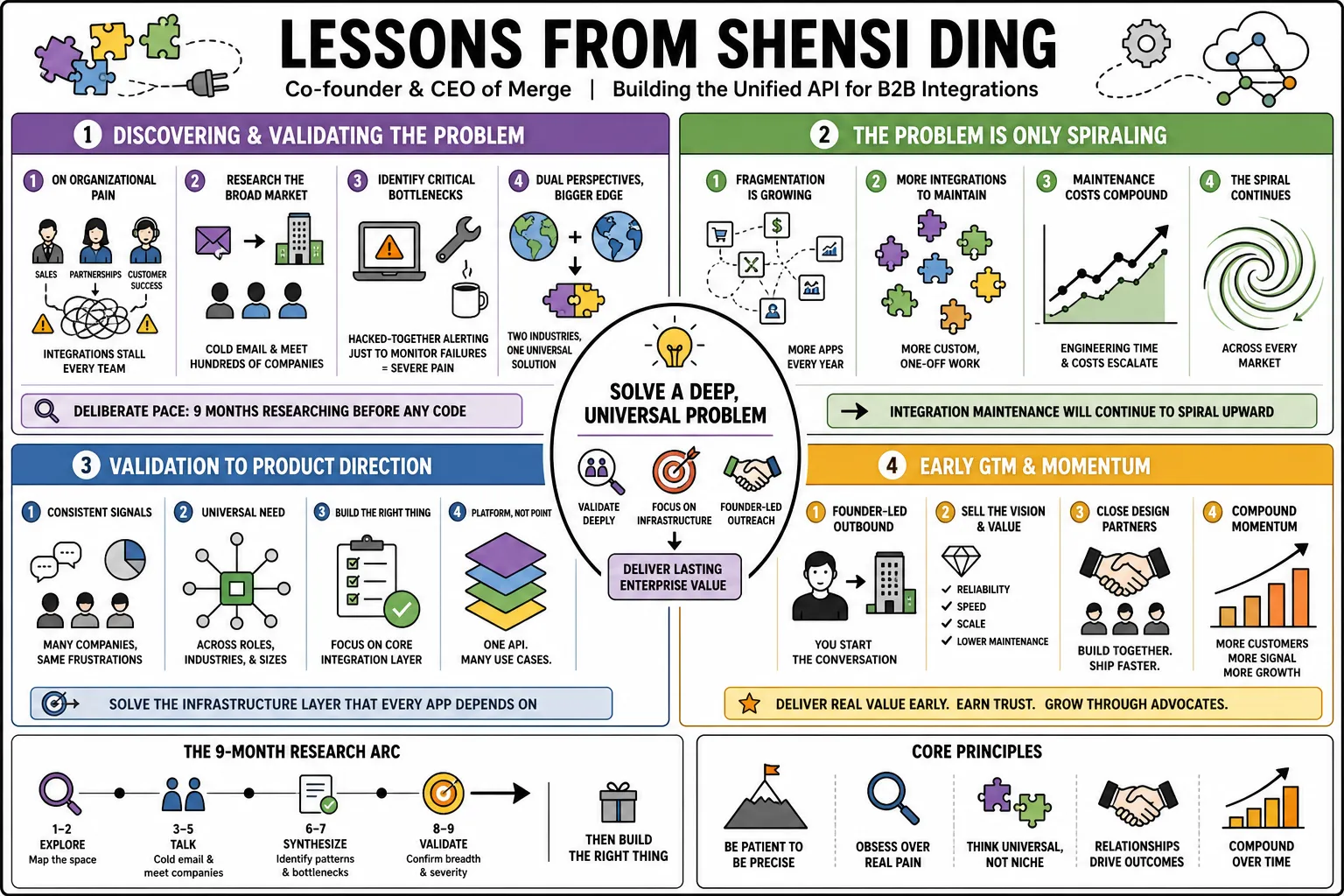
Part 1: Discovering and Validating the Problem
- On organizational pain: Integrations are not just an engineering problem; they stall sales, tie up partnership teams, and overwhelm customer success with troubleshooting. — Reference: Why we started Merge
- On researching the market: Before writing any code, cold email and meet with hundreds of companies to ensure a problem affects the broader market and isn't just specific to your own past roles. — Reference: Merge’s Path to Product-Market Fit
- On identifying critical bottlenecks: When potential customers are hacking together alerting tools just to monitor when an integration fails, you have found a severely painful issue worth solving. — Reference: Merge’s Path to Product-Market Fit
- On dual perspectives: Approaching a widespread problem from two entirely different industries provides a significant competitive edge, allowing founders to build a universal solution rather than a niche one. — Reference: Merge’s Path to Product-Market Fit
- On the spiraling problem: The fragmentation of B2B applications is only increasing, ensuring that integration maintenance will continue to spiral into a larger issue across every market. — Reference: Merge’s Path to Product-Market Fit
- On deliberate pacing: Spending nine months deeply researching a market before writing a single line of code can become a distinct competitive edge in an industry known for rushing to build. — Reference: Instagram: notanotherpodcast.clips
Part 2: The Co-Founder Dynamic
- On balancing skill sets: A founding team where one person is a strong engineer and the other operates as a finance and operations generalist makes delegating easier and presents a compelling, well-rounded story to early investors. — Reference: Building the Unified API
- On establishing trust: Starting a company with your college best friend ensures the business is built on a deep, pre-existing foundation of mutual trust. — Reference: Merge Co-Founder & CEO Shensi Ding-Lopez
- On investigative patience: Spend a significant amount of time thoroughly thinking about the mechanics of a problem before rushing to build the initial solution. — Reference: Building the Unified API
Part 3: The Economics of Integration Maintenance
- On table stakes: The responsibility of offering integrations has shifted entirely to the software vendor; if your product doesn't connect to a buyer's existing stack, you will lose the deal. — Reference: The Full Ratchet
- On cross-category architecture: Planning to serve multiple software categories from day one requires a heavier upfront technical investment but results in a highly scalable product that is difficult for competitors to copy. — Reference: A behind the scenes look at Merge
- On building conviction: The longer you spend immersed in a difficult, widespread operational problem, the more confidence you gain that every new startup will eventually need to buy a solution for it. — Reference: A behind the scenes look at Merge
- On maintenance dominating the build: Building an integration is only the beginning; maintaining edge cases for every single customer becomes a never-ending drain on engineering and support teams. — Reference: Merge’s Path to Product-Market Fit
- On end-user errors vs bugs: When end-users input incorrect API keys or permissions, it often looks like an engineering bug, forcing developers to get involved just to prove the error wasn't theirs. — Reference: Merge’s Path to Product-Market Fit
Part 4: Approaching Go-To-Market
- On reversing the traditional playbook: Selling to enterprise customers while the market is still greenfield builds a deep, secure product that makes your software sticky, allowing you to layer a self-serve motion later. — Reference: GTM: The Enterprise→PLG Playbook
- On forward-deployed engineers: When an enterprise product satisfies almost all requirements but gets blocked by a tiny technical edge case, deploying engineers directly to solve it can multiply product usage overnight. — Reference: GTM: The Enterprise→PLG Playbook
- On engineering your marketing: When product velocity outpaces market awareness, structure your marketing like an engineering function by automating repetitive tasks, such as generating release logs and managing outreach workflows. — Reference: GTM: The Enterprise→PLG Playbook
- On early hustle: Founders can generate their initial user base by personally cold-messaging tens of thousands of potential users to prove there is demand. — Reference: A Product Market Fit Show
- On marketing automation: A "dinner agent" that automatically handles outreach lists, closed-lost accounts, and seating charts can dramatically scale high-touch field marketing events. — Reference: GTM: The Enterprise→PLG Playbook
Part 5: The Realities of Fundraising
- On playing the game: Fundraising follows specific mechanics and expectations, and founders must take the time to learn this structured process rather than hoping investors will fund them purely based on passion. — Reference: Fintech Leaders
- On taking meetings seriously: There are no casual interactions with venture capitalists; approach every single pitch as a highly consequential meeting that requires meticulous preparation. — Reference: Building the Unified API
- On demonstrating value: Dedicate a month or more to crafting a robust, functional product demo before raising money, because showing a working product is vastly more persuasive than just explaining an idea. — Reference: Merge Co-Founder & CEO Shensi Ding-Lopez
- On early capital: Raising a seed round based on a strong demo removes the immense stress of trying to hire top-tier engineers without resources, allowing you to confidently support your first production customers. — Reference: Merge Co-Founder & CEO Shensi Ding-Lopez
- On ignoring stealth mode: Do not hide your product out of fear that it will be copied; practically nobody cares enough to steal your idea, so focus instead on networking and maintaining a public presence. — Reference: Building the Unified API
Part 6: Customer Obsession and Product Quality
- On holistic product quality: Simply offering the most integrations is no longer enough; buyers now expect exceptional customer support, ease of use, and continuous development velocity as baseline features. — Reference: A behind the scenes look at Merge
- On technical credibility: If you are selling infrastructure to engineers and product managers, you must possess a fundamental, hands-on understanding of your own product's technical details to speak with true authority. — Reference: Fintech Leaders
- On setting the bar high: The demanding standards of your very first customers can permanently imprint a culture of high velocity and low bug tolerance that serves the company well as it scales. — Reference: Building the Unified API
- On avoiding shortcuts: Even when the team is exhausted, deliberately choosing the harder internal engineering path to deliver a superior customer experience will generate massive long-term loyalty. — Reference: Fintech Leaders
- On early security investments: Proactively acquiring compliance certifications right out of the gate assures enterprise customers that you are treating their data with the required level of seriousness. — Reference: Why we started Merge
- On true product-market fit: You know you have built something indispensable when early customers encounter severe bugs in your initial release but choose to work with you to fix them rather than abandoning the tool. — Reference: Merge Co-Founder & CEO Shensi Ding-Lopez
- On enterprise stakes: In the B2B space, data quality and reliability are critical; you cannot afford a single negative customer experience when processing their core business information. — Reference: Why we started Merge
Part 7: Building Momentum and Willing Growth
- On accidental confidence: First-time founders possess a unique advantage where their natural naivety and boundless energy outweigh their inexperience, creating a boldness that drives them to attempt the impossible. — Reference: Fintech Leaders
- On the grind of scaling: Growing an early-stage startup requires immense effort, and every new revenue milestone will continuously test the founding team's resilience. — Reference: Building the Unified API
- On prioritizing momentum: Startups survive on momentum, so it can be strategically wise to delay collecting revenue initially until there is a clear path to generating a million dollars in annual recurring revenue. — Reference: A Product Market Fit Show
- On proving your worth: Offering your first cohort of customers free access for a few months gives them a low-risk environment to validate your product's usefulness before committing financially. — Reference: A Product Market Fit Show
- On brute force: It is entirely possible for founders to will their company to its first ten million in revenue purely through relentless outbound sales and back-to-back product demos. — Reference: A Product Market Fit Show
- On lost deals: Losing a major account to a competitor who cloned your product is painful, but you can win them back later by out-executing the imitation over time. — Reference: A Product Market Fit Show
Part 8: Transitioning from Hustle to Scale
- On evolving past founder-led growth: While you can force your way to early revenue milestones, scaling to massive figures like a hundred million requires a highly competent leadership team that can make excellent strategic decisions independent of the founders. — Reference: A Product Market Fit Show
- On enforcing culture: Maintaining a strict in-office requirement, even when it means rejecting talented remote engineers during a pandemic, helps forge a tight-knit and highly aligned early team culture. — Reference: A Product Market Fit Show
- On continuous expansion: To maintain growth and appeal to larger enterprise clients, a company must strategically diversify its product offerings and expand into entirely new software categories. — Reference: Building the Unified API
- On founder fatigue: The sheer exhaustion of willing a startup into existence is immense, making it difficult for some first-time founders to ever imagine repeating the process with the same level of intensity. — Reference: Fintech Leaders
- On the difficulty curve: While the early days of starting a company are incredibly hard, the challenge actually continues to compound rather than getting easier as you progress from zero to one. — Reference: The Full Ratchet
Part 9: Establishing the Culture of Speed
- On the mercenary vs missionary test: Use an "anti-sell" during the hiring process to weed out candidates who are only looking for a quick payout rather than committing to the company's long-term mission. — Reference: GTM: The Enterprise→PLG Playbook
- On competitive differentiation: You can differentiate early on simply by choosing the more difficult implementation path that prioritizes a seamless experience over internal convenience. — Reference: Fintech Leaders
Part 10: Navigating the AI Frontier
- On chasing trends: "You can’t build it just because everyone else is if it is not the right thing for your company." — Source: Spotlight On: AI
- On agent risk profiles: The security risks of AI multiply significantly when agents are granted permission to interact dynamically with third-party tools, making strict credential management and activity monitoring essential. — Reference: Merge Co-Founder & CEO Shensi Ding-Lopez
- On geographic stigmas: Evaluate open-source models based on where your data actually lives during execution, recognizing that a model developed overseas can still be safely run on secure domestic infrastructure. — Reference: GTM: The Enterprise→PLG Playbook
- On optimizing model spend: Defaulting to the most expensive frontier model for every query is financially unsustainable; implement smart routing to direct simpler tasks to cheaper models and reserve high-cost processing for complex work. — Reference: GTM: The Enterprise→PLG Playbook
- On hands-on learning: Founders who built their core products before the current AI wave should personally build a new product from scratch to fully understand the capabilities and limitations of modern LLM tools. — Reference: GTM: The Enterprise→PLG Playbook
- On the surge in AI demand: An unprecedented wave of AI startups requires continuous integrations to feed data into large language models, creating massive downstream demand for infrastructure platforms. — Reference: Spotlight On: AI
- On dynamic API usage: The shift from deterministic, button-press integrations to on-the-fly decision making by AI agents requires entirely new security parameters and credential management. — Reference: Merge Co-Founder & CEO Shensi Ding-Lopez
Part 11: Founding Convictions
- On taking the hard road: Building a large company requires choosing a problem that is genuinely difficult and painful enough to sustain a durable advantage. — Reference: A behind the scenes look at Merge
- On positioning: A company cannot credibly compete as both the best and the cheapest; founders need to decide which position they intend to own. — Reference: Momentum to Millions