Shiven Ramji served as the Senior Vice President of Product at DigitalOcean and the President of Customer Identity Cloud (Auth0) at Okta before becoming President of Products and Technology at Cellebrite in 2026. He is best known for his work focusing on developers as primary decision-makers and advocating for identity as the essential control plane for securing AI agents. This profile organizes his perspectives on product management, scaling organizations, and the intersection of artificial intelligence and security.
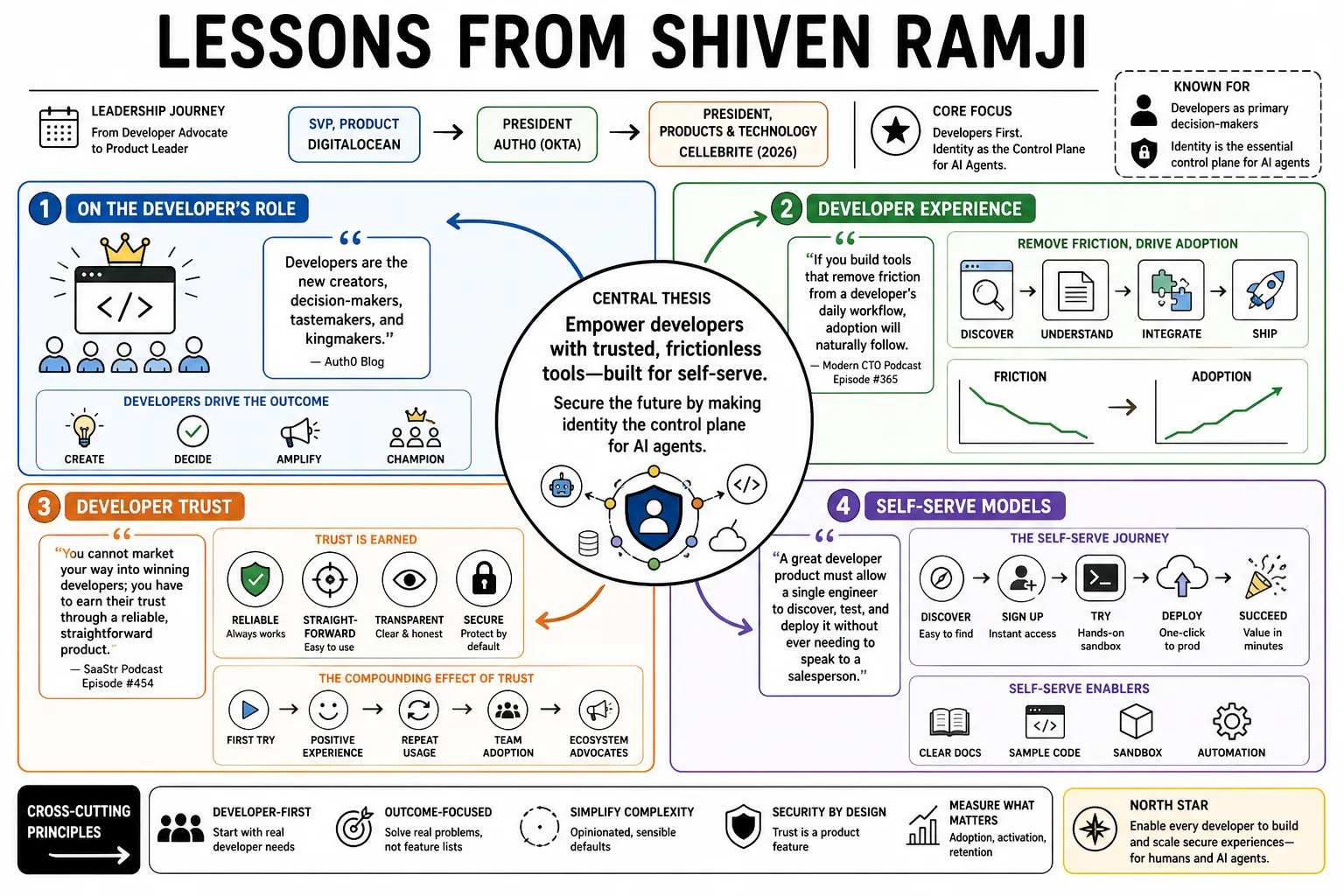
Part 1: Empowering Developers
- On the Developer's Role: "Developers are the new creators, decision-makers, tastemakers, and kingmakers." — Source: Auth0 Blog
- On Developer Experience: "If you build tools that remove friction from a developer's daily workflow, adoption will naturally follow." — Source: Modern CTO Podcast Episode #365
- On Developer Trust: "You cannot market your way into winning developers; you have to earn their trust through a reliable, straightforward product." — Source: SaaStr Podcast Episode #454
- On Self-Serve Models: "A great developer product must allow a single engineer to discover, test, and deploy it without ever needing to speak to a salesperson." — Source: DigitalOcean Blog
- On API Design: "APIs should be intuitive enough that a developer can understand the core functionality within five minutes of reading the documentation." — Source: Products That Count
- On Building for Builders: "When you build for developers, you are building the foundation that the rest of the software ecosystem will rely upon." — Source: Auth0 Blog
- On Removing Roadblocks: "The best product feature is often simply the removal of an unnecessary configuration step." — Source: Modern CTO Podcast Episode #365
- On Community Feedback: "Active listening in developer communities is more valuable than any traditional focus group." — Source: SaaStr Podcast Episode #454
- On Tooling Choices: "Developers want opinionated defaults combined with the flexibility to override them when necessary." — Source: DigitalOcean Blog
- On Product Adoption: "Bottom-up adoption starts with a single developer solving a single painful problem on a Friday afternoon." — Source: Products That Count
Part 2: Identity as the Control Plane
- On Identity Security: "Identity is no longer just a login box; it is the fundamental control plane for securing digital access." — Source: Okta Customer Identity Trends Report 2025
- On Trust: "Setting up the login box or signing up is a little bit like dating. You don't give up all your details on the first date." — Source: Okta Blog
- On Identity and AI: "Identity security is absolutely non-negotiable for AI adoption in the enterprise." — Source: Big Technology Podcast
- On Access Management: "The shift from perimeter security to identity-centric security was accelerated by remote work, but solidified by cloud adoption." — Source: Auth0 Blog
- On Identity Fabrics: "Modern organizations require an identity fabric that seamlessly connects internal employees, external partners, and customers." — Source: Oktane 2024
- On Customer Identity: "A customer's identity experience dictates their entire perception of your brand's security and competence." — Source: Finscale Vol. 2
- On Continuous Authentication: "Authentication should not be a one-time event at the door; it needs to be continuous and context-aware." — Source: The IT Pro Podcast
- On Data Privacy: "Users demand personalized experiences, but they will immediately abandon services that misuse their identity data." — Source: Okta Customer Identity Trends Report 2025
- On Identity Standards: "Open standards in identity are critical because proprietary silos ultimately hurt the end user." — Source: Auth0 Blog
- On Fraud Prevention: "Identity systems must balance aggressive fraud prevention with a frictionless legitimate user experience." — Source: Finscale Vol. 2
Part 3: Securing AI Agents
- On Agentic Sprawl: "The non-deterministic nature of AI creates a very real risk of 'agentic sprawl' if proper governance is not established." — Source: Big Technology Podcast
- On AI Authentication: "Traditional identity solutions were built for humans; they are insufficient for autonomous AI agents." — Source: The IT Pro Podcast
- On AI Authorization: "AI agents must be explicitly authorized to ensure they only act within the specific boundaries set by a user." — Source: Oktane 2024
- On Human-in-the-Loop: "Sensitive actions executed by AI, such as financial transactions, must always require explicit human approval." — Source: Auth0 Blog
- On Fine-Grained Permissions: "Access for AI agents must be precise, ephemeral, and strictly limited to the data the agent specifically needs for that exact task." — Source: Oktane 2024
- On AI Governance: "Security guardrails for generative AI must be embedded by developers from the start, not bolted on as an afterthought." — Source: Okta Blog
- On Machine Identity: "We are moving into an era where managing the identity of machines and agents will be just as complex as managing human identities." — Source: The IT Pro Podcast
- On AI Data Leakage: "Without a strong identity control plane, AI agents can inadvertently become the biggest vector for internal data leakage." — Source: Big Technology Podcast
- On AI Connectivity: "Agents require secure, scalable methods to interact with internal and external applications like Slack or Workday." — Source: Auth0 Blog
- On Building Secure AI: "Developers must treat every AI agent as a privileged user that needs constant monitoring and verification." — Source: Oktane 2024
Part 4: Product Strategy & Scale
- On Strategy vs. Execution: "A strong product strategy is meaningless if the organization lacks the execution muscle to deliver it consistently." — Source: SaaStr Podcast Episode #454
- On Prioritization: "Saying 'no' to good ideas is the only way a product team can retain the capacity to execute on great ideas." — Source: Products That Count
- On Scaling Products: "What works for a product at ten million in revenue will fundamentally break when attempting to scale to a hundred million." — Source: SaaStr Podcast Episode #454
- On Pricing: "Pricing should reflect the value delivered to the user, not just the cost of infrastructure to provide the service." — Source: DigitalOcean Blog
- On Product Velocity: "High-quality outcomes can be achieved through speed, provided that services are properly isolated to allow for smaller, manageable deployments." — Source: Computer Weekly
- On Partnerships: "Strategic partnerships only work when there is a clear, mutual benefit that ultimately serves the shared customer." — Source: Auth0 Blog
- On Market Expansion: "Expanding a product line requires a deep understanding of whether you are solving an adjacent problem or entering a completely new market." — Source: Products That Count
- On Customer Feedback Loops: "The distance between a customer reporting a problem and an engineer understanding it must be as short as possible." — Source: Modern CTO Podcast Episode #365
- On Metrics: "Focus on the input metrics you can control, rather than endlessly obsessing over lagging revenue indicators." — Source: SaaStr Podcast Episode #454
Part 5: Hiring & Leadership
- On Product Taste: "Great product leaders have 'good taste'; data validates decisions, but intuition and experience dictate what 'good' looks like." — Source: Okta Blog
- On Hiring VP+ Leaders: "When hiring senior leaders, look for individuals capable of guiding a company through scale, managing strategy, execution, and organizational design simultaneously." — Source: SaaStr Podcast Episode #454
- On Analyzing Data: "The current landscape requires leaders who possess a knack for extracting actionable insights from vast amounts of noise." — Source: Products That Count
- On Remote Work: "A remote-centric approach gives you access to the best talent globally, but you still need intentional hubs to maintain team culture." — Source: Auth0 Blog
- On Building Teams: "You do not just hire a resume; you hire the capacity for an individual to adapt to the specific scaling challenges of your current growth stage." — Source: SaaStr Podcast Episode #454
- On Cross-Functional Alignment: "The most effective product leaders spend as much time aligning sales and marketing as they do working with engineering." — Source: Modern CTO Podcast Episode #365
- On Managing Talent: "Top performers will leave if they feel their impact is being stifled by unnecessary organizational bureaucracy." — Source: Products That Count
- On Mentorship: "A leader's legacy is defined by the caliber of product managers they have mentored and promoted over the years." — Source: SaaStr Podcast Episode #454
- On Failure: "A healthy product organization treats a failed launch as a systemic learning opportunity, not a witch hunt." — Source: Modern CTO Podcast Episode #365
Part 6: Building for Developers at DigitalOcean
- On Infrastructure Simplicity: "The goal of cloud infrastructure should be to make the underlying servers invisible so developers can focus strictly on code." — Source: DigitalOcean Blog
- On Container Orchestration: "Ramji framed DigitalOcean Kubernetes as a response to Kubernetes becoming the container orchestration platform of choice: the product was meant to let developers ship applications without carrying the burden of creating and running secure, scalable clusters themselves." — Reference: DigitalOcean KubeCon Europe announcement of DigitalOcean Kubernetes
- On Managed Databases: "Offering managed databases removes one of the most stressful operational burdens from small engineering teams." — Source: DigitalOcean Blog
- On Startup Needs: "Early-stage startups do not want complex enterprise features; they want predictable pricing and a platform that gets out of their way." — Source: DigitalOcean Blog
- On Developer Communities: "Ramji described open source support as a responsibility for cloud providers, saying DigitalOcean needed to give back to projects that help developers build applications rather than only benefiting from those ecosystems." — Reference: Linux Foundation Ceph Foundation launch quote from Shiven Ramji
- On Platform Evolution: "As developers mature, the platform must evolve to offer advanced capabilities without cluttering the baseline experience." — Source: Products That Count
- On Technical Debt: "Ignoring technical debt in infrastructure products eventually leads to catastrophic outages that erode developer trust." — Source: Computer Weekly
- On Product Integration: "Acquiring a technology is easy; integrating it seamlessly into the existing developer workflow is the real challenge." — Source: DigitalOcean Blog
- On Documentation: "For developer products, the documentation is just as critical as the user interface." — Source: Modern CTO Podcast Episode #365
Part 7: Authentication & The User Experience
- On Passwordless Future: "The transition to passwordless authentication is inevitable because traditional passwords are fundamentally broken from both a security and usability standpoint." — Source: Modern CTO Podcast Episode #365
- On Multi-Factor Authentication: "A user-first approach to MFA focuses on balancing robust security with user convenience and privacy." — Source: CISO Forum Canada 2021
- On Friction in Security: "Adding friction during authentication should only happen when the risk context strictly requires it." — Source: Auth0 Blog
- On Login Conversion Rates: "Every extra field in a signup form directly correlates to a drop in customer conversion rates." — Source: Okta Customer Identity Trends Report 2025
- On Progressive Profiling: "Collect user information gradually as trust is built, rather than demanding everything upfront." — Source: Okta Blog
- On Biometrics: "Biometric authentication bridges the gap between high security requirements and consumer expectations of instant access." — Source: Finscale Vol. 2
- On Account Recovery: "The true test of an authentication system's usability is how gracefully it handles edge cases like account recovery." — Source: CISO Forum Canada 2021
- On Threat Detection: "Modern authentication systems must analyze behavioral signals in the background to detect threats without bothering the legitimate user." — Source: Auth0 Blog
- On Trust Ecosystems: "When a user logs in, they are trusting you to protect their digital footprint; breaking that trust is often unrecoverable." — Source: Okta Customer Identity Trends Report 2025
Part 8: The Future of Cloud & Infrastructure
- On Cloud Abstraction: "DigitalOcean Kubernetes fit Ramji's developer-simplicity thesis by abstracting away much of the complexity of running Kubernetes while still giving teams isolated clusters, API access, storage, firewall, metrics, logging, and access-control integrations." — Reference: TechCrunch on DigitalOcean Kubernetes abstracting infrastructure complexity
- On Edge Computing: "Pushing compute closer to the user is essential for the next generation of latency-sensitive applications." — Source: DigitalOcean Blog
- On Multi-Cloud Realities: "Multi-cloud is rarely a deliberate Day 1 strategy; it usually happens by accident through acquisitions or specific team preferences." — Source: Computer Weekly
- On Infrastructure as Code: "The DigitalOcean developer platform supported infrastructure-as-code workflows through its Terraform provider, letting teams define, version, and automate cloud infrastructure instead of managing resources only by hand." — Reference: DigitalOcean Terraform provider announcement
- On Serverless Architectures: "Serverless fundamentally changes the economics of software development, aligning costs directly with usage." — Source: Products That Count
- On Open Source Monetization: "Cloud providers must find sustainable ways to partner with open source creators rather than simply hosting their software." — Source: DigitalOcean Blog
- On Observability: "As infrastructure becomes more abstracted, robust observability tools become the only way engineers can understand system health." — Source: Computer Weekly
- On Security at the Edge: "When compute moves to the edge, the security perimeter dissolves, making identity the only viable boundary." — Source: Auth0 Blog
- On the Developer's Future: "The evolution of cloud infrastructure will ultimately be judged by how much time it returns to developers to focus on innovation." — Source: Modern CTO Podcast Episode #365