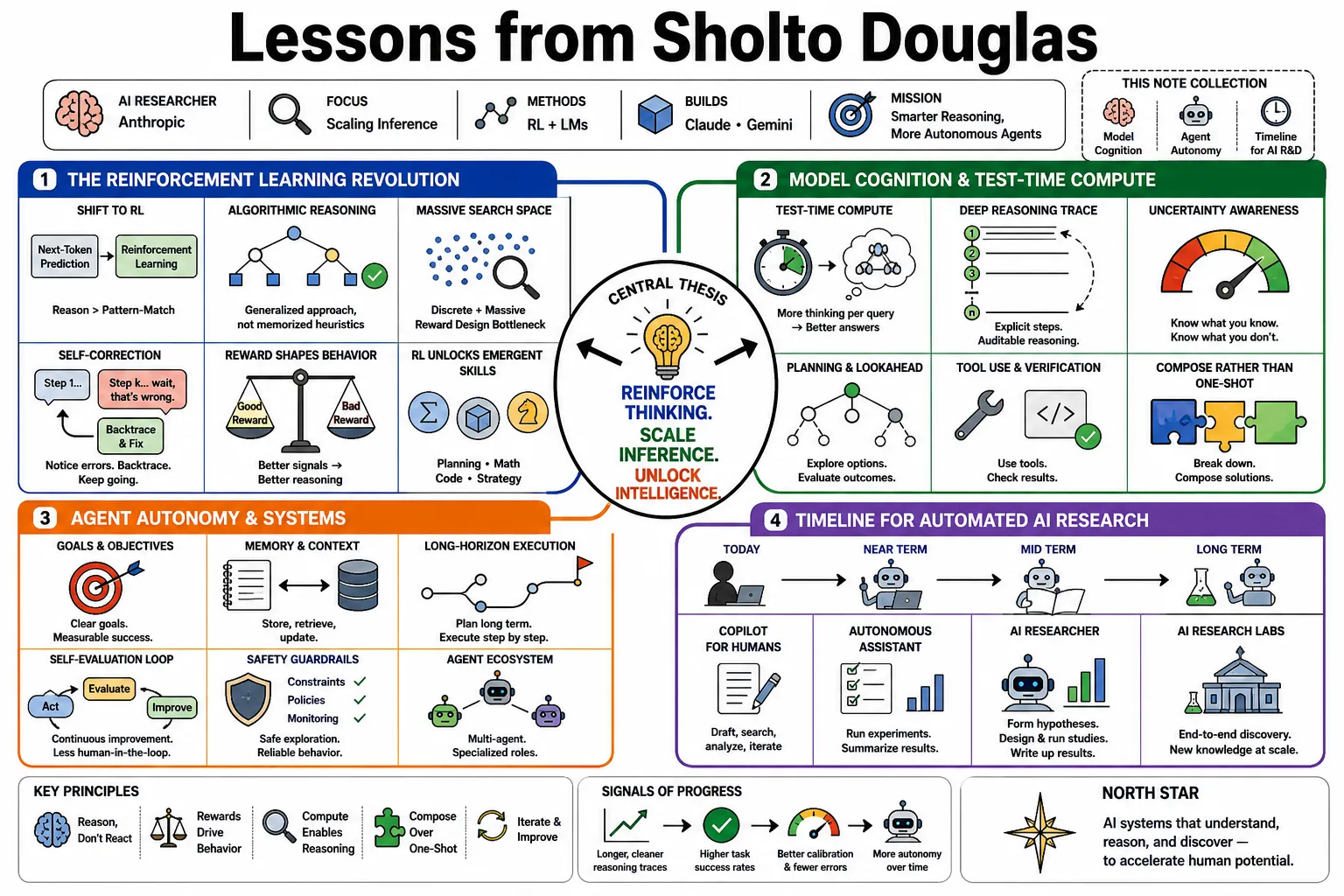
Lessons from Sholto Douglas
Sholto Douglas is an AI researcher at Anthropic and formerly Google DeepMind who works on scaling inference and combining reinforcement learning with language models. He helps build systems like Claude and Gemini, with a focus on how models use test-time compute to reason through hard problems. This collection compiles his technical notes on model cognition, agent autonomy, and the timeline for automated AI research.
Part 1: The Reinforcement Learning Revolution
- On the shift to RL: "The transition from purely next-token prediction to reinforcement learning is a fundamental shift in how we get models to reason rather than pattern-match." — Source: [Dwarkesh Podcast: Is RL + LLMs enough for AGI?]
- On algorithmic reasoning: "RL forces the model to learn a generalized algorithmic approach to problem-solving, rather than memorizing heuristics from human data." — Source: [Dwarkesh Podcast: Is RL + LLMs enough for AGI?]
- On search spaces: "When you apply RL to language, the action space is discrete and massive, making the reward design the primary bottleneck for success." — Source: [Dwarkesh Podcast: Is RL + LLMs enough for AGI?]
- On self-correction: "A clear indicator of successful RL training is a model’s ability to notice its own logical errors halfway through a derivation and backtrace without external prompting." — Source: [Dwarkesh Podcast: Is RL + LLMs enough for AGI?]
- On verifiable domains: "RL takes off fastest in domains where correctness is easily verifiable, like math and code, because you have an automated, infinite supply of true reward signals." — Source: [X / Twitter]
- On human preference data: "Relying purely on human raters for RLHF breaks down as tasks exceed human cognitive limits; we need automated verifiers to push beyond our own capabilities." — Source: [Dwarkesh Podcast: Is RL + LLMs enough for AGI?]
- On reasoning traces: "The internal chain of thought generated during RL training often looks alien to human logic, optimized entirely for task completion rather than legibility." — Source: [Dwarkesh Podcast: Is RL + LLMs enough for AGI?]
- On data walls: "RL is the most viable path through the data wall, allowing models to generate their own high-quality synthetic data through trial and error." — Source: [Dwarkesh Podcast: Scaling AMA]
- On training stability: "Balancing exploration and exploitation in language model RL is notoriously fragile, often requiring heavy engineering to prevent mode collapse." — Source: [Dwarkesh Podcast: Is RL + LLMs enough for AGI?]
- On capability overhangs: "We are constantly discovering that models trained with RL possess latent capabilities that we simply haven't learned how to prompt correctly yet." — Source: [X / Twitter]
Part 2: Inference Scaling and Model Compute
- On test-time compute: "Allowing models to spend longer searching for a solution at inference time is the next major scaling axis for intelligence." — Source: [Dwarkesh Podcast: How LLMs Actually Think]
- On inference constraints: "Memory bandwidth is frequently the silent killer of inference speed, forcing us to rethink how we serve massive transformer models." — Source: [Dwarkesh Podcast: How LLMs Actually Think]
- On KV caching: "Efficiently managing the Key-Value cache is one of the hardest engineering problems when trying to scale context windows to millions of tokens." — Source: [Dwarkesh Podcast: How LLMs Actually Think]
- On batching dynamics: "Continuous batching systems are essential for maximizing GPU utilization, but they introduce immense complexity in request scheduling." — Source: [Dwarkesh Podcast: How LLMs Actually Think]
- On compute trading: "We are moving toward a paradigm where users can explicitly trade time for accuracy, paying for more compute to solve harder problems." — Source: [Dwarkesh Podcast: Scaling AMA]
- On hardware utilization: "The gap between theoretical peak FLOPs and actual achieved FLOPs during inference is where the most valuable engineering work happens." — Source: [Dwarkesh Podcast: How LLMs Actually Think]
- On speculative decoding: "Drafting tokens with a smaller model to verify with a larger one is a highly effective way to bypass memory bandwidth bottlenecks." — Source: [Dwarkesh Podcast: How LLMs Actually Think]
- On quantization tradeoffs: "Pushing models to lower bit precisions saves memory but eventually degrades reasoning; finding the optimal frontier is a constant empirical battle." — Source: [X / Twitter]
- On long context: "A million-token context window changes the fundamental use case of an LLM from a retrieval system to a comprehensive reasoning engine over entire codebases." — Source: [X / Twitter]
- On distributed inference: "Splitting a single model's inference across multiple chips requires networking speeds that push the absolute limits of current hardware infrastructure." — Source: [Dwarkesh Podcast: How LLMs Actually Think]
Part 3: The Mechanics of Modern LLMs
- On representation learning: "Language models build deep, structured internal representations of reality; they do not simply act as surface-level statistical parrots." — Source: [Dwarkesh Podcast: How LLMs Actually Think]
- On attention heads: "Individual attention heads often learn highly specific, specialized tasks, acting like functional circuits within the broader network." — Source: [Dwarkesh Podcast: How LLMs Actually Think]
- On feature superposition: "Models compress concepts by packing multiple unrelated features into the same dimensional space, unpacking them only when context demands it." — Source: [Dwarkesh Podcast: How LLMs Actually Think]
- On grokking: "There is a distinct phase transition during training where a model shifts from memorizing the training data to discovering the underlying generalized rule." — Source: [Dwarkesh Podcast: How LLMs Actually Think]
- On tokenization limits: "Tokenization remains a stubborn source of brittleness; models struggle with character-level tasks simply because they cannot see individual letters natively." — Source: [X / Twitter]
- On induction heads: "Induction heads are the mechanical engine of in-context learning, allowing models to dynamically bind new information to existing concepts." — Source: [Dwarkesh Podcast: How LLMs Actually Think]
- On mechanistic interpretability: "Understanding exactly what individual neurons are doing is scientifically fascinating, but practically very difficult to scale to frontier models." — Source: [Dwarkesh Podcast: How LLMs Actually Think]
- On modality integration: "True multimodal models avoid simply bolting vision onto text; they map visual and textual concepts into a unified latent space." — Source: [X / Twitter]
- On loss curves: "Smooth loss curves hide massive, discontinuous jumps in specific capabilities that emerge suddenly as scale increases." — Source: [Dwarkesh Podcast: Scaling AMA]
- On prompting phenomena: "Prompt engineering works because it acts as a search mechanism, guiding the model's activations toward the correct region of its latent space." — Source: [Dwarkesh Podcast: How LLMs Actually Think]
Part 4: AI Agents and Autonomy
- On autonomous workflows: "The shift from single-turn chatbots to agents that can run asynchronously for hours is the defining product evolution of this era." — Source: [The 2026 AI Forecast with Sarah & Elad - No Priors Ep. 144]
- On tool use: "An agent's ability to reliably use bash, python, and web browsers is a much better test of its intelligence than static benchmarks." — Source: [X / Twitter]
- On error recovery: "An agent's capability is proven when it reads an error trace and fixes its own mistake, rather than writing perfect code on the first try." — Source: [X / Twitter]
- On task decomposition: "Agents still struggle to break massive, ambiguous goals into discrete, executeable steps without getting lost in loops." — Source: [The 2026 AI Forecast with Sarah & Elad - No Priors Ep. 144]
- On infinite contexts: "As context windows grow to cover entire project histories, agents will maintain perfect state across long-running tasks without needing separate memory modules." — Source: [X / Twitter]
- On human supervision: "We are moving from a paradigm of humans writing code to humans acting as technical managers reviewing agent pull requests." — Source: [Dwarkesh Podcast: Scaling AMA]
- On reliability ceilings: "Agent unreliability compounds; if an agent is ninety percent reliable per step, it will almost certainly fail a ten-step task. We need models that are nearly perfect per step." — Source: [The 2026 AI Forecast with Sarah & Elad - No Priors Ep. 144]
- On multi-agent systems: "Having multiple agents debate a problem often yields better results than a single agent, as it mimics the dynamic of a code review." — Source: [Dwarkesh Podcast: Is RL + LLMs enough for AGI?]
- On environmental feedback: "Agents need tight feedback loops from their environment; an agent running code and seeing the output learns vastly faster than an agent that only outputs text." — Source: [X / Twitter]
Part 5: Navigating an AI Research Career
- On academic pedigree: "In the current AI research environment, shipping high-quality technical blog posts and reproducing papers is often more valuable than a traditional PhD." — Source: [Dwarkesh Podcast: Scaling AMA]
- On empirical intuition: "The best researchers develop a deep, almost physical intuition for how models behave by spending thousands of hours staring at training logs." — Source: [Dwarkesh Podcast: How LLMs Actually Think]
- On engineering skills: "You cannot be an effective AI researcher today without being an exceptional distributed systems engineer; the algorithms are intrinsically tied to the hardware." — Source: [X / Twitter]
- On picking problems: "Avoid competing directly with the core scaling teams unless you have the compute; focus on the messy, unoptimized frontiers like evaluation or RL." — Source: [Dwarkesh Podcast: Scaling AMA]
- On pace of execution: "The defining characteristic of successful AI labs is the speed at which they can run a failed experiment, learn from it, and start the next one." — Source: [X / Twitter]
- On cross-disciplinary learning: "Having a background outside of standard computer science, like mechatronics or physics, helps you view scaling laws as natural phenomena rather than just code." — Source: [Dwarkesh Podcast: Scaling AMA]
- On intellectual honesty: "When a model fails, the reflex should not be to patch the prompt, but to fundamentally question whether the architecture is capable of the task." — Source: [Dwarkesh Podcast: How LLMs Actually Think]
- On open source: "Working in open source is the fastest way to build competence; if you can train a small model efficiently on public hardware, you can adapt to a cluster." — Source: [X / Twitter]
- On career transitions: "It is entirely possible to pivot into frontier AI research from consulting or unrelated engineering fields if you are willing to obsessionally self-teach." — Source: [Dwarkesh Podcast: Scaling AMA]
Part 6: Timelines and the Path to AGI
- On automation targets: "We should expect models to be fully capable of automating the majority of white-collar, knowledge-based roles within the 2027 to 2028 timeframe." — Source: [X / Twitter]
- On coding as a bellwether: "Coding is the canary in the coal mine for AGI; it requires logic, planning, and tool use. When AI masters coding, everything else follows rapidly." — Source: [X / Twitter]
- On scaling limits: "We have not yet hit a hard physical or data limit that breaks the scaling laws; the path forward is still mostly bounded by capital and power." — Source: [Dwarkesh Podcast: Scaling AMA]
- On AI researchers: "One of the final milestones before AGI is when an AI agent can independently conceive, execute, and write up a novel machine learning architecture." — Source: [Dwarkesh Podcast: Is RL + LLMs enough for AGI?]
- On continuous progress: "Progress will likely feel smooth to the people building the models, but it will appear as massive, disruptive step-functions to the rest of the world." — Source: [Dwarkesh Podcast: Scaling AMA]
- On economic impact: "The economic value of an AI that can reliably replace a junior software engineer is so high that it justifies almost any capital expenditure on compute." — Source: [X / Twitter]
- On algorithmic breakthroughs: "While scaling compute is reliable, we still need a few core algorithmic breakthroughs, particularly in search and memory, to reach true general intelligence." — Source: [Dwarkesh Podcast: Is RL + LLMs enough for AGI?]
- On safety timelines: "As capabilities accelerate, the window to implement reliable alignment and safety measures is compressing faster than many anticipated." — Source: [Dwarkesh Podcast: Scaling AMA]
- On hardware lead times: "The timeline to AGI is largely dictated by the supply chain logistics of building gigawatt data centers and fabricating cutting-edge GPUs." — Source: [X / Twitter]
Part 7: Continual Learning and Future Paradigms
- On static weights: "The current paradigm where model weights are frozen after training is a massive limitation; true intelligence requires the ability to update beliefs on the fly." — Source: [The 2026 AI Forecast with Sarah & Elad - No Priors Ep. 144]
- On continual learning: "Solving continual learning without catastrophic forgetting is one of the most pressing open research problems, and we expect significant progress by 2026." — Source: [The 2026 AI Forecast with Sarah & Elad - No Priors Ep. 144]
- On in-context vs. weight updates: "Currently, we simulate learning by stuffing information into the context window, but eventually, models must efficiently bake new knowledge directly into their weights." — Source: [The 2026 AI Forecast with Sarah & Elad - No Priors Ep. 144]
- On lifelong agents: "An agent that lives for months, continuously interacting with an environment, needs a mechanism to consolidate its daily experiences into long-term memory." — Source: [X / Twitter]
- On synthetic environments: "Future training paradigms will rely heavily on models exploring simulated environments, similar to how AlphaGo learned by playing against itself." — Source: [Dwarkesh Podcast: Is RL + LLMs enough for AGI?]
- On dynamic compute allocation: "Models will eventually learn to route their own compute, dynamically spending more FLOPs on difficult logic and bypassing deep layers for trivial tasks." — Source: [Dwarkesh Podcast: How LLMs Actually Think]
- On personalization: "Continual learning will enable models that deeply adapt to individual users over years, matching their exact communication style and context." — Source: [The 2026 AI Forecast with Sarah & Elad - No Priors Ep. 144]
- On architectural stagnation: "The transformer has been incredibly resilient, but resolving its quadratic context cost and lack of working memory may require a structural evolution." — Source: [Dwarkesh Podcast: How LLMs Actually Think]
- On real-time adaptation: "A model should be able to read a breaking news article and immediately update its worldview without requiring a multi-million dollar retraining run." — Source: [The 2026 AI Forecast with Sarah & Elad - No Priors Ep. 144]
Part 8: Engineering vs. Science in AI
- On empirical focus: "AI research today is an empirical science; we are running experiments on these massive digital brains to observe phenomena we don't fully understand." — Source: [Dwarkesh Podcast: How LLMs Actually Think]
- On systemic complexity: "Frontier models are complex systems; a bug in the data pipeline can manifest as a bizarre behavioral quirk that takes weeks to diagnose." — Source: [Dwarkesh Podcast: Scaling AMA]
- On infrastructure constraints: "The most elegant algorithmic idea is completely useless if it cannot be parallelized across tens of thousands of GPUs efficiently." — Source: [X / Twitter]
- On data quality over quantity: "Engineering high-quality, perfectly curated datasets is now a harder and more impactful scientific problem than tweaking the model architecture." — Source: [Dwarkesh Podcast: Scaling AMA]
- On evaluation metrics: "We are flying blind; our evaluation benchmarks are saturating faster than we can build them, making it hard to rigorously measure progress." — Source: [X / Twitter]
- On the value of tooling: "Investing in internal tooling for visualization and debugging is the highest ROI activity a research team can undertake." — Source: [Dwarkesh Podcast: How LLMs Actually Think]
- On brute force vs. elegance: "Historically in AI, the bitter lesson holds true: brute force scaling of compute and data consistently beats human-engineered algorithmic elegance." — Source: [Dwarkesh Podcast: Scaling AMA]
- On reproducibility: "Replicating papers is incredibly difficult because essential engineering details, like hyperparameter schedules and data mixing ratios, are often left out." — Source: [Dwarkesh Podcast: Scaling AMA]
- On the pace of deployment: "The engineering challenge of safely and reliably serving a model to millions of users is often more daunting than the science of training it." — Source: [X / Twitter]