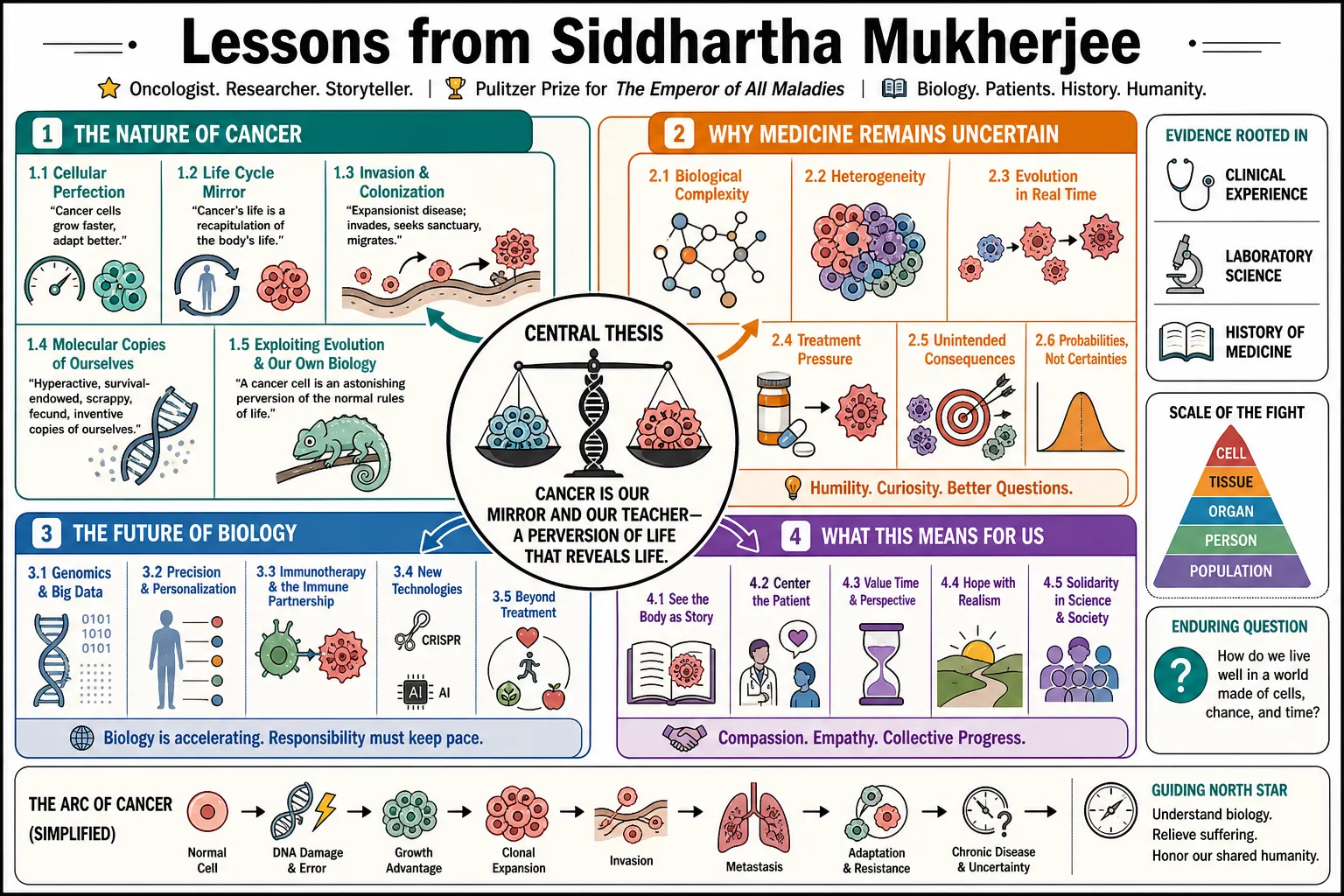
Lessons from Siddhartha Mukherjee
Siddhartha Mukherjee is an oncologist and researcher who writes about genetics, cell biology, and the history of disease. He won a Pulitzer Prize for The Emperor of All Maladies, a biography of cancer that grounds clinical science in the stories of patients and doctors. This collection gathers his observations on how the human body works, why medicine remains uncertain, and what the future of biology means for everyday life.
Part 1: The Nature of Cancer
- On cellular perfection: "Cancer cells grow faster, adapt better. They are more perfect versions of ourselves." — Source: [The Emperor of All Maladies]
- On cancer's life cycle: "Cancer’s life is a recapitulation of the body’s life, its existence a pathological mirror of our own." — Source: [The Emperor of All Maladies]
- On invasion: "Cancer is an expansionist disease; it invades through tissues, sets up colonies in hostile landscapes, seeking 'sanctuary' in one organ and then immigrating to another." — Source: [The Emperor of All Maladies]
- On our inner molecular copies: "Down to their innate molecular core, cancer cells are hyperactive, survival-endowed, scrappy, fecund, inventive copies of ourselves." — Source: [The Emperor of All Maladies]
- On exploiting evolution: "A cancer cell is an astonishing perversion of the normal cell. Cancer is a phenomenally successful invader and colonizer in part because it exploits the very features that make us successful as a species or as an organism." — Source: [The Emperor of All Maladies]
- On discrete steps to illness: "In genetic terms, our cells were not sitting on the edge of the abyss of cancer. They were dragged toward that abyss in graded, discrete steps." — Source: [The Emperor of All Maladies]
- On mutated normal genes: "If there's a seminal discovery in oncology in the last 20 years, it's that idea that cancer genes are often mutated versions of normal genes." — Source: [The Emperor of All Maladies]
- On the destiny of our genes: "The Greeks had been peculiarly prescient yet again in their use of the term oncos. Cancer was intrinsically 'loaded' in our genome, awaiting activation. We were destined to carry this fatal burden in our genes, our own genetic 'oncos'." — Source: [The Emperor of All Maladies]
- On encountering tumors: "It is hard to look at the tumor and not come away with the feeling that one has encountered a powerful monster in its infancy." — Source: [The Emperor of All Maladies]
- On the biological marvel of disease: "In a very cold, scientific sense, I think a cancer cell is a kind of biological marvel." — Source: [The Emperor of All Maladies]
Part 2: Genetics and Evolution
- On fate and choice: "There is an exquisite precision in that mad scheme. We call this intersection 'fate'. We call our responses to it 'choice'." — Source: [The Gene: An Intimate History]
- On evolution and norms: "Freaks become norms, and norms become extinct. Monster by monster, evolution advanced." — Source: [The Gene: An Intimate History]
- On normalcy: "Normalcy is the antithesis of evolution." — Source: [The Gene: An Intimate History]
- On genetic mismatch: "Every genetic illness is a mismatch between an organism's genome and its environment." — Source: [The Gene: An Intimate History]
- On the genotype of mental illness: "If you cannot separate the phenotype of mental illness from creative impulses, then you cannot separate the genotype of mental illness and creative impulse." — Source: [The Gene: An Intimate History]
- On defining heritable traits: "The narrower the definition of the heritable feature or the trait, the more likely we will find a genetic locus for that trait, and the more likely we will find that the trait will segregate within some human sub-population." — Source: [The Gene: An Intimate History]
- On a single universal code: "The truth turned out to be quite the opposite: just one molecule carries the code, and just one code pervades the biological world." — Source: [The Gene: An Intimate History]
- On the basic unit of heredity: "The gene represents the irreducible unit, the building block, the basic organizational unit of heredity and biological information." — Source: [The Gene: An Intimate History]
- On mapping the genome: "By using linkage to establish the relative positions of genes on chromosomes, Sturtevant would also lay the groundwork for the future cloning of genes tied to complex familial diseases." — Source: [The Gene: An Intimate History]
- On Darwinian selection: "Cancer thus exploits the fundamental logic of evolution unlike any other illness. If we, as a species, are the ultimate product of Darwinian selection, then so, too, is this incredible disease that lurks inside us." — Source: [The Emperor of All Maladies]
Part 3: The Cell as the Unit of Life
- On defining life: "Life's definition, as it stands now, is akin to a menu. It is not one thing but a series of things, a set of behaviors, a series of processes, not a single property." — Source: [The Song of the Cell]
- On cellular purpose: "The purpose of a cell in a multicellular organism, though, is not to be alone, or to live alone; it is to serve the needs of the organism. It has to function as part of an ecosystem; it must be an integral part of the sum." — Source: [The Song of the Cell]
- On the scale of DNA: "If a single cell's DNA could be stretched out straight, like a wire, it would measure six and a half feet." — Source: [The Song of the Cell]
- On anatomical plasticity: "We grow, mostly, by dying. We are hardwired not to be hardwired, and this anatomical plasticity may be the key to the plasticity of our minds." — Source: [The Song of the Cell]
- On observing cells: "I love looking at cells, in the way that a gardener loves looking at plants, not just the whole but also the parts within the parts." — Source: [The Song of the Cell]
- On pathology slides: "The slides are like previews of books, or movie trailers. The cells will begin to reveal the stories of the patients even before I see them in person." — Source: [The Song of the Cell]
- On the center of medical mysteries: "Why, you might ask, do the medical mysteries of the Covid-19 pandemic sit at the center of a book on cell biology? Because cell biology sits at the center of the medical mysteries." — Source: [The Song of the Cell]
- On cellular therapy: "Their medical quest is to seek cellular therapies, to use the building blocks of humans to rebuild and repair humans." — Source: [The Song of the Cell]
- On the characteristics of living organisms: "To be living, an organism must have the capacity to reproduce, to grow, to metabolize, to adapt to stimuli, and to maintain its internal milieu." — Source: [The Song of the Cell]
Part 4: The Art and Uncertainty of Medicine
- On perfect decisions: "It's easy to make perfect decisions with perfect information. Medicine asks you to make perfect decisions with imperfect information." — Source: [The Laws of Medicine]
- On clinical intuition: "A strong intuition is much more powerful than a weak test." — Source: [The Laws of Medicine]
- On medical education: "My medical education had taught me plenty of facts, but little about the spaces that live between facts." — Source: [The Laws of Medicine]
- On knowledge versus wisdom: "The profusion of facts obscured a deeper and more significant problem: the reconciliation between knowledge (certain, fixed, perfect, concrete) and clinical wisdom (uncertain, fluid, imperfect, abstract)." — Source: [The Laws of Medicine]
- On sixth sense for biases: "The greatest clinicians who I know seem to have a sixth sense for biases." — Source: [The Laws of Medicine]
- On applying knowledge: "They understand, almost instinctively, when prior bits of scattered knowledge apply to their patients, but, more important, when they don't apply to their patients." — Source: [The Laws of Medicine]
- On outliers: "Normals teach us rules; outliers teach us laws." — Source: [The Laws of Medicine]
- On biases in experiments: "For every perfect medical experiment, there is a perfect human bias." — Source: [The Laws of Medicine]
- On the nature of the profession: "The art of medicine is long, Hippocrates tells us, and life is short; opportunity fleeting; the experiment perilous; judgment flawed." — Source: [The Emperor of All Maladies]
- On the limits of the kill and cure model: "When it comes to medicine, one rule of thinking has generally prevailed: Have disease, take pill, kill something. But treatment should take a broader approach." — Source: [TED Talk: A 3-part diagnosis for medicine]
Part 5: Science, History, and Knowledge
- On science and history: "History repeats, but science reverberates." — Source: [The Emperor of All Maladies]
- On science versus technology: "It is the impulse of science to try to understand nature, and the impulse of technology to try to manipulate it." — Source: [The Gene: An Intimate History]
- On science and totalitarianism: "Junk science props up totalitarian regimes. And totalitarian regimes produce junk science." — Source: [The Gene: An Intimate History]
- On the human nature of science: "In an age of increasingly mechanized production, the genesis of scientific knowledge remains an unyieldingly, obstreperously hand-hewn process. It is among the most human of our activities." — Source: [The Gene: An Intimate History]
- On underestimating complexity: "When scientists underestimate complexity, they fall prey to the perils of unintended consequences." — Source: [The Gene: An Intimate History]
- On scientific breakthroughs: "Rather than explain one observation or phenomenon in a single, pixelated step, an entire field of observations suddenly seems to crystallize into a perfect whole. The effect is almost like watching a puzzle solve itself." — Source: [The Gene: An Intimate History]
- On memory and reality: "Memories sharpen the past; it is reality that decays." — Source: [The Gene: An Intimate History]
- On the nature of search: "What I searched so earnestly for I never found; but just in that searching, I found the whole universe unbound." — Source: [The Emperor of All Maladies]
- On the eye in the sandstorm problem: "Scientific problem-solving often resembles finding a specific signal amidst a chaotic, overwhelming noise, which we can call the eye in the sandstorm problem." — Source: [The Drive Podcast with Peter Attia]
Part 6: Patients, Grief, and Humanity
- On cancer and people: "Cancer begins and ends with people. In the midst of scientific abstraction, it is sometimes possible to forget this one basic fact." — Source: [The Emperor of All Maladies]
- On attitude and disease: "A positive attitude does not cure cancer, any more than a negative one causes it." — Source: [The Emperor of All Maladies]
- On patient storytelling: "A patient, long before he becomes the subject of medical scrutiny, is, at first, simply a storyteller, a narrator of suffering." — Source: [The Emperor of All Maladies]
- On the heroism of patients: "If the history of medicine is told through the stories of doctors, it is because their contributions stand in place of the more substantive heroism of their patients." — Source: [The Emperor of All Maladies]
- On physician dispassion: "Good physicians are rarely dispassionate. They agonize and self-doubt over patients." — Source: [The Emperor of All Maladies]
- On grief as natural: "I am human, we all are, all doctors are, and grieving is a natural part of medicine. If you deny that, you get into a trap of curing and victory. I think grief is very important." — Source: [Fixing Healthcare Podcast]
- On what makes survivorship: "Resilience, inventiveness, and survivorship, qualities often ascribed to great physicians, are reflected qualities, emanating first from those who struggle with illness and only then mirrored by those who treat them." — Source: [The Emperor of All Maladies]
- On losing vulnerability: "Illness might progressively vanish so might identity. Grief might be diminished, but so might tenderness. Traumas might be erased but so might history. Infirmities might disappear, but so might vulnerability. Chance would become mitigated, but so, inevitably, would choice." — Source: [The Gene: An Intimate History]
- On knowing the enemy: "The book is a very long answer to a question first posed to me by a patient, 'Well, I am willing to go on, but in order to go on I need to know what it is I am battling.'" — Source: [The Emperor of All Maladies]
Part 7: Writing, Storytelling, and Discovery
- On stories in medicine: "Medicine, I said, begins with storytelling. Patients tell stories to describe illness; doctors tell stories to understand it. Science tells its own story to explain diseases." — Source: [The Emperor of All Maladies]
- On biological and metaphorical exploration: "I wanted to explore cancer not just biologically, but metaphorically." — Source: [The Emperor of All Maladies]
- On the danger of expertise in writing: "Writing anything as an expert is really poisonous to the writing process, because you lose the vulnerability of not knowing." — Source: [The Guardian Interview]
- On the author's presence: "I do not like writing as if I do not exist." — Source: [The Guardian Interview]
- On bearing witness: "Some of us write to bear witness. Some of us tell stories." — Source: [The Guardian Interview]
- On writing about psychiatric illness: "Books about the psyche are hard to write because they can stereotype and typecast people. It is important to be honest and sensitive when writing about psychiatric illness." — Source: [Open The Magazine]
- On the language of cancer: "The language of cancer is grammatical, methodical, and even quite beautiful." — Source: [The Emperor of All Maladies]
- On the cycles of a writer and physician: "By the time I sit down to write in my office, I have typically gone through several internal cycles of remission and relapse. I have probably finished my rounds in the cancer ward." — Source: [The Guardian Interview]
- On starting projects: "The fundamental rule that works for me is just to throw something at the world. The first line, the first experiment, the first idea, and then, keep at it." — Source: [The Drive Podcast with Peter Attia]
Part 8: The Future of Biology and Medicine
- On the three ideas of the twentieth century: "Three profoundly destabilizing scientific ideas ricochet through the twentieth century, trisecting it into three unequal parts: the atom, the byte, the gene." — Source: [The Gene: An Intimate History]
- On emancipation versus enhancement: "When discussing the future of gene therapy and editing, we must distinguish between emancipation, which means freeing patients from suffering, and enhancement, which is the desire to go beyond emancipation to alter human capabilities." — Source: [The Drive Podcast with Peter Attia]
- On our existence: "The bizarre question that you should ask is not why we are complex, you should ask why we exist at all, why aren't we all bacteria?" — Source: [The Drive Podcast with Peter Attia]
- On the liability of complexity: "Falling is a complex coordination task and a leading cause of accidental death for humans, which is a direct consequence of our complex, multicellular structure and the liability of multicellular existence." — Source: [The Drive Podcast with Peter Attia]
- On treating complexity: "What doctors fight against isn't just the disease itself, but their own cognitive biases when dealing with the vast complexity of the human body." — Source: [TED Talk: A 3-part diagnosis for medicine]
- On the limits of science: "Science works very much as a community, and that community requires evidence. And when someone comes up with an idea that is completely out of the blue, the scientific community's response is to demand that it has to be backed up with evidence." — Source: [Harvard University Press]
- On understanding organs: "To understand the biology of humans, then, we need to understand organs. And to understand organs, their dysfunctions in disease, and the possibility of rebuilding them, we must understand the biology of the cells that make them work." — Source: [The Song of the Cell]
- On individual uniqueness: "All cancers are alike but they are alike in a unique way." — Source: [The Emperor of All Maladies]
- On the scale of cancer: "More people will die from cancer over the next two years than died in combat in all the wars the United States has ever fought." — Source: [The Emperor of All Maladies]