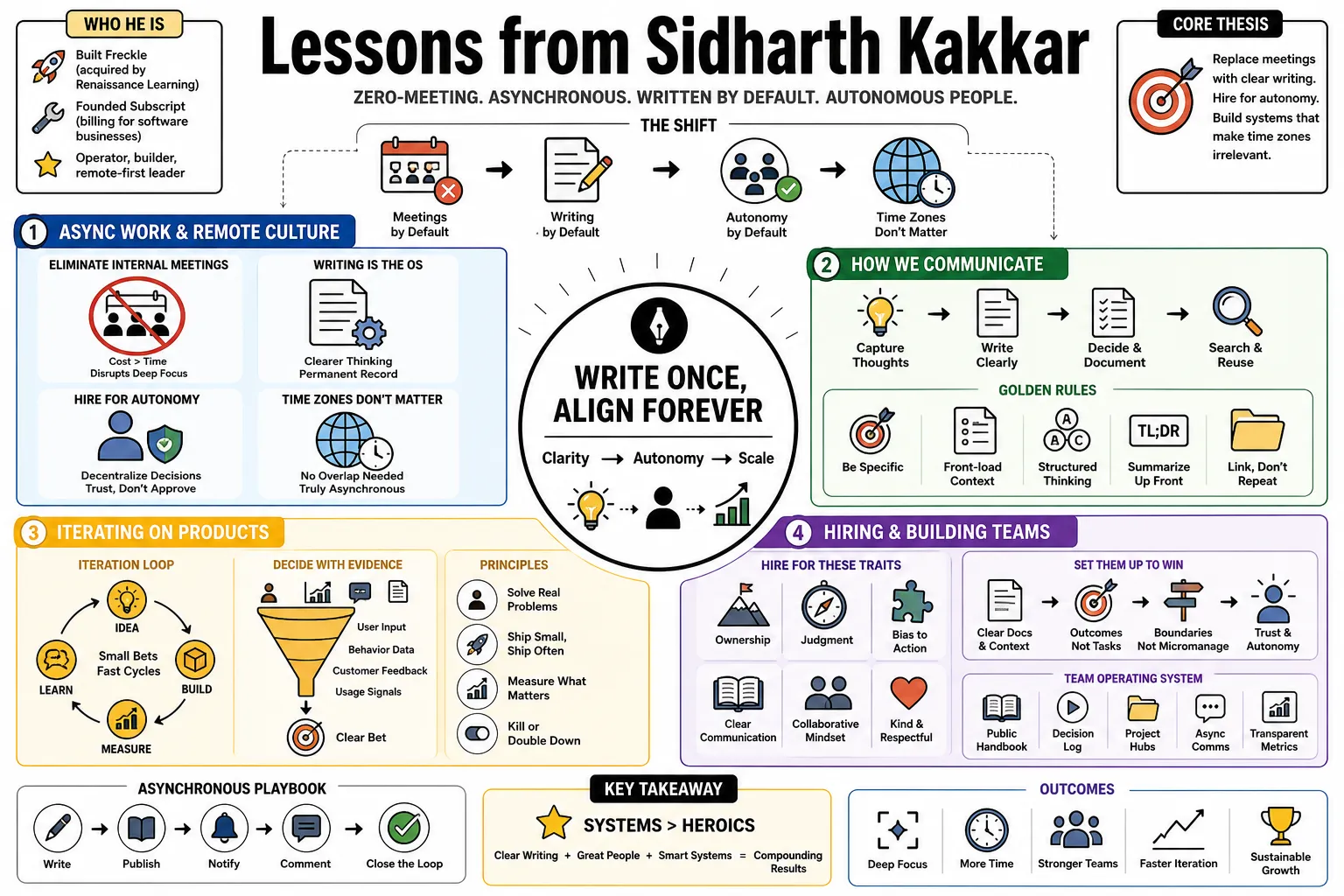
Lessons from Sidharth Kakkar
Sidharth Kakkar built the edtech platform Freckle (acquired by Renaissance Learning) and later launched Subscript, a billing tool for software businesses. He runs his companies on a strict zero-meeting, asynchronous culture that demands written documentation instead of calendar syncs. This collection gathers his frameworks for iterating on products, hiring for autonomy, and managing early-stage growth.
Part 1: Asynchronous Work & Remote Culture
- On eliminating internal meetings: "We realized that the cost of synchronicity was more than time; it was the disruption of deep focus. Moving to a zero-meeting internal culture forced us to communicate with intention." — Source: [First Round Review]
- On the power of writing: "When you remove meetings, writing becomes your primary operating system. It requires clearer thinking and leaves a permanent record of decisions." — Source: [First Round Review]
- On autonomy: "You cannot build an asynchronous company if you have to approve every decision. You have to hire people who can drive their work forward independently." — Source: [Subscript Blog]
- On time zones: "True asynchronous work makes time zones irrelevant. If the system relies on overlapping hours, it is merely remote work, rather than async work." — Source: [First Round Review]
- On documentation: "The unwritten rules of an office do not exist remotely. If a process or a rationale is absent from a shared space, it might as well not exist." — Source: [Medium]
- On over-communication: "In an asynchronous environment, silence is ambiguous. Over-communicating context and intent is the only way to keep everyone aligned without hopping on a call." — Source: [First Round Review]
- On deep work: "The modern office interrupts people constantly. Async culture is designed to protect uninterrupted blocks of time so people can actually do the work they were hired for." — Source: [Subscript Blog]
- On measuring output: "When you cannot see someone sitting at their desk, you are forced to measure the only thing that matters: the actual output they deliver." — Source: [First Round Review]
- On async onboarding: "Onboarding asynchronously requires a heavier upfront investment in materials, but it pays off when new hires can ramp up at their own pace without bottlenecking the team." — Source: [SyncSpider Interview]
- On the limits of async: "Async does not mean anti-social. It simply means reserving live interactions for relationship building and complex problem-solving, rather than daily status updates." — Source: [First Round Review]
Part 2: Hiring & Team Building
- On reference checks: "Reference checks should not be about verifying dates of employment; they are your best tool for uncovering how to manage the person effectively before day one." — Source: [First Round Review]
- On the twist question: "Bring up a weakness the candidate already admitted to during their interview. It gives the reference permission to speak candidly about that specific area without feeling like they are sabotaging the candidate." — Source: [First Round Review]
- On filtering for autonomy: "We look for a history of self-directed projects. If someone needs a highly structured environment to thrive, an async culture will leave them feeling lost." — Source: [First Round Review]
- On culture as a product: "Company culture is a product you build for your employees. Similar to any product, it needs to solve a specific problem for a specific group of people." — Source: [First Round Review]
- On hiring as segmentation: "Hiring is an exercise in segmentation. You are not trying to appeal to every candidate; you are trying to find the exact subset of the market that thrives in your specific environment." — Source: [First Round Review]
- On repelling candidates: "A good job description should actively repel the wrong candidates. If everyone reads it and thinks it sounds like a good fit, you have not been opinionated enough." — Source: [First Round Review]
- On written communication skills: "Since our company runs on writing, we test for it heavily. A candidate's ability to structure an argument in a memo is highly predictive of their success here." — Source: [Medium]
- On self-awareness: "I ask candidates to describe a time they failed because of their own shortcomings. The specific failure matters less than their ability to analyze it objectively." — Source: [SyncSpider Interview]
- On looking for drivers: "You need people who will push a project uphill. If a project stalls because someone did not reply to an email, that person is a passenger, rather than a driver." — Source: [First Round Review]
- On interview projects: "Paid take-home projects are the highest fidelity signal you can gather. They simulate the actual work environment far better than any conversational interview." — Source: [Subscript Blog]
Part 3: Management & Leadership
- On micromanagement vs delegation: "Delegation without context looks exactly like abandonment. You have to provide the framework and the constraints before you step back." — Source: [First Round Review]
- On radical transparency: "If you want people to make CEO-level decisions, you have to give them access to the same information the CEO has." — Source: [Subscript Blog]
- On trusting the team: "Trust goes beyond believing someone is competent; it is about being comfortable with the reality that they will solve a problem differently than you would." — Source: [First Round Review]
- On coaching vs directing: "A manager's job shifts from telling people what to do, to asking the right questions so they figure out what to do." — Source: [Medium]
- On giving constructive feedback: "Feedback should be immediate and low-stakes. When you save it up for a quarterly review, it turns into an indictment rather than a helpful correction." — Source: [Medium]
- On the I like, I wish format: "We run bi-weekly feedback sessions using the 'I like, I wish' framework. It forces critiques to be constructive and forward-looking." — Source: [Medium]
- On preventing burnout: "Burnout usually does not stem from working too many hours; it is about working in a state of high friction and low autonomy." — Source: [First Round Review]
- On the role of a CEO: "The CEO's job is to define the destination and ensure the team has the resources to get there, rather than dictate every turn along the road." — Source: [Forbes]
- On permission to fail: "If your team has never shipped a failure, your culture is too risk-averse. Autonomy requires the psychological safety to make mistakes." — Source: [First Round Review]
- On managing remote teams: "Managing remote teams requires deliberate design. You cannot rely on hallway conversations to patch over poor communication habits." — Source: [SyncSpider Interview]
Part 4: Product Development & Prototyping
- On rapid prototyping: "In the early days of Front Row, our entire strategy was getting a raw, imperfect product in front of users as fast as humanly possible." — Source: [Medium]
- On getting out of the building: "You will never learn what a user actually needs by sitting in a conference room hypothesizing. You have to go watch them work." — Source: [Medium]
- On building for classrooms: "Observing a teacher try to use software in a room of thirty distracted kids completely changes how you think about user interface design." — Source: [Medium]
- On observing users struggle: "The most valuable insights come from watching a user confidently click the wrong button. Do not correct them; watch what they do next to recover." — Source: [Subscript Blog]
- On daily iterations: "We used to sit in classrooms during the day, watch the students struggle with the math app, and then rewrite the code that night to test again the next morning." — Source: [Medium]
- On prioritizing features: "Users will ask for a thousand features. Your job is to ignore the feature requests and dig into the underlying friction they are trying to solve." — Source: [First Round Review]
- On avoiding scope creep: "Every feature you add increases the complexity of the product forever. Default to 'no' until the pain of not having the feature becomes unbearable." — Source: [Subscript Diving Deep]
- On building what users need: "If you build exactly what the user asks for, you often end up with a faster horse. You have to synthesize their requests into a better structural solution." — Source: [Medium]
- On the value of a bad prototype: "A broken, ugly prototype that solves a real problem will always beat a polished product that solves a fake problem." — Source: [Medium]
Part 5: User Feedback & Iteration
- On direct observation: "Self-reported feedback is flawed because people want to be polite. Direct observation is the only way to see the truth of how your product is used." — Source: [Medium]
- On real-time adaptation: "The advantage of a startup is not capital or distribution; it is the ability to absorb feedback on Tuesday and ship a fix on Wednesday." — Source: [Subscript Blog]
- On taking feedback as a gift: "Defensiveness is the enemy of iteration. When a user tells you your product is confusing, they are giving you a free roadmap to growth." — Source: [Medium]
- On anonymous feedback channels: "Power dynamics make honest feedback difficult. Creating structured, anonymous channels is required if you want to hear the hard truths about your leadership." — Source: [Medium]
- On the silent majority: "The loudest customers are rarely representative of your user base. You have to proactively seek out feedback from the users who are quietly churning." — Source: [Subscript Diving Deep]
- On validating assumptions: "Every product decision is a hypothesis. You do not know if you are right until a paying user confirms it with their behavior." — Source: [eCom Ops Podcast]
- On closing the feedback loop: "When a user gives you feedback and you actually fix the issue, you convert a frustrated user into an evangelist for life." — Source: [Medium]
- On the growth mindset: "The trajectory of an employee is determined entirely by how quickly they can internalize critical feedback and change their behavior." — Source: [First Round Review]
- On the danger of isolation: "Founders who stop talking to users inevitably start building for themselves. That is the first step toward irrelevance." — Source: [Medium]
Part 6: B2B SaaS & Financial Metrics
- On subscription intelligence: "B2B SaaS finance is uniquely complex because revenue is never a single transaction; it is a living timeline of contract upgrades and renewals." — Source: [Subscript Blog]
- On ARR predictability: "A company with $10M in highly predictable ARR is fundamentally more valuable than a company with $15M in chaotic, high-churn revenue." — Source: [Subscript Blog]
- On the fragmentation of finance data: "Finance teams spend half their month trying to reconcile data between the CRM, the billing system, and their spreadsheets. It is a massive waste of strategic talent." — Source: [Subscript Blog]
- On moving beyond spreadsheets: "Spreadsheets are the duct tape of B2B finance. They work in the early days, but they become a dangerous single point of failure as you scale." — Source: [Subscript Diving Deep]
- On pricing strategies: "Pricing is rarely a math problem; it is a positioning problem. How you price dictates exactly who will buy your product and how they will value it." — Source: [Subscript Diving Deep]
- On tracking the right metrics: "Vanity metrics look good on a slide deck, but net dollar retention and gross margin are what actually dictate the survival of a SaaS business." — Source: [Subscript Blog]
- On revenue recognition: "Recognizing SaaS revenue in a spreadsheet is a ticking time bomb. The moment a contract gets amended mid-cycle, the math breaks down completely." — Source: [Subscript Blog]
- On B2B go-to-market: "In B2B, you are not simply selling a tool; you are selling a workflow change. Your sales motion has to address the friction of change management." — Source: [eCom Ops Podcast]
- On the CFO's changing role: "The modern SaaS CFO is no mere bookkeeper; they are the strategic architect of the company's growth engine." — Source: [Subscript Blog]
Part 7: Scaling & Growth Strategy
- On scaling from 0 to $40M ARR: "The skills required to get a company off the ground are entirely different from the skills required to manage a machine that generates tens of millions in revenue." — Source: [Forbes]
- On the transition to CEO: "As a founder, you build the product. As a CEO, you build the organization that builds the product. It is a completely different job." — Source: [First Round Review]
- On surviving the early days: "The early days of a startup are an exercise in prolonged irrationality. You have to believe in the vision strongly enough to ignore the constant evidence that you might fail." — Source: [Medium]
- On acquisitions: "An acquisition is successful when there is genuine alignment in how both organizations view the market and the product's future, rather than solely the financial terms." — Source: [Forbes]
- On the pain points of scaling: "Every time your headcount triples, every single communication process breaks. You have to constantly rebuild your internal infrastructure." — Source: [First Round Review]
- On organizational debt: "Similar to technical debt, organizational debt accumulates when you hire fast to solve short-term problems without thinking about the long-term architecture of the team." — Source: [First Round Review]
- On maintaining speed at scale: "The enemy of scale is consensus. If you require ten people to agree before shipping a feature, your startup has already become a bureaucracy." — Source: [First Round Review]
- On resource allocation: "Strategy is simply resource allocation. If you say a project is a priority but you fail to put your best engineers on it, it is not actually a priority." — Source: [Subscript Diving Deep]
- On knowing when to pivot: "You pivot when the market tells you that your current solution is a nice-to-have commodity rather than a hair-on-fire necessity." — Source: [Medium]
Part 8: Founder Mindset & Personal Growth
- On the second-time founder advantage: "The main advantage of being a repeat founder is not knowing exactly what to do; it is knowing exactly which mistakes will kill you and which ones you can survive." — Source: [eCom Ops Podcast]
- On emotional resilience: "The hardest part of being a founder is neither the code nor the sales; it is managing your own psychology during the extreme highs and lows." — Source: [Medium]
- On the reality of the journey: "The media glamorizes the founding journey, but the reality is years of unglamorous grinding, staring at spreadsheets, and fixing broken processes." — Source: [Subscript Blog]
- On seeking mentors: "The best mentors do not give you answers. They give you frameworks to help you arrive at the answer yourself." — Source: [Medium]
- On continuous learning: "The moment you think you have mastered the job of a CEO, the company scales and the job description changes entirely. You have to remain a student." — Source: [Medium]
- On detaching from failure: "You have to separate your personal identity from the success or failure of the company. If you are the company, you will struggle to make objective decisions." — Source: [SyncSpider Interview]
- On intellectual honesty: "Intellectual honesty means looking at your metrics and admitting that your core thesis might be wrong, even when it hurts your ego." — Source: [Subscript Blog]
- On balancing work and life: "You can sprint for a few months, but building a durable company is a decade-long endeavor. You have to construct a life that sustains that timeline." — Source: [First Round Review]
- On the purpose of building: "Ultimately, we build software to remove friction from people's lives so they can focus on the work that actually matters." — Source: [Subscript Diving Deep]