Lessons from Sinan Aral
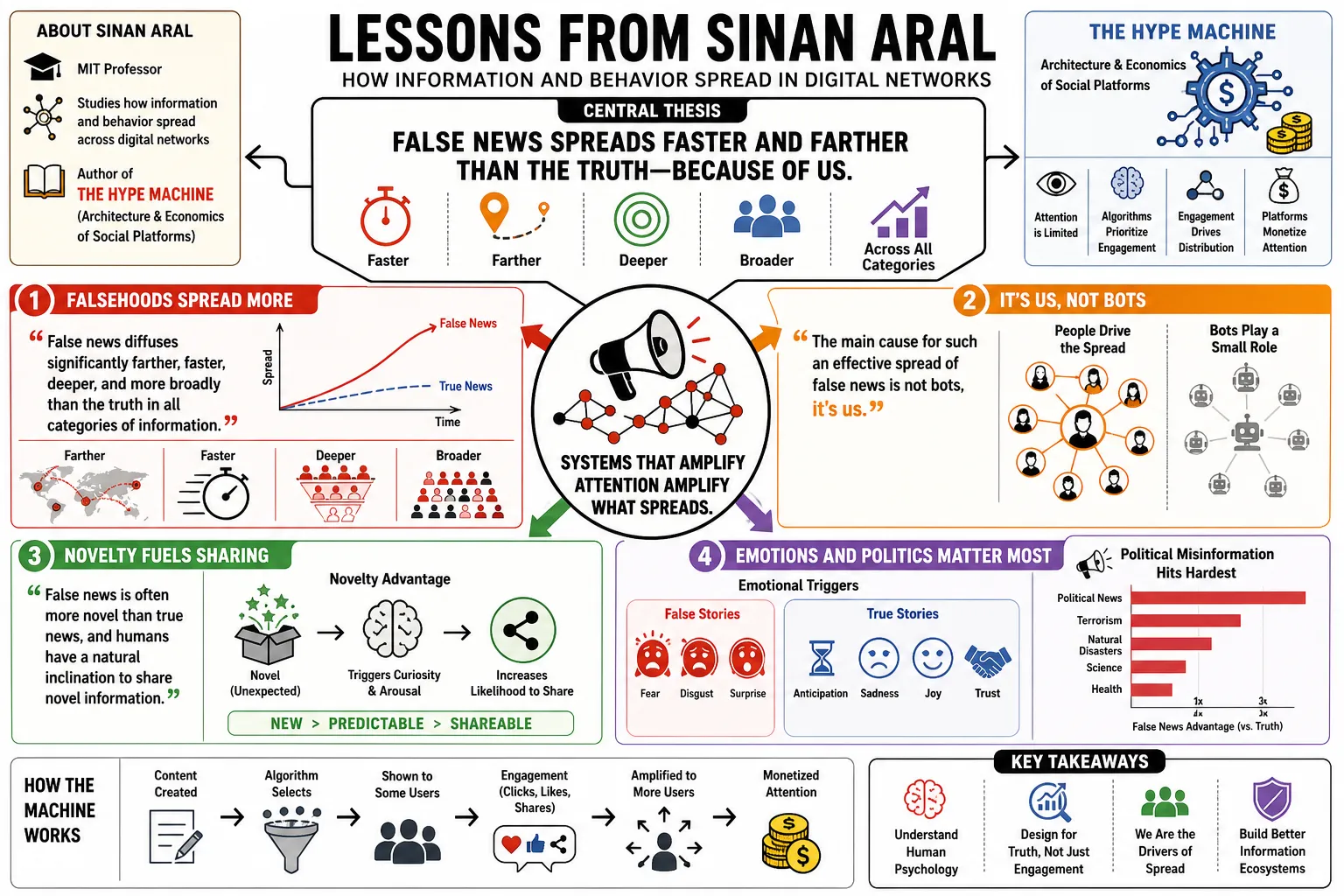
MIT professor Sinan Aral studies how information and behavior spread across digital networks. He is best known for his 2018 research on the rapid spread of false news and his book The Hype Machine, which examines the architecture and economics of social platforms. This collection outlines his findings on attention, algorithms, and viral marketing to explain how these systems actually operate.
Part 1: The Spread of False Information
- On Falsehoods: "False news diffuses significantly farther, faster, deeper, and more broadly than the truth in all categories of information." — Source: [Science]
- On Human Agency: "The main cause for such an effective spread of false news is not bots, it’s us." — Source: [MIT IDE]
- On Novelty: "False news is often more novel than true news, and humans have a natural inclination to share novel information." — Source: [Science]
- On Emotional Triggers: "False stories inspire feelings of fear, disgust, and surprise, whereas true stories are more likely to inspire anticipation, sadness, joy, and trust." — Source: [MIT Sloan]
- On Political Misinformation: "The effect of false news spreading faster than the truth is most pronounced for political news compared to terrorism, natural disasters, or financial information." — Source: [Science]
- On Speed: "It takes true news about six times as long to reach 1,500 people as it does for false news to reach the same number of people." — Source: [MIT News]
- On Retweeting: "Falsehoods are 70% more likely to be retweeted than the truth, even when controlling for the account's age, activity level, and number of followers." — Source: [Science]
- On Echo Chambers: "The algorithms read our behavior to determine the kinds of content we like, and then show us more of the content we prefer, narrowing the scope of our reality." — Source: [The Hype Machine]
- On Bots vs Humans: "While bots spread both true and false news, they do so at roughly the same rate. Humans are the ones disproportionately sharing the false news." — Source: [Science]
- On Information Cascades: "A lie travels halfway around the world while the truth is putting on its shoes, amplified by structural network topologies." — Source: [The Hype Machine]
Part 2: The Attention Economy
- On Attention Scarcity: "A wealth of information creates a poverty of attention, changing how we filter and consume reality." — Source: [Medium]
- On Monetizing Eyeballs: "The social media advertising ecosystem monetizes attention, creating a perverse incentive for creators to produce sensationalized fake news." — Source: [Marketplace]
- On Digital Marketing: "In the Hype Machine, everyone is a digital marketer, whether we're fighting for ideas or for consumer dollars." — Source: [The Hype Machine]
- On Real-time Feedback: "We are constantly bombarded with streams of status updates, news stories, tweets, pokes, posts, and ratings from peers." — Source: [MIT IDE]
- On Attention Hijacking: "The platforms are designed to hijack our attention by tapping into our innate psychological need for social validation." — Source: [Hidden Forces]
- On Clickbait: "Economic motives drive the creation of clickbait, which exploits our psychological vulnerabilities to capture and sell our attention." — Source: [Marketplace]
- On Content Saturation: "With trillions of digital social signals sent daily, our primary constraint is no longer access to information, but the capacity to process it." — Source: [The Hype Machine]
- On Algorithmic Filtering: "Because we cannot process all the information available, we rely on algorithms to curate our feeds, giving them immense power over our worldview." — Source: [Computer History Museum]
- On The Tyranny of Trends: "Social platforms inject the influence of our peers into our daily decisions, leading to mass persuasion and the tyranny of trends." — Source: [The Hype Machine]
- On Information Overload: "As the cost of producing content drops to zero, the value of the filters that manage our attention skyrockets." — Source: [MIT Sloan]
Part 3: Viral Marketing and Influence
- On Passive Broadcasts: "Passive-broadcast viral features are significantly more effective at creating total peer contagion than active-personalized invitations." — Source: [Management Science]
- On Influence and Susceptibility: "Understanding contagion requires measuring both the influence of a sender and the susceptibility of the receiver." — Source: [NYU Stern]
- On Targeted Marketing: "Firms must move beyond simple metrics to identify the specific individuals who drive the propagation of behaviors within a network." — Source: [MIT IDE]
- On Peer Influence: "People are heavily influenced by the behaviors and decisions of their peers, especially when those behaviors are made visible through social platforms." — Source: [Management Science]
- On ROI of Social: "Applying big data analytics to marketing allows companies to calculate the precise return on investment for social media campaigns." — Source: [Sinan Aral Insights]
- On Product Design: "Products must be designed with viral features baked in, encouraging users to naturally broadcast their usage to their networks." — Source: [The Hype Machine]
- On Message Efficacy: "While personalized invitations are more effective per message, passive broadcasts reach a much larger audience, resulting in greater overall contagion." — Source: [Management Science]
- On Network Topologies: "The structure of the social network determines how quickly and broadly a marketing message will spread." — Source: [MIT News]
- On Identifying Influencers: "True influencers are not always those with the most followers, but those who are connected to the most susceptible peers." — Source: [NYU Stern]
- On the Scale of Influence: "A 246% increase in peer influence can be achieved through passive broadcasts compared to the 98% increase provided by active-personalized messages." — Source: [Management Science]
Part 4: The Hype Machine
- On The Definition: "The Hype Machine is a conglomeration of technologies that influences everything from how we shop, to who we date, to how we vote." — Source: [Motionographer]
- On Design: "Social media is designed for our brains. It interfaces with the parts of the human brain that regulate our sense of belonging and social approval." — Source: [The Hype Machine]
- On Duality: "This technology has the potential for tremendous promise and tremendous peril. It depends on how you use it." — Source: [MIT News]
- On Social Signals: "Every minute of every day, our planet now pulses with trillions of digital social signals." — Source: [The Hype Machine]
- On the Match and Gasoline: "When you develop a population-scale technology that delivers social signals in real-time, it's like tossing a lit match into a pool of gasoline." — Source: [MIT IDE]
- On Reality Distortion: "We had uncovered a reality-distortion machine in the pipes of social media platforms, through which falsehood traveled like lightning." — Source: [The Hype Machine]
- On Human Connection: "The Hype Machine rewards our dopamine system and encourages us to seek more rewards by connecting, engaging, and sharing online." — Source: [The Hype Machine]
- On Good vs Evil: "When asked if social media is good or evil, the answer is 'yes'." — Source: [Computer History Museum]
- On Structural Change: "The transition to a digitally connected society has fundamentally altered the mechanics of human interaction on a global scale." — Source: [The Hype Machine]
Part 5: Algorithmic Amplification
- On Recommendation Systems: "Recommendation algorithms are designed to maximize engagement, which often means prioritizing sensational and emotionally charged content over accuracy." — Source: [Hidden Forces]
- On Feedback Loops: "The algorithms learn from our clicks and shares, creating a feedback loop that continuously refines and intensifies the content we are exposed to." — Source: [The Hype Machine]
- On Polarization: "By showing users only what they already agree with, algorithmic filtering accelerates political and social polarization." — Source: [MIT Sloan]
- On Platform Incentives: "Platforms have built algorithms to optimize for the metrics that drive their revenue, not necessarily the metrics that promote a healthy society." — Source: [Marketplace]
- On Algorithmic Transparency: "We need greater transparency into how these algorithms function to understand their true impact on public discourse." — Source: [Computer History Museum]
- On Virality Engineering: "Virality is no longer a random occurrence; it is engineered by algorithms designed to surface content with the highest probability of being shared." — Source: [The Hype Machine]
- On Nudges: "Platforms can reduce the spread of misinformation by implementing nudges—design features that encourage users to pause before sharing." — Source: [Computer History Museum]
- On Algorithmic Interventions: "We can adjust the code of these platforms to downrank low-quality information and promote authoritative sources." — Source: [MIT IDE]
- On The Speed of Information: "Algorithms dictate not just what we see, but the velocity at which information travels through the network." — Source: [Science]
Part 6: Network Science and Susceptibility
- On Social Topography: "The shape and structure of a social network can accelerate or impede the flow of information." — Source: [MIT News]
- On Hubs and Spans: "Information spreads fastest when it hits highly connected hubs that bridge different communities within a network." — Source: [Science]
- On Behavioral Contagion: "Behaviors, like information, can be contagious, spreading from person to person based on network proximity." — Source: [Management Science]
- On Targeting Susceptibility: "Marketing is most effective when it targets individuals who are highly susceptible to influence from their specific peers." — Source: [NYU Stern]
- On Network Density: "Densely connected networks tend to reinforce existing beliefs, making it harder for novel or contradictory information to penetrate." — Source: [MIT IDE]
- On Cascading Failures: "In interconnected networks, a small piece of misinformation can trigger a cascading failure of truth across the system." — Source: [The Hype Machine]
- On Empirical Network Analysis: "We must move from theoretical models of networks to empirical analysis using large-scale data from social platforms." — Source: [Sinan Aral Insights]
- On Peer Clusters: "People tend to cluster with others who share their views, creating structurally isolated echo chambers." — Source: [Science]
- On The Mathematics of Influence: "By mathematically mapping the network, we can predict the paths through which information is most likely to flow." — Source: [Management Science]
Part 7: Human Psychology and Social Signals
- On Dopamine: "Social media engagement triggers dopamine release, creating a neurological loop of seeking and receiving social validation." — Source: [The Hype Machine]
- On Social Proof: "We use the behavior of others as a heuristic for our own decisions, a dynamic heavily amplified by social platforms." — Source: [MIT Sloan]
- On Emotional Contagion: "Emotions expressed online can spread through social networks, affecting the moods of people who consume the content." — Source: [The Hype Machine]
- On Status Seeking: "Much of our online behavior is driven by an innate desire to signal our status and align with our in-groups." — Source: [Hidden Forces]
- On The Fear of Missing Out: "The constant stream of updates creates a persistent fear of missing out, driving compulsive engagement with the platforms." — Source: [The Hype Machine]
- On Cognitive Bias: "Social media exploits our cognitive biases, such as confirmation bias, to keep us engaged with content that validates our worldview." — Source: [MIT News]
- On The Illusion of Consensus: "When we only see opinions that match our own, we develop a false sense of consensus about the broader public opinion." — Source: [Science]
- On Identity Performance: "Online platforms serve as stages where we perform our identities for an audience of our peers." — Source: [The Hype Machine]
- On Trust: "The erosion of trust in traditional institutions is partly a consequence of the decentralized nature of information sharing on social media." — Source: [MIT IDE]
Part 8: Steering the Future of Social Media
- On The Four Levers: "We have four levers available to us to steer social media technology toward promise and away from peril: money, code, norms, and laws." — Source: [Computer History Museum]
- On Economic Incentives: "We must realign the economic incentives of the platforms to reward quality and accuracy over mere engagement." — Source: [The Hype Machine]
- On Platform Architecture: "Modifying the code and architecture of the platforms is essential for mitigating the spread of harmful content." — Source: [MIT IDE]
- On Social Norms: "Developing new digital social norms can help self-regulate behavior and reduce the toxicity of online interactions." — Source: [The Hype Machine]
- On Regulation and Law: "Thoughtful legislation is required to address issues of data privacy, algorithmic transparency, and platform liability." — Source: [Computer History Museum]
- On A Scientific Approach: "We must approach the challenges of social media in a rigorous, analytical, and scientific way, rather than with political slogans." — Source: [IEDP]
- On Platform Responsibility: "Tech companies have a responsibility to act as stewards of the digital public square, not just neutral conduits." — Source: [MIT News]
- On Data Access: "Independent researchers need greater access to platform data to properly study and understand the societal impacts of social media." — Source: [Science]
- On the Ultimate Choice: "The future of social media is not predetermined; it is a choice we must actively make as a society." — Source: [The Hype Machine]