Lessons from Soichiro Honda
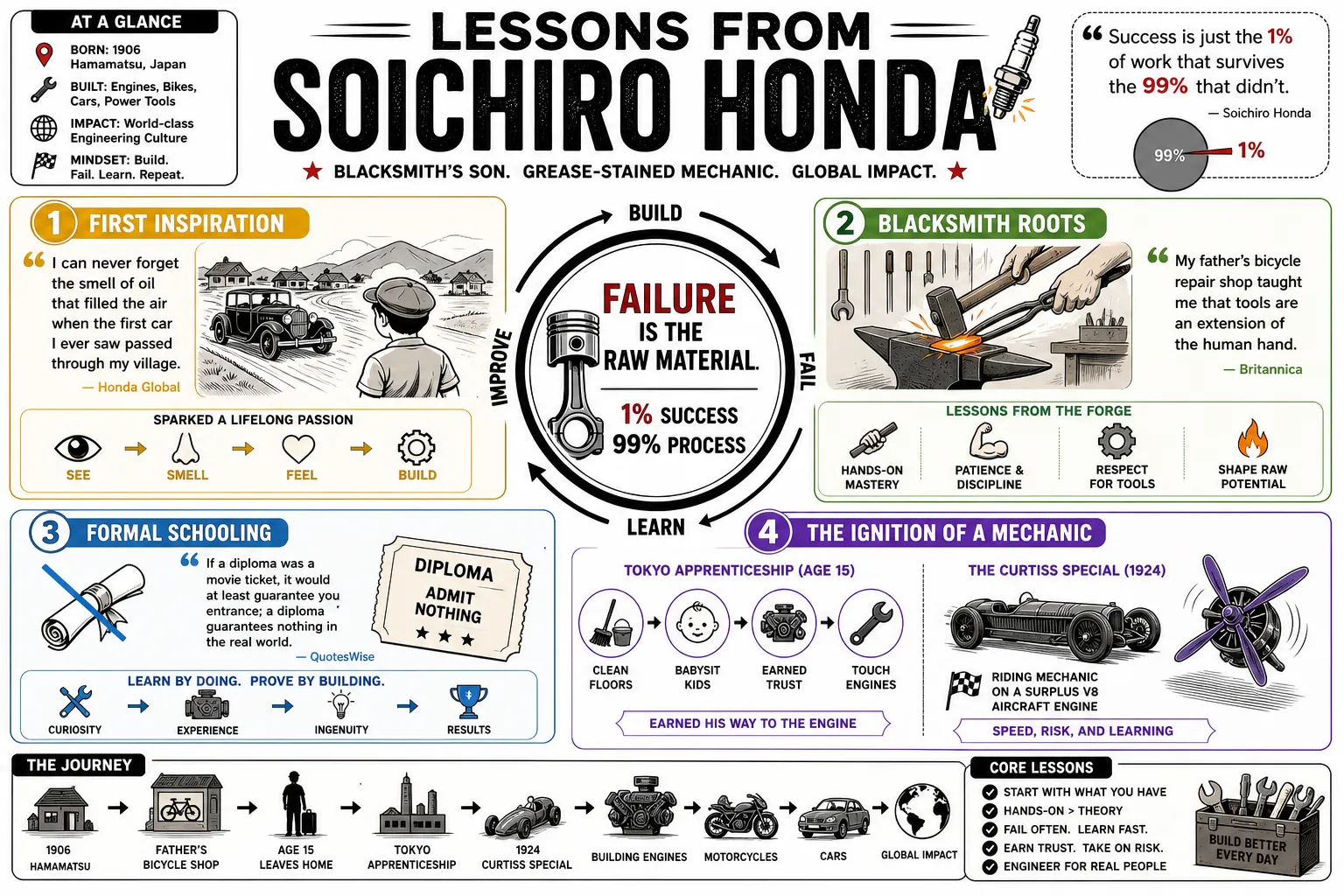
Soichiro Honda was a blacksmith’s son who built a global empire by treating failure as his primary raw material. He famously argued that success is just the 1% of work that survives the 99% that didn't. This is how a "grease-stained" mechanic from post-war Japan out-engineered the establishment.
Part 1: The Ignition of a Mechanic
- On First Inspiration: "I can never forget the smell of oil that filled the air when the first car I ever saw passed through my village." — Source: Honda Global
- On Blacksmith Roots: Honda credited his father's bicycle repair shop for teaching him that tools are an extension of the human hand. — Source: Britannica
- On Formal Schooling: "If a diploma was a movie ticket, it would at least guarantee you entrance; a diploma guarantees nothing in the real world." — Source: QuotesWise
- On the Tokyo Apprenticeship: At age 15, Honda left home for Art Shokai, where he spent his first year cleaning floors and babysitting the owner's children before being allowed near an engine. — Source: Honda Global
- On the Curtiss Special: In 1924, Honda served as the riding mechanic for a race car built using a surplus V8 aircraft engine from a Curtiss biplane. — Source: SFC Riga
- On Winning Early: The victory of the Curtiss Special at the Fifth Japan Automobile Competition cemented his belief that racing was the ultimate test of engineering. — Source: Honda Global
- On Personal Risk: Honda suffered a near-fatal crash in 1936 that left him with a broken back and facial scars, which only deepened his obsession with safety and speed. — Source: Wikipedia
- On Mechanical Intuition: He believed that an engineer should be able to "hear" a machine’s problems before seeing them through diagnostic tools. — Source: Right Attitudes
- On Practical Knowledge: "Action without philosophy is a lethal weapon; philosophy without action is worthless." — Source: Scribd
Part 2: Engineering as a Way of Life
- On the Factory Floor: Honda famously preferred his white coveralls to a business suit, spending the majority of his time in the R&D labs. — Source: ASME
- On the "Genba" Spirit: He believed the only way to solve a problem was to go to the "actual place" where the work was happening. — Source: Right Attitudes
- On Technical Humility: "The machine never lies; if it fails, it is because your understanding of the laws of nature is incomplete." — Source: Honda Global
- On the Smell of Oil: To his workers, he often said that the scent of grease and oil was "the perfume of progress." — Source: Britannica
- On Uniforms: Honda insisted that everyone in the company, including executives, wear the same white uniform so that "grease and dirt would show." — Source: Honda Global
- On R&D Separation: He established Honda R&D as a separate company to protect engineers from being managed by the short-term financial goals of the sales department. — Source: Honda Global
- On Sound Theory: "Respect sound theory, develop fresh ideas, and make the most effective use of time." — Source: Honda Global
- On the Limits of Logic: He felt that while logic is necessary to build a car, "emotion is necessary to make people want to drive it." — Source: Scribd
Part 3: The Piston Ring Ordeal
- On Early Failure: Honda’s first batch of 50 piston rings for Toyota was rejected because only three met the required quality standards. — Source: Sutlej Textiles
- On Returning to School: After the Toyota rejection, he realized he lacked metallurgical knowledge and enrolled in technical school at age 31. — Source: Asian Studies
- On Ignoring Grades: He was eventually expelled from school because he refused to take the final exams, claiming he only wanted the knowledge, not the paper. — Source: QuotesWise
- On Sacrificing for a Dream: During the struggle to perfect his piston rings, Honda’s wife reportedly had to pawn her jewelry to keep the business afloat. — Source: Sutlej Textiles
- On Success vs. Failure: "Success represents the 1% of your work which results from the 99% that is called failure." — Source: Dual Sport SD
- On Post-War Ingenuity: In 1946, he used surplus radio generator engines from the military to power bicycles, creating his first motorized transport. — Source: Honda Global
- On the Destruction of Plants: His piston ring factories were destroyed twice—once by B-29 bombers in 1944 and once by an earthquake in 1945. — Source: Wikipedia
- On Pivoting: Instead of rebuilding his old business, he sold the remains to Toyota and used the capital to found the Honda Technical Research Institute. — Source: Britannica
- On the First "Dream": The 1949 D-Type motorcycle was named the "Dream" because it realized his goal of building a complete, original motorized vehicle. — Source: Honda Global
- On Persistence: "The true measure of success is how many times you can bounce back from failure." — Source: Bookey
Part 4: The Partnership of Honda & Fujisawa
- On the Division of Labor: Honda focused entirely on engineering while Takeo Fujisawa handled all aspects of marketing, finance, and sales. — Source: Honda Global
- On Mutual Trust: The two partners had a handshake agreement never to interfere in the other’s domain of expertise. — Source: BikeBD
- On Anti-Nepotism: Honda and Fujisawa made a pact that their sons would never be allowed to join the company to ensure it remained a meritocracy. — Source: Honda Global
- On Financial Independence: Fujisawa fought to keep Honda independent of the major Japanese industrial groups (keiretsu) to maintain creative freedom. — Source: Honda Global
- On Public Ownership: "A public corporation belongs to the public, not to the family of the founder." — Source: Right Attitudes
- On Leaving Together: They agreed to retire on the same day to ensure the next generation could lead without being overshadowed by the founders. — Source: Honda Global
- On Global Viewpoint: "Maintaining a global viewpoint, we are dedicated to supplying products of the highest quality." — Source: Honda Global
- On the Handover: When Fujisawa said it was time to quit, Honda replied, "If you're quitting, I'm quitting too." — Source: BikeBD
- On Independent Financing: They funded the Super Cub expansion through a unique deposit system with small bicycle dealers rather than relying on bank loans. — Source: Honda Global
Part 5: The Honda Way of Leadership
- On "Mr. Thunder": Employees called him "Mr. Thunder" because of his explosive temper when he witnessed sloppy work or lack of effort. — Source: Britannica
- On Being "Pop": Despite his temper, workers also called him "Oyaji" (Pop), reflecting their deep personal affection for him as a mentor. — Source: Honda Global
- On Youthful Spirit: Honda prioritized putting young engineers in charge because they "did not know what was impossible." — Source: Right Attitudes
- On Equality: He believed that in a workshop, there are no superiors or subordinates, only different roles in pursuit of a common goal. — Source: Honda Global
- On Incentivizing Innovation: He allowed employees to keep royalties for inventions they developed, even those made using company resources. — Source: Britannica
- On Communication: "Enjoy your work and encourage open communications." — Source: Honda Europe Logistics
- On Initiative: The Honda Philosophy defines initiative as "thinking creatively and acting on your own initiative and judgment." — Source: Global Honda
- On Harmony: He emphasized creating a "harmonious work flow" where different departments collaborated rather than competed. — Source: Honda Europe Logistics
Part 6: The Joy of Creating
- On the Three Joys: Honda codified "The Joy of Creating, The Joy of Selling, and The Joy of Buying" as the core pillars of his business. — Source: Honda Global
- On the Joy of Creating: This occurs when engineers see that their work has brought happiness to customers and dealers. — Source: Inc.
- On the Joy of Buying: Honda believed the customer is the final judge and that a product should exceed their expectations. — Source: MPI Group
- On the Super Cub Design: He insisted the bike be operable with one hand so that soba delivery boys could balance trays of noodles with the other. — Source: WebBikeWorld
- On the Automatic Clutch: This requirement for "one-handed" use led to the development of the automatic centrifugal clutch, a breakthrough in ease of use. — Source: Honda Global
- On Social Acceptability: He insisted on a 4-stroke engine for the Super Cub because it was quieter and "nicer" for residential neighborhoods. — Source: Note.com
- On Democratic Mobility: The Super Cub was designed to be "step-through" to accommodate women wearing skirts and workers mounting frequently. — Source: Honda Global
- On Market Disruption: The "You meet the nicest people on a Honda" campaign in the U.S. successfully rebranded motorcycles away from "outlaw" imagery. — Source: Howard Yu
- On Product Universality: "Good products know no national boundaries." — Source: Honda Middle East
Part 7: Racing and Technical Competition
- On Why Honda Races: "If Honda does not race, there is no Honda." — Source: Right Attitudes
- On the Isle of Man Declaration: In 1954, Honda boldly declared his intention to enter the TT races, even though his company was still small and struggling. — Source: Honda Global
- On Improving the Breed: He viewed racing as the ultimate laboratory for testing the limits of materials and engineering. — Source: Scribd
- On F1 Entry: Honda entered Formula 1 in 1964, only one year after producing its first passenger car, to prove Japanese engineering to the world. — Source: Automotive Hall of Fame
- On Air-Cooled Stubbornness: Honda originally insisted on air-cooled engines because "water-cooled engines eventually use air to cool the water anyway." — Source: Cycle World
- On Admitting Mistakes: When his engineers proved water-cooling was necessary for emissions standards, he relented, saying, "Do whatever you want. Just take care of the water leaks." — Source: Honda Global
- On the CVCC Breakthrough: This technical shift led to the CVCC engine, the first to meet the U.S. Clean Air Act without a catalytic converter. — Source: Honda West Knoxville
- On Competitive Drive: "In racing, the results are clear. You either win or you lose." — Source: Scribd
- On the RA302 Incident: The 1968 crash of the air-cooled F1 car reinforced the need for safer, liquid-cooled technology. — Source: Honda Global
- On Engineering Logic: He believed that if you don't compete, you will never know the true quality of your own thoughts. — Source: Right Attitudes
Part 8: Legacy and the Final Dream
- On Knowing When to Leave: Honda retired in 1973 because he felt he had become "an obstacle" to the younger engineers' new ideas. — Source: Honda Global
- On Retirement Travel: After retiring, he traveled to every Honda dealer in Japan to thank them personally for their work. — Source: Honda Global
- On Personal Hobbies: In his later years, he devoted himself to painting and calligraphy, applying the same focus he once gave to engines. — Source: Wikipedia
- On the Value of Life: "The value of life can be measured by how many times your soul has been deeply stirred." — Source: Scribd
- On Dreams and Reality: "If you don't have a dream, how can you make it come true?" — Source: Addicted 2 Success
- On Retirement Identity: He stayed away from the company headquarters after 1973 so that the new president could lead without his interference. — Source: Honda Global
- On Immortality: "The day I stop dreaming is the day I die." — Source: Dual Sport SD
- On the Final Result: By the time of his death in 1991, Honda had built the largest motorcycle manufacturer in the world. — Source: Britannica