Sridhar Ramaswamy led Google's advertising business as it grew from $1.5 billion to over $100 billion, giving him a front-row seat to the economics of the modern internet. He later co-founded Neeva to build a subscription-based search engine free of ads, and he now serves as the CEO of Snowflake, where he is navigating the shift toward enterprise AI. This profile collects his direct observations on the hidden costs of ad-supported products, the realities of scaling massive engineering teams, and the operational intensity required to compete in software.
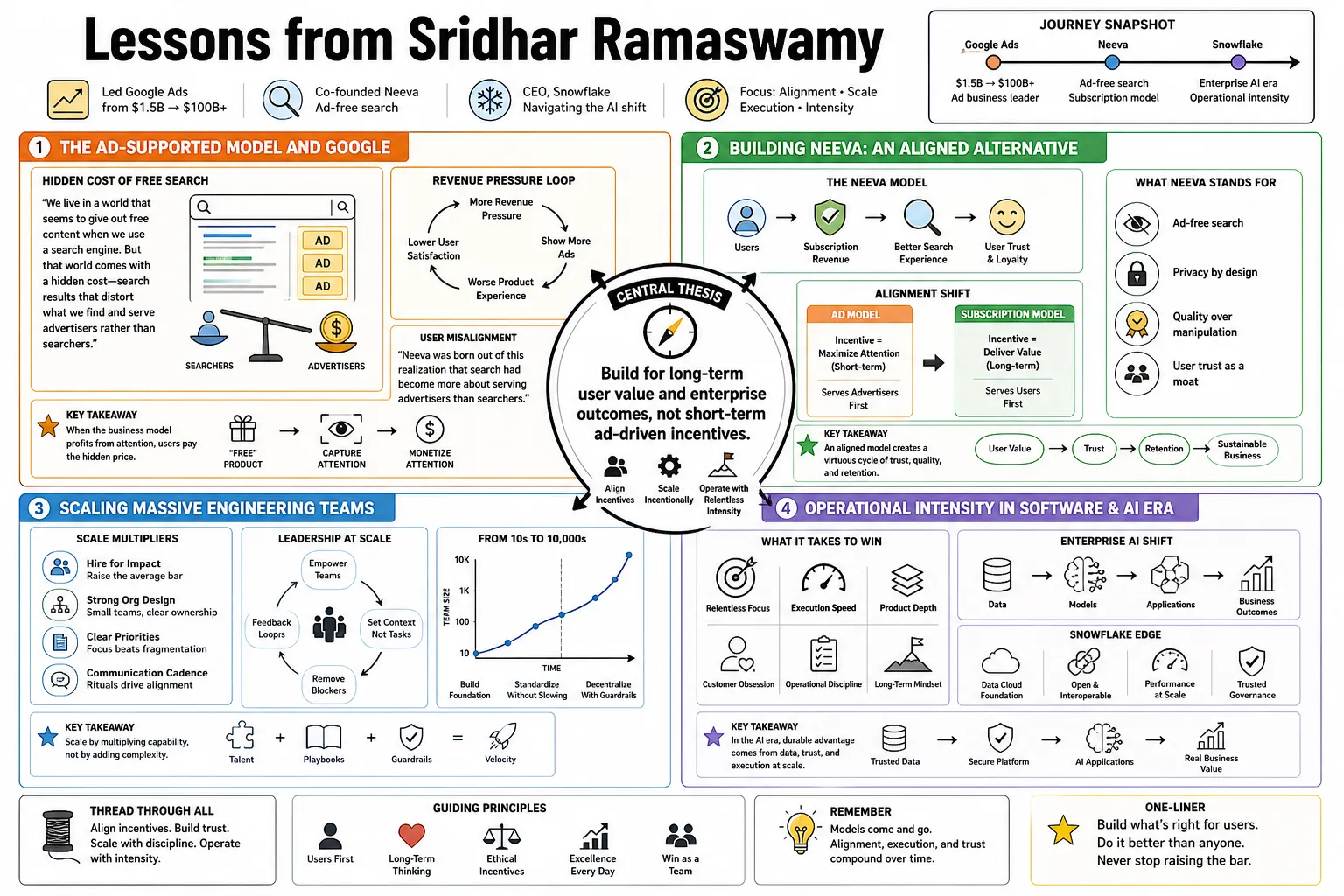
Part 1: The Ad-Supported Model and Google
- On the hidden cost of free search: "We live in a world that seems to give out free content when we use a search engine. But that world comes with a hidden cost—search results that distort what we find and serve advertisers rather than searchers." — Source: [EconTalk]
- On revenue pressure: "Search—as a product—was just going to continue to face more and more revenue pressure, forcing us to show more and more ads, and inevitably making the product worse over time." — Source: [Glasp]
- On user misalignment: "Neeva was born out of this realization that we had that search had become more about serving advertisers than about really serving users." — Source: [Inc.]
- On ad blockers: "The problem isn't that users hate all ads, it's that ad blockers are an all-or-nothing switch that penalizes quality ads, formats and placements along with the bad." — Source: [MarTech]
- On ad quality standards: We need clear standards for what constitutes a good ad, focusing on formats and placements that everyday consumers actually find acceptable. — Source: [MarTech]
- On Google's scale: Managing the growth of the ads division required continuously balancing basic product utility with immense and unyielding commercial demands. — Source: [Thought Economics]
- On the nature of free products: The realization that advertising was aggressively taking over our online lives was a primary motivator for exploring alternative business models. — Source: [Inc.]
- On advertising incentives: The economic incentives of a dominant ad model naturally push platforms to serve the highest bidder rather than surfacing the most relevant information. — Source: [EconTalk]
- On the ad-centric web: Over time, the internet transitioned from a focused tool for finding information into a landscape primarily optimized for capturing and monetizing attention. — Source: [Thought Economics]
Part 2: The Vision for Search and Neeva
- On building user-centric products: "If we don't make you happy, we don't make money, and that's the very direct tie-in we have with the user." — Source: [Glasp]
- On personalization and privacy: "We can then layer personalisation on top meaning that with your permission and with full transparency, your personal data can be used to serve you a better product—and not for any other reason." — Source: [Glasp]
- On timing in tech: "At Neeva, which converged onto a view of what search should be that was very similar to Perplexity, we were just two, three years early. And timing ends up being everything." — Source: [Sequoia: Training Data with Sridhar Ramaswamy]
- On the search-to-answers shift: The rise of Generative AI and large language models marked a fundamental transition in how people interact with information, moving from browsing links to seeking direct answers. — Source: [This Week in Startups: Sridhar Ramaswamy]
- On audacious goals: Neeva began as an audacious attempt to reimagine search, proving that the tech industry still needs companies willing to challenge established monopolies. — Source: [Investment Reports]
- On winding down Neeva: Winding down an ambitious dream is bittersweet, but it underscores the reality that even brilliant ideas sometimes meet immovable market realities. — Source: [Investment Reports]
- On the subscription search model: A paid subscription model aligns a company’s financial success entirely with the quality of the product and the satisfaction of the end-user. — Source: [EconTalk]
- On the evolution of LLMs: Large language models fundamentally altered the competitive landscape of search, changing the barrier to entry and resetting baseline expectations for users. — Source: [No Priors: Sridhar Ramaswamy]
- On early adoption: Being early to a market shift like AI-driven search provides invaluable operating lessons, even if the broader market isn't quite ready to adopt the new paradigm. — Source: [Sequoia: Training Data with Sridhar Ramaswamy]
Part 3: The Era of AI and Agents
- On AI implementation: "AI should not be a Big Bang. It should be a series of little projects that show value every step of the way." — Source: [Forbes]
- On the unknown future of AI: "In this world of AI, nobody knows what the perfect product will be, so you have to adapt... you and I can do things with AI that we would not even have dreamed of two years ago." — Source: [Snowflake CEO Sridhar Ramaswamy]
- On AI market perception: "People either overhype the impact of AI, or assume doomsday scenarios." — Source: [Business Insider]
- On the agentic enterprise: AI agents are moving beyond simple chat interfaces to perform autonomous actions and permanently alter enterprise workflows. — Source: [Snowflake CEO Sridhar Ramaswamy]
- On industrializing intelligence: Generative AI is effectively industrializing intelligence, making the capacity to process and act on information cheaper and more abundant. — Source: [The McKinsey Podcast]
- On software democratization: AI has fundamentally lowered the cost and barrier to entry for building software, altering how companies should allocate their engineering resources. — Source: [The McKinsey Podcast]
- On shadow AI: The rise of unmanaged AI usage in enterprises presents a security risk, requiring companies to establish governed frameworks for adoption. — Source: [Big Technology]
- On AI model providers: Foundational AI model companies represent a unique competitive challenge, reshaping the traditional hierarchy of the tech stack. — Source: [In Good Company: Sridhar Ramaswamy]
- On creating value with AI: The goal for enterprise vendors shouldn't be just selling AI, but rather focusing on mutual success and tangible value creation for customers. — Source: [CRN]
- On continuous adaptation: The speed of AI advancement means that product roadmaps must remain flexible, allowing teams to incorporate capabilities that didn't exist just months prior. — Source: [No Priors: Sridhar Ramaswamy]
Part 4: Enterprise Strategy and Software Moats
- On shifting moats: As AI makes building software faster and cheaper, the traditional moats of software companies are eroding, placing a higher premium on proprietary data. — Source: [The McKinsey Podcast]
- On consumption-based pricing: Consumption-based business models ensure a vendor's success is directly tied to the actual value and usage derived by the customer. — Source: [In Good Company: Sridhar Ramaswamy]
- On data as the foundation: Reliable, effective AI applications cannot exist in a vacuum; they require a robust, well-governed data platform beneath them. — Source: [Sequoia: Training Data with Sridhar Ramaswamy]
- On open-source models: Open-source AI models play a critical role in the ecosystem, preventing vendor lock-in and driving down the baseline cost of intelligence. — Source: [Big Technology]
- On avoiding AI hype: Companies must move away from the speculative hype of artificial intelligence and focus on practical outcomes that solve real business problems. — Source: [Business Insider]
- On strategic partnerships: Forming multi-billion dollar agreements with major cloud providers is essential for scaling enterprise data platforms in the modern era. — Source: [Bloomberg]
- On the priority of data quality: In an age where basic code is commoditized by AI, the quality, governance, and accessibility of an organization's data become its primary competitive advantage. — Source: [Stratechery]
- On transforming workflows: The true promise of enterprise AI lies not in novelty, but in fundamentally restructuring data pipelines and daily operational workflows. — Source: [Snowflake]
- On mutual success: Enterprise software thrives when there is a clear philosophy of shared success between the vendor, the implementation partners, and the end customers. — Source: [CRN]
Part 5: Operational Intensity and Execution
- On striving for success: "Companies can go from being hungry for success to just expecting success for all that they do... part of what I've tried to drill into every Snowflake person's way of thinking is the need to strive for success." — Source: [Semafor]
- On relentless execution: Especially amidst rapid technological change, maintaining a relentless focus on high-quality execution is the differentiator between vision and reality. — Source: [Sequoia: Training Data with Sridhar Ramaswamy]
- On meeting hygiene: Every meeting must have a clear agenda and purpose; gatherings that lack these elements only serve to slow down the organization. — Source: [Business Insider]
- On decision-making speed: Keep meetings short and end them immediately as soon as a decision is reached to respect the team's time and maintain momentum. — Source: [Business Insider]
- On transparency in decisions: Published notes and open discussions are vastly preferable to closed-door, one-on-one decision-making that breeds corporate bureaucracy. — Source: [Business Insider]
- On facing reality: Successful leaders must embrace the facts of their business—even when they are difficult—and adapt swiftly based on new information. — Source: [Snowflake CEO Sridhar Ramaswamy]
- On intentionality: Operating with intensity and intention every day is required to prevent large organizations from drifting into complacency. — Source: [Snowflake CEO Sridhar Ramaswamy]
- On product innovation speed: Increasing the velocity of product innovation is paramount; a company cannot rely solely on its past successes to guarantee future relevance. — Source: [Runtime]
- On the value of hard work: Cultivating a culture where hard work is visibly valued and recognized is essential for driving ambitious technical projects forward. — Source: [YourStory]
- On fighting bureaucracy: Eliminating the bureaucratic layers that naturally form in large companies is a constant, necessary battle for any executive. — Source: [Business Insider]
Part 6: Leadership and Accountability
- On taking initiative: "Nothing can prepare you. It’s just that someone trusts you can do it." — Source: [Glasp]
- On earning success: "I told my team that they had to earn their way back to a higher stock price, that no one was going to give it to them." — Source: [Semafor]
- On organizational judgment: As AI accelerates coding, the primary constraint for organizations shifts from technical output to organizational judgment—how quickly a company can learn and redeploy talent. — Source: [The McKinsey Podcast]
- On defining excellence: You cannot effectively discuss performance without clearly defining what excellence means for a specific role or team. — Source: [Semafor]
- On honest conversations: Leaders must set clear expectations and be willing to have direct, honest conversations when those expectations are not met. — Source: [Semafor]
- On leading through transitions: Navigating teams through massive industry shifts requires transparent communication and a steady focus on the long-term vision. — Source: [Beyond the Hype: Sridhar Ramaswamy]
- On empowering teams: Trusting your team with responsibilities before they feel entirely ready is one of the most effective ways to accelerate their development. — Source: [Economic Times]
- On continuous learning: A leader must model adaptability, demonstrating a willingness to update their own mental models as new technologies emerge. — Source: [Snowflake CEO Sridhar Ramaswamy]
- On setting the pace: While leaders may work exceptionally long hours, the goal should be to set a standard of commitment rather than demanding identical schedules from everyone. — Source: [YourStory]
- On operational changes: Bringing a new operational cadence to an established company requires both respecting its history and challenging its comfortable habits. — Source: [Beyond the Hype: Sridhar Ramaswamy]
Part 7: Career Growth and Resilience
- On unconventional success: "My success comes from jobs I didn't deserve." — Source: [Economic Times]
- On stepping into the unknown: Taking on roles and responsibilities before feeling fully prepared is the catalyst for the most significant leaps in a professional career. — Source: [Economic Times]
- On cultivating resilience: "Take risks, but cultivate resilience because even brilliant ideas sometimes meet immovable realities." — Source: [Investment Reports]
- On career transitions: Moving from an established tech giant to a startup environment teaches invaluable lessons about agility and the raw mechanics of building a business. — Source: [Stratechery]
- On the venture capital perspective: Serving as an investor provides a unique vantage point on the broader technology ecosystem, sharpening commercial instincts. — Source: [Snowflake]
- On embracing failure: Winding down a company is painful, but the experience of daring to challenge an incumbent monopoly builds foundational executive character. — Source: [Investment Reports]
- On stepping out of comfort zones: True professional growth only happens when individuals are placed in situations that force them to adapt and learn rapidly. — Source: [Economic Times]
- On the founder mentality: Bringing a founder’s mindset to a CEO role means retaining a sense of urgency and a deep connection to the product's core value. — Source: [Snowflake CEO Sridhar Ramaswamy]
- On navigating tech cycles: Surviving and thriving through multiple eras of technology—from early search to mobile to AI—requires an enduring curiosity and resilience. — Source: [Snowflake CEO Sridhar Ramaswamy]
Part 8: Business Strategy and Competition
- On the illusion of safety: "Future success is never guaranteed. There is a tonne of competition out there and it can come out of nowhere." — Source: [Irish Times]
- On shrewd business moves: "It’s equally important to remember that Google became a meaningful, substantial and then dominant player not just on the back of having a great product, but because of a whole set of incredibly shrewd business moves." — Source: [Glasp]
- On strategic timing: In technology, being right about a product vision is only half the battle; right time and right place matter just as much for capturing the market. — Source: [Sequoia: Training Data with Sridhar Ramaswamy]
- On distribution vs. product: A great product cannot win without an equally aggressive and intelligent strategy for distribution and market capture. — Source: [Glasp]
- On evaluating threats: Identifying which new technologies represent existential threats versus passing fads is the core strategic duty of an executive team. — Source: [Snowflake CEO Sridhar Ramaswamy]
- On platform lock-in: The technology industry constantly battles between closed, proprietary ecosystems and the democratizing force of open standards. — Source: [Big Technology]
- On anticipating market shifts: Strategy requires actively visualizing the future landscape of the industry and placing bets before that future is entirely obvious to the competition. — Source: [Snowflake CEO Sridhar Ramaswamy]
- On the impact of partnerships: Early foundational deals often dictate the long-term trajectory of a business more than early product iterations. — Source: [Glasp]
- On the AI race: The current competitive environment in AI demands that companies not only build intelligent features but fundamentally re-architect their go-to-market strategies. — Source: [Big Technology]