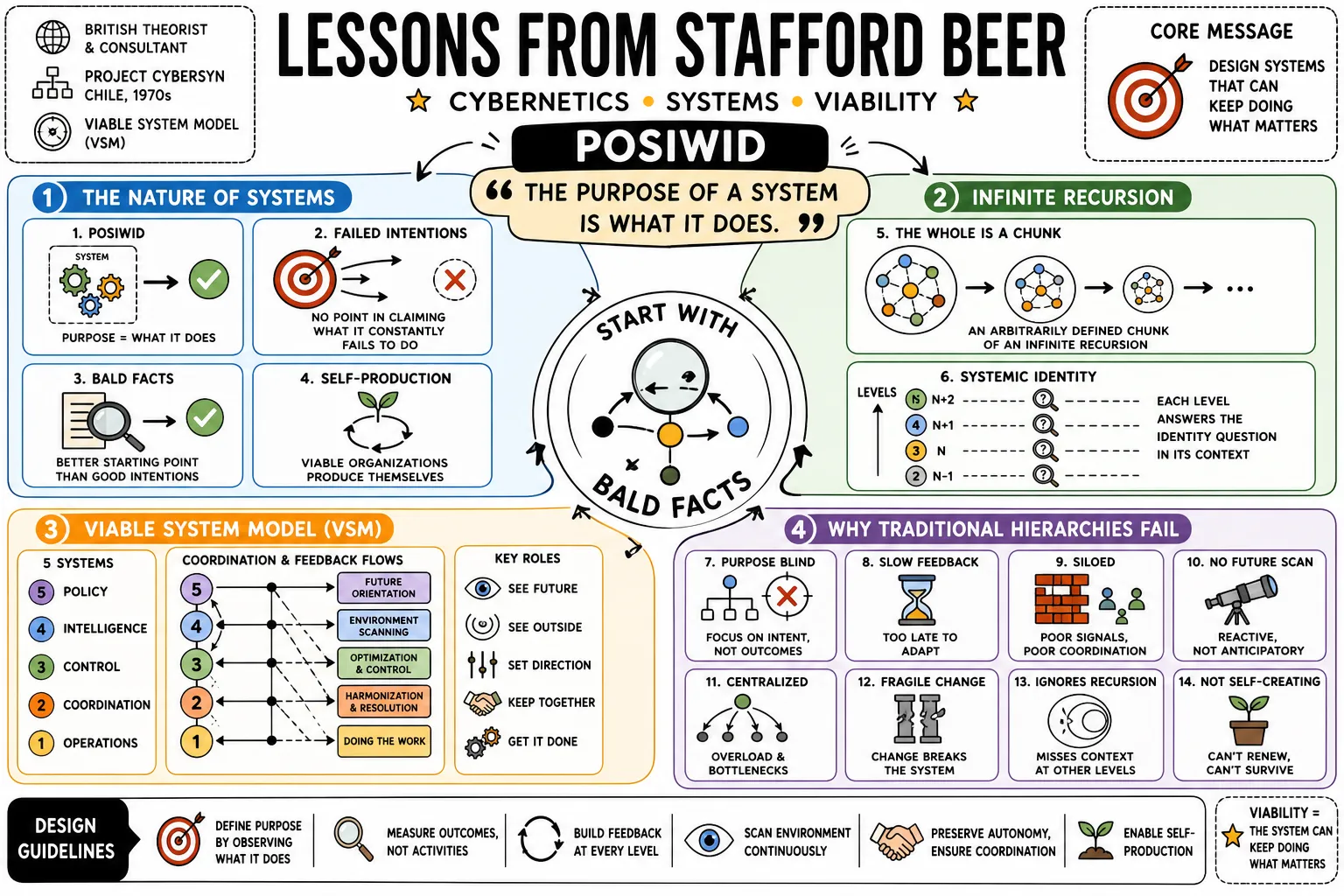
Stafford Beer was a British theorist and management consultant who applied cybernetics to organizational design, developing the Viable System Model and Chile's Project Cybersyn economic network. He coined POSIWID, establishing the rule that the purpose of any system is strictly what it does. This collection outlines his mechanics for structural autonomy and explains why traditional hierarchies fail.
Part 1: The Nature of Systems
- On POSIWID: "The purpose of a system is what it does." — Source: [Wikipedia]
- On failed intentions: "There is after all, no point in claiming that the purpose of a system is to do what it constantly fails to do." — Source: [Goodreads]
- On bald facts: "According to the cybernetician, the purpose of a system is what it does. This is a basic dictum. It stands for bald fact, which makes a better starting point in seeking understanding than the familiar attributions of good intention." — Source: [Goodreads]
- On self-production: "Viable organizations produce themselves." — Source: [Wikipedia]
- On infinite recursion: "The whole is simply an arbitrarily defined chunk of an infinite recursion." — Source: [Block Science]
- On systemic identity: "Each level of recursion is likely to answer the identity question differently." — Source: [Systems Thinking Alliance]
- On the illusion of boundaries: "A system is not something presented to the observer, it is something recognized by him." — Source: [ToolsHero]
- On structure and behavior: "The output of a complex probabilistic system is a function of a self-regulating, self-organizing organization in which regulatory power is not vested in a 'controller' but in the structure of that organization itself." — Source: [Syscoi]
- On systemic limits: "Every system, however large, is part of another system, which means there are always constraints placed upon it from the outside." — Source: [LibQuotes]
- On systemic design: "A system is defined by its boundaries, and those boundaries are set by the observer based on what they wish to understand or control." — Source: [Kybernetik]
Part 2: Cybernetics and Management
- On the definition of management: "If cybernetics is the science of control, management is the profession of control." — Source: [QuoteFancy]
- On the core functions: "Policy-making, decision-taking, and control: These are the three functions of management that have intellectual content." — Source: [ToolsHero]
- On probabilistic results: "A stochastic process is about the results of convolving probabilities—which is just what management is about, as well." — Source: [LibQuotes]
- On the fallacy of organizational charts: "The typical organization chart... is a mere instrument for discovering who is to blame." — Source: [Kybernetik]
- On dynamic control: "Instead of trying to specify it in full detail, you specify it only somewhat. You then ride on the dynamics of the system in the direction you want to go." — Source: [More Dark Than Shark]
- On true centralization: "No viable organism is either centralized or decentralized. It is both things at once, in different dimensions." — Source: [Block Science]
- On handling management problems: "Management problems are not respecters of the company organization, nor of the talents of the people appointed to solve them." — Source: [LibQuotes]
- On robustness: "Certain management policies—stretching of credit resources, for example—may lead to great progress in good conditions; but, like the Grand Prix car in comparison with the Land Rover, they may not be robust enough to survive when the going gets tough." — Source: [ToolsHero]
- On homeostasis: "Homeostasis is the property of a system that regulates its internal environment and tends to maintain a stable, constant condition." — Source: [Wikipedia]
Part 3: The Viable System Model
- On recursive architecture: "In a recursive organizational structure any viable system contains, and is contained in, a viable system." — Source: [Wikipedia]
- On operational autonomy: "System 1 units must be granted the maximum possible autonomy so that they can effectively handle the variety of their local environments." — Source: [Systems Thinking Alliance]
- On conflict resolution: "The purpose of System 2 is to dampen oscillations and coordinate the activities of System 1 units so they do not destabilize each other." — Source: [Umbrex]
- On synergy: "System 3 operates in the 'here and now,' ensuring that the operational units work together to achieve synergy, making the whole greater than the sum of its parts." — Source: [ScienceOpen]
- On future planning: "System 4 is concerned with the 'outside and then,' scanning the environment to identify threats and opportunities that require the organization to adapt." — Source: [Umbrex]
- On organizational identity: "System 5 defines the ethos, identity, and ultimate direction of the enterprise, acting as the final arbiter between the demands of the present and the future." — Source: [ScienceOpen]
- On systemic failure: "An organization fails when its subsystems become disconnected or when one system dominates the others at the expense of overall viability." — Source: [Systems Thinking Alliance]
- On self-awareness: "For a system to be viable, it must possess a model of itself within its own intelligence gathering mechanism." — Source: [Goodreads]
- On continuous adaptation: "Viability is not a state that is achieved once and for all; it is a continuous process of adaptation to a changing environment." — Source: [ToolsHero]
- On biological inspiration: "The Viable System Model is mapped onto the neurophysiological structure of the human nervous system, which has proven its resilience over millions of years." — Source: [Wikipedia]
Part 4: Information and Variety
- On Ashby's Law: "Only variety can absorb variety. A manager cannot control a system more complex than their own capacity to process information." — Source: [Wikipedia)]
- On mastering complexity: "Anyone who fails to master complexity will be overcome by it." — Source: [Kybernetik]
- On information overload: "The problem with modern management is not a lack of information, but a lack of structural capability to filter and process the relevant variety." — Source: [Goodreads]
- On attenuation: "To manage a highly complex environment, an organization must build attenuators that filter out irrelevant environmental variety before it overwhelms the system." — Source: [Systems Thinking Alliance]
- On amplification: "Management must amplify its own regulatory variety to match the complexity of the operational units it governs." — Source: [ScienceOpen]
- On necessary obscurity: "It is terribly important to appreciate that some things remain obscure to the bitter end." — Source: [ToolsHero]
- On the danger of detail: "Too close a view may interfere with one's grasp of an overall problem or concept." — Source: [ToolsHero]
- On structural feedback: "Feedback must be immediate and structurally integrated into the system, not delayed by bureaucratic reporting cycles." — Source: [Syscoi]
- On measuring variety: "Variety is not a measure of what is happening, but a measure of the number of possible states a system can exhibit." — Source: [Kybernetik]
Part 5: Project Cybersyn
- On taking the job in Chile: "When Fernando Flores invited me to help redesign the Chilean economy using cybernetics, I realized it was the opportunity of a lifetime." — Source: [Blogspot]
- On real-time governance: "A nation cannot be managed on data that is six months old; governance requires a real-time nervous system." — Source: [Wikipedia]
- On the Ops Room design: "The operations room was designed without keyboards to prevent ministers from feeling like clerks, allowing them to interact directly with the economic data." — Source: [Jarango]
- On worker empowerment: "Cybersyn was fundamentally different from Soviet central planning; it was designed to maximize factory-level autonomy, intervening only when local systems could not cope." — Source: [Wikipedia]
- On management by exception: "The central government should only be alerted if a factory’s performance deviated significantly from its own predicted normal range." — Source: [ScienceOpen]
- On destroying bureaucracy: "I can see no way of practical change that does not very quickly damage the Chilean bureaucracy beyond repair." — Source: [Goodreads]
- On the algedonic loop: "The algidometer was proposed as a direct democratic feedback loop, allowing citizens to transmit their level of social satisfaction or pain directly to the state in real time." — Source: [Wikipedia]
- On economic models: "Raising interest rates is voo-doo. You can't deal with a global system problem by trying to solve it with this." — Source: [Goodreads]
- On the tragic end of Cybersyn: "The military coup in Chile destroyed not just a government, but an unprecedented experiment in using technology for democratic economic management." — Source: [Blogspot]
Part 6: Freedom and Institutional Change
- On designing freedom: "Freedom is not the absence of regulation, but the output of a properly designed system that allows for individual autonomy within a stable whole." — Source: [The Ice Machine]
- On technological stagnation: "We insist on retaining the original structures and automating them. In so doing, we enshrine in steel, glass, and semiconductors those very limitations of hand, eye, and brain that the computer was invented precisely to transcend." — Source: [LibQuotes]
- On the obsolete mind: "Man is a prisoner of his own thinking and his own stereotype of himself. His machine for thinking, the brain, has been programmed to deal with a vanished world." — Source: [World Government House]
- On systemic emancipation: "Work, in its most civilized form, should enrich, empower, and emancipate." — Source: [Wikiquote]
- On resisting change: "Every time we hear that a proposal will destroy society as we know it, we should have the courage to say: 'Thank God; at last.'" — Source: [Goodreads]
- On paradigm shifts: "If you want to create a change, you must challenge not only the models of Unreality, but the paradigms that underwrite them." — Source: [Goodreads]
- On outliving our institutions: "The institutions of government, education, and law were designed for a world that no longer exists and are fundamentally incapable of handling modern complexity." — Source: [Syscoi]
- On the necessity of new tools: "Given all this new technology, we need new institutions for handling it, rather than trying to retrofit it into archaic structures." — Source: [Wikiquote]
- On personal accountability: "I will do it, or I know who can." — Source: [Goodreads]
- On true liberty: "A viable system grants its constituent parts the maximum possible freedom, because only through distributed autonomy can a complex organism survive." — Source: [Systems Thinking Alliance]
Part 7: Team Syntegrity and Consensus
- On collective synergy: "Reverberation in a closed system results in synergy." — Source: [Metaphorum]
- On geometric thinking: "Team Syntegrity uses the geometry of an icosahedron to structure conversations so that information reverberates and leads to consensus without a central authority." — Source: [Metaphorum]
- On group intelligence: "It operates as if a large group of people formed a single, healthily operating brain." — Source: [United Diversity]
- On heterogeneous problem-solving: "Team Syntegrity will create the widest possible understanding and interconnection within a large heterogeneous group to enable a complex, difficult and/or conflict-ridden problem to be solved." — Source: [United Diversity]
- On self-organization in teams: "In Team Syntegrity, we simply developed a framework for self-organization, for creative spontaneity that will generate meaning and purpose." — Source: [Kybernetik]
- On non-hierarchical communication: "Hierarchy restricts information flow; true syntegrity requires a networked communication protocol where ideas compete on merit, not origin." — Source: [Metaphorum]
- On resolving conflict: "Conflict within an organization is often just a symptom of a structural failure to process variety adequately." — Source: [Systems Thinking Alliance]
- On shared models: "A team cannot function effectively unless it shares a common, working model of the environment it is trying to navigate." — Source: [ScienceOpen]
- On the limits of debate: "Debate that does not lead to structural adjustment is merely the dissipation of organizational energy." — Source: [Kybernetik]
Part 8: Eudemony and Language
- On what really matters: "My life is certainly about eudemony: is not yours?" — Source: [Red Wedge Magazine]
- On money as a constraint: "It is for this reason that I have come to see money as a constraint on the behaviour of eudemonic systems, rather than to see eudemony as a by-product of monetary systems." — Source: [Red Wedge Magazine]
- On the illusion of wealth: "Money is nonetheless an epiphenomenon of a system that actually runs on eudemony." — Source: [Red Wedge Magazine]
- On the poverty of language: "To the cybernetician, language is a limiting code in which everything has to be expressed—more's the pity, for the code is not nearly rich enough to cope." — Source: [Goodreads]
- On the utility of models: "A model is neither true nor false; it is more or less useful." — Source: [ToolsHero]
- On mathematical abstraction: "A model is not a load of mathematics... it is simply an account expressed as you will of the actual organization of a real system." — Source: [ToolsHero]
- On institutional reform: "The bureaucratic systems by their very nature cannot promote swift action because delaying tactics dissipate the energy of reform." — Source: [LibQuotes]
- On genuine learning: "Information is what changes us. If we are not changed by a message, it contained no information." — Source: [Systems Thinking Alliance]
- On the ultimate goal: "The goal of cybernetics is not to turn people into machines, but to build machines that allow people to be fully human." — Source: [Wikiquote]