Lessons from Stephen Wolfram
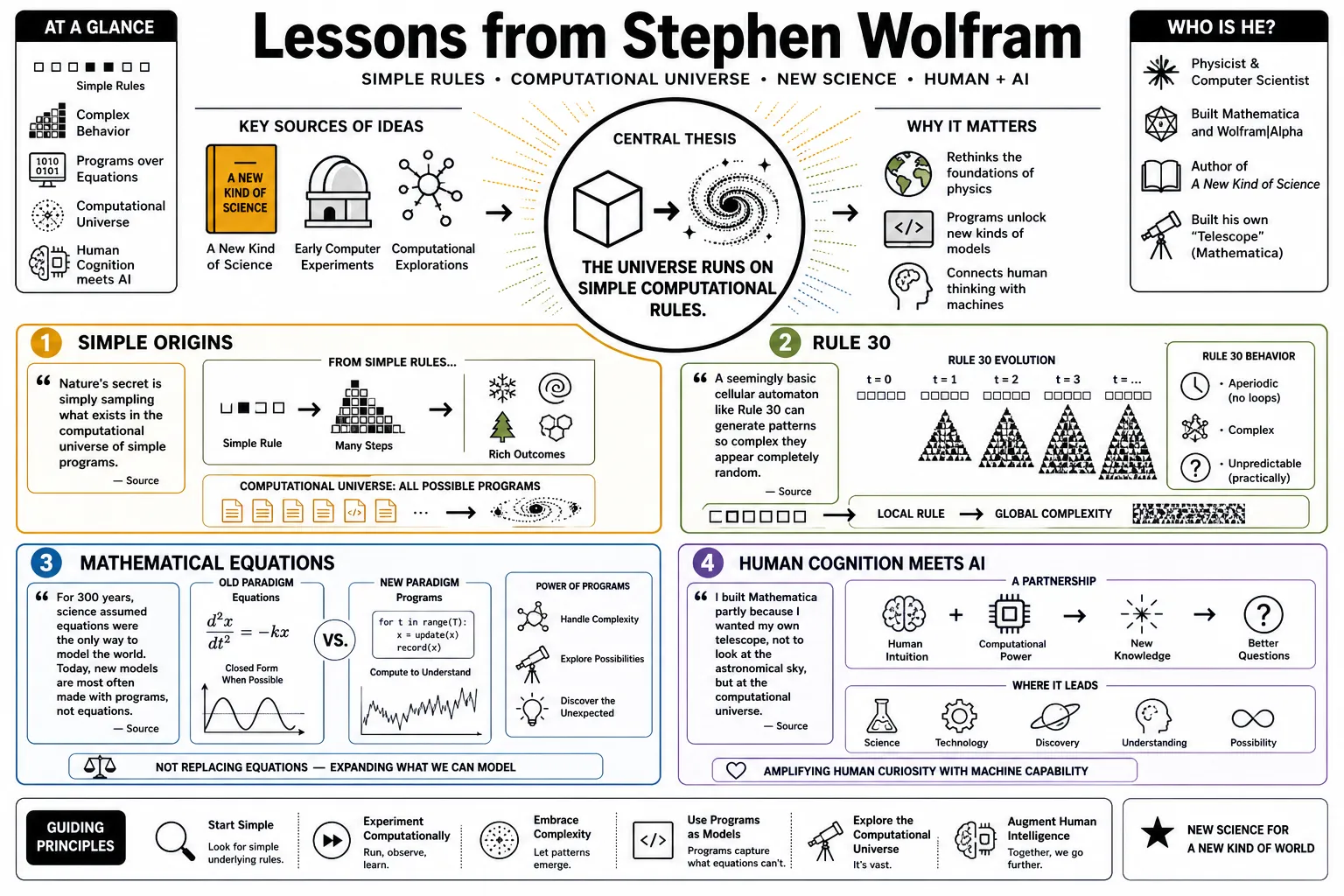
Stephen Wolfram is the physicist and computer scientist who built Mathematica and Wolfram|Alpha. He is best known for arguing in A New Kind of Science that the universe runs on simple computational rules rather than traditional equations. This profile collects his ideas on computational irreducibility, the foundations of physics, and how human cognition intersects with artificial intelligence.
Part 1: Cellular Automata and Simple Rules
- On Simple Origins: "Nature's secret is simply sampling what exists in the computational universe of simple programs." — Source: [A New Kind of Science]
- On the First Experiments: "In the early 1980s, I did computer experiments and realized that complex things can arise from very simple programs." — Source: [Lex Fridman Podcast #124]
- On Rule 30: "A seemingly basic cellular automaton like Rule 30 can generate patterns so complex they appear completely random." — Source: [A New Kind of Science]
- On Mathematical Equations: "For 300 years, science assumed equations were the only way to model the world. Today, new models are most often made with programs, not equations." — Source: [Lex Fridman Podcast #124]
- On the Computational Universe: "I built Mathematica partly because I wanted my own telescope, not to look at the astronomical universe, but at the computational one." — Source: [TED Talk: Computing a Theory of Everything]
- On Nature's Complexity: "It has always seemed a mystery how nature effortlessly produces complexity; it simply executes simple computational rules." — Source: [Goodreads]
- On Discrete Systems: "Cellular automata are discrete dynamical systems with simple construction but complex self-organizing behavior." — Source: [Universality and Complexity in Cellular Automata (1984)90245-8)]
- On Algorithmic Discovery: "The future of science lies in exploring the computational universe of possible algorithms rather than just analyzing the physical universe." — Source: [A New Kind of Science]
- On Universal Computation: "Even the simplest rules in the computational universe can achieve universal computation, capable of performing any algorithmic process." — Source: [A New Kind of Science]
Part 2: The Principle of Computational Equivalence
- On Human Capability: "It is humbling to discover that we, as humans, are computationally no more capable than cellular automata with very simple rules." — Source: [A New Kind of Science]
- On the Universe's Sophistication: "The Principle of Computational Equivalence implies that what goes on inside us achieves the exact same level of computational sophistication as our whole universe." — Source: [Goodreads]
- On Human Significance: "While science has historically made humans seem insignificant compared to the cosmos, computational equivalence shows we operate at the very same computational level as the universe itself." — Source: [Goodreads]
- On Outrunning Nature: "Our brains are doing computations that are equivalent to those in natural systems, meaning we cannot systematically outrun nature's calculations." — Source: [Lex Fridman Podcast #124]
- On Intelligence: "There are no fundamentally dumb or smart computations; past a very low threshold, all complex-seeming computations are equivalent in power." — Source: [A New Kind of Science]
- On the Extension of Gödel: "Computational equivalence is a natural extension of Gödel's incompleteness theorem and Turing's halting problem, pointing to a fundamental limitation in predictive science." — Source: [Lex Fridman Podcast #124]
- On Pancomputationalism: "Everything in the universe, from human brains to gas molecules to weather systems, is ultimately performing computations of equivalent sophistication." — Source: [Lex Fridman Podcast #124]
- On the Illusion of Specialness: "The only thing special about human computation is that it is connected to our specific purposes and our ways of thinking, not that it is fundamentally more powerful." — Source: [Lex Fridman Podcast #124]
- On the Unity of Systems: "Whether we look at mathematics, biology, or physics, we are ultimately looking at computationally equivalent processes." — Source: [A New Kind of Science]
Part 3: Computational Irreducibility
- On Predictive Limits: "Computational irreducibility means there is no mathematical shortcut to predict what a system will do; you just have to run the computation and watch it unfold." — Source: [A New Kind of Science]
- On the Exception of Reducibility: "Reducibility—the ability to predict outcomes with simple formulas—is likely the exception rather than the rule in physical questions." — Source: [Undecidability and Intractability in Theoretical Physics (1985)]
- On Pockets of Reducibility: "Science has historically concentrated on the rare pockets of reducibility where traditional methods allow for successful prediction, like the motion of planets." — Source: [Lex Fridman Podcast #124]
- On Human Survival: "If we want a predictable life, we must deliberately engineer and stay within these limited pockets of computational reducibility." — Source: [Lex Fridman Podcast #124]
- On Unanswerable Questions: "If you pick an arbitrary question about a complex system, it will most likely be irreducible and mathematically unanswerable." — Source: [Lex Fridman Podcast #124]
- On the Value of Simulation: "Because of irreducibility, simulation is not just a convenient tool; it is a fundamental theoretical necessity to know the future of a system." — Source: [A New Kind of Science]
- On the Illusion of Chaos: "What appears as randomness or chaos in nature is often just the unfolding of computationally irreducible processes following deterministic rules." — Source: [A New Kind of Science]
- On Time: "Time is simply the inexorable execution of computationally irreducible steps; it cannot be skipped or bypassed." — Source: [A Project to Find the Fundamental Theory of Physics]
- On Free Will: "Computational irreducibility gives a mechanism for free will; even though the rules of our brain are deterministic, the outcome of our choices cannot be known before we make them." — Source: [A New Kind of Science]
Part 4: The Fundamental Theory of Physics
- On the Base Level of Reality: "Space and time are not continuous; they are emergent properties generated by a vast, evolving network of discrete computational nodes." — Source: [The Wolfram Physics Project]
- On General Relativity and Quantum Mechanics: "People have struggled to unite gravity and quantum mechanics, but at the computational level, they turn out to be exactly the same theory." — Source: [Lex Fridman Podcast #124]
- On the Unifying Rule: "To find the fundamental theory of physics is to reduce the universe to a problem of mathematics, finding a simple rule and running it." — Source: [Lex Fridman Podcast #124]
- On the Speed of Discovery: "I thought it would take a lifetime to figure out the first fraction of a second of the universe, but the computational framework let us get unbelievably much further." — Source: [Lex Fridman Podcast #124]
- On the Core of Modern Physics: "The great pillars of modern physics—general relativity and quantum field theory—are exactly the phenomena that emerge in the computationally reducible slices of these hypergraphs." — Source: [Lex Fridman Podcast #124]
- On the Hypergraph: "The universe is a giant hypergraph being continually rewritten by simple rules, from which everything we know emerges." — Source: [The Wolfram Physics Project]
- On Dimensionality: "Space does not intrinsically have three dimensions; the dimensionality of the universe is an emergent feature of the connectivity of its underlying hypergraph." — Source: [A Project to Find the Fundamental Theory of Physics]
- On the Heat Death of the Universe: "The heat death of the universe isn't simply boring equilibrium; it is an elaborate computation of molecules bouncing around that we currently lack the framework to appreciate." — Source: [Lex Fridman Podcast #124]
- On Scientific Paradigms: "The shift from equations to computations is a fundamental paradigm shift, and pitchforks come out with new paradigms." — Source: [Wikiquote]
- On the Genericity of Physics: "The laws of physics we observe are not finely tuned anomalies, but generic consequences of any sufficiently unstructured underlying computational rule." — Source: [Lex Fridman Podcast #124]
Part 5: The Ruliad and the Observer
- On the Ultimate Abstraction: "The Ruliad is the entangled limit of all possible computations, representing the ultimate theoretical structure of all rules and all possibilities." — Source: [The Concept of the Ruliad]
- On Our Place in the Ruliad: "Our specific universe and its laws are merely a consequence of the specific place we occupy and the specific way we observe the Ruliad." — Source: [The Concept of the Ruliad]
- On Alien Physics: "Extraterrestrial intelligences might perceive entirely different physical laws simply because they are sampling a different part of the Ruliad based on their sensory and cognitive architecture." — Source: [The Concept of the Ruliad]
- On the Observer: "Physics is intimately tied to the observer; without our computationally bounded minds, the universe would just be raw, unresolved computational activity." — Source: [The Wolfram Physics Project]
- On Ruliology: "Understanding the landscape of all possible rules—a field I call ruliology—is as fundamental as studying the physical laws of our specific universe." — Source: [A New Kind of Science]
- On Truth: "In the context of the Ruliad, mathematical truth is not absolute but relative to the computational pathways chosen by the observer." — Source: [The Physicalization of Metamathematics]
- On Human Constraints: "We perceive space and time as continuous and distinct only because our brains have finite computational capacity and process information sequentially." — Source: [The Wolfram Physics Project]
- On the Equivalence of Universes: "There is only one Ruliad. Every possible universe and every possible formal system are ultimately just different ways of looking at this same object." — Source: [The Concept of the Ruliad]
- On the Nature of Mathematics: "Human mathematics is not an arbitrary invention; it is the specific exploration of the Ruliad shaped by our human cognitive constraints." — Source: [The Physicalization of Metamathematics]
Part 6: Artificial Intelligence and Language Models
- On Human Purpose: "What will limit us is not the possible evolution of technology, but the evolution of human purposes." — Source: [Goodreads]
- On What ChatGPT Does: "Underneath, ChatGPT is simply asking: Given the text so far, what is the most likely next word? and estimating those probabilities." — Source: [What Is ChatGPT Doing ... and Why Does It Work?]
- On the Surprise of LLMs: "The fact that predicting the next word generates such coherent logic was a profound scientific surprise, revealing that human language has a much simpler underlying computational structure than we thought." — Source: [What Is ChatGPT Doing ... and Why Does It Work?]
- On Meaning: "Language models don't understand meaning; they trace the computational pathways of syntax and usage that humans have laid down over centuries." — Source: [What Is ChatGPT Doing ... and Why Does It Work?]
- On Computation vs. Language: "AI models are excellent at fluent language but fail at irreducible computation; they need external tools, like Wolfram|Alpha, to compute factual, structured logic." — Source: [ChatGPT Gets Its “Wolfram Superpowers”]
- On Computational Language: "The goal of the Wolfram Language is to create a computational language that allows humans and AI to communicate structured, actionable ideas to machines." — Source: [Stephen Wolfram Writings]
- On the Alignment Problem: "You cannot mathematically prove that an AI will behave well, because of computational irreducibility; you can only guide its purpose." — Source: [Stephen Wolfram Writings]
- On the Future of Programming: "Traditional coding will become less relevant; the future is about defining goals in computational language and letting AI generate the lower-level execution." — Source: [Stephen Wolfram Writings]
- On Artificial General Intelligence: "AGI is not a distinct threshold. Intelligence is just computation, and computation is everywhere; AGI is just computation aligned with human-like tasks." — Source: [A New Kind of Science]
Part 7: Tool-Building and the Wolfram Language
- On Building Tools for Oneself: "I built Mathematica because I wanted to use it myself, much like Galileo built a telescope to see what was out there." — Source: [TED Talk: Computing a Theory of Everything]
- On Defining Paradigms: "The tools we build shape the paradigms we can conceive. Mathematica wasn't just software; it was a way to think differently about mathematics and logic." — Source: [Stephen Wolfram Writings]
- On the Effort of Design: "Good language design is extraordinarily difficult; it requires boiling down vast amounts of human knowledge into clean, simple, computational primitives." — Source: [Stephen Wolfram Writings]
- On Automation: "The history of technology is the history of automating tasks. The Wolfram Language aims to automate the process of translating human thought into computational reality." — Source: [Stephen Wolfram Writings]
- On Wolfram|Alpha: "We built Wolfram|Alpha to make the world's knowledge computable, turning static data into dynamic answers." — Source: [Wolfram|Alpha Blog]
- On the Longevity of Code: "If you design a language based on fundamental principles rather than fleeting hardware constraints, the code will remain valid and useful decades later." — Source: [Stephen Wolfram Writings]
- On the Role of the Creator: "To maintain the vision of a complex system like a programming language over decades requires a single, coherent design philosophy, not a committee." — Source: [Lex Fridman Podcast #124]
- On Computable Contracts: "In the future, legal and societal agreements will be written in computational language, allowing them to be automatically verified and executed." — Source: [Stephen Wolfram Writings]
- On the Tower of Abstraction: "Civilization advances by building towers of abstraction. We no longer worry about assembly code; we build on top of computational language." — Source: [Stephen Wolfram Writings]
- On Integrating Knowledge: "A computational language must contain intrinsic knowledge about the real world—cities, chemicals, geometry—not just abstract programming constructs." — Source: [Stephen Wolfram Writings]
Part 8: Productivity, Life, and Discovery
- On Committee Science: "It is far easier for one person to have a crisp, paradigm-shifting idea than it is for a large committee to reach consensus on one." — Source: [Lex Fridman Podcast #124]
- On Timing: "It frequently happens that you have a great idea, but the ambient world isn't ready for it, making it incredibly hard to gain traction." — Source: [Lex Fridman Podcast #124]
- On Productivity Analytics: "I have obsessively logged every keystroke, email, and meeting for decades because measuring your life reveals the structural rhythms of your work." — Source: [The Personal Analytics of My Life]
- On Figuring Stuff Out: "My core philosophy and primary methodology across all fields—from physics to software—is simply sitting down and figuring stuff out." — Source: [Guy Kawasaki's Remarkable People Podcast]
- On Drilling to the Foundations: "To have big ideas, you cannot accept the current surface level of a field; you must drill down to its absolute foundations and question the axioms." — Source: [How to Have Big Ideas]
- On the Value of Outsiders: "Major paradigm shifts often come from outsiders because they bring new tools and are not bound by the institutional inertia of the establishment." — Source: [Stephen Wolfram Writings]
- On Visualizing Data: "Visualization is not just for presentation; looking at the raw, visual output of computer experiments is exactly how the behavior of complex systems was discovered." — Source: [A New Kind of Science]
- On Taking Action: "To maintain high productivity over a lifetime, you must adopt a 'now or never' mindset for capturing ideas and completing tasks." — Source: [Stephen Wolfram Writings]
- On Humility in Science: "If an experiment does not do what you expect, have the humility to realize nature might be doing something deeper, rather than assuming it's an error." — Source: [Stephen Wolfram Writings]
- On a Lifetime of Projects: "The most important thing I have learned is to build tools that compound. Every project should lay the foundation for the next, exponentially increasing what you can achieve." — Source: [Stephen Wolfram Writings]