Steve Blank is an entrepreneur and educator known for creating the Customer Development methodology, which served as the foundation for the Lean Startup movement. By arguing that startups are not simply smaller versions of large companies, he changed how founders approach building businesses, prioritizing early customer feedback over rigid business plans. This compilation gathers his most enduring observations on product-market fit, corporate innovation, and the realities of the founder's journey.
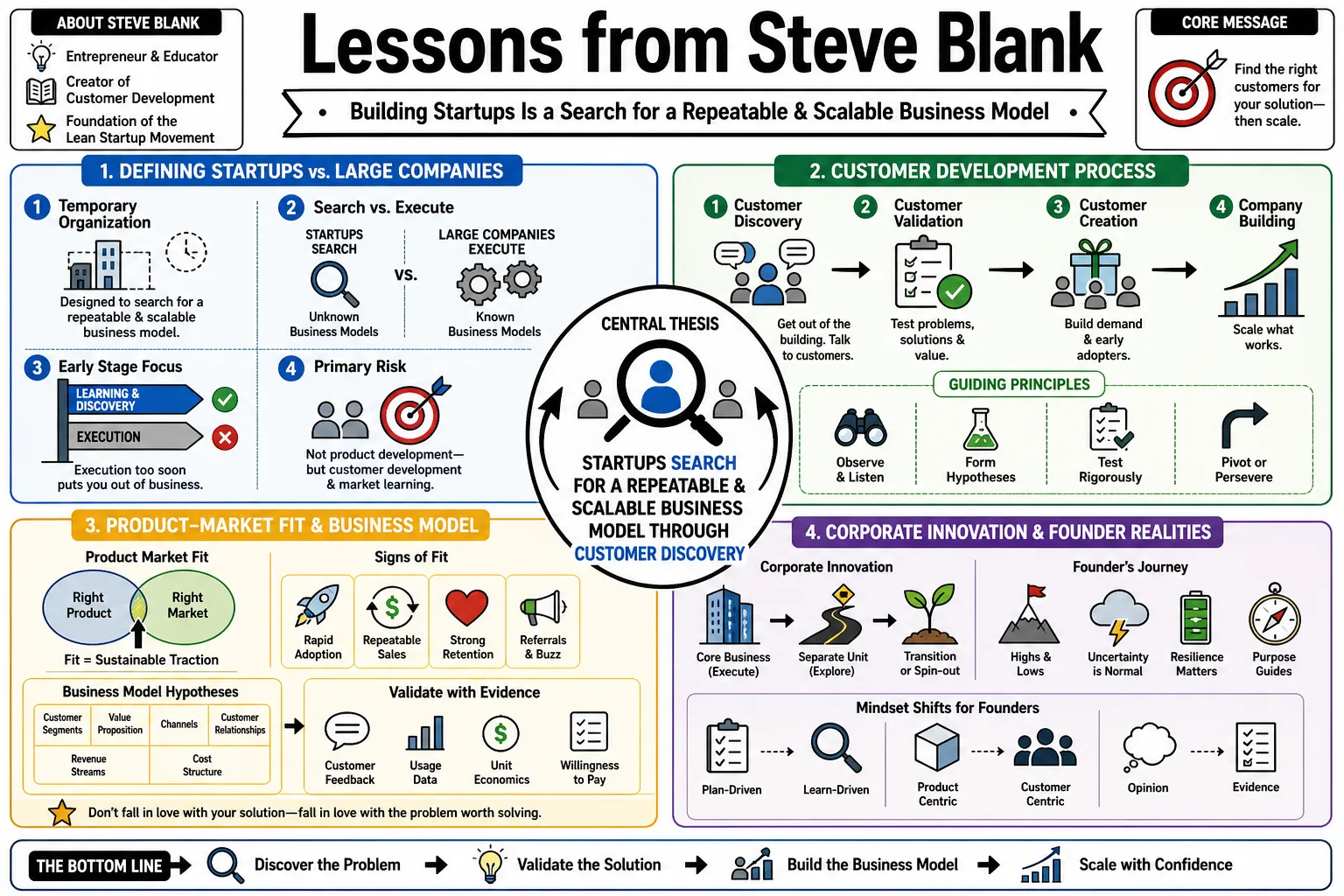
Part 1: Defining Startups vs. Large Companies
- On the nature of a startup: "A startup is a temporary organization designed to search for a repeatable and scalable business model." — Source: QuoteFancy
- On execution vs. search: Blank's core distinction is that startups are not smaller versions of large companies: existing companies execute around known customers and models, while startups need discovery tools for searching and testing before they scale execution. — Reference: Steve Blank books page on startups not being smaller versions of large companies and needing their own tools
- On early-stage focus: "In the early stages of a startup, focusing on 'execution' will put you out of business. Instead, you need a 'learning and discovery' process..." — Source: Goodreads
- On the primary risk: "The greatest risk is not the development of a new product, but the development of customers and markets." — Source: AZQuotes
- On why startups fail: "Startups don't fail because they lack a product; they fail because they lack customers and a profitable business model." — Source: QuoteFancy
- On organizational structure: "In a startup, the founders define the product vision and then use customer discovery to find customers and a market for that vision." — Source: Goodreads
- On the myth of standard management: Traditional management tools that apply to execution in large companies are the wrong tools for startups searching for a model. — Source: Inc. Magazine
- On the goal of a startup: The ultimate objective is to transition from a startup into a functional, professional organization once the business model is proven. — Source: SoBrief
- On premature scaling: The prevailing venture capital 'get big fast' mantra can lead to premature scaling and eventual collapse before a business model is actually found. — Source: Goodreads
- On repeatable paths: "There is a true and repeatable path to success, a path that eliminates or mitigates the most egregious risks and allows the company to grow into a large, successful enterprise." — Source: What Should I Read Next
Part 2: Getting Out of the Building (Customer Development)
- On the most famous rule: "There are no facts inside your building, so get the hell outside." — Source: AZQuotes
- On the reality distortion field: In a startup, no facts exist inside the building, only opinions. — Source: AZQuotes
- On validating assumptions: Because customers and market realities exist outside the office, the only way to validate a business model is to interact directly with potential users. — Source: Innovation Leader
- On the role of guessing: Blank argues that new ventures begin with hypotheses, not validated facts, so teams need to make their guesses explicit and test them instead of treating a business plan as proof. — Reference: Steve Blank on build-measure-learn starting with hypotheses rather than untested ideas
- On the Customer Discovery step: The first step of the process is Customer Discovery, which focuses purely on identifying and understanding the customer's problem. — Source: Bookey
- On Customer Validation: Customer Validation tests whether the proposed product actually solves the problem you discovered. — Source: Medium
- On Customer Creation: Customer Creation is about scaling and driving demand only after the product has been validated. — Source: SoBrief
- On Company Building: Company Building is the final step, where the organization transitions from a discovery-focused startup to an execution-focused enterprise. — Source: SoBrief
- On starting with insight: "Start by asking yourself, 'What insight do I need to move forward?' Then ask, 'What's the simplest test I can run to get it?'" — Source: Goodreads
- On the importance of action: "The world is run by those who show up…not those who wait to be asked." — Source: AZQuotes
Part 3: The Illusion of the Business Plan
- On first contact: "No business plan survives first contact with customers." — Source: Goodreads
- On creative writing: "Unless you have tested the assumptions in your business model first, outside the building, your business plan is just creative writing." — Source: AZQuotes
- On framing hypotheses: Instead of writing a static plan, use a business model canvas to frame hypotheses about your business. — Source: Goodreads
- On the nature of plans: Business plans are composed overwhelmingly of guesses, and relying on them to drive early-stage decisions is insanity. — Source: Steve Blank Blog
- On the strategy of hope: "'Build and they will come' is not a strategy, it's a prayer." — Source: AZQuotes
- On testing assumptions: Success requires testing your business plan's assumptions early and pivoting when those hypotheses inevitably prove incorrect. — Source: VistaPub
- On the irrelevance of opinions: The only opinion that truly matters for product-market fit is the customer's, not the investor's or the founder's initial plan. — Source: Venture Hacks
- On static vs. dynamic environments: A business plan assumes a static environment, whereas a startup operates in a highly dynamic search for a model. — Source: Steve Blank Blog
- On the Lean Startup process: The process replaces the traditional business plan with three parts: the business model canvas, customer development, and agile engineering. — Source: What Should I Read Next
- On the illusion of certainty: Writing a detailed plan provides an illusion of certainty in an environment that is fundamentally uncertain. — Source: Steve Blank Blog
Part 4: Minimum Viable Products and Agile Engineering
- On agile development: Agile engineering works hand-in-hand with customer development to build products efficiently. — Source: PanicOla
- On eliminating waste: Agile development eliminates wasted time and resources by developing the product iteratively rather than in year-long cycles. — Source: PanicOla
- On the birth of Lean: The Lean Startup movement was born when Eric Ries combined the customer development model with the agile method. — Source: Latitud
- On AgileFall: "AgileFall is an ironic term for program management where you try to be agile and lean, but you keep using waterfall development techniques." — Source: Steve Blank Blog
- On building MVPs: Agile engineering is the exact process by which startups create the minimum viable products they need to test with customers. — Source: PanicOla
- On the "First Customer Ship" trap: The product launch date only reflects when the engineering team thinks a release is finished, not when the company actually understands its customers. — Source: Goodreads
- On waterfall vs. agile: Unlike waterfall engineering where things are built one step at a time, agile is about building iteratively and everywhere all at once. — Source: Latitud
- On rapid feedback loops: What matters most is having a tight, fact-based data and metrics feedback loop to help you quickly recognize and reverse incorrect decisions. — Source: Goodreads
- On the purpose of the MVP: The minimum viable product is designed to run disciplined experiments fast enough and cheap enough to discover the truth. — Source: Unusual Ventures
Part 5: Product-Market Fit and Feature Bloat
- On the definition of fit: Product-market fit is fundamentally the match between product features and customer needs. — Source: Medium
- On finding desperate customers: Startups need to find early adopters who are desperate for an alternative outcome, as you cannot artificially manufacture demand. — Source: Unusual Ventures
- On the prerequisite for growth: It is pointless to try to scale or grow without a great offering that you’ve already proven people want, need, and love. — Source: NFX
- On feature bloat: "You tend to collect a list of features that if added, will get one additional customer to buy. Soon you have a 10-page feature list just to sell 10 customers." — Source: Goodreads
- On the goal of a feature list: The ultimate goal is to have a single paragraph feature list that can sell to thousands of customers, rather than a customized list for each individual. — Source: Goodreads
- On the moment of fit: There is no single textbook moment of product-market fit; it is typically characterized by a distinct shift in customer behavior and demand. — Source: Steve Blank Blog
- On discovering the truth: Finding product-market fit is not about guessing right initially, but about running experiments honestly enough to ruthlessly cut what doesn’t work. — Source: Unusual Ventures
- On continuous discovery: Finding a market for a product vision requires ongoing customer discovery, not just a one-time launch. — Source: Goodreads
- On reversing decisions: "My advice was to start a policy of making reversible decisions before anyone left the meeting or the office." — Source: Goodreads
Part 6: Failure, Learning, and the Founder's Journey
- On the romanticization of failure: "Anybody who tells you that failure's good and it's fine to fail, obviously has never done it." — Source: Columbia Business School YouTube clip “Steve Blank: Failure Sucks”
- On learning from failure: "If you're not failing, you're not learning fast enough... On the other hand, if you're not learning anything out of it, it's an indication of stupidity." — Source: Guy Kawasaki
- On the term for a failed entrepreneur: In a healthy entrepreneurial culture like Silicon Valley, a failed entrepreneur is simply called "experienced." — Source: Startup Istanbul
- On the emotional stages of failure: The journey of failure mirrors grief, moving through Shock and Surprise, Denial, Anger and Blame, Depression, Acceptance, and Insight and Change. — Source: Steve Blank Blog
- On firing hypotheses: If a test fails, the founder should "fire the hypothesis," rather than necessarily firing the team. — Source: WikiQuote
- On rapid failure: Founders should not aim for failure itself, but rather for rapid, low-cost pass/fail tests that accelerate learning. — Source: Guy Kawasaki
- On the necessity of forward momentum: "In a startup, it doesn't matter if you're 100 percent right 100 percent of the time. What matters is having forward momentum..." — Source: Goodreads
- On founders as artists: "Founders are truly artists—they see something no one else does." — Source: WikiQuote
- On the nature of the job: "Entrepreneurship is an art, not a job." — Source: WikiQuote
Part 7: Corporate Innovation and "Innovation Theater"
- On execution vs. innovation: "Execution pays your salary. Innovation pays your pension." — Source: Medium
- On defining innovation theater: Innovation theater occurs when corporate innovation activities prioritize optics but deliver few or no tangible results. — Source: SolvInnov
- On the symptoms of theater: Blank warns that innovation theater produces visible activity, awards, demos, coffee cups, and posters, but disappoints when judged against mission or operating-group outcomes over time. — Reference: Steve Blank on innovation programs producing coffee cups and posters without mission deliverables
- On corporate incubators: While fashionable to build corporate incubators, there is little evidence they deliver more than theater if the internal culture still applies traditional execution metrics to them. — Source: Forbes
- On structural conflict: Large companies are designed for efficiency and predictability, which fundamentally conflicts with the discovery and pivoting required for true innovation. — Source: Forbes
- On the litmus test for innovation: The ultimate test for whether an organization is truly innovating is whether its new ideas are actually being adopted and delivered to customers. — Source: Innovation Leader
- On visionary leadership: "Visionary CEOs are not 'just' great at assuring world-class execution... they are also world-class innovators." — Source: What Should I Read Next
- On corporate culture: Corporate innovation is not simply the sum of smart people or key acquisitions; it requires a culture that actually matches and supports it. — Source: What Should I Read Next
- On strategy and ego: "Confusing testosterone with strategy is a bad idea." — Source: WikiQuote
Part 8: Mission-Driven Entrepreneurship and Venture Capital
- On mission-driven work: "Mission-driven entrepreneurship is the answer to students who say, 'I want to give back... while solving some of the toughest problems.'" — Source: Medium
- On mission achievement: In programs like Hacking for Defense, success is not measured by revenue, but by "Mission Achievement"—delivering value to the end beneficiary in a mission-driven organization. — Source: SquareSpace
- On defense innovation: The traditional defense acquisition model is over-optimized for perfect performance at the expense of providing timely, necessary capabilities to the warfighter. — Source: Army.mil
- On the purpose of service: "My interest in starting Hacking for Defense was rooted in my long belief in service — not just paying taxes or voting, but actual service." — Source: Medium
- On the relationship with VCs: "VCs Are Not Your Friends"—founders must remember that the relationship with venture capitalists is fundamentally professional and transactional. — Source: Steve Blank Blog
- On VC incentives: Founders often mistakenly assume VCs want to build profitable companies, when their actual business model is to invest in markets that make the most money for their limited partners. — Source: Steve Blank Blog
- On the decoupling of capital: While venture capital and national interests were once somewhat aligned, today the industry is completely decoupled and designed strictly to optimize investor returns. — Source: Guy Kawasaki
- On the necessity of belief: You cannot convince investors, customers, or your team to join you unless you are building something you genuinely believe will change the world. — Source: AZQuotes
- On the true demo day: Unlike a traditional shark tank, a real lessons-learned presentation tells the story of a hard-won journey where you discover that everything you thought you knew on day one was wrong. — Source: Substack