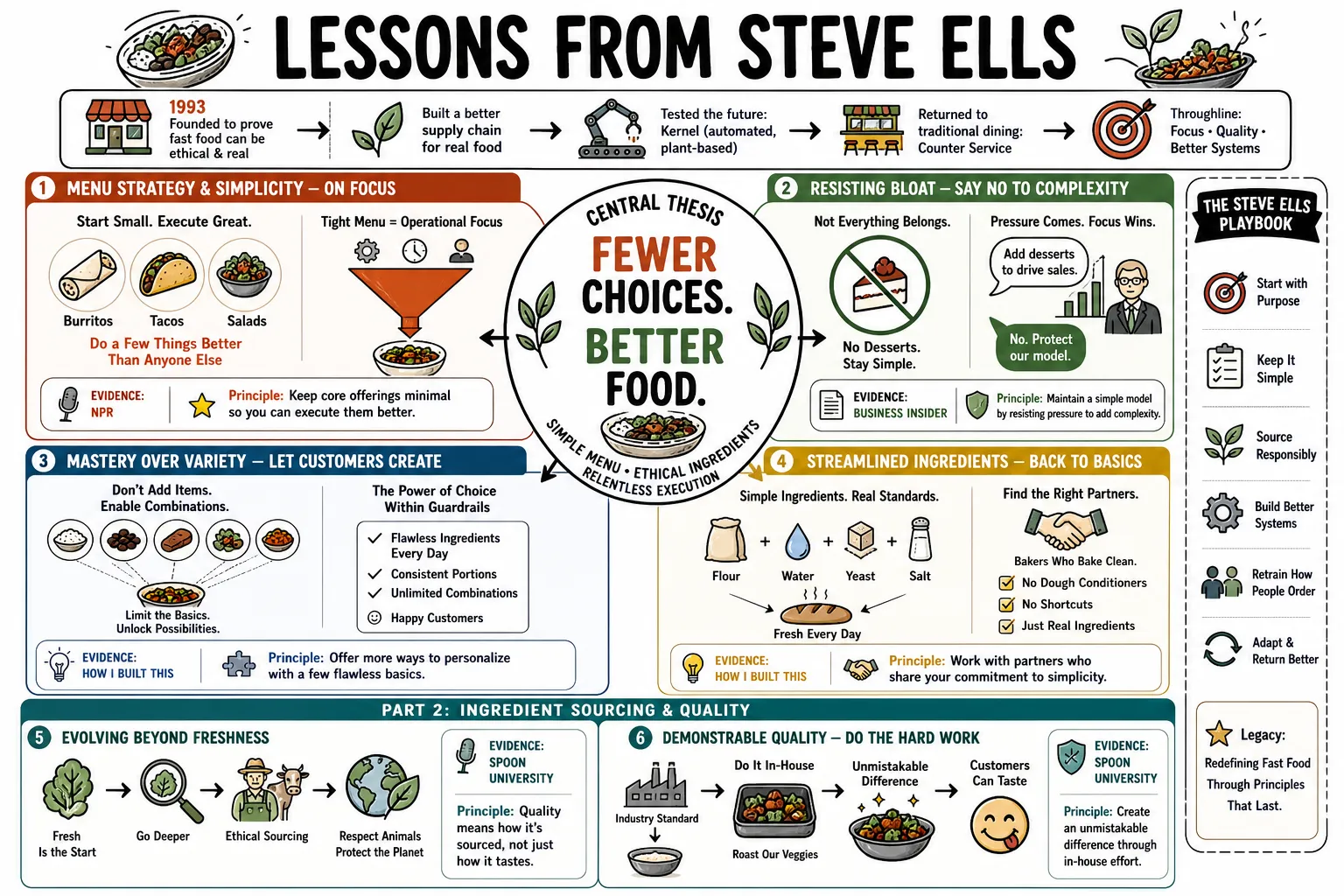
Steve Ells founded Chipotle in 1993 to prove that fast food could run on ethically sourced ingredients and classic cooking techniques. He spent decades figuring out how to scale fresh food production, testing the automated, plant-based startup Kernel before returning to traditional dining with Counter Service. His career is defined by keeping menus tight, overhauling supply chains, and retraining how people order their food.
Part 1: Menu Strategy & Simplicity
- On Focus: Keep your core offerings minimal so you can execute them better than anyone else, a principle that drove the decision to limit the initial menu to just burritos, tacos, and salads. — Reference: NPR
- On Resisting Bloat: Maintaining a simple operational model means rejecting outside pressure to add complexity, such as refusing to introduce desserts despite persistent advice from financial analysts. — Reference: Business Insider
- On Mastery over Variety: When pushed to offer more choices, let customers create their own combinations from a few flawless basics rather than expanding the foundational menu. — Reference: How I Built This
- On Streamlined Ingredients: Bread does not need dough conditioners. A commitment to simplicity means finding partners who can bake fresh products using just flour, water, yeast, and salt every single day. — Reference: How I Built This
Part 2: Ingredient Sourcing & Quality
- On Evolving Beyond Freshness: Serving fresh food is not a complete solution; a true commitment to quality requires sourcing ingredients from farmers who respect animal welfare and the environment. — Reference: Spoon University
- On Demonstrable Quality: Make sure there is an unmistakable difference between standard industry offerings and your own by doing the hard work in-house, such as roasting your own vegetables, squeezing fresh citrus, and chopping fresh herbs. — Reference: How I Built This
- On Financial Commitment to Values: Upholding high sourcing standards requires directing an unusually large share of restaurant economics toward better ingredients instead of optimizing only for immediate margin. — Reference: Spoon University
- On Building Supply, Not Accepting It: When ethical ingredients are scarce, a growing restaurant can guarantee demand and help more farmers adopt better methods instead of quietly reverting to conventional supply. — Reference: The Guardian
- On Scaling Through Partners: Chipotle's demand for naturally raised pork initially grew alongside Niman Ranch's farmer network, showing that purchasing commitments can expand a supplier ecosystem rather than merely consume it. — Reference: The Guardian
- On Transparency as Positioning: Most fast-food brands avoid drawing attention to sourcing. Ells made sourcing visible in the restaurant, accepting scrutiny as the price of making ingredient standards part of the product. — Reference: The Guardian
Part 3: Operational Innovation & Automation
- On Scaling Quality: Mass-producing food doesn't require chemical additives; Chipotle spent years reworking tortilla production so a national chain could use a short ingredient list without standard dough conditioners and preservatives. — Reference: Chipotle Newsroom
- On Strategic Automation: Use robotics to manage workflow, such as picking items from a rack and placing them in an oven, rather than replacing authentic cooking processes that require pots, pans, and cutting boards. — Reference: How I Built This
- On the Human Element in Automation: While robotics can improve kitchen efficiency, relying too heavily on automated assembly can alienate customers who still value human interaction when ordering their food. — Reference: How I Built This
- On Rethinking Concepts: Do not settle for moderate traction when introducing a new business model. If a project lacks explosive growth after a year, be prepared to close it down and pivot. — Reference: How I Built This
- On Preserving the Thesis Through a Pivot: A failed operating format does not require abandoning the underlying customer promise. After Kernel's first model stalled, Ells rebuilt it as Counter Service while retaining the focus on minimally processed food cooked from scratch. — Reference: Restaurant Business Online
Part 4: Brand Identity & Storytelling
- On Sense of Place: A product that speaks to its specific origin and environment creates a powerful brand story that stands out in a crowded market. — Reference: How I Built This
- On Specialization: Focus your brand identity on being the absolute best in the world at one particular thing instead of offering an unfocused, broad product line to capture more customers. — Reference: How I Built This
- On Packaging as Storyteller: Do not hide the manual labor and unique sourcing that goes into your product. Attach booklets or explicit tasting notes to the physical packaging so customers understand exactly what they are experiencing. — Reference: How I Built This
- On Authentic Messaging: Avoid traditional corporate marketing campaigns and focus instead on letting the genuine story of the product, its origin, and the people making it speak for itself. — Reference: How I Built This
Part 5: Customer Education & Experience
- On Changing Behavior: If you are introducing a completely new operational model, you must be prepared to manually lead customers through the process until it becomes standard behavior. — Reference: How I Built This
- On Cultivating Advocates: Building a new category requires forming one-on-one relationships with early customers. If you provide a superior, personalized experience, those diners will do the heavy lifting of educating the rest of the market. — Reference: How I Built This
- On the Human Element in Hospitality: Efficient workflows should never fully replace human greetings. Ensuring customers are welcomed and taken care of by actual people remains a fundamental part of the dining experience. — Reference: How I Built This
- On Strategic Partnerships: Find well-known experts in your industry, such as respected chefs, and partner with them to feature your product. Educating them on your story allows them to authentically promote it to their own audiences. — Reference: How I Built This
Part 6: Founder Psychology & Leadership
- On Unrelenting Focus: Building a category-defining business often demands an initial period of absolute focus, where you work morning to night without taking any days off except major holidays. — Reference: How I Built This
- On the Cost of Insularity: While obsessive dedication contributes to early success, becoming too insular can prevent you from seeing a broader perspective that might accelerate growth even further. — Reference: How I Built This
- On Finding Balance: In retrospect, integrating time for friends, family, and personal reflection into a demanding schedule is a necessary component for long-term strategic clarity rather than a distraction from business. — Reference: How I Built This
- On Commercial Realities: If a business has a strong humanitarian mission, you must still build a sustainable economic model first by targeting premium consumers before you can afford to give products away or scale your social impact. — Reference: How I Built This
- On Refusing Hidden Tradeoffs: After seeing how factory farming worked, Ells decided that Chipotle's success could not depend on practices he considered harmful to animals and the environment. Growth principles matter most when they constrain what the company is willing to profit from. — Reference: University of Colorado Boulder