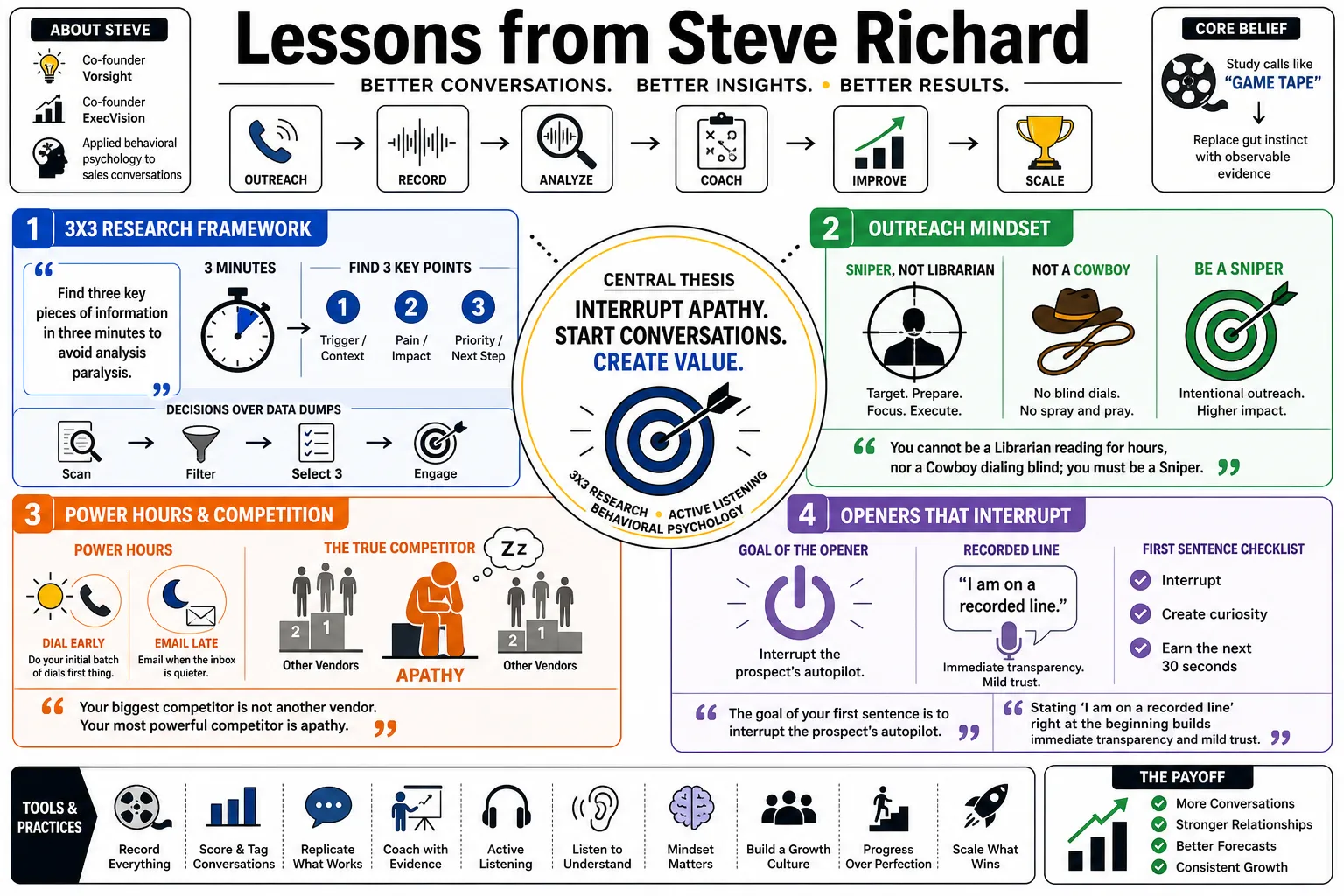
Lessons from Steve Richard
Steve Richard co-founded Vorsight and ExecVision, pushing sales managers to abandon gut instinct and start studying call recordings like "game tape." He developed the 3x3 research framework and applied behavioral psychology to help reps bypass automatic rejections on cold calls. This profile covers his tactical approaches to conversation intelligence, active listening, and scaling sales development.
Part 1: The Foundations of Cold Calling
- On 3x3 Research: "Find three key pieces of information in three minutes to avoid analysis paralysis." — Source: [ExecVision Archives]
- On outreach styles: "You cannot be a Librarian reading for hours, nor a Cowboy dialing blind; you must be a Sniper." — Source: [Sales Game Changers Podcast]
- On power hours: "Dial early, email late. Do your initial batch of dials first thing before the inbox distracts you." — Source: [Steve Richard on LinkedIn]
- On the true competitor: "Your biggest competitor is not another vendor. Your most powerful competitor is apathy." — Source: [Vorsight Core Principles]
- On the goal of an opener: "The goal of your first sentence is to interrupt the prospect's autopilot." — Source: [ExecVision Archives]
- On recorded lines: "Stating 'I am on a recorded line' right at the beginning builds immediate transparency and mild trust." — Source: [Steve Richard on LinkedIn]
- On utilizing gatekeepers: "Do not treat gatekeepers as blockers. Ask for their help so you avoid embarrassing yourself when you reach the executive." — Source: [Sales Game Changers Podcast]
- On the essence of selling: "The best selling approach feels exactly like helping, because it is." — Source: [ExecVision Archives]
- On cold calling reality: "Salespeople generally perform poorly at prospecting and claim they lack the time for it, which is why systematic processes are required." — Source: [Vorsight Core Principles]
Part 2: The Art of Active Listening
- On the 80/20 rule: "All good communication is a two-way street, but successful reps spend 20 percent of their time talking and 80 percent listening." — Source: [Mediafly Insights]
- On top performer reality: "While extreme listening is the ideal, our data shows top performers in discovery land closer to a 65:35 or 55:45 talk-to-listen ratio." — Source: [ExecVision Archives]
- On deeper intent: "Active listening goes beyond hearing words. It requires trying to understand the thought behind the thought." — Source: [Steve Richard on LinkedIn]
- On silent signals: "Pay as much attention to tone and what the prospect leaves unsaid as you do to their explicit words." — Source: [Sales Game Changers Podcast]
- On questioning cadence: "Do not stack questions. Ask one clear question, shut up, and let the prospect fill the silence." — Source: [Vorsight Core Principles]
- On the fight or flight response: "If you talk excessively, you trigger resistance. If you listen well, you disarm it." — Source: [ExecVision Archives]
- On discovery depth: "The goal of discovery is to provoke the prospect into exploring their own pain rather than running down a checklist." — Source: [Steve Richard on LinkedIn]
- On self-awareness: "Most reps do not realize how much they talk until they hear their own recordings." — Source: [Mediafly Insights]
- On the value of the pause: "A two-second pause after a prospect finishes speaking often yields their most honest insight." — Source: [Sales Game Changers Podcast]
Part 3: Overcoming Resistance and Objections
- On the Because Rule: "Adding the word 'because' to your request significantly increases compliance from gatekeepers and prospects." — Source: [ExecVision Archives]
- On LinkedIn utility: "You are significantly more likely to get an appointment on a cold call if you cite a common LinkedIn group." — Source: [Vorsight Core Principles]
- On BANT evolution: "Traditional qualification falls short. Add 'R' for Risk, focusing on the specific risks of the prospect taking no action." — Source: [Steve Richard on LinkedIn]
- On gamifying rejection: "Incentivize your team based on the number of rejections they receive to desensitize them to the word 'no'." — Source: [Sales Game Changers Podcast]
- On the social surround: "Warm up a cold call by surrounding the prospect first. Engage on LinkedIn or Twitter before picking up the phone." — Source: [Mediafly Insights]
- On handling the brush-off: "When someone says they are busy, acknowledge it immediately rather than arguing for their time." — Source: [ExecVision Archives]
- On typical objections: "Most objections are reflex reactions from a brain operating in autopilot." — Source: [Steve Richard on LinkedIn]
- On early resistance: "Expect resistance early in the call and prepare specific, empathetic pivot statements to handle it smoothly." — Source: [Vorsight Core Principles]
- On unstated objections: "The hardest objection to overcome is the one the prospect never says out loud." — Source: [Sales Game Changers Podcast]
Part 4: Implementing the Game Tape Philosophy
- On the game tape analogy: "Go back and review your game tape. Break it down for what works and how you can improve." — Source: [ExecVision Archives]
- On identifying gaps: "Game tape reveals the performance gap. It shows exactly what your top performers do differently from the middle group." — Source: [Mediafly Insights]
- On the problem with roleplay: "Role-playing in training is insufficient because it cannot replicate the dynamic friction of a live buyer." — Source: [Steve Richard on LinkedIn]
- On Call Camps: "Listening to calls as a team builds a culture where vulnerability and peer learning replace defensiveness." — Source: [Vorsight Core Principles]
- On observable moments: "When reviewing tape, look for the specific, observable moments where the deal was either won or lost." — Source: [ExecVision Archives]
- On self-diagnosis: "When reps hear themselves on a call, they realize their own flaws. They believe themselves far more than they believe a manager." — Source: [Sales Game Changers Podcast]
- On specific focus: "Focus on one thing at a time when reviewing tape. Find one thing that works and drill it." — Source: [Mediafly Insights]
- On continuous review: "Reviewing tape should never be an event. It needs to be a continuous habit built into the weekly cadence." — Source: [Steve Richard on LinkedIn]
- On eliminating blind spots: "Everyone has a blind spot in their pitch. Game tape is the only objective mirror." — Source: [ExecVision Archives]
- On manager alignment: "Managers must score calls using the same criteria as the reps to ensure alignment on what good execution looks like." — Source: [Vorsight Core Principles]
Part 5: Coaching Beyond the Classroom
- On coaching vs. training: "Training is an event. Coaching is a continuous process of behavior change." — Source: [ExecVision Archives]
- On the Observe step: "Before giving feedback, managers must listen to the call objectively without projecting their own assumptions." — Source: [Steve Richard on LinkedIn]
- On the Describe step: "State exactly what happened temporally, such as 'At minute four, you interrupted', rather than offering subjective critiques." — Source: [Mediafly Insights]
- On the Prescribe step: "Ask the rep what they could have done differently before prescribing a specific path to mastery." — Source: [Sales Game Changers Podcast]
- On avoiding defensiveness: "The Observe-Describe-Prescribe model prevents triggering the fight or flight reflex in a rep being critiqued." — Source: [Vorsight Core Principles]
- On insight and action: "Insights alone fail to create behavior change. Action has to be taken through accountability." — Source: [ExecVision Archives]
- On professionalizing sales: "Treat sales as a profession rather than an ad hoc skill you are either endowed with or not." — Source: [Steve Richard on LinkedIn]
- On the manager's primary job: "A sales leader's main function is elevating the team's capacity to close, rather than stepping in to close deals for them." — Source: [Mediafly Insights]
- On rep ownership: "You own your own development. If you fail, own it." — Source: [Sales Game Changers Podcast]
- On lifelong schooling: "Sales is the school you never graduate from. There is always a new baseline of mastery." — Source: [ExecVision Archives]
Part 6: Systems for Scaling Sales Teams
- On the DEPTT framework: "Scaling a high-performing team requires aligning DNA, Environment, Performance Management, Training, and Technology." — Source: [Steve Richard on LinkedIn]
- On hiring DNA: "You cannot train innate curiosity and resilience. You must hire for the core DNA first." — Source: [Vorsight Core Principles]
- On leading indicators: "Move beyond quota attainment. Track pipeline velocity and meeting-to-opportunity ratios to predict future success." — Source: [Mediafly Insights]
- On pipeline coverage: "A healthy sales organization maintains a 3-4x pipeline coverage ratio in active, qualified opportunities." — Source: [ExecVision Archives]
- On KPI overload: "Have three to five KPIs tops. You cannot ask a sales team to focus on eight metrics simultaneously." — Source: [Sales Game Changers Podcast]
- On activity metrics: "Track meaningful conversations and conversions rather than raw dial volume." — Source: [Steve Richard on LinkedIn]
- On smart alerts: "Use technology to flag behavioral gaps automatically, such as skipping a pricing discussion or failing to handle an objection." — Source: [Mediafly Insights]
- On the tech stack: "Technology should serve the behavior change, not the other way around." — Source: [ExecVision Archives]
- On team environment: "The physical or digital workspace must foster high energy and continuous peer-to-peer coaching." — Source: [Vorsight Core Principles]
Part 7: Behavioral Psychology in Selling
- On System 1 autopilot: "Most prospects answer cold calls in 'System 1', a fast, emotional, reactive state programmed to say 'not interested'." — Source: [Steve Richard on LinkedIn]
- On triggering System 2: "The purpose of 3x3 research is forcing the prospect's brain to engage 'System 2' logic and pause their reflex." — Source: [ExecVision Archives]
- On hyper-specificity: "A highly specific detail about their industry creates cognitive dissonance with their desire to hang up." — Source: [Sales Game Changers Podcast]
- On cognitive load: "Reduce the prospect's cognitive load by omitting feature dumps so they can focus on their own problem." — Source: [Mediafly Insights]
- On compliance psychology: "Small agreements early in a call build the behavioral momentum needed for larger commitments later." — Source: [Vorsight Core Principles]
- On tone of voice: "Your tone dictates the prospect's emotional state long before they process the meaning of your words." — Source: [Steve Richard on LinkedIn]
- On vulnerability as strength: "Admitting a gap in your own knowledge during a call often builds more trust than feigning expertise." — Source: [ExecVision Archives]
- On mirroring: "Matching the pace and volume of your prospect reduces friction and subconsciously signals alignment." — Source: [Sales Game Changers Podcast]
- On fear of missing out: "Framing your solution around the risk of inaction is often more compelling than the promise of future gain." — Source: [Mediafly Insights]
Part 8: The Culture of Accountability and Growth
- On the definition of culture: "Culture is what people do when no one is watching." — Source: [Steve Richard on LinkedIn]
- On leadership pillars: "Effective sales leadership boils down to two words: Consistency and Accountability." — Source: [ExecVision Archives]
- On the value of losing: "No one remembers the deals they win. They remember the deals they lost." — Source: [Sales Game Changers Podcast]
- On failure as a foundation: "Failure is the foundation of a winning philosophy. If you learn something from it, it was meant to be." — Source: [Mediafly Insights]
- On peer accountability: "The highest performing teams are managed top-down and hold each other accountable laterally." — Source: [Vorsight Core Principles]
- On celebrating the micro-win: "Celebrate the perfectly executed discovery question rather than solely focusing on the closed deal." — Source: [Steve Richard on LinkedIn]
- On removing excuses: "When you provide clear frameworks and transparent game tape, you remove the space for excuses." — Source: [ExecVision Archives]
- On the middle pack: "Your biggest growth lever as a leader is moving your middle 60 percent of performers slightly to the right." — Source: [Sales Game Changers Podcast]
- On leading by example: "A manager who refuses to have their own calls reviewed cannot expect their reps to be vulnerable." — Source: [Mediafly Insights]
- On sustainable growth: "Lasting performance improvement is born from the relentless weekly cadence of coaching, rather than a motivational kickoff." — Source: [ExecVision Archives]