Steven Spielberg is an American film director and producer known for establishing the modern blockbuster and bringing personal themes of childhood, wonder, and broken families into mainstream cinema. Over five decades, he has directed some of the highest-grossing films in history while continually experimenting with genre and visual effects. This collection outlines his approach to visual storytelling, working with actors, and trusting his own anxieties as a compass.
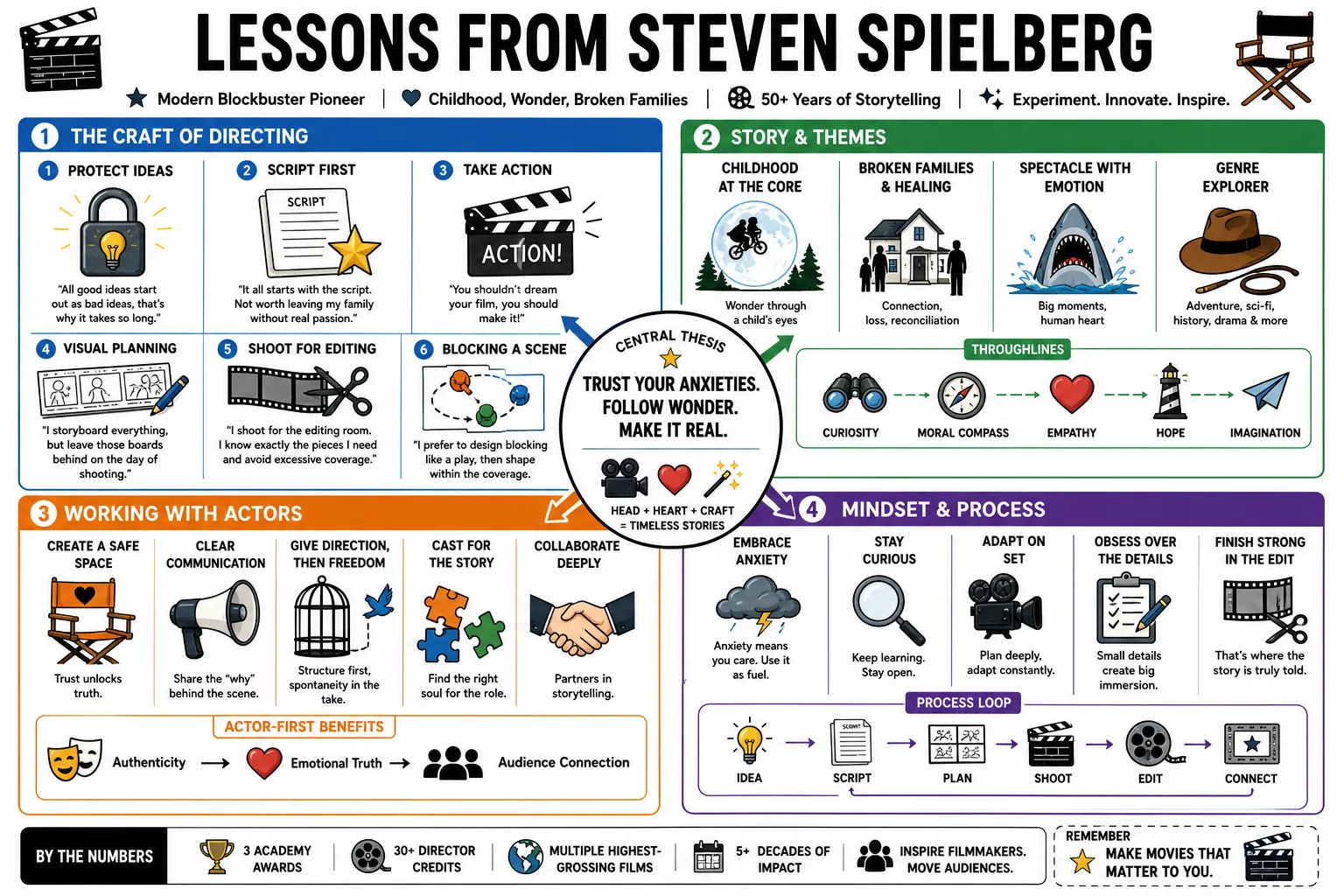
Part 1: The Craft of Directing
- On protecting ideas: "All good ideas start out as bad ideas, that's why it takes so long." — Source: [Empire Magazine]
- On script selection: "It all starts with the script. It's not worth taking myself away from my family if I don't have something I'm really passionate about." — Source: [Chris Jones Blog]
- On taking action: "You shouldn't dream your film, you should make it!" — Source: [No Film School]
- On visual planning: "I storyboard everything, but I often leave those boards behind on the day of shooting to stay open to what happens on set." — Source: [American Cinematographer]
- On editing philosophy: "I shoot for the editing room. I know exactly the pieces I need and generally avoid shooting excessive coverage." — Source: [CineMontage]
- On blocking a scene: "I prefer to design blocking that lets a scene play out in a single unbroken shot, rather than chopping the geography up into close-ups." — Source: [Directors Guild of America]
- On trusting intuition: "I rely heavily on my gut instinct. If I think about a problem too long, I talk myself out of the best solution." — Source: [The Hollywood Reporter]
- On prioritizing narrative: "The most expensive gear in the world cannot save a weak narrative, and your unique voice is your most valuable tool. The dreaming has to come first. Everything else is execution." — Source: [No Film School]
- On movement: "Camera movement must be motivated by the characters. If the camera moves independently of the action, the audience becomes aware of the director." — Source: [Film Comment]
- On adapting constraints: "When the mechanical shark broke on Jaws, we were forced to hide the monster, which made the film infinitely scarier. Constraints force better directing." — Source: [IMDb]
Part 2: Storytelling and Audience Connection
- On narrative structure: "People have forgotten how to tell a story. Stories don't have a middle or an end anymore. They usually have a beginning that never stops beginning." — Source: [Indie Film Hustle]
- On shared experiences: "Through careful manipulation and good storytelling, you can get everybody to clap at the same time, to hopefully laugh at the same time, and to be afraid at the same time." — Source: [Goodreads]
- On subjective interpretation: "You can get an audience to react in unison, but you can't get everybody to interpret the result in the same way. That's thrilling to know, that everybody will see it differently." — Source: [Goodreads]
- On tension vs. surprise: "Tension is giving the audience information the characters do not have, then making them wait for the inevitable." — Source: [Sight & Sound]
- On establishing tone: "The first ten minutes of a film are a contract with the audience. You are teaching them how to watch the rest of the movie." — Source: [Variety]
- On audience fatigue: "I am terrified of boring an audience. The thing that I'm scared to death of is that someday I'm going to wake up and bore somebody with a film." — Source: [QuoteFancy]
- On emotional entry points: "If a story doesn't have a deeply personal core, all the spectacle in the world will feel empty." — Source: [Time Magazine]
- On dialogue: "Good dialogue should sound like characters speaking, not the writer making a point." — Source: [Writers Guild of America]
- On visual exposition: "I always try to find a way to convey information visually before relying on dialogue to explain the plot." — Source: [American Film Institute]
- On testing screenings: "You learn everything about your movie by sitting in the back of a theater and feeling the ambient temperature of a live audience." — Source: [Los Angeles Times]
Part 3: Harnessing Imagination and Childhood
- On a lifetime of dreaming: "I don't dream at night, I dream at day, I dream all day; I'm dreaming for a living." — Source: [No Film School]
- On retaining youth: "I have never felt like an adult. I'm stuck at a certain age, and it allows me to access the wonder I felt when I was young." — Source: [The New York Times]
- On early obsessions: "I get that same queasy, nervous, thrilling feeling every time I go to work. That's never worn off since I was 12 years old with my dad's 8-millimeter movie camera." — Source: [Chris Jones Blog]
- On childhood isolation: "I felt like an alien growing up. Movies were the first place where I felt like I belonged and could communicate with others." — Source: [Failfection]
- On suburban settings: "The suburbs represent a false sense of security. Placing extraordinary events in ordinary neighborhoods makes the fantastical feel real." — Source: [Rolling Stone]
- On facing monsters: "Children are inherently drawn to scary things because surviving the scare gives them a sense of control over their world." — Source: [Vanity Fair]
- On the child's perspective: "I frequently place the camera at a lower height to force the audience to view the world from a child's physical perspective." — Source: [Directors Guild of America]
- On broken homes: "My parents' divorce is the defining trauma of my youth, and I have spent my entire career rewriting that event through my characters." — Source: [HBO]
- On the necessity of play: "You have to maintain a sense of play on set. If it becomes purely technical, the magic drains out of the frame." — Source: [Empire Magazine]
- On trusting the subconscious: "Your intuition is your subconscious speaking to you. You have to learn to listen to that quiet voice." — Source: [Harvard University]
Part 4: Working with Actors and Casting
- On casting as directing: "Casting is eighty percent of my job as a director. If I get the casting right, the rest of the movie tells itself." — Source: [Casting Society of America]
- On rehearsal: "I prefer not to rehearse heavily. I want the actors to discover the emotional truth in front of the lens, not in a rehearsal room." — Source: [Screen Actors Guild]
- On working with children: "When directing kids, you never talk down to them. You talk to them like peers and expect the same level of professionalism." — Source: [Backstage]
- On happy accidents: "You have to leave room on set for accidents. Some of the best moments in cinema are mistakes that an actor stayed in character to fix." — Source: [The Hollywood Reporter]
- On actor preparation: "I want actors to come with strong choices, even if they are completely different from my own preconceptions of the scene." — Source: [Bravo TV]
- On vulnerability: "The director must create a safe environment where an actor feels comfortable failing completely in front of the crew." — Source: [Directors Guild of America]
- On defining characters: "A character is defined by their actions under extreme pressure, not by what they say about themselves in a calm room." — Source: [American Film Institute]
- On giving direction: "The best direction is often a single verb rather than a long psychological explanation." — Source: [Variety]
- On background acting: "The background artists are vital to the reality of the film. If they aren't paying attention, the audience won't either." — Source: [Film Comment]
Part 5: Navigating Fear and Creative Risk
- On the value of fear: "Fear is my primary fuel. The day I walk onto a set and don't feel terrified is the day I need to quit directing." — Source: [Time Magazine]
- On failure: "Failure is inevitable. Success is elusive." — Source: [AZQuotes]
- On accepting outcomes: "Whether in success or in failure, I'm proud of every single movie I've directed." — Source: [No Film School]
- On taking leaps: "If you are completely comfortable with a project, you are probably repeating yourself. You must seek out discomfort." — Source: [The New York Times]
- On critical reception: "You can't let reviews dictate your next move. You have to make movies for yourself and trust that audiences will connect with your sincerity." — Source: [Entertainment Weekly]
- On defying expectations: "After making massive blockbusters, directing Schindler's List was terrifying. I felt entirely unqualified to tell that story, which meant I had to do it." — Source: [USC Shoah Foundation]
- On financial risks: "Every movie feels like a massive financial gamble, but you have to divorce the budget from the creative process while shooting." — Source: [Deadline]
- On overcoming doubt: "Doubt is a normal part of the creative process. The goal isn't to eliminate it, but to learn how to function while experiencing it." — Source: [Los Angeles Times]
- On career valleys: "The valleys in a career are more instructive than the peaks. You learn nothing from a runaway hit, but a flop teaches you exactly where you miscalculated." — Source: [The Hollywood Reporter]
Part 6: The Mechanics of Filmmaking
- On music's role: "John Williams is the co-author of my films. His scores provide the emotional narrative that my visuals can only suggest." — Source: [Classic FM]
- On sound design: "Audiences forgive bad lighting, but they will immediately check out of a film with poor sound design. Sound is half the picture." — Source: [Sound & Vision]
- On practical effects: "Whenever possible, I prefer practical effects on set over digital replacements. Actors perform better when they are reacting to a physical object." — Source: [Wired Magazine]
- On CGI integration: "Computer graphics should be used to enhance reality, not replace it. If the audience is thinking about the effects, the illusion has failed." — Source: [Cinefex]
- On lighting for mood: "Shadow is just as important as light. What you choose to hide in the darkness tells the audience exactly how to feel." — Source: [American Cinematographer]
- On production design: "The production designer is responsible for creating a world that feels lived-in before the camera even rolls. Every prop must have a history." — Source: [Architectural Digest]
- On pacing the edit: "An edit should feel rhythmic, like breathing. If a scene holds a shot too long, the audience feels suffocated." — Source: [CineMontage]
- On the role of producers: "A great producer protects the director from the studio and protects the studio from the director's worst excesses." — Source: [Producers Guild of America]
- On shooting schedules: "A tight schedule forces a director to rely on instinct. Having too much time to shoot a scene usually results in overthinking it." — Source: [Variety]
Part 7: Leadership and Collaboration
- On delegation: "Filmmaking is all about appreciating the talents of the people you surround yourself with and knowing you could never have made any of these films by yourself." — Source: [Chris Jones Blog]
- On partnerships: "I love creating partnerships; I love not having to bear the entire burden of the creative storytelling." — Source: [AZQuotes]
- On mentoring: "The delicate balance of mentoring someone is not creating them in your own image, but giving them the opportunity to create themselves." — Source: [BrainyQuote]
- On hiring crew: "I hire people who are better than I am at their specific jobs, and then I listen to them." — Source: [Directors Guild of America]
- On set culture: "The director sets the tone for the entire crew. If you are anxious and screaming, the crew will be anxious and make mistakes." — Source: [The Hollywood Reporter]
- On conflict resolution: "Disagreements on set should always serve the story, never the ego. If a crew member has a better idea, I steal it immediately." — Source: [American Film Institute]
- On valuing the crew: "Every person carrying a cable or holding a boom mic is essential. A film set operates like a military unit without the violence." — Source: [Empire Magazine]
- On continuous learning: "All of us every single year, we're a different person. I don't think we're the same person all our lives." — Source: [AZQuotes]
- On maintaining vision: "You must collaborate openly while fiercely protecting the core intention of the movie. It is a very difficult balancing act." — Source: [Los Angeles Times]
Part 8: Reflection and Legacy
- On the impact of film: "Cinema has the power to change minds in a way that politics cannot. It creates empathy through shared emotional experience." — Source: [Time Magazine]
- On aging: "As I get older, I find myself drawn to historical subjects because I finally have the patience to understand them." — Source: [The New York Times]
- On self-awareness: "I am fully aware of my limitations as a filmmaker. I rely on my collaborators to fill in the blind spots of my own perspective." — Source: [Directors Guild of America]
- On nostalgia: "Nostalgia is a dangerous trap. You must acknowledge the past, but you cannot allow it to dictate how you create in the present." — Source: [Variety]
- On finding purpose: "The work you do must mean something to you beyond the box office returns, or you will eventually burn out." — Source: [Harvard University]
- On historical responsibility: "When depicting true events, you owe a massive debt to the real people who lived through the trauma. You are no longer just an entertainer; you are a historian." — Source: [USC Shoah Foundation]
- On cinematic evolution: "The medium of film will constantly change through technology, but a well-told story will never become obsolete." — Source: [Wired Magazine]
- On future filmmakers: "I advise young directors to put down their phones, stop watching content, and start observing how people interact in the real world." — Source: [American Film Institute]
- On the ultimate goal: "I just want to leave behind stories that make people feel a little less alone in the dark." — Source: [Entertainment Weekly]