Strauss Zelnick is the CEO of Take-Two Interactive and the founder of the private equity firm Zelnick Media Capital. He is known for steering major entertainment franchises like Grand Theft Auto and advocating for strict operational discipline. This compilation organizes his perspectives on managing creative talent, assessing new technology, and maintaining physical fitness as a foundation for business.
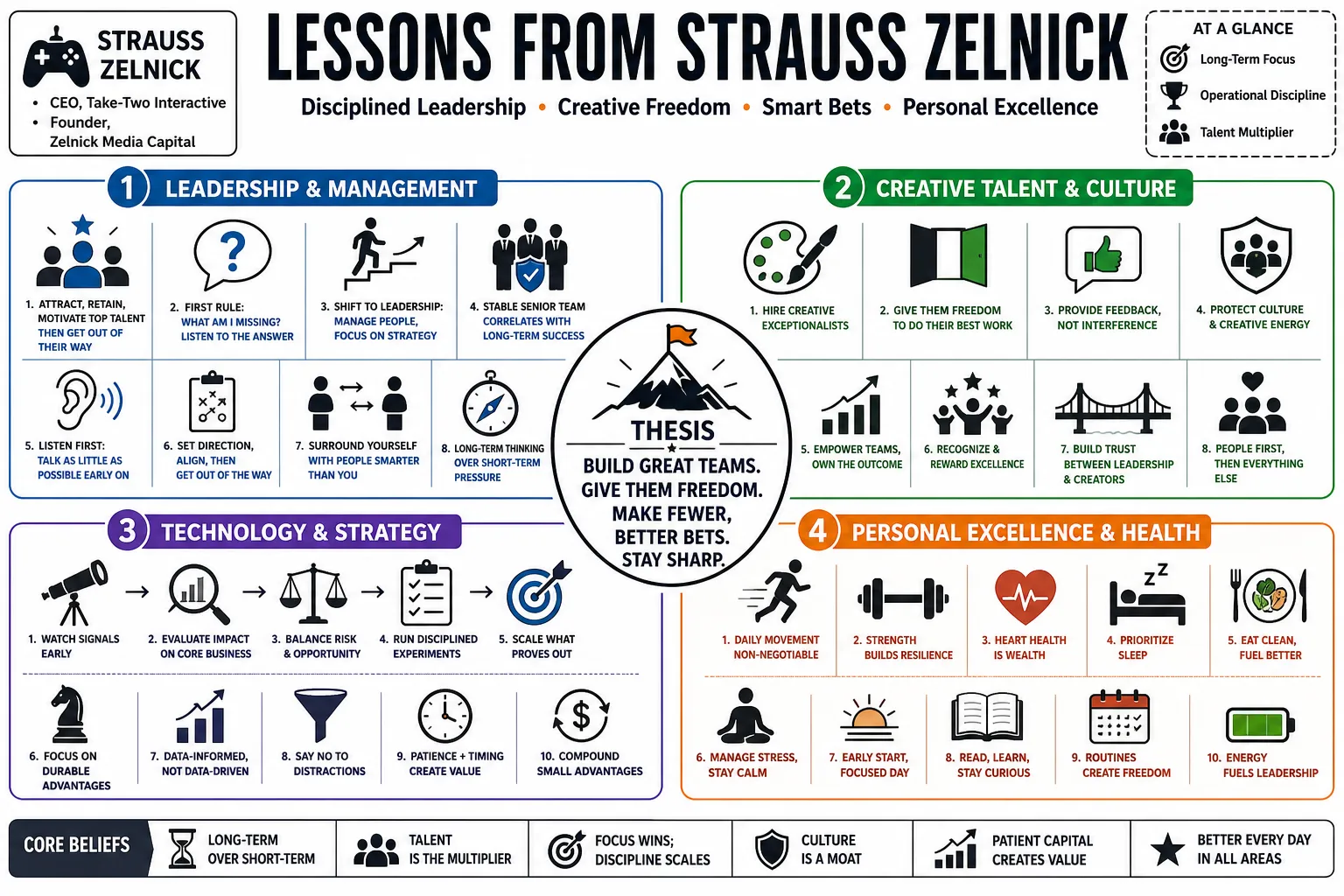
Part 1: Leadership and Management
- On his primary role: "My role is to attract, retain, and motivate the best talent in the business and then get out of their way." — Source: India Times
- On the first rule of decision-making: "Always ask: What am I missing? And listen to the answer." — Source: Meaning Ring
- On transitioning to leadership: "Leave behind the specific skills that made you successful early on; your job now is to manage the people who possess those skills so you can focus on broader strategy." — Source: Best Life Online
- On organizational stability: "The long-term tenure of a senior management team is one of the highest correlates with an entertainment company's success." — Source: GamesIndustry.biz
- On listening: "Talk as little as possible during your first few weeks in a new role; focus entirely on learning from your colleagues to understand the business before acting." — Source: Best Life Online
- On straightforward communication: "I try to show up, honestly, and never mislead people. And if I say I'm gonna do something, I do it. And if I say I'm not going to do something, I don't do it. I don't play games." — Source: Thirty Minute Mentors
- On economic alignment: "In a for-profit enterprise, you have to start by aligning economic incentives. Or all together too many leaders and companies that say nice words about all of us being in this together... and then the spoils are reserved for the boss." — Source: Thirty Minute Mentors
- On creating psychological safety: "It's critical to create a safe place to take risks... because you don't get yelled at if things don't go well. And secondly, we have an underlying financial framework that can survive a failure and live to play another day." — Source: Leaders Mag
- On recommended reading: "Dale Carnegie’s How to Win Friends and Influence People remains a highly effective guide to both leadership and salesmanship." — Source: Most Recommended Books
- On core values: "Most importantly, we aim to do this in a culture of transparency, integrity, high performance and kindness." — Source: Business Wire
Part 2: Corporate Strategy and Value Creation
- On defining business success: "Success is being of service to your customers at scale, and the numbers will flow from that, regardless of whether you're a private company or a public company." — Source: Leaders Mag
- On the intersection of media and tech: "The most reliable long-term investment strategy is identifying where new technology is about to supercharge an existing legacy business, and arriving there first." — Source: Founders Podcast
- On capital deployment: "Rather than relying on financial engineering, firms should prioritize operational value creation by actively assisting portfolio companies with sales, business development, and recruiting." — Source: Financial Post
- On firing on all cylinders: "When a company executes well across the board, a single successful product launch can establish a permanent new baseline for future growth." — Source: Take-Two Interactive
- On market catalysts: "When there's a big hit in the market, you know what it does, it energizes consumers around the entertainment market, and they consume more." — Source: The Street
- On founder partnerships: "In highly competitive capital markets, aligning strategic views and genuinely enjoying the people you partner with is a mandatory requirement for investment." — Source: Business Wire
- On independent publishing: "Operating as a successful, independent major publisher provides a distinct advantage in an era where peers are frequently acquired or struggling to maintain margins." — Source: GamesIndustry.biz
- On portfolio diversity: "A stable business model requires a mix of high-end console and PC franchises alongside a strong mobile division to stabilize revenue between major releases." — Source: GamesIndustry.biz
- On product marketing: "Do we see in any release, no matter how highly anticipated it is, both the need to market the title and the opportunity in marketing the title? We do." — Source: Take-Two Interactive
Part 3: Talent and Creative Culture
- On creative freedom: "We not only want people to pursue their passions creatively, we insist that they pursue their passions. We don't work on projects, about which our creative teams are not passionate." — Source: Thirty Minute Mentors
- On taking risks: "Without the freedom to fail, many people won't take an appropriate risk." — Source: Quite a Quote
- On studio independence: "A publisher’s role is to provide financial backing and distribution infrastructure while strictly protecting the creative autonomy of its development studios." — Source: Take-Two Interactive
- On hit creation: "Blockbuster cultural products cannot be engineered from the top down; they require a specific spark of human originality that corporate mandates cannot replicate." — Source: PC Gamer
- On managing creative talent: "The key to overseeing artistic teams is offering resources and time without interfering in the nuances of their creative process." — Source: GamesIndustry.biz
- On motivation: "Sharing economics meaningfully throughout the organization is the most reliable way to maintain a highly motivated creative workforce." — Source: Leaders Mag
- On continuous learning: "Maintaining a dual interest in creative arts and finance allows an executive to better understand both the artists producing the work and the market consuming it." — Source: Medium
- On the nature of hits: "All hits are by their very nature unexpected." — Source: PC Gamer
- On corporate interference: "When publishers attempt to micromanage the creative choices of top-tier developers, the resulting products usually suffer in quality and commercial appeal." — Source: Take-Two Interactive
Part 4: The Gaming Industry and Entertainment
- On personal consumption: "I am not a gamer. I do not play video games at all." — Source: India Times
- On consumer value: "Our frontline prices are still very, very low because we offer many hours of engagement. The value of the engagement is very high." — Source: GamesIndustry.biz
- On the future of gaming: "I think it's moving towards PC and business is moving towards open rather than closed... But if you define console as the property, not the system, then the notion of a very rich game that you engage in for many hours that you play on a big screen—that's never going away." — Source: PC Gamer
- On game pricing models: "Pricing games by the hour is an ineffective metric; the industry should focus on the overall price-to-value ratio offered to consumers." — Source: GamesIndustry.biz
- On industry evolution: In SALT Talks, Zelnick describes leaving a major film-studio role because he saw video games as the beginning of a huge entertainment business with the same early-stage opportunity that motion pictures had in the 1920s. — Reference: SALT Talks #124 where Zelnick compares early video games to the motion-picture business in the 1920s
- On mobile gaming: "Acquiring mobile game developers is essential for traditional publishers to reach audiences that do not own dedicated gaming hardware." — Source: GamesIndustry.biz
- On marketing shifts: "Promoting a modern video game requires moving away from traditional network television and executing broad campaigns that meet younger audiences where they spend their time online." — Source: GamesIndustry.biz
- On interactive entertainment: Zelnick argues that interactive entertainment is unusually powerful because players can share a game with friends and communities in real time, compete or cooperate as characters, and participate in a story arc rather than merely watch one. — Reference: SALT Talks #124 where Zelnick contrasts interactive games with watching films and explains real-time participation
- On franchise longevity: "Managing a gaming property effectively means balancing the desire for frequent releases with the necessity of giving developers enough time to innovate." — Source: Take-Two Interactive
- On executive distance: "An entertainment CEO should focus on strategic leadership and capital allocation rather than attempting to act as the consumer in chief for their own products." — Source: India Times
Part 5: Artificial Intelligence and New Technology
- On the nature of AI: "Remember what AI is, despite the fact that there are people in Silicon Valley who don't want you to believe this. It's big data sets, lots of compute, and a large language model mushed together... data sets by their very nature are backward-looking." — Source: Business Insider
- On AI and creativity: "AI so far is really great at asset creation, but hit creation isn't asset creation." — Source: PC Gamer
- On cloning vs. innovating: "The technology, prior to AI, existed to clone GTA, but it won't be GTA. It'd be a clone of GTA; clones don't sell." — Source: PC Gamer
- On the reality of game development: "For those who believe you'll press a button and make a competitive game, good luck. Technology doesn't do that." — Source: Games Radar
- On AI as a tool: "AI should be viewed as a tool to handle backend tasks rather than a replacement for human imagination." — Source: IGN
- On development costs: "Introducing easier tools into the development pipeline often leads to higher creative ambitions rather than reducing overall development time or budgets." — Source: Business Insider
- On adopting new tools: "Companies should actively encourage employees to use modern language models to streamline routine work, freeing up time for complex problem-solving." — Source: Business Insider
- On the term AI: "It is more accurate and grounded to refer to artificial intelligence simply as technology, acknowledging it as the latest iteration of digital tools rather than a mystical force." — Source: MassivelyOP
- On technological cycles: "Every major technological shift creates anxiety in the entertainment industry, but these tools ultimately expand the scope of what creators can build." — Source: The Game Business
Part 6: Health, Fitness, and "The Program"
- On aging: "If you believe my fitness buddies, I have a body that's aging in reverse... And Becoming Ageless is filled with the amazing tips and unique principles you'd find if you trained with me." — Source: Goodreads
- On late-life quality: "Research says you can eat a phenomenally strict diet, get lots exercise, not smoke, and you'll extend your life — but only by a couple years. The question is, what does late life look like?" — Source: Whoop Podcast
- On physical fitness and business: "I've come to believe that a good foundation of health is actually one of the smartest things that you can do if you want a great business career, because the energy that you bring to bear is a huge part of your success." — Source: Habits and Hustle
- On practical nutrition: "Sustained health does not require a hugely strict diet; it requires cutting out refined carbs, sugar, and alcohol while eating reasonably well." — Source: Legion Athletics
- On group training: "The Program, a private morning training group, operates without a profit motive to foster camaraderie, elevate peers, and maintain physical rigor among congenial people." — Source: Muscle and Fitness
- On building habits: "Long-term fitness is achieved by starting slowly, being kind to oneself, and taking baby steps to create permanent lifestyle changes." — Source: Legion Athletics
- On surrounding yourself with youth: "Training with partners who are significantly younger helps maintain an aggressive, youthful mindset and prevents complacency." — Source: Business Insider
- On everyday movement: "Fitness is not limited to the gym; it involves finding opportunities to integrate physical activity into daily life wherever possible." — Source: Habits and Hustle
- On the pillars of health: "True longevity requires a combination of consistent exercise, a reasonable diet, a spiritual practice, and active community engagement." — Source: Habits and Hustle
Part 7: Overcoming Adversity and Personal Growth
- On reacting to tragedy: "In any family tragedy, there are two paths from which they choose. One is a path of feeling victimized, which doesn't lead to good things. And the other is a path of deciding that you're going to surmount those challenges." — Source: Thirty Minute Mentors
- On the illusion of perfection: "I think that I decided that if I were perfect at everything, bad things wouldn't happen to me anymore. That's not true. And by the way, it's impossible to be perfect at everything." — Source: Thirty Minute Mentors
- On behavioral change: "I had the presence of mind to understand that I would have to alter that behavior to be successful in business." — Source: Adam Mendler
- On evolving motivations: "Early career drive is often fueled by a fear of adversity and a need for control, but mature leadership must be driven by positive goals like fostering creativity." — Source: Adam Mendler
- On defining personal success: "Define what success means to you first and foremost... Don't pay any attention at all to my journey. My journey is my journey. Pay attention to what you want out of life." — Source: Thirty Minute Mentors
- On life goals: "Most people don't care all that much about money and work positions. Most people don't want to be the CEO of anything. Most people want to have serene, happy, engaging lives." — Source: Thirty Minute Mentors
- On managing ego: "The transition from individual contributor to executive requires dismantling the ego and accepting that you are no longer the smartest person in the room regarding specific tasks." — Source: Best Life Online
- On avoiding victimhood: "Dwelling on unfair circumstances halts personal progress; deciding to overcome those circumstances is the only viable path forward." — Source: Thirty Minute Mentors
- On self-awareness: "True growth in a corporate environment requires the humility to recognize your own difficult personality traits and actively work to soften them." — Source: Adam Mendler
Part 8: Business Philosophy and Long-Term Vision
- On the nature of celebrity: "I just sort of feel like, you know, Andy Warhol's tongue-in-cheek comment that, in the future, everyone will be famous for 15 minutes has come, and it will go. I think eventually we’re gonna go back to a world where celebrity is not enough." — Source: Habits and Hustle
- On long-term value: "Building a lasting enterprise requires looking past quarterly earnings to focus on the slow accumulation of high-quality intellectual property." — Source: Founders Podcast
- On media consumption: "Understanding shifts in how young demographics spend their leisure time is more necessary for a media executive than understanding the technical specifics of a new platform." — Source: GamesIndustry.biz
- On turnaround strategies: "Rescuing a distressed company requires immediate stabilization of talent, followed by a clear, unyielding commitment to product quality over speed." — Source: Founders Podcast
- On maintaining perspective: "High-pressure business environments demand that executives cultivate outside interests to avoid being entirely consumed by industry volatility." — Source: Habits and Hustle
- On legacy industries: "Legacy media companies fail when they view new technology as a threat to be managed rather than a tool to supercharge their existing catalog." — Source: Founders Podcast
- On the limits of scale: "Scaling a business should never come at the expense of the core cultural values that allowed the company to succeed in the first place." — Source: Business Wire
- On financial discipline: "A successful media company must operate with an underlying financial framework strong enough to absorb inevitable product failures." — Source: Leaders Mag
- On consumer trust: "Delivering a rushed, low-quality product damages a franchise's reputation permanently, whereas a delayed product is only a temporary financial setback." — Source: Take-Two Interactive
- On the ultimate goal: In LEADERS, Zelnick says entertainment companies have to make huge hits that resonate like art: Take-Two is for-profit, but it also has to trust creative teams enough to create something people love. — Reference: LEADERS interview where Zelnick says entertainment hits are art that must resonate and create something people love