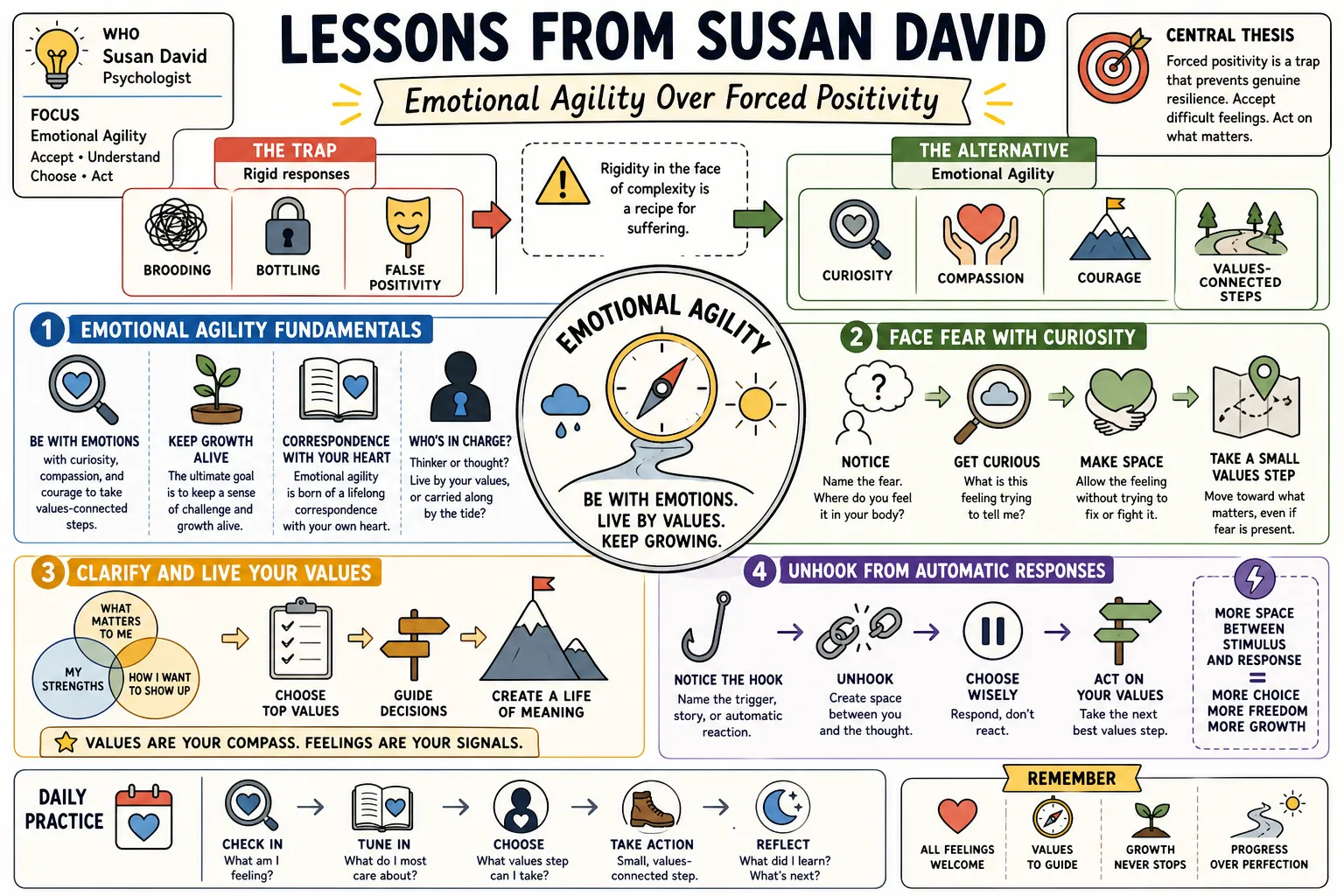
Lessons from Susan David
Psychologist Susan David argues that forced positivity is a trap that prevents genuine resilience. Her work on emotional agility focuses on accepting difficult feelings instead of trying to suppress them. To build that agility, she outlines methods for facing fear, clarifying personal values, and unhooking from automatic responses.
Part 1: Emotional Agility Fundamentals
- On the core definition: "Emotional agility is the ability to be with your emotions with curiosity, compassion, and especially the courage to take values-connected steps." — Source: [TED Talk]
- On the primary objective: "The ultimate goal of emotional agility is to keep a sense of challenge and growth alive and well throughout your life." — Source: [Emotional Agility]
- On internal awareness: "Emotional agility is born of a lifelong correspondence with your own heart." — Source: [TED Talk]
- On agency: "Who’s in charge—the thinker or the thought? Are we managing our own lives according to our own values, or are we simply being carried along by the tide?" — Source: [Harvard Business Review]
- On rigid responses: "If there’s one common feature of brooding, bottling, or false positivity, it’s this: they are all rigid responses. And rigidity in the face of complexity is toxic." — Source: [TED Talk]
- On true happiness: "Research shows that the radical acceptance of all of our emotions—even the messy, difficult ones—is the cornerstone to resilience, thriving, and true, authentic happiness." — Source: [Dare to Lead]
- On loosening up: "Emotional agility is about loosening up, calming down, and living with more intention. It's about choosing how you'll respond to your emotional warning system." — Source: [Emotional Agility]
- On the scope of impact: "How we deal with our inner world drives everything. Every aspect of how we love, how we live, how we parent and how we lead." — Source: [TED Talk]
- On the final reckoning: "When our moment comes to face our fragility, in that ultimate time, it will ask us, 'Are you agile?' Let the moment be an unreserved 'yes.'" — Source: [TED Talk]
- On taking the wheel: Emotional agility does not mean controlling your thoughts, but rather recognizing them and deciding whether they are serving you, allowing you to stop being driven by automatic reactions. — Source: [Ten Percent Happier]
Part 2: The Trap of Toxic Positivity
- On the tyranny of cheer: "Being positive has become a new form of moral correctness. It’s a tyranny of positivity. And it’s cruel, unkind, and ineffective." — Source: [Dare to Lead]
- On forced cheerfulness: "Forced false positivity... is denial wrapped up in rainbows and sparkles." — Source: [Diary of a CEO]
- On self-deception: "Toxic positivity is the denial or suppression of emotions considered negative... we are basically gaslighting ourselves." — Source: [Diary of a CEO]
- On losing capacity: "When we push aside normal emotions to embrace a false positivity, we lose our capacity to develop skills to help us deal with the world as it is, not as we wish it to be." — Source: [TED Talk]
- On the rebound effect: "When we try to push aside difficult emotions... they come back stronger." — Source: [Emotional Agility]
- On societal conditioning: "The overarching narrative even in psychology is that emotions are good or bad, positive or negative. Now if we grow up in a society that tells us that some of our emotions are bad... we then learn a whole lot of strategies to try and suppress them." — Source: [Diary of a CEO]
- On avoiding reality: Forced positivity prevents individuals and teams from honestly addressing systemic problems, making it a hindrance to genuine progress. — Source: [Harvard Business Review]
- On the cruelty of forcing cheer: Demanding positivity from someone in pain is a failure of empathy that isolates the suffering person rather than supporting them. — Source: [Dare to Lead]
- On "good vibes only": The "good vibes only" mantra sets an impossible standard that leads directly to feelings of failure and shame when natural human struggles arise. — Source: [Rich Roll Podcast]
- On embracing the messy: A truly healthy emotional culture does not demand smiles, but rather creates space for the messy, unpolished reality of human experience. — Source: [TED Talk]
Part 3: Emotions as Data
- On data versus directives: "Emotions are data, they are not directives. We can show up to and mine our emotions for their values without needing to listen to them." — Source: [TED Talk]
- On driving the car: "Emotions are data, they are not directives. We can learn from them, but we don't have to let them drive the car." — Source: [Dare to Lead]
- On transient information: "Labeling allows you to see your thoughts and feelings for what they are: transient sources of data that may or may not prove helpful." — Source: [Harvard Business Review]
- On over-identification: When we believe our emotions are unquestionable facts, we surrender our agency to biological reactions rather than thoughtful choices. — Source: [Ten Percent Happier]
- On the flashing light: Strong feelings are like the oil light on a car dashboard; they alert you that something needs attention, but they do not steer the vehicle. — Source: [Rich Roll Podcast]
- On feeling without obeying: You can deeply feel an emotion like anger or resentment without acting upon the impulse to lash out or withdraw. — Source: [Emotional Agility]
- On evaluating utility: After observing an emotion, the necessary next step is to ask if the feeling is currently serving the life you want to lead. — Source: [Emotional Agility]
- On decoupling action and feeling: True maturity is internalizing the difference between how you feel in the moment and the value-aligned action you choose to take. — Source: [Harvard Business Review]
- On behavioral flexibility: Emotions carry vital information about how we interpret the world, but treating them as absolute commands severely limits our behavioral flexibility. — Source: [TED Talk]
Part 4: The Role of Values
- On signposting: "Emotions signpost our values." If you feel strong anger or grief, it is usually because something you value is being threatened. — Source: [Emotional Agility]
- On walking your why: "Determining what you truly care about is only half the process of walking your why. Once you've identified your values, you then have to take them out for a spin." — Source: [Emotional Agility]
- On the psychological keel: "Values serve as a kind of psychological keel to keep you steady." — Source: [Emotional Agility]
- On generating the best self: "When we internalize the difference between how I feel... and what I do in a values-aligned action, we generate the pathway to our best selves." — Source: [TED Talk]
- On guilt as a value signal: If you feel guilty about working too much, it is not proof that you are a bad parent; it is a signal that you deeply value connection and presence. — Source: [Dare to Lead]
- On everyday choices: Values are not abstract concepts posted on a wall; they are the accumulation of small, daily choices made when under pressure. — Source: [Emotional Agility]
- On internal resources: "Effective leaders are mindful of their inner experiences but not caught in them. They know how to free up their internal resources and commit to actions that align with their values." — Source: [Harvard Business Review]
- On decision frameworks: Having clarity on your personal values provides an immediate decision-making framework when navigating ambiguity or conflict. — Source: [Ten Percent Happier]
- On authentic commitment: Moving from being driven by the fear of negative consequences toward being driven by a commitment to personal values is the essence of adult growth. — Source: [Rich Roll Podcast]
Part 5: Navigating Discomfort and Fragility
- On the price of meaning: "Discomfort is the price of admission to a meaningful life." — Source: [TED Talk]
- On "Dead People's Goals": The desire to never feel stressed, never fail, and never get your heart broken is pursuing a "dead person's goal." Only dead people are free from these experiences. — Source: [Ten Percent Happier]
- On beauty and fragility: "Life’s beauty is inseparable from its fragility. We are young until we are not. We are healthy until we are not. We are with those we love until we are not." — Source: [TED Talk]
- On acceptance and change: "Acceptance is a prerequisite for change... not acting on every thought or resigning yourself to negativity, but responding to your ideas and emotions with an open attitude." — Source: [Harvard Business Review]
- On the contract of life: "Only dead people never get stressed, never get broken hearts, never experience the disappointment that comes with failure. Tough emotions are part of the contract of life." — Source: [TED Talk]
- On avoiding pain: Structuring your life entirely around the avoidance of pain guarantees that you will also avoid the deep connections and risks that make life rewarding. — Source: [Emotional Agility]
- On leaning in: Moving toward discomfort rather than away from it builds the internal resilience needed to weather inevitable future storms. — Source: [Rich Roll Podcast]
- On acknowledging reality: You cannot fix a challenging situation until you drop the expectation that the situation shouldn't be challenging in the first place. — Source: [Emotional Agility]
- On the illusion of control: Accepting our fragility means letting go of the illusion that we can control every outcome, which paradoxically reduces our daily anxiety. — Source: [Dare to Lead]
- On the nature of struggle: Experiencing difficulty is not a sign that you are doing life wrong; it is the ultimate proof that you are fully engaged with it. — Source: [Diary of a CEO]
Part 6: Language, Labeling, and Space
- On emotional granularity: "When we label our emotions accurately, we are able to see the 'why' behind the 'what.' It moves us from being 'hooked' by the emotion to being an observer of it." — Source: [Rich Roll Podcast]
- On linguistic unhooking: Instead of saying "I am sad," say "I am noticing that I am feeling sad." This creates necessary space between the person and the feeling. — Source: [TED Talk]
- On calling a spade a spade: "Just as you call a spade a spade, call a thought a thought and an emotion an emotion. 'I’m not doing enough' becomes 'I’m having the thought that I’m not doing enough.'" — Source: [Harvard Business Review]
- On the space between: "Between stimulus and response there is a space. In that space is our power to choose our response. In our response lies our growth and our freedom." — Source: [Mayim Bialik Breakdown]
- On the limits of "stressed": Defaulting to the word "stressed" masks more specific, actionable emotions like "disappointed," "lonely," or "unsupported." — Source: [Dare to Lead]
- On precise discernment: "When we label our emotions accurately, we are more able to discern the precise cause of our feelings... and take the right steps for us." — Source: [TED Talk]
- On identity and feeling: You are not your emotion. You are the context, the vessel in which the emotion is temporarily happening. — Source: [Emotional Agility]
- On observing the mind: Cultivating an observer's mindset allows you to watch a thought pass through your mind without automatically treating it as an objective truth. — Source: [Ten Percent Happier]
- On expanding vocabulary: Expanding your emotional vocabulary directly expands your capacity to cope with complex, nuanced life events. — Source: [Rich Roll Podcast]
Part 7: Courage and Fear
- On the definition of courage: "Courage is not the absence of fear; courage is fear walking." — Source: [TED Talk]
- On taking fear with you: True bravery is acknowledging that you are terrified, packing that fear in your bag, and taking the necessary step forward anyway. — Source: [Diary of a CEO]
- On waiting for confidence: If you wait until you feel completely confident and unafraid before acting, you will remain stagnant indefinitely. — Source: [Emotional Agility]
- On values-driven risk: Courageous action is fundamentally driven by a clear understanding of what you value more than your own comfort. — Source: [Emotional Agility]
- On the necessity of fear: Fear is a normal biological response to stepping into the unknown; interpreting it as a stop sign prevents growth. — Source: [Ten Percent Happier]
- On daily bravery: Courage is rarely about grand, heroic gestures; it is most often found in small, daily decisions to tell the truth or set a boundary. — Source: [Dare to Lead]
- On stepping out: Growth requires a willingness to intentionally step out of your emotional comfort zone and tolerate the resulting awkwardness. — Source: [Harvard Business Review]
- On vulnerability: True courage requires emotional exposure; you cannot be brave while completely shielding yourself from potential judgment or failure. — Source: [Rich Roll Podcast]
- On reframing anxiety: The physiological sensation of fear is nearly identical to excitement; how we label the arousal dictates whether we retreat or advance. — Source: [Emotional Agility]
Part 8: Connection, Leadership, and Parenting
- On "Sawubona": "In South Africa, where I come from, 'Sawubona' is the Zulu word for 'hello.' It literally translates as 'I see you, and by seeing you, I bring you into being.'" — Source: [TED Talk]
- On seeing others: "In seeing yourself, you are also able to see others, too: the only sustainable way forward in a fragile, beautiful world." — Source: [TED Talk]
- On leadership stumbles: "Leaders stumble not because they have undesirable thoughts and feelings—that’s inevitable—but because they get hooked by them, like fish caught on a line." — Source: [Harvard Business Review]
- On validating children's emotions: When parents rush to "fix" a child's negative emotions, they inadvertently teach the child that difficult feelings are dangerous and to be feared. — Source: [Emotional Agility]
- On emotional culture at work: A resilient organization does not mandate optimism; it creates psychological safety for employees to voice genuine concerns and doubts. — Source: [Harvard Business Review]
- On holding space: The most profound way to support a friend or colleague in pain is not to offer solutions, but simply to sit with them in the dark. — Source: [Dare to Lead]
- On modeling agility: Leaders build resilient teams by transparently modeling their own emotional agility, demonstrating how to acknowledge difficulty without being derailed by it. — Source: [Harvard Business Review]
- On parental expectations: Pressuring children to be happy all the time is an unintentional form of invalidation that limits their emotional toolkit. — Source: [Ten Percent Happier]
- On authentic leadership: The most trusted leaders are those who align their private internal experience with their public actions, maintaining legibility and consistency even under stress. — Source: [Rich Roll Podcast]