Tae Kim is a technology journalist and author who specializes in the semiconductor industry, artificial intelligence, and corporate strategy. He spent years as a tech writer for Barron's and Bloomberg Opinion before launching his independent research platform, Key Context, and publishing his 2024 book on the rise of Nvidia. The insights below trace his evolution from a hedge fund analyst to a leading chronicler of the hardware infrastructure powering modern computing.
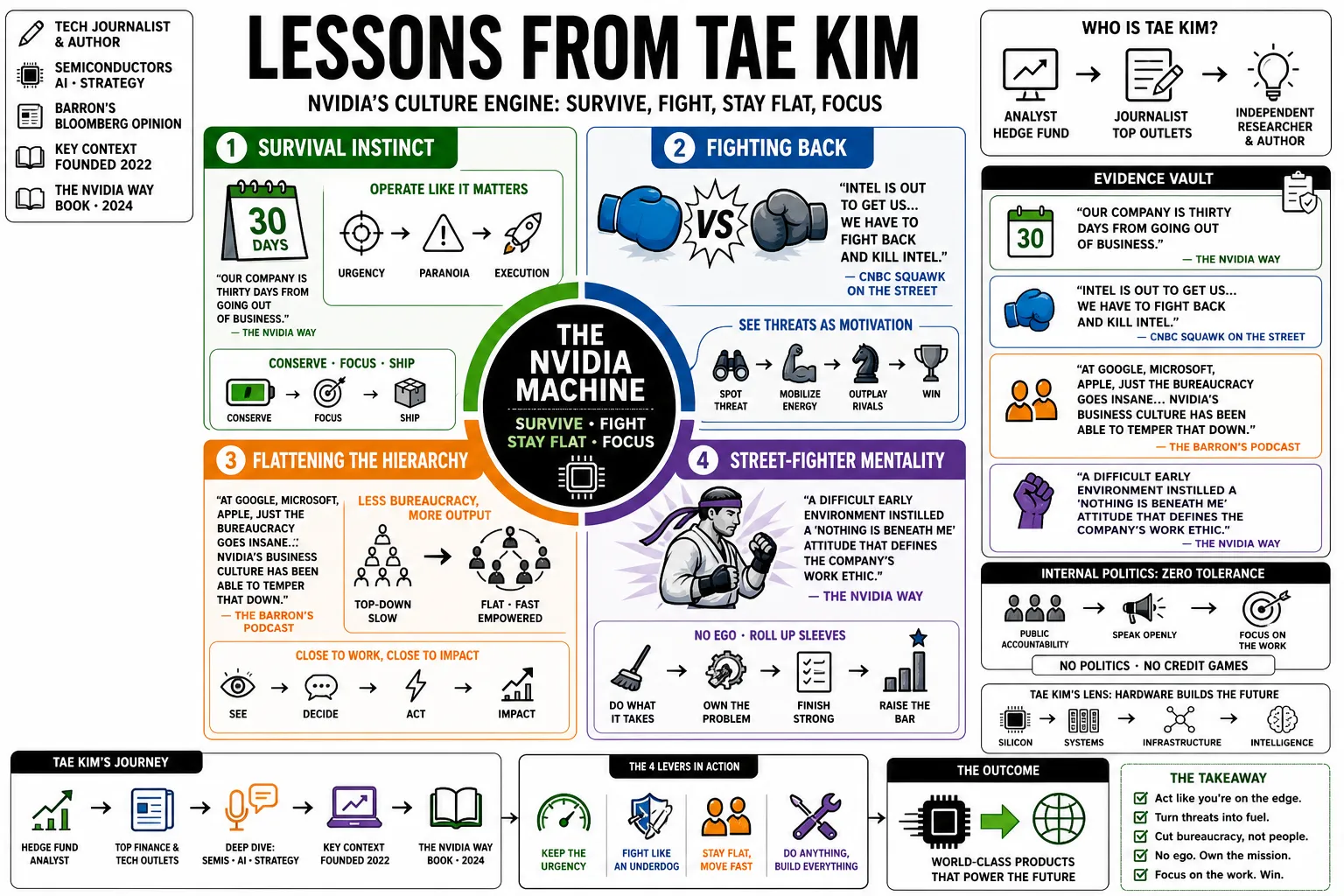
Part 1: The Nvidia Machine and Culture
- On the Survival Instinct: "Our company is thirty days from going out of business." — The Nvidia Way
- On Fighting Back: "Intel is out to get us... we have to fight back and kill Intel." — CNBC Squawk on the Street
- On Flattening the Hierarchy: "At Google, Microsoft, Apple, just the bureaucracy goes insane... Nvidia’s business culture has been able to temper that down." — The Barron's Podcast
- On Street-Fighter Mentality: "A difficult early environment instilled a 'nothing is beneath me' attitude that defines the company's work ethic." — The Nvidia Way
- On Internal Politics: "Public accountability is preferred; playing internal politics or trying to make a boss look good over focusing on the mission is swiftly corrected." — The Nvidia Way
- On Ephemeral Ideas: "The whiteboard is the primary tool for communication, representing possibility and the reality that even brilliant ideas must eventually be erased for better ones." — The Nvidia Way
- On Work Ethic vs. Intelligence: "Intelligence alone does not equate to greatness; character and resilience are the true markers of success within Nvidia's ranks." — The Nvidia Way
- On Employee Retention: "Managers prefer to push employees to solve their own problems rather than firing them, ensuring talent is developed rather than discarded." — The Nvidia Way
- On Corporate Missions: "The company is organized around solving the world's most difficult computing problems, not just hitting quarterly revenue targets." — Key Context
- On Rough Justice: "Partnerships do not have to be an exact win-win in every transaction, but they must balance out to be fair over the long term." — The Nvidia Way
Part 2: Jensen Huang's Leadership
- On Adversity: "I wish upon you ample doses of pain and suffering." — The Nvidia Way
- On Resilience: "People with very high expectations have very low resilience. Unfortunately, resilience matters in success... Greatness comes from character." — The Nvidia Way
- On Outworking the Competition: "There may be people smarter than me, but no one is ever going to work harder than me." — The Nvidia Way
- On the Definition of Excellence: "Excellence is the capacity to take pain." — The Nvidia Way
- On Management Philosophy: "I don’t like giving up on people. I’d rather torture them into greatness." — The Nvidia Way
- On CEO Skillsets: "Huang is a rare 'quadruple threat' who combines deep technical knowledge with charismatic business leadership." — Key Context
- On Resourcefulness: "Every time there's an instance where they're almost about to go out of business, he's resilient and resourceful... he comes out with solutions and funding that just come out of nowhere." — TBPN Live
- On Avoiding Complacency: "Huang proactively reinvents strategy before the market demands it, viewing complacency as the ultimate existential threat." — The Nvidia Way
- On Bold Bets: "He uses simplified 'CEO math' to assess massive market opportunities quickly, enabling swift, bold decisions without the paralysis of false precision." — The Nvidia Way
- On Winning the Day: "You’re not talking to somebody who woke up a loser." — Key Context
Part 3: The Artificial Intelligence Supercycle
- On the AI Revolution: "The current AI infrastructure buildout and computing shift is the biggest investment theme of our lifetime." — Key Context
- On the Compute Squeeze: "There’s not going to be enough compute in the world to meet the demand." — Key Context
- On Agentic AI: "Agentic AI is a real generational paradigm shift." — TBPN Live
- On AI's True Moment: "For years, artificial intelligence seemed on the cusp of becoming the next big thing... Now, the changes caused by the COVID-19 pandemic may mean AI's moment is finally upon us." — Bloomberg Opinion
- On the Golden Age: "With the increasing inflow of talent and large amounts of capital going after such exciting ideas, we may be on the brink of a golden age for innovation." — Bloomberg Opinion
- On Valuation Realities: "AI giants trading at 25-30x earnings reflect strong fundamentals, sharply contrasting with the 100x multiples seen during the dot-com bubble." — Key Context
- On Scaling Laws: "Progress in AI is accelerating, driven by advances in models from companies like Anthropic and Google, proving that scaling laws remain intact." — Key Context
- On Capitalizing on Crisis: "So long as companies proceed responsibly... the advances in AI catalyzed by the coronavirus crisis may be one of the silver linings we remember." — Bloomberg Opinion
- On Productivity Gains: "The market underestimates how tiny teams can now use AI to generate massive revenue and fundamentally alter corporate productivity." — Key Context
- On the Ultimate Differentiator: "Compute is the ballgame, marking scale as the decisive factor in the artificial intelligence race." — Key Context
Part 4: Semiconductor Strategy and "Speed of Light"
- On Shrinking Timelines: "They accelerated the product cycle from 18 months to 6 months... that relentless execution improvement has shown why they've been successful." — Barron's
- On Betting on Weak Signals: "CUDA was a decade-long bet that had no immediate market but was rigorously extrapolated from first principles to become the foundation of modern computing." — The Nvidia Way
- On Vertical Integration: "Controlling the entire stack from silicon to software to networking creates an insurmountable moat against fragmented competitors." — Key Context
- On Navigating Supply Chains: "Proactive supply chain management and securing massive wafer allocations with TSMC position companies to capture exponential demand without bottlenecks." — TBPN Live
- On Architecture Transitions: "Shifting to a one-year architecture release cycle ensures competitors remain perpetually behind the technological curve." — Key Context
- On Networking Acquisitions: "Expanding into networking through acquisitions like Mellanox was a vital step in dominating the AI cluster architecture." — Key Context
- On Production Hiccups: "Qualification issues in next-generation chips are minor hurdles as long as the underlying exponential demand for compute remains unsatisfied." — Key Context
- On Inference Markets: "Partnering to explore Tensor Processing Units signals a strategic expansion into the highly lucrative AI inference space." — Key Context
- On Economic Potential: "The upside of greater computing power, better business insights and cost efficiencies from AI is too big to ignore." — Bloomberg Opinion
Part 5: Assessing the Giants (Apple, Intel, Amazon)
- On Apple's Fortress: "Integrating external AI models into the ecosystem validates Apple’s platform as the ultimate consumer gateway." — Key Context
- On iPhone Supercycles: "The bad news for Apple is that many consumers may now believe the best iPhone is already in their pockets. The technology giant needs to do better than a smaller notch to get them to think otherwise." — Bloomberg Opinion
- On Apple's Search Engine Ambitions: "It’s time for Apple Inc. to get off its easy money addiction and go for a bigger score: develop its own search engine." — Bloomberg Opinion
- On Supply Chain Pivots: "Apple’s strategic manufacturing agreements and shift toward India reflect a necessary evolution to mitigate geopolitical risks." — Key Context
- On Intel's Bureaucracy: "Large legacy chipmakers often suffer from indecisive paralysis, a stark contrast to the agile execution found in modern hardware leaders." — Barron's
- On AMD's Resurgence: "Early identification of AMD's server market share gains highlighted a fundamental shift away from Intel's historical dominance." — Barron's
- On Amazon's Headwinds: "Amazon may be facing headwinds from a slowdown in the entire e-commerce category, which faces tough comparisons from the peak pandemic months." — Bloomberg Opinion
- On Tech Resilience: "Companies that adapt their supply chains and rapidly pivot toward hardware sovereignty demonstrate the highest resilience in volatile markets." — Key Context
- On Moving the Needle: "Large technology markets like search are among the few arenas capable of moving the needle for multi-trillion-dollar valuations." — Bloomberg Opinion
Part 6: From Hedge Funds to Tech Journalism
- On Foundational Experience: "Starting in management consulting and as a hedge fund analyst provided the rigorous analytical framework required to assess complex tech equities." — X
- On Information Arbitrage: "The primary goal of tech journalism is to find alpha by reading the tea leaves of the semiconductor supply chain before the broader market reacts." — Barron's
- On Independent Research: "Transitioning to an independent platform allows for deeper, uninterrupted focus on long-term technological supercycles rather than daily news churn." — Key Context
- On Cultivating Sources: "Writing a definitive business history requires conducting hundreds of insider interviews to map the true internal dynamics of a company." — The Nvidia Way
- On Technical Literacy: "Being a lifelong tech nerd and building PCs for decades offers a distinct advantage in understanding the hardware constraints of the AI boom." — Asianometry
- On Market Nostalgia: "Since early in the pandemic, soaring demand for consumer electronics led to persistent chip shortages... but the pandemic rush to computers and printers won’t repeat itself." — Bloomberg Opinion
- On Micro over Macro: "The best analytical approach prioritizes companies with products so dominant they can thrive regardless of the broader macroeconomic environment." — TBPN Live
- On Following the Engineers: "To understand where the market is going, analysts must talk to actual engineers rather than relying solely on Wall Street consensus." — Key Context
- On Recognizing Shifts: "Moving from Yahoo Finance to CNBC to Barron's demonstrated a steady progression toward highly specialized, alpha-generating journalism." — X
Part 7: Financial Market Analysis
- On Cyclical Upswings: "An investor maxim says technology companies tend to handily outperform during cyclical upswings while the reverse is true on the downside." — Bloomberg Opinion
- On Market Panics: "Recent pullbacks in hardware stocks are often driven by cyclical market fears rather than any deterioration in underlying technological fundamentals." — TBPN Live
- On Evaluating Risk: "Identifying a company's weak fundamentals, such as rising channel inventories during a crypto downturn, is crucial before a major stock correction." — Barron's
- On Peak Capex Fears: "Investors should ignore the chorus of bears predicting peak AI spending and instead focus on the massive expansion of cloud provider partnerships." — Key Context
- On the Definition of Bubble: "True financial bubbles involve extreme overvaluation of companies without cash flow; the current AI buildout is supported by massive, real-world revenue generation." — Key Context
- On Geopolitical Volatility: "The market often overreacts to short-term geopolitical posturing while underestimating the long-term hardware dependencies that bind global supply chains." — Key Context
- On Sector Rotation: "The shift of capital toward companies building the physical layer of the AI economy represents a fundamental re-rating of the semiconductor industry." — Key Context
- On Infrastructure Moats: "Capital-intensive infrastructure investments create impenetrable moats that protect early movers from sudden disruptive competition." — The Nvidia Way
- On Recognizing Value: "Deep technical knowledge combined with financial modeling is the only way to accurately price companies operating at the edge of the computing frontier." — X
Part 8: Key Context and Future Outlook
- On Continuous Reinvention: "The ultimate lesson from studying tech giants is that the moment a company stops cannibalizing its own products, it begins its decline." — The Nvidia Way
- On the Chip-to-Agent Pipeline: "The future belongs to organizations that can seamlessly integrate the raw silicon layer with autonomous software agents." — Key Context
- On Independent Media: "The rise of platforms like Substack enables highly specialized analysts to bypass traditional editorial bureaucracy and deliver direct value to investors." — TBPN Live
- On Information Velocity: "Financial markets now react to hardware specs and supply chain leaks faster than ever, requiring analysts to operate closer to the metal." — Key Context
- On Identifying Supercycles: "True technological supercycles are rare and require conviction to ride out the inevitable periods of macroeconomic doubt." — Key Context
- On the Future of Hardware: "As software complexity increases, the premium placed on flawless, high-yield hardware manufacturing will only continue to rise." — Key Context
- On Cross-Disciplinary Expertise: "The analysts of the future must be equally fluent in semiconductor physics, supply chain logistics, and financial valuation." — X
- On Institutional Agility: "Bureaucracy is the enemy of innovation; maintaining a startup’s sense of urgency at scale is the defining challenge for the next decade's tech leaders." — The Barron's Podcast
- On The Final Analysis: "The current AI infrastructure buildout is the biggest investment theme of our lifetime, and those who understand its foundational layers will define the next economic era." — Key Context